Great Lakes - PGDM & PGPM Admissions 2027
Globally Recognized by AACSB (US) & AMBA (UK) | 18 LPA Avg. CTC for PGPM 2026


XAT Verbal Ability and Logical Reasoning preparation requires a balance of reading comprehension, critical reasoning, vocabulary, grammar and verbal logic. The XAT 2026 paper had 26 VALR questions, with Reading Comprehension accounting for 12 questions or 46.2% of the section. Critical Reasoning contributed another 19.2%, while Para Jumbles, Vocabulary and Grammar & Usage each had 11.5%. These numbers provide a useful data-backed framework for XAT 2027 preparation. XAT 2027 is scheduled for January 3rd, 2027, which makes it the right time to start the preparation.

Check out the detailed analysis of XAT 2026 by downloading XAT 2026 Master Analysis PDF: Topic-wise Question Distribution
Topic | XAT 2026 Questions | Share |
Reading Comprehension | 12 | 46.2% |
Critical Reasoning | 5 | 19.2% |
Para Jumbles | 3 | 11.5% |
Vocabulary | 3 | 11.5% |
Grammar & Usage | 3 | 11.5% |
The XAT 2026 Question paper analysis shows that RC and Critical Reasoning together accounted for 17 of the 26 VALR questions.
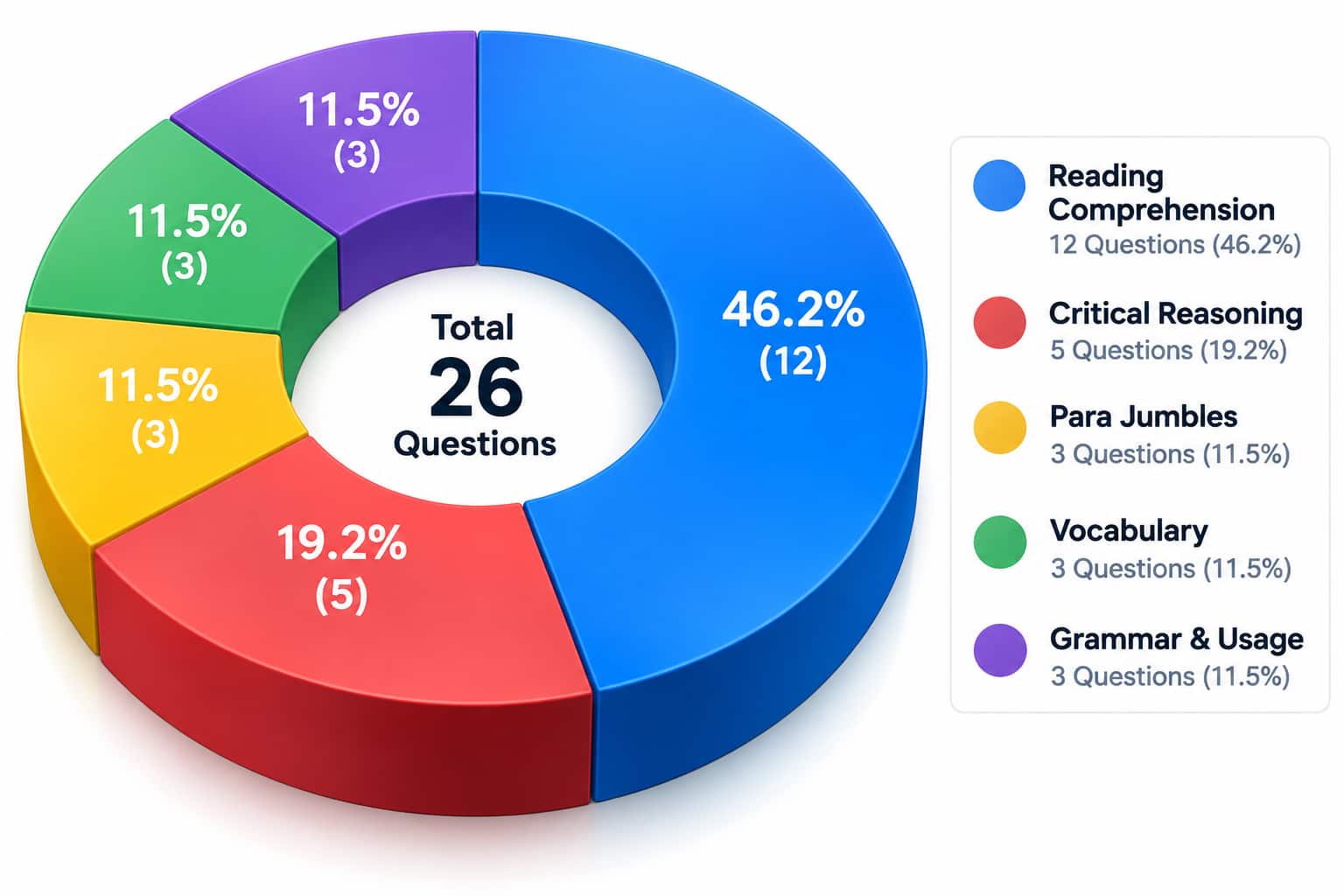
The distribution clearly places comprehension and reasoning at the centre of XAT VALR preparation.
Reading Comprehension formed the largest component, with 12 questions across three passages. Each passage contributed exactly four questions.
Focus preparation on:
Main idea and central argument
Author's tone and intent
Inference-based questions
Passage structure
Supporting arguments and examples
Meaning of statements in context
Elimination of close options
XAT RC preparation should prioritise understanding the author's argument rather than reading every sentence at the same speed. Regular practice with unfamiliar and abstract passages can improve comprehension flexibility.
A practical progression is:
Stage | Focus |
Initial | Untimed passage reading and analysis |
Intermediate | Timed RC sets |
Advanced | Mixed passages under section-level time pressure |
Final | Full VALR mocks and detailed error analysis |
After every RC set, the focus should be on why an option is correct or incorrect rather than only recording the score.
Critical Reasoning was the second-largest component, with five questions accounting for 19.2% of VALR in the previous year question paper.
Common preparation areas include:
Assumptions
Conclusions
Arguments
Strengthening and weakening arguments
Inference
Cause and effect
Logical consistency
Globally Recognized by AACSB (US) & AMBA (UK) | 18 LPA Avg. CTC for PGPM 2026
Test centres are available in 70+ cities across India | 75,000+ aspirants apply for the NMAT exam | Accepted by 58+ institutions like NMIMS, KJSIM, ISB, SPJIMR and Great Lakes.
The central skill is identifying the relationship between the evidence and conclusion.
A useful approach is:
Identify the conclusion.
Identify the evidence supporting it.
Determine what the question is asking.
Eliminate options that introduce irrelevant information.
Check whether the remaining option logically fits the argument.
CR practice should gradually move from individual questions to timed mixed sets.
Para Jumbles contributed three questions, or 11.5% of the section.
Preparation should focus on identifying sentence relationships rather than arranging sentences randomly.
Pronouns and their antecedents
Articles such as “a”, “an” and “the”
Transition words
Cause-and-effect relationships
Chronological sequence
General-to-specific movement
Introduction and conclusion sentences
A strong approach is to first identify mandatory pairs and opening sentences before constructing the complete sequence.
Vocabulary contributed three questions in XAT 2026, representing 11.5% of VALR.
Instead of memorising isolated word lists, preparation can combine:
Contextual vocabulary
Synonyms and antonyms
Word usage
Root words
Prefixes and suffixes
Vocabulary from reading material
Maintaining a revision list of unfamiliar words encountered during RC practice can make vocabulary preparation more relevant to actual usage.
Grammar and Usage also accounted for three questions, giving it an 11.5% share of the section.
Important areas include:
Subject-verb agreement
Tenses
Pronouns
Modifiers
Prepositions
Articles
Parallelism
Sentence structure
Usage-based errors
Grammar preparation should combine concept revision with question practice because XAT can test grammatical correctness through contextual sentences.
The 2026 distribution can be converted into a practical preparation priority.
Priority | Area | 2026 Questions | Weightage |
1 | Reading Comprehension | 12 | 46.2% |
2 | Critical Reasoning | 5 | 19.2% |
3 | Para Jumbles | 3 | 11.5% |
3 | Vocabulary | 3 | 11.5% |
3 | Grammar & Usage | 3 | 11.5% |
This does not mean lower-weightage areas should be skipped. The data shows that the three smaller categories collectively contributed nine questions, or more than one-third of the section.
Worried about your preparation? Attempt our XAT 2027 Free Mock Test and analyze your preparation, analyse mistakes.
A balanced XAT preparation plan should reflect the actual distribution of questions rather than allocating equal time to every topic.
Since RC contributed 46.2% of VALR, regular passage practice should form the largest component of preparation.
CR accounted for another 19.2%. Practising arguments, assumptions and inference-based questions can complement RC preparation because both require careful interpretation and logical evaluation.
Para Jumbles, Vocabulary and Grammar each contributed three questions. These can be covered through shorter daily practice sessions rather than taking up the same preparation time as RC.
Errors can be classified as:
Misread passage
Incorrect inference
Vocabulary gap
Grammar concept gap
Incorrect elimination
Time-management error
Careless mistake
This helps identify whether low accuracy comes from conceptual weakness or question-selection issues.
Speed should be developed after accuracy becomes reasonably consistent. Start with individual timed sets and progress towards complete VALR sections.
A weekly plan can allocate preparation time according to the latest question distribution.
Area | Suggested Focus |
Reading Comprehension | Daily passage practice |
Critical Reasoning | 3-4 practice sessions per week |
Para Jumbles | 2-3 practice sessions per week |
Vocabulary | Daily vocabulary revision |
Grammar | 2-3 focused sessions per week |
Weekly initially; increase closer to exam |
The exact schedule can be adjusted according to existing strengths and preparation time.
Given below are the few common mistakes that candidates must avoid:
Fast reading without understanding the argument can increase errors in inference-based questions.
XAT questions often include plausible distractors. An option should be supported by the passage or argument rather than general knowledge.
A difficult passage can consume disproportionate time. Section-level practice should include decisions about when to move to another question or passage.
Although Vocabulary, Grammar and Para Jumbles individually contributed 11.5%, together they accounted for nine questions.
A mock score alone does not show the reason behind an incorrect answer. Post-test analysis should identify the exact source of each error.
The latest XAT data provides a clear preparation framework. RC accounted for 12 of 26 questions, making comprehension the largest component. Critical Reasoning added five questions, while Para Jumbles, Vocabulary and Grammar & Usage contributed three questions each.
For XAT 2027, preparation can therefore be structured around RC and Critical Reasoning as the core, supported by consistent practice in Para Jumbles, Vocabulary and Grammar. The objective should be to improve comprehension, logical evaluation, accuracy and time management together rather than preparing each topic in isolation.
Frequently Asked Questions (FAQs)
XAT VALR includes Reading Comprehension, Critical Reasoning, Para Jumbles, Vocabulary and Grammar & Usage.
The XAT 2026 paper had 12 RC questions across three passages, with four questions from each passage.
Reading Comprehension had the highest weightage in XAT 2026, accounting for 12 of 26 questions or 46.2% of the section.
XAT 2026 had five Critical Reasoning questions, accounting for 19.2% of VALR.
Regular RC and Critical Reasoning practice, supported by Para Jumbles, Vocabulary and Grammar revision, can build accuracy and section-level speed.

On Question asked by student community
Hello Student, exam-centre availability can change depending on the live slots shown during the XAT application process. I would suggest checking Chikkaballapura directly in the test-city selection before completing the application. If the city is not appearing, it may mean that the centre is unavailable or not offered for that
You can find all the information here:
CAT- https://www.careers360.com/mba/articles/cat-exam-dates
SNAP- https://www.careers360.com/mba/articles/snap-exam-dates
You can check the XIMB XAT Cutoff 2026 to determine the percentile for non-domicile female candidates.
The IRMA XAT 2026 cutoff is expected to be in the range of 55 to 60 percentile for ST category candidates. At an XAT score of 47 percentile, it is unlikely to get a PI call for the IRMA MBA admission 2026.

Globally Recognized by AACSB (US) & AMBA (UK) | 18 LPA Avg. CTC for PGPM 2026
Gateway to IBS Hyderabad & 8 other IBS campuses | Scholarships worth 10 CR
Among top 6% B-Schools globally to be accredited by AACSB | Highest Package-35 LPA
Test centres are available in 70+ cities across India | 75,000+ aspirants apply for the NMAT exam | Accepted by 58+ institutions like NMIMS, KJSIM, ISB, SPJIMR and Great Lakes.
400+ Recruiters | Highest CTC 17.2 LPA | Average CTC 8 LPA | 92% Avg. Placements | Ranked as Platinum Institute | Awarded Best Business School of the Year
Application Open | Scholars’ Round Deadline: 14th Nov’26 | Earn upto 50% merit Scholarship + 10% for top performers | EFMD Accredited | AACSB & Business Graduates Association Member | Highest CTC 28 LPA