


Lens Displacement Method
The lens displacement method is one of the most accurate and commonly used techniques in optics to determine the focal length of a convex lens. In this method, an object and a screen are kept fixed at a certain distance, and the lens is moved between them to obtain sharp images at two different positions. The distance between these two positions helps in calculating the focal length precisely.
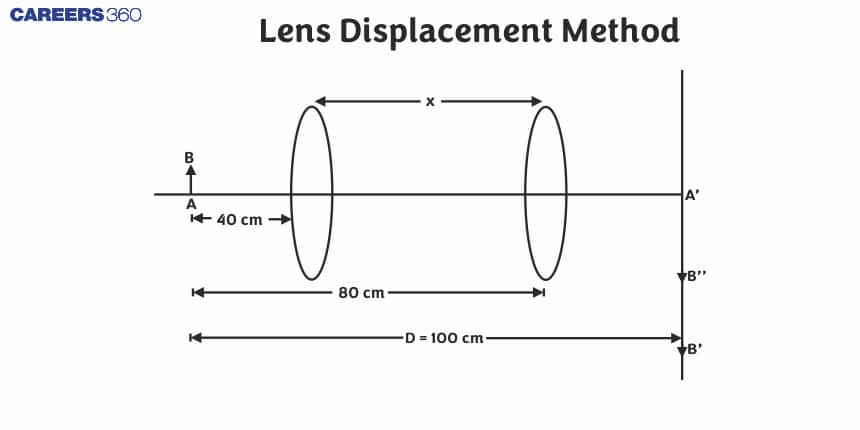
This method is widely used in physics experiments, practical exams, and optical instrument design because it reduces errors and does not require direct measurement of object and image distances. Due to its simplicity and high accuracy, the lens displacement method is an important topic for students preparing for board exams, JEE, and other competitive exams.
Displacement Method
Consider an object and a screen fixed at a distance $D$ apart. Let a lens of focal length $f$ be placed between the object and the screen.
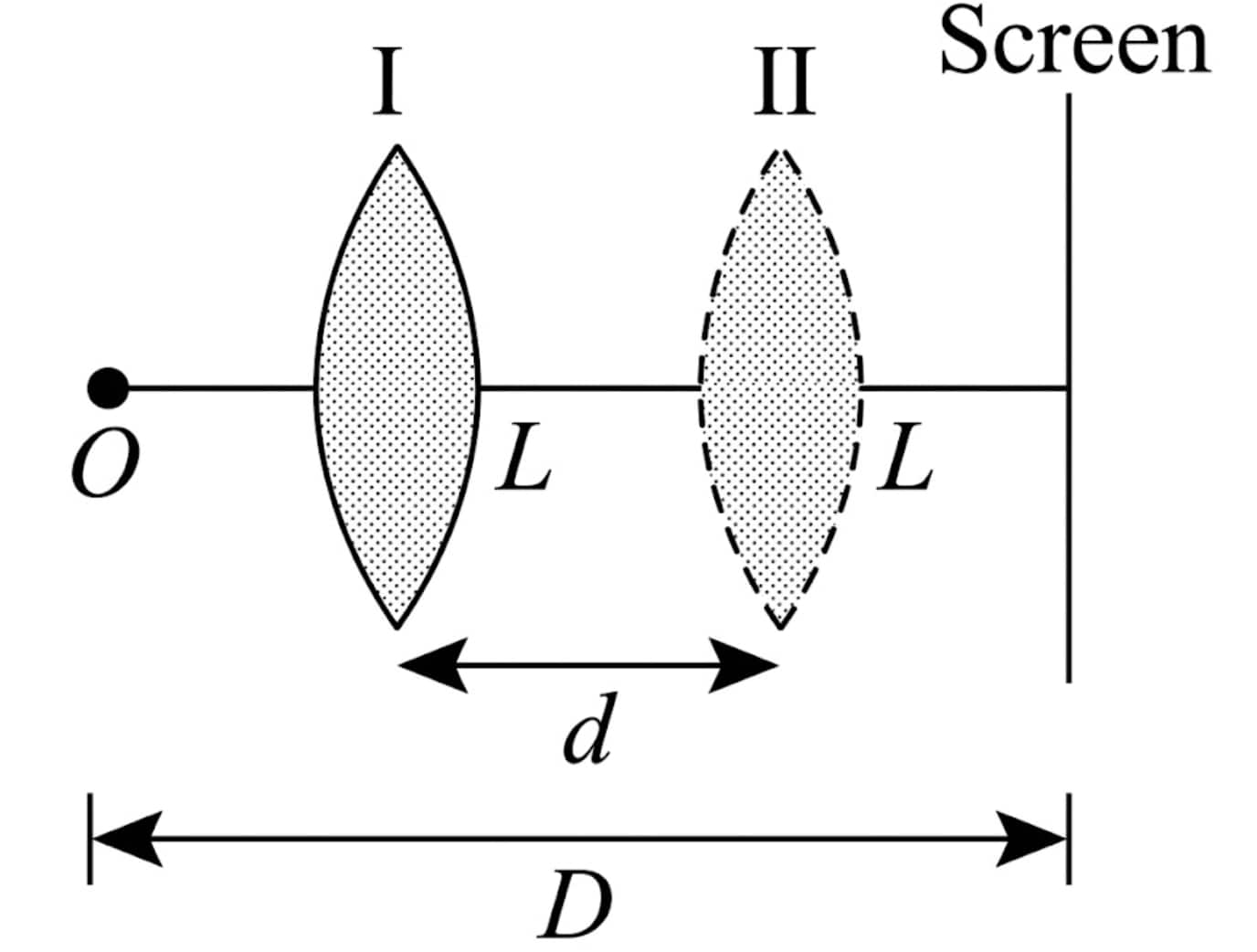
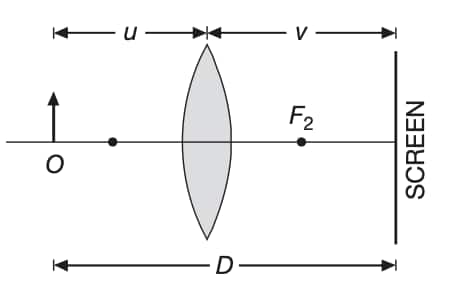
From figure we observe that
$
u+v=D \quad \Rightarrow \quad v=D-u
$
Also from Lens formula
$
\frac{1}{v}-\frac{1}{u}=\frac{1}{f}
$
$\begin{aligned} & \frac{1}{D-u}-\frac{1}{-u}=\frac{1}{f} \\ & \frac{1}{D-u}+\frac{1}{u}=\frac{1}{f} \\ & D f=(D-u) u \\ & u^2-D u+D f=0 \\ & u=\frac{D \pm \sqrt{D^2-4 f D}}{2}\end{aligned}$
For $u$ to be mathematically real,
$
\begin{aligned}
& D^2-4 f D \geq 0 \\
\Rightarrow \quad & D \geq 4 f
\end{aligned}
$
CASE-1: For $D=4 f$
$
u=v=\frac{D}{2}
$
i.e. the lens is placed exactly between the object and the screen.
CASE-2: For $D>4 f$
We get two different position of lens ( $L_1$ and $L_2$ ) for which the image of object on the screen is distinct and clear.
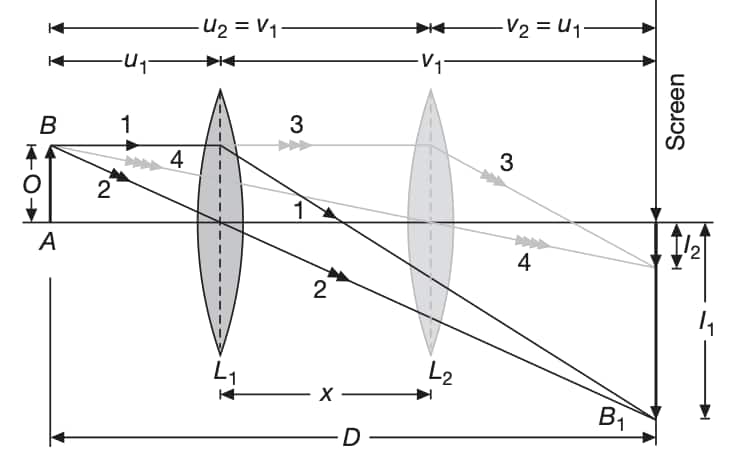
The object distances for these two positions are given by
$
\begin{aligned}
& u_1=\frac{D-\sqrt{D^2-4 f D}}{2} \\
& u_2=\frac{D+\sqrt{D^2-4 f D}}{2}
\end{aligned}
$
Since $u+v=D$, so
$
\begin{aligned}
& v_1=\frac{D+\sqrt{D^2-4 f D}}{2} \\
& v_2=\frac{D-\sqrt{D^2-4 f D}}{2}
\end{aligned}
$
We observe that
$
\begin{aligned}
& u_1=v_2=u(\text { say }) \\
& v_1=u_2=v(\text { say })
\end{aligned}
$
Let the lens be displaced through $x$, then we observe from figure that
$
\begin{aligned}
& x=v_1-u_1=\sqrt{D^2-4 f D} \\
\Rightarrow & x^2=D^2-4 f D \\
\Rightarrow & f=\frac{D^2-x^2}{4 D}
\end{aligned}
$
Use of Lens Displacement Method
- It is used to determine the focal length of a convex lens accurately.
- It avoids separate measurement of object distance $u$ and image distance $v$, reducing experimental error.
- It is useful when exact positions of object and image are difficult to measure directly.
- It gives more precise results compared to the simple $u-v$ method.
Note - This method is applicable to convex lens, not for concave lens
Solved Examples Based on Lens Displacement Method
Example 1: A screen is kept at a distance of 1 m from the object. A converging lens between the object and screen when placed at any positions which are 60cm apart forms a sharp image of the object on the screen, The focal length of the lens is:
1) 8cm
2) 12cm
3) 14cm
4) 16cm
Solution:
Given:
Distance between object and screen,
$D=1 \mathrm{~m}=100 \mathrm{~cm}$
Distance between two positions of lens,
$d=60 \mathrm{~cm}$
Formula:
$f=\frac{D^2-d^2}{4 D}$
$f=\frac{100^2-60^2}{4 \times 100}=\frac{10000-3600}{400}=\frac{6400}{400}=16\mathrm{~cm}$
$f=16 \mathrm{~cm}$
Hence, the answer is the option (4).
Example 2: The minimum distance between the object and the screen to form a real image by a converging lens is:
1) f
2) 2f
3) 3f
4) 4f
Solution:
Given:
Focal length of lens $=f$
For a real image to be formed on a screen by a convex lens, the object distance and image distance become equal at the minimum condition.
$u=v=2 f$
Distance between object and screen,
$D=u+v=2 f+2 f=4 f$
Hence, the answer is the option (4)
Summary
The lens displacement method is a technique for determining the focal length of a lens by measuring the shift in image position when the lens is displaced. This method is valuable in calibrating optical instruments like cameras, microscopes, and telescopes, ensuring precise focusing and image clarity. By analyzing how the image position changes with lens displacement, the focal length can be accurately calculated, which is crucial for achieving optimal performance in various optical applications.