Parul University B-TECH Admissions 2026
FINAL Deadline for Registrations– 25th August | India's youngest NAAC A++ accredited University | NIRF rank band 151-200 | 2200 Recruiters | 45.98 Lakhs Highest Package


B.E. full form is Bachelor of Engineering; the course duration is four years, spread across eight semesters. The Bachelor of Engineering degree is designed to provide students with knowledge of basic engineering concepts and theories. Candidates who have passed 10+2 in the science stream and want to develop technical skills can opt for the BE degree courses.
This Story also Contains
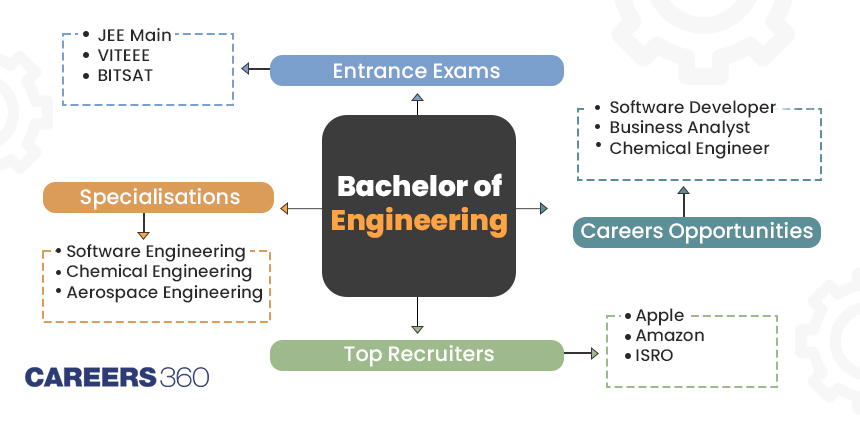
AICTE grants equal recognition to the BE degree as BTech and does not differentiate between these two. More than 4,000 colleges across all states and the United States territories of the country offer BE/B.Tech courses. Most of these BE colleges are Co-Ed, whereas very few are gender specific. The average BE course fee is around Rs 6 Lakhs.
Engineering professions are among the world's highest-paid professions, and graduating with a BE course will let students earn a high income, depending on their skill set. Their job roles mainly rely on the branch they choose to study during their Bachelor of Engineering degree. Civil engineering, Mechanical engineering, Electrical engineering, Computer Science Engineering, Robotics, and Chemical engineering are some popular branches of BE courses.
FINAL Deadline for Registrations– 25th August | India's youngest NAAC A++ accredited University | NIRF rank band 151-200 | 2200 Recruiters | 45.98 Lakhs Highest Package
NAAC A+ Accredited | Among top 2% Universities Globally (QS World University Rankings 2026)
Key Aspects of B.E. (Bachelor of Engineering):
The full form of BE is Bachelor of Engineering, which is an undergraduate degree programme of four years duration. During the course curriculum, students learn a theoretical and practical understanding of engineering and science. After graduation, students can become Network administrators, Design engineers, Computer architects, and Quality control engineers, depending on their specialisation.
| Particulars | Values |
|---|---|
Course Name | BE |
BE Full Form | Bachelor of Engineering |
BE Course Level | Undergraduate |
BE Eligibility Criteria | 10+2 class with PCM as mandatory subjects |
BE Course Duration | Four years |
BE Admission Process | Entrance examination |
BE Entrance Exam | JEE Main, AP EAMCET, MHT CET, TS EAMCET, KCET, JEE Advanced |
BE Course Fee | Rs 6.0 Lakhs |
BE Average Salary | Rs 8.5 LPA |
BE Job Options | Quality Control Engineer, Process Development Engineer, Civil Engineer, Electrical Engineer and Design Engineer |
BE Top Recruiters | HCL Technologies Ltd, Infosys Limited, Google, Tata Consultancy Services Limited, and Accenture |
B.E. fee structure varies depending on the type of college and the facilities offered by the college. The course fees for a Bachelor of Engineering vary from Rs. 6000 and Rs. 21 Lakhs. Government colleges generally charge lower fees as compared to private institutes. However, private colleges may provide good infrastructure, facilities and placement opportunities. However, in India, the average Bachelor of Engineering fee is Rs. 6 Lakhs.
Also Read: Top IIIT Online Programmes 2026: Opportunities and Avenues After Online Engineering Degrees
The Bachelor of Engineering course focuses on building a strong foundation for students in any chosen specialisation. Below, we have listed important BE course details that will be useful for the candidates.
Candidates who want to learn technical aspects and develop their programming skills can choose the B.E. programme. Nowadays, engineers are in great demand in the job market. Below are some of the key points of this section.
Also Read: Career in Data Science and AI
Candidates seeking admission into the B.E. programme must go through the eligibility criteria to ensure that they are eligible for admission to top colleges. They need to fulfil certain requirements to pursue the B.E. course. Mentioned below are the Bachelor of Engineering eligibility criteria that candidates can go through.
| Eligibility Parameters | Details |
|---|---|
Educational Qualification | 10+2 from a recognised institute in India with Physics, Chemistry, and Mathematics (PCM) as mandatory subjects |
Minimum aggregate score | 50-60 per cent aggregate score |
Reserved category applicants | 5-10 per cent relaxation for candidates belonging to the reserved categories |
Lateral Entry | For lateral entry, a diploma in a relevant discipline from a recognised institute is compulsory. |
Also Read: MTech Without GATE in IIT Kanpur
Bachelor of Engineering is a four-year-long course similar to a B.Tech degree. However, for lateral entry students, the BE duration is three years, as they are provided direct entry into the second year of the programme. The BE course duration is the same for each college, and college authorities are not authorised to change the duration.
Generally, the admission process is done based on entrance examinations conducted all over the country. The admission process varies from one college to another. The admission process can be divided into two types: entrance-based and merit-based.
Also, there are two types of entry- direct and lateral, and the admission procedures for both are different. Candidates can check the steps for BE admission below.
BE or Bachelor of Engineering (BE) degree holds promising global recognition due to its academic rigour, technical depth, and industry relevance. Globally, BE degrees are considered equivalent to BTech and BSc (Engineering), depending on the country's academic structure. BE graduates can also qualify for professional certifications, licensure exams such as FE (Fundamentals of Engineering), in the USA, or chartered engineer status in the UK and Commonwealth Countries.
Additionally, multinational corporations actively recruit BE graduates, given their problem-solving, analytical, and technical expertise. From IT and electronics to civil and mechanical fields, BE professionals find career opportunities in diverse global industries, making it a highly respected and portable qualification.
Candidates interested in becoming engineers need to appear for entrance examinations conducted by various institutes. There are many examinations held for the BE courses at the state, university, and national levels. A few BE entrance examinations are mentioned below:
| Exam Name | Conducting Body | Exam Schedule |
|---|---|---|
NTA | ||
Karnataka Examinations Authority | ||
JNTU Kakinada | ||
Consortium of Medical Engineering and Dental Colleges of Karnataka | ||
West Bengal Joint Entrance Examinations Board | ||
BITS | ||
SRM University | ||
Anna University | ||
State Common Entrance Test Cell - Maharashtra State | ||
IIT Bombay |
The Bachelor of Engineering cut-off is a set of criteria used to evaluate a student's merit or exam performance. It is determined by the qualifying examinations and the number of applicants who take the entrance exam, which varies by institution. The BE cut-off marks are also affected by the reservation category. In the table below, we have mentioned the B.E. cut-off of some prominent colleges.
Course Name | Category | Opening Rank | Closing Rank |
BE Civil Engineering | OPEN | 902254.00 | 902774.00 |
ST | 905685.00 | 905685.00 | |
SEBC | 904417.00 | 906173.00 | |
SC | 910238.00 | 910238.00 | |
BE CSE | OPEN | 900037.00 | 900037.00 |
EWS | 900096.00 | 900096.00 | |
SEBC | 900302.00 | 900302.00 | |
ST | 903987.00 | 903987.00 | |
BE Electrical Engineering | OPEN | 900604.00 | 900604.00 |
SEBC | 901783.00 | 901783.00 | |
EWS | 902340.00 | 902340.00 | |
SC | 904799.00 | 904799.00 | |
BE Chemical Engineering | OPEN | 902065.00 | 902065.00 |
SEBC | 903302.00 | 903302.00 | |
SC | 907757.00 | 907757.00 | |
ST | 914750.00 | 914750.00 | |
BE Civil Engineering | OPEN | 902662.00 | 903126.00 |
SEBC | 905042.00 | 905042.00 | |
ST | 909634.00 | 909634.00 | |
BE Computer Engineering | OPEN | 900102.00 | 900155.00 |
EWS | 900416.00 | 900416.00 | |
SEBC | 900337.00 | 900437.00 | |
ST | 904526.00 | 904526.00 | |
A Bachelor of Engineering syllabus is divided into four years with eight semesters. Each semester has different subjects for every branch except the first-year syllabus. In the table below, we have mentioned the B.E. syllabus of Jadavpur University, Kolkata.
In the first year, students will mainly concentrate on subjects related to physics, chemistry, and other programming languages. Below, we have provided subjects taught during the first year.
| Semester 1 | Semester |
|---|---|
Introduction to Programming | Data Structures & Algorithms |
Physics-I A | Mathematics II (Modules 5 and 6) |
Basic Electronics | Digital Logic & Digital Circuit |
Mathematics I (Modules 1 and 2) | Electrical Measurements |
Engineering Mechanics | Physics IIA |
Electrical Circuits | Electrical Technology Laboratory |
Basic Electronics Laboratory | Digital Logic Laboratory |
Programming Laboratory | Data Structure Laboratory |
Engineering Drawing | English For Communication & Social Studies |
Workshop | - |
The second year provides introductory knowledge on subjects that students will study in the degree. The main subjects of specialisation and their practical work are taught from the second year.
| Semester 3 | Semester 4 |
|---|---|
Object-Oriented Programming | Object-Oriented Systems |
Mathematics–III (Modules 3 and 10) | Mathematics– IV (Modules 8 and 12) |
Database Management Systems | Software Engineering |
Principles of Communication Engineering | Microprocessors |
Computer Graphics | Computer Networks |
Computer Architecture | Numerical Analysis Laboratory |
Object-Oriented Programming Laboratory | Numerical Methods & Optimisation Techniques |
Database Management Systems Laboratory | Object Oriented Programming Laboratory–II |
Programming Practice Laboratory | Microprocessor Laboratory |
With more advanced topics, the third-year curriculum consists of important and industry-relevant subjects. Topics taught during this year are important from a placement point of view as well.
| Semester 5 | Semester 6 |
|---|---|
MultimediaCoding & communications | Design & Analysis of Algorithms |
Wireless Networks | Cryptography & Network Security |
Graph Theory | Distributed Systems: Algorithms |
Web Technologies –I | Web Technologies – II |
Operating System Laboratory | Software Laboratory–II |
Principles of Compiler Design | Formal Language & Automata Theory |
Operating Systems | Elective–I |
Multimedia Laboratory | Web Application Laboratory |
Systems Programming Laboratory* | Software Laboratory–I* |
The last year of the Bachelor of Engineering course focuses on research and project-based learning. The following table highlights the syllabus of the 4th year of the B.E. degree.
| Semester 7 | Semester 8 |
|---|---|
Elective–I | Distributed System & Applications |
Elective–II | Management |
Image Processing | Elective–IV |
Economics | Seminar |
Image Processing Laboratory | Digital Signal Processing |
Project Laboratory* | Comprehensive VivaVoce |
- | Project |
B.E. courses offer various specialisations to the candidates. Candidates who choose a specific subject will become experts in a chosen field of engineering. The table below shows a few specialisations under the bachelor's degree in engineering.
| B.E in Mechanical Engineering | B.E in Civil Engineering |
| B.E. in Marine Engineering | B.E. in Marine Engineering |
| B.E. in Software Engineering | B.E. in Petroleum Engineering |
| B.E. in Chemical Engineering | B.E. in Aerospace Engineering |
BE and B.Tech are both popular courses in engineering and are mostly similar. However, there are some differences. In the table below, we have discussed the differences between BE and B.Tech.
| Particulars | BE | BTech |
|---|---|---|
Full Form | BE full form is Bachelor of Engineering | The BTech full form is Bachelor of Technology |
Approach | More oriented towards academic and research-oriented learning. | Leans towards industry applications and modern technological practices. |
Focus | Emphasises theoretical principles and fundamentals of engineering. | Focuses more on practical applications and current technology trends. |
Curriculum | It has a broader and more traditional engineering curriculum. | Includes more practical, hands-on projects and technology-oriented courses. |
Career Path | Prepare students for careers in research, academic positions, or specialised engineering roles. | Graduates are more geared towards immediate entry into technology sectors and industry roles. |
Candidates who have completed the BE (Bachelor of Engineering) course can improve their technical skills, such as M.Tech. If candidates are interested in management roles, they can also opt for an MBA degree. Candidates can get a good position after completing M.Tech from a top and reputable university.
Jobs in Core Engineering Fields: BE graduates can work in various industries, such as IT, electronics, manufacturing, construction, or automobile, based on their BE specialisation. Graduates can work as design engineers, software developers, or project managers.
Higher Studies: After completing the BE course, graduates can pursue postgraduate degrees like ME, M.Tech or MS to get more specialised knowledge in their specific field. Graduates can also opt for management courses like an MBA degree to get into managerial positions.
Government Sector Jobs: BE graduates can opt for various government jobs. They need to apply for exams like GATE for PSU jobs and other technical roles at ISRO, DRDO, or BHEL.
Research and Development: After completing the Bachelor of Engineering degree programme, students can join various companies as research associates or they can even opt for a PhD degree to do research in their chosen field. If they are inclined towards business or creating something new, entrepreneurship is also an available option.
Graduates of this domain have a great scope in the majority of the sectors. Recruiters hire them based on their technical and theoretical skills. Graduates can get opportunities in several fields and various designations. Students having a degree in engineering get a handsome salary. Profiles that students achieve after their graduation are listed below.
| Job Profile | Job Description | Average Salary |
|---|---|---|
Software Developers are professionals who are responsible for analysing user needs and developing their needs. They also design the applications that run in the systems to satisfy customer needs with the best results. | Rs. 8.4 LPA | |
Civil engineers design infrastructure such as roads, bridges, dams, airports, sewerage systems, and buildings. They are hired by both the government and private companies for several projects. | Rs. 4.5 LPA | |
Mechanical engineers are individuals who specialise in designing machinery systems and their components. They work with refrigeration machines, electric generators, internal combustion engines, steam, and gas turbines. | Rs. 4.5 LPA | |
Electrical engineers are responsible for designing equipment and devices to solve electrical problems. They specialised in developing various electrical systems for different purposes. | Rs. 4.5 LPA | |
Chemical engineers pursue roles in the oil and petroleum industry, plastic industry, drug industry, and other industries where chemicals are used. They study and investigate processes of chemical compounds and fuels. | Rs. 5.0 LPA |
Source: Ambition Box
The salary of a Bachelor of Engineering (BE) differs depending on various factors such as skills, abilities, and experience. It also changes for every job profile. The more skilled and experienced engineers are generally paid better as compared to freshers. Discussed below are the average salaries of private and government recruiters.
To provide the students with more insight into the salary structure for the respective job roles, we have discussed the salary in the table below. We have mentioned the average salary and job roles for top recruiters of the BE course.
Recruiter Name- Apple | |
Job Position | Average Salary |
Rs. 37.5 LPA | |
Rs. 19.2 LPA | |
Rs. 27 LPA | |
Rs. 31.3 LPA | |
Recruiter Name- DLF | |
Civil Engineer | Rs. 5.6 LPA |
Site Engineer | Rs. 5.0 LPA |
Rs. 9.4 LPA | |
Source: Ambition Box
Many students find it interesting to know the job roles and the salary offered after the BE courses in the public sector. In the table below, for the information.
Recruiter Name- Indian Railways | |
Job Position | Average Salary |
Mechanical Engineer | Rs. 4.7 LPA |
Electrical Engineer | Rs. 9.1 LPA |
Signal Engineer | Rs. 6.9 LPA |
Recruiter Name- DRDO | |
Design Engineer | Rs. 3.4 LPA |
Rs. 19.6 LPA | |
Rs. 3.0 LPA | |
Source: Ambition Box
Students who have successfully completed the B.E. course can apply for job positions in both the public and private sectors. Mentioned below are some of the popular employment areas BE graduates can work after successfully completing the programme.
| Multinational Companies (MNCs) | Government Organisations |
| Public Sector Undertakings (PSUs) | Universities |
| Laboratories | Construction |
In India, more than 3,500 private engineering colleges offer bachelor's degrees in engineering. Private universities are significantly more expensive than public universities. Some of the top private BE colleges and their fees are discussed below:
| Colleges | NIRF Ranking | Fees |
|---|---|---|
20 | Rs. 20.15 lakhs | |
25 | Rs. 20.17 lakhs | |
38 | Rs. 6.96 lakhs | |
63 | - | |
66 | - | |
77 | Rs. 2.25 lakhs | |
78 | Rs. 4.80 lakhs | |
86 | - | |
96 | Rs. 3.86 lakhs | |
101-105 | Rs. 3.18 lakhs |
A government-run engineering college is less expensive than a private engineering college. Government B.E. Colleges are well known for their high academic standards throughout India. There are around 700 government colleges that offer BE courses; some of them are listed below.
| Colleges | NIRF Ranking | Fees |
|---|---|---|
Jadavpur University, Kolkata | 10 | - |
24 | - | |
52 | Rs. 10.0 lakhs | |
101-150 | Rs. 1.04 lakhs | |
101-150 | Rs. 7.63 lakhs | |
101-150 | Rs. 4.90 lakhs | |
151-200 | - | |
151-200 | Rs. 33,360 | |
151-200 | Rs. 2.15 lakhs | |
- | - |
BE course provides comprehensive knowledge of engineering principles, problem-solving skills, and practical experience through lab work and projects. It also equips students with the knowledge and expertise to pursue a wide range of careers in a wide variety of sectors. Pursuing a BE degree can be a great choice, but only if candidates are interested in it.
Frequently Asked Questions (FAQs)
BTech stands for Bachelor of Technology. BTech courses mainly concentrate on technological aspects, whereas B.E. concentrates on knowledge-oriented subjects.
Computer Science, Mechanical, Electrical, and Civil Engineering are a few specialisations offered in B.E. degree courses.
The full form of B.E. is Bachelor of Engineering and it is for four years. Students aspiring to enter the engineering world can take up this course.

On Question asked by student community
Hello, pursuing an M.Tech in Artificial Intelligence and Machine Learning after B.E. in AI and ML can help you gain advanced knowledge and specialise in the field. You can explore M.Tech AI and ML colleges and fees details here: https://engineering.careers360.com/colleges/list-of-artificial-intelligence-and-machine-learning-colleges-in-india?degree=6&stream=1&branch=588
You can pursue B.Tech in Robotics, Automation or Mechatronics after Class 12 with PCM. Admission depends on the university and may be through JEE Main or merit.
For example, Galgotias University offers B.Tech in Robotics and Mechatronics, so these can be good options to explore if you're interested in automation
Hi,
Yes, you can still join BE/BTech through KCET counselling. Since you officially discontinued your B.Sc Agriculture seat, submitted the discontinuation letter, and got your TC/documents back without penalty, you are generally eligible to participate in KCET counselling again.
KEA mainly creates issues when students block seats and do not
If you're specifically looking for B.E./ B. Tech in Aerospace Engineering (not Aeronautical Engineering) , it's worth considering LPU as well. Aerospace Engineering is a broader field that covers the design, development, testing, and maintenance of both aircraft and spacecraft , including satellites, rockets, and space exploration systems, whereas Aeronautical
Hello
If you are looking for the BE/B.Tech in Aerospace Engineering in Karnataka or Tamil Nadu States. There are some reputed colleges which offer this course with good academics and the best placement records.
Here are some colleges that offer BE/B.Tech in Aerospace Engineering -

Among top 100 Universities Globally in the Times Higher Education (THE) Interdisciplinary Science Rankings 2026
Among top 100 Universities Globally in the Times Higher Education (THE) Interdisciplinary Science Rankings 2026
Last Date to Apply: 20th August | Ranked #43 among Engineering colleges in India by NIRF | Get Upto 100% Scholarships | Spot Admissions via CUET
NAAC A++ Grade | Recognized as Category-1 Deemed to be University by UGC | 41,000 + Alumni Imprints Globally
Recognized as Category-1 Deemed to be University by UGC | 41,000 + Alumni Imprints Globally | Students from over 20+ countries
100+ Recruiters | 1200+ Placements of 2026 Batch | NBA & NAAC Accredited | Highest CTC 37 LPA