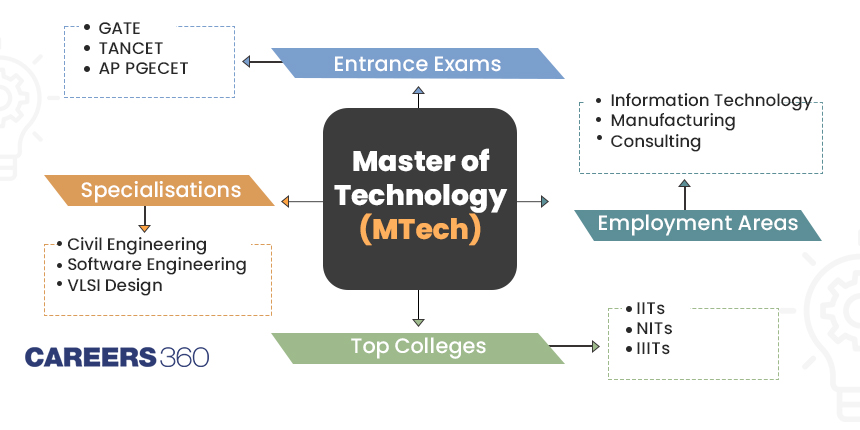
The Master of Technology (MTech) is a highly popular postgraduate engineering degree in India, with over one lakh BTech/BE graduates enrolling every year. The course is offered by more than 2,600 public and private institutions, including IITs and NITs. The MTech course has nearly 200 specialisations, such as Computer Science Engineering, Mechanical Engineering, and Civil Engineering, available in full-time, part-time, distance, and online modes. Admission is largely through the GATE exam, though state and university-level tests are also conducted. Foreign students increasingly pursue MTech in India, making it a competitive and career-focused programme. According to the AISHE 2021–22 report, the total enrolment in higher education increased to nearly 4.33 crore, marking a 26.5 per cent rise since 2014–15.
The full form of MTech is Master of Technology. It is a full-time technical degree for B.Tech graduates. Various specialisations are available in the MTech course. Candidates can apply for MTech admissions in a full-time, distance, and online (WILP) mode. Every mode can have different eligibility requirements and a course curriculum.
MTech Course Details - Highlights
The MTech course is a popular postgraduate programme in engineering that offers advanced knowledge and research opportunities across multiple specialisations. It is pursued by BTech/BE graduates aiming for higher studies or career growth in technical fields. Below are the key highlights of the course, such as admission process, eligibility, top exams, average salary, and top recruiters.
India’s technology sector is expanding quickly and is expected to reach around Rs. 29 lakh crore by 2030 (approximately $350 billion). Fields like Artificial Intelligence, cloud computing, and cybersecurity are growing fast, creating a strong demand for skilled professionals. MTech graduates with advanced expertise are in a good position to benefit from these opportunities. (Source: Corum Group)
MTech fees vary depending on the type and ownership of the institute. The fees typically range from Rs. 4,000 to Rs. 20 lakhs, with private colleges being more expensive due to their better infrastructure and placement opportunities. Scholarships based on GATE scores can reduce costs, while self-sponsored students usually pay higher fees. The average total fee is around Rs. 3 lakh.
What is the MTech Course Duration?
MTech duration is two years, divided into four semesters. The first year of the programme generally focuses on theoretical knowledge, while the second year focuses on projects, thesis, and research work. MTech courses can be studied in different modes: part-time, full-time, distance, and online. Reputed institutions like IIT Guwahati and IISc also offer online MTech degrees.
MTech Course Details
MTech is a master-level course offered across all states and UTs of the country to help students gain in-depth knowledge of subjects they had studied in B.Tech/BE. MTech is a degree where students can convert their degree knowledge into innovation, as its main focus is towards research work.
MTech uses a practice-oriented approach and includes strong research work throughout the curriculum.
Internships, projects, dissertations, and a thesis are important aspects of the MTech degree.
GATE is the primary exam for M.Tech admission.
Those who have been admitted through GATE are provided with an AICTE scholarship, which is Rs. 12,400 per month for the entire duration of two years.
The average base salary for MTech graduates is Rs. 10.0 LPA, according to Payscale.
Top Reasons to Choose MTech
Pursuing an MTech degree after a B.Tech provides ample time to gain in-depth technical knowledge on the subject and have more control over it. The following list highlights some benefits that candidates can consider while enrolling for the MTech programme.
Opportunities to work for various well-regarded research institutions such as BARC, DRDO, ISRO, IITs, IISc, CSIR, and RRI.
It opens up the door to pursue a career as an academician.
Top PSUs and MNCs directly recruit MTech students with valid GATE scores.
Non-Sponsored seats for GATE pass students by the Government of India, which means low MTech course fees.
Opportunities to pursue Ph.D. from top universities of India as well as abroad.
The potential for high earnings. As per the IIT Bombay M.Tech placement data of 2022-2023, 532 students participated in the campus placement process. A total number of 479 students got placed on campus with a placement percentage rate of 90 per cent.
Geeta University B.Tech Admissions 2026
40 LPA Highest Package | Up to 100% Scholarship worth 24 Crore via GUTS exam
Each engineering institution has its own eligibility criteria for M Tech to ensure it admits the most deserving students. However, many M Tech requirements are the same among these institutions. Below, we have listed the eligibility criteria for M Tech based on their seat type.
Particulars
Eligbility Parameters
MTech Educational Qualification
Students must have completed a BE (Bachelor of Engineering) or B.Tech (Bachelor of Technology) from a recognised institute in India
MTech Admission aggregate score requirements
55-60 per cent aggregate marks (vary depending on the institute)
For candidates belonging to the reserved categories, they may get a relaxation of 5-10 per cent.
MTech Entrance Exams
GATE is a popular entrance examination for admission to M.Tech courses
For GATE Candidates (Non-Sponsored Seat)
Candidates who have passed the GATE entrance examination with a good score can gain admission to non-sponsored seats. This means that the MTech fees for such students will be minimal. They should follow the steps provided for MTech admission.
Candidates must have a Bachelor's degree in Engineering/Technology/ or other related specialisation from a recognised university.
They must have scored a valid GATE score.
Candidates must have a minimum of 6 CGPA or 60 per cent in their bachelor's degree.
For reserved category candidates, the minimum mark will be 5.5 CGPA or 55 per cent.
For Sponsored Candidates
Such candidates do not receive any scholarship or stipend from the institution. Many colleges offer sponsored seats for working professionals. They need to meet the following eligibility criteria for M Tech.
Individuals working in an academic institution/PSU,/ Government organisations are considered sponsored candidates.
They need to have a minimum of 2 years of work experience.
Such candidates must be sponsored by their respective organisations.
They must have a valid GATE score.
A minimum of 60 per cent or 6 CGPA is mandatory for general category candidates. 5 per cent less for reserved category candidates.
For Self-sponsored Candidates
Students who have not appeared for the GATE examination or have low scores are considered for self-sponsored seats. These candidates have to pay more fees than others, and it is generally twice the amount. They do not receive any scholarships or stipends during their MTech course.
These candidates have to appear for an institution-specific test and/or a personal interview.
Their collective performance in the test, personal interview, and scorecard of the degree is reviewed by the college authorities.
Candidates are allocated seats based on the availability of unfilled seats.
For IIT Graduates
IIT MTech eligibility criteria are different for its graduates. IIT graduates planning to pursue an MTech degree from IITs are not required to take the GATE entrance exam. They can follow the steps below.
Such candidates must have a minimum of 8 CGPA in their B.Tech/BE degree.
Their applications will be reviewed by the respective institutions, and based on their academic records and seat availability, they will be considered for MTech admission.
MTech Course Admission Process
The admission process for MTech may vary slightly across colleges, but the overall steps are similar. Most institutes consider the GATE score as the primary criterion, while some also offer sponsored or self-sponsored seats with slightly different eligibility. Below are the steps involved:
Step 1 – Check Eligibility: Before applying, candidates must ensure they meet the eligibility criteria prescribed by the institute, including academic qualifications and other requirements.
Step 2 – Application Form: Eligible candidates need to fill out the online application form for the respective entrance examination. A separate form is required for each exam.
Step 3 – Admit Card: Authorities issue the admit card containing exam details such as date, time, duration, and examination centre. No candidate is allowed to appear without it.
Step 4 – Entrance Examination: All registered candidates can appear for the exam. The score or rank obtained forms the basis for the merit list.
Step 5 – Counselling: Shortlisted candidates are called for counselling based on merit and seat availability. Top institutes, like IITs, may also conduct personal interviews.
Step 6 – Final Admission: Admission is granted according to merit, preferred specialisation, and seat availability. Selected candidates must confirm their admission by submitting the required documents and paying the fees.
Note: For sponsor and self-sponsored seats, the MTech admission procedures are different. Check the official website of the particular college for more information.
MTech and its Dual Degrees Admission Trends and Insights for 2021-22
MTech is also offered as a dual degree programme, which can be integrated with undergraduate, postgraduate, and even doctoral degrees. Below are the enrolment figures for MTech and its related dual degrees for the academic year 2021-22, based on the AISHE report.
The high placement rates of BTech have decreased student interest in pursuing MTech degrees. This has resulted in a decline in MTech admissions. However, the government is making efforts to increase enrolment by offering scholarships and stipends. See the data from the AISHE report in the table below.
Academic Year
Total Enrolment
2016-17
160895
2017-18
142081
2018-19
135500
2019-20
137051
2020-21
138533
2021-22
135076
Top M.Tech Entrance Exams
There are more than 50 entrance exams administered at national, state, and university levels that facilitate admission to M.Tech courses. It is important to know the right way to enrol for any of the top institutions offering MTech. Below are some of the most popular MTech entrance examinations:
The MTech cut-off reflects a student’s merit for admission, with the GATE score being the primary criterion accepted by most engineering colleges. Other state or university-level entrance exams may also have specific cut-offs. Candidates can check detailed cut-off information in the table below for various MTech entrance exams:
The MTech course is offered in many specialisations, and the syllabus differs for each. For example, Computer Science Engineering covers advanced computing, algorithms, and research topics. In the table below, we have mentioned the MTech CSE syllabus of MAKAUT Kolkata.
MTech CSE First Year Syllabus
The MTech first-year syllabus includes core subjects, electives, and practical lab sessions. Key topics cover Computer Organisation, Data Structures & Algorithms, Operating Systems, Database Management, and Networks. Students gain foundational knowledge and hands-on experience in their chosen specialisation, preparing them for advanced studies in the second year.
Semester 1
Semester 2
Computer Organisation & Architecture
Theoretical Foundations of Computer Science
Data Structure & Algorithms
Advanced Base Management System
Systems Programming & Operating Systems
Distributed Computer Systems
Elective 1
Elective 3
Data Structure & Algorithms Laboratory
Elective 4
Networks & System Programming Laboratory
-
Elective 2
-
MTech CSE Second Year Syllabus
The MTech second-year syllabus comprises core subjects, electives, project work, and a viva voce. Electives may include Web Technology, AI & Neural Networks, Mobile Computing, VLSI Design, and Robotics. Students gain advanced technical knowledge and practical experience in their chosen specialisation.
Semester 3
Semester 4
Elective 5
Project Work (Phase-II) & Seminar
Project Work (Phase-I)
Viva-voce
Elective 6
-
Electives
Web Technology & E-Commerce
Internet Technology
Advanced Windows Programming
Software Engineering & Project Management
Elements of Robotics
Mobile Computing
VLSI System Design
Real-Time & Embedded Systems
Cellular Automata & Its Applications
AI & Neural Network
Object-Oriented Information System Design
Enterprise Computing Methodologies
Multimedia Technology
Digital Signal Processing
Image Processing & Pattern Recognition
Bio-informatics
Soft Computing
Courseware Engineering
Advanced Microprocessors
Parallel Computing
Compiler Construction
Cryptography and Computer Security
Browse Top M.Tech Colleges by States
Most states in India have universities or colleges administered by the local or central government that offer MTech programmes. In the list below, we have provided MTech colleges administered in some states of the country.
MTech courses are available in a wide range of fields, allowing candidates to select a specialisation that suits their interests and career goals. Some of the newly introduced and most sought-after MTech branches include emerging and traditional engineering domains. In the table below, we have added some MTech specialisations:
M.Tech is a gateway to grab job opportunities at some of the best companies. Candidates who have obtained a Master's degree in Technology have a good hold on technical knowledge. This opens up the way to many good job opportunities. Students will be able to work in various fields depending on their specialisation.
Career opportunities are ample in the private sector, government sector, and teaching, to name a few. If students are interested in specialising further, they can also plan for a PhD This provides an edge over others at a later stage and broadens the career opportunities for students.
However, MTech students are highly involved in research work right from the start of their final year. They can continue their research and join research institutions such as DRDO and space agencies like ISRO and NASA, where they can work on new projects as well.
Career Opportunities After the MTech Course
Pursuing an MTech degree opens up a wide range of job opportunities. Engineering is one of the fields whose students are always in demand. Listed below are some of the career opportunities as per the specialisation selected by the candidates after completing the M.Tech course:
Mechanical engineers design various types of machines that produce power. They are responsible for installing and maintaining the manufacturing of the machinery systems.
Civil engineers plan, design, construct, and maintain various infrastructural projects of different types. They build roads and bridges and prepare and construct the public transport layout.
Software Engineers use their knowledge of engineering and software development to build various software products. They also design computer games and operate network control systems.
Electrical engineers design and test equipment that runs on electricity. They find solutions to various electrical problems by applying the principles of electricity.
Biomedical engineers design medical equipment and devices for healthcare applications. These devices include replacements for body parts and artificial internal organs.
Rs. 3.6 LPA
Salary Source: AmbitionBox
Top Recruiters for M.Tech Graduates
An MTech degree is highly regarded and valued by many top recruiters. In this table, we have compiled a list of MTech job opportunities across the private sector, public sector, and public sector undertakings (PSUs).
Private Recruiters
PSUs
Government Recruiters
HCL Technologies
ONGC
ISRO
TATA Consultancy
NTPC
DRDO
Google
Bharat Heavy Electricals Limited (BHEL)
Defence
Goldman Sachs
Indian Oil Corporation
Indian Railways
IBM Global Services
Hindustan Petroleum Corporation Limited (HPCL)
Colleges/ Universities
Hindustan Unilever Ltd
Coal India Limited
Bhabha Atomic Research Centre ( BARC )
EY
Steel Authority of India Limited (SAIL)
IITs
Intel
Gas Authority of India Limited (GAIL)
Indian Institutes of Science Education and Research
Infosys Technologies
BSNL
National Highways Authority of India (NHAI)
Salaries After MTech Degree
After completing a Master of Technology (MTech), candidates can earn attractive salary packages. The level of pay often depends on the college or university attended, as well as the candidate’s skills and specialisation. Graduates from reputed institutions generally have better job opportunities and higher starting salaries in the industry.
Job Position and Salary for Top PSUs
An employee's salary also depends on the organisation they are working for. Below, we have listed some top PSUs in India with job positions and the average salary they offer to MTech graduates in PSUs.
Job Position and Salary for Top Private Recruiters
Many private companies hire MTech course graduates for different job roles. Below are some job roles, and their respective average salary that top MNCs in India offer.
After graduation, many engineering students find themselves confused between the two most popular postgraduate degrees: MTech vs MBA. Choosing between “M Tech and MBA which is better, should be based on the candidate's interests and career objectives. To help candidates, we have listed below the M Tech vs MBA key differences.
Particulars
MTech
MBA
Full Form
MTech full form is Master of Technology
MBA full form is Master of Business Administration
M Tech vs MBA Salary
The average MTech salary in India is around Rs. 7.6 LPA.
The average salary of an MBA graduate is around Rs. 7.7 LPA.
Projects, research, and thesis are major components of MTech.
Mainly offers business-related subjects.
Stipends
Yes, if admission is through the GATE exam, then students receive Rs. 12,400 per month.
No
Course Fees
The MTech fee is around Rs. 3.0 lakhs.
The MBA fee is around Rs. 15.0 LPA
Career Paths
Research and Development, Technical Consulting, Engineering Management, Teaching, or Specialised Technical Roles.
Management, Consulting, Finance, Marketing, or Entrepreneurship
Modes
Full-Time, Part-Time, Distance, or Online
Full-Time, Part-Time, Online, Global, Distance, and Executive
Engineering NIRF Rankings 2024
Listed below is the NIRF (National Institutional Ranking Framework) 2024 ranking. Students interested in studying MTech can choose the college based on their NIRF Ranking.
Colleges
NIRF Ranking 2024
IIT Madras
1
IIT Delhi
2
IIT Bombay
3
IIT Kanpur
4
IIT Kharagpur
5
IIT Roorkee
6
IIT Guwahati (IITG)
7
IIT Hyderabad
8
NIT Trichy
9
IIT BHU
10
Top Private MTech Colleges in India
In India, more than 2,000 private engineering colleges offer MTech degrees in various specialisations. The MTech fees in private colleges are generally higher than in public colleges. Below are some of the top private MTech colleges, along with their fees:
M Tech fees in government colleges are less than in private engineering colleges. There are more than 500 government colleges that are known for their high academic standards throughout India. The following are some of the best government MTech colleges, along with their fees.
An MTech degree provides both theoretical and practical knowledge of science and technology. Students who want to pursue higher education after pursuing a B.Tech degree can opt for M.Tech degree programmes.
IITs, NITs, and IIITs are well known for their MTech programme, providing good quality education and excellent placements. While most M.Tech admissions are done based on the GATE exam, some institutes also conduct their own entrance test or interview.
Frequently Asked Questions (FAQs)
Q: What is M.Tech?
A:
M.Tech is a postgraduate course of two years in Engineering. It stands for Master of Technology and is offered in various specialisation like computer science, AI, electronics, mechanical, VLSI, and the like.
Q: What is the average salary offered to M.Tech students?
A:
The average salary after Master of Technology is Rs. 10.0 LPA, according to Payscale.
Q: What are the career options available for M.Tech students?
A:
There are many jobs available in the market for M.Tech students such as Engineering Technologist, Mechanical Design Engineer, Teacher, and Executive Engineer.
Q: What is the eligibility criteria for M.Tech?
A:
To be eligible for M.Tech admission, candidates must have obtained a Bachelor degree in engineering.
The choice between mtech in Control Instrumentation and mtech in Chemical Engineering totally depends on your interest or career goal. If you are interested in designing and operation of chemical processes, you should go for chemical engineering. While if your interest lies in automation, measurement, or control
If you're aiming for
M.E./M.Tech in Electrical and Electronics Engineering
through GATE, you'll need to appear for the
GATE EE (Electrical Engineering)
paper. The syllabus covers a broad range of topics like:
Engineering Mathematics
– Linear Algebra, Calculus, Probability, Complex Numbers, etc.
Looking at the previous year TANCET Cutoff, you have good chances to get ME/M.tech colleges in Tamil Nadu. Some of the predicted colleges that you can get according to the previous year cutoff is given below :
Look, to get admission in M.Tech in any college , you need to qualify GATE that stands for Graduate Aptitude Test for Engineering , conducted by 23 IITs and IISc individually each year .
For more details about GATE , you may refer this :
According to latest cut offs if one is applying for PSG Tech if he/she belongs to General category then there cut offs are 75-80. And if one belongs to SC/ST/OBC and other backward classe their cut offs are 33,25,20 and 35 respectively.