Great Lakes Institute of Management, Chennai
Globally Recognized by AACSB (US) & AMBA (UK) | 18 LPA Avg. CTC for PGPM 2026


The NMAT 2026 retake gives candidates an opportunity to improve their performance after analysing their first attempt. Since NMAT by GMAC allows up to three attempts in a testing cycle, candidates can use the retake strategically to address gaps in speed, accuracy, question selection and section-wise performance. For NMAT 2026, the exam delivery window is November 2 to December 20, 2026, rather than a single exam date, giving aspirants flexibility in scheduling their attempts.
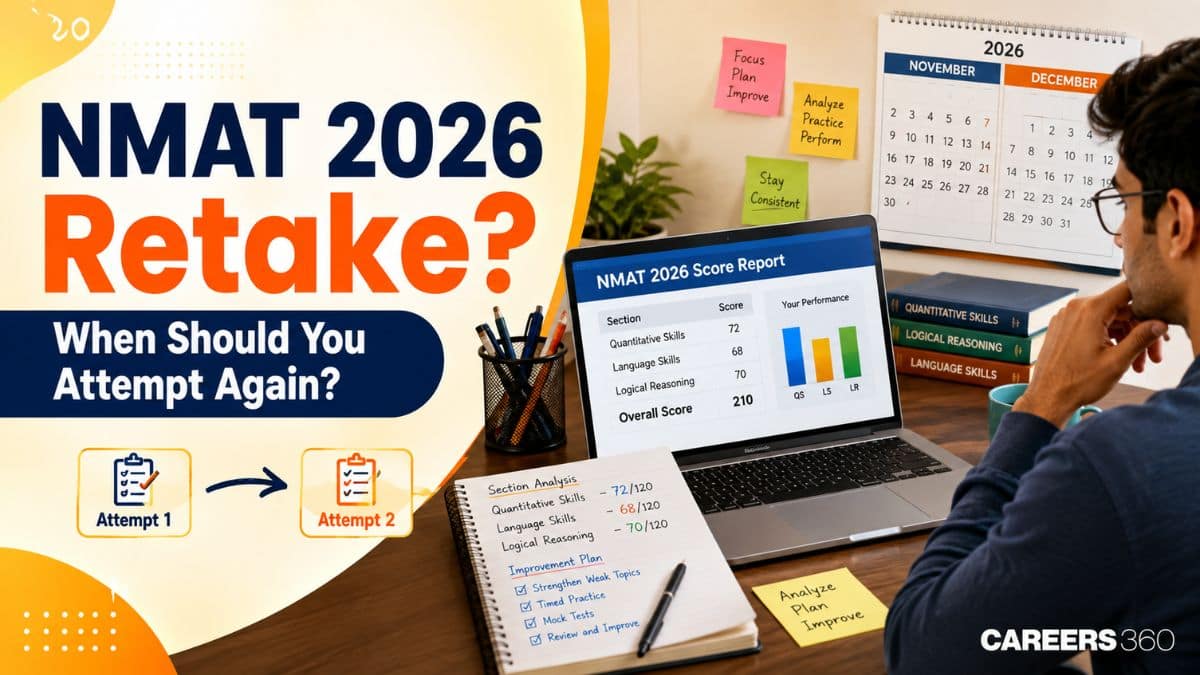
This guide explains how to analyse the first attempt, decide when to retake NMAT, use the gap effectively and build a focused score-improvement strategy.
A second attempt makes the most sense when you can identify what went wrong in the first attempt and have enough time to address it. Simply taking the exam again without changing your preparation approach may not produce a meaningful improvement.
Consider a retake if:
Your score is below the target required by your preferred B-schools.
One section has significantly affected your overall performance.
You lost questions because of time pressure.
Your accuracy dropped under actual exam conditions.
Your mock scores indicate that a higher score is achievable.
The strongest reason to retake is therefore a measurable improvement opportunity, not just the availability of another attempt.
Your situation | Recommended action |
Score below target college requirement | Consider retake |
One section significantly weak | Target that section |
Speed affected score | Practise timed questions |
Accuracy was low | Analyse error patterns |
Mock scores are consistently higher | Consider retake |
Score meets all target requirements | Retake may not be necessary |
Targeting NMIMS | Check first-score policy before retake |
Candidates can take NMAT a maximum of three times in a testing cycle, including the first attempt and two retakes. GMAC's current scheduling guidance states that when a valid score has been received, the next attempt must be scheduled for a date at least seven days after the previous successful attempt.
For NMAT 2026, the important dates are:
Event | NMAT 2026 Date |
August 20-October 10, 2026 | |
Exam delivery | November 2-December 20, 2026 |
Retake registration | November 3-December 17, 2026 |
Retake scheduling | November 3-December 17, 2026 |
Retake fee | ₹3,000 + applicable taxes |
Exam slots are limited and allocated on a first-come, first-served basis, so candidates planning multiple attempts should avoid delaying their scheduling.
The main advantage of an NMAT retake is that the first attempt gives you actual exam experience. You already understand the interface, pacing, section timings and pressure involved in completing the test.
Better understanding of your actual speed
More targeted section-wise preparation
Improved question-selection strategy
Opportunity to correct recurring errors
Familiarity with the exam environment
A chance to improve your overall performance
NMAT also allows candidates to choose their section order and has no negative marking, giving candidates scope to refine their test-taking strategy between attempts.
Your first score should become the starting point for your second-attempt preparation. Look beyond the overall score and identify exactly where performance changed during the exam.
What to analyse | What it tells you |
Overall score | Distance from your target |
Section scores | Priority section |
Accuracy | Concept or selection issue |
Questions attempted | Completion level |
Time spent | Pacing problem |
Mock vs actual score | Exam-day performance gap |
For example, if your Quantitative Skills score is reasonable but you leave several questions because of time, revising more formulas may not be the best use of your preparation time. Timed practice and faster question selection could have greater impact.
The second attempt should not mean restarting the entire syllabus. Use your first score and performance analysis to create a targeted NMAT preparation plan.
Analyse: Identify your biggest score and time losses.
Prioritise: Select the two or three areas with the highest improvement potential.
Practise: Solve targeted questions under NMAT-style time limits.
Simulate: Take full-length practice tests in one sitting.
Review: Track changes in accuracy, speed and section scores.
GMAC's official preparation platform provides two free online practice exams, each containing 108 questions and following the structure and features of the actual NMAT. The score report also provides section-wise and time-management insights.
Explore practical ways to use ChatGPT, Gemini, Claude, Perplexity and other AI tools for CAT, XAT and NMAT preparation, from creating study plans and practice questions to analysing mocks and improving section-wise performance.
Read the full guide: How to Use AI Tools for CAT, XAT and NMAT Preparation
There is no fixed number of days required for a second attempt. The preparation period should depend on the reason behind your first score.
First-attempt issue | Retake preparation focus |
Slow solving | Timed drills |
Low accuracy | Concept revision + practice |
Weak section | Section-specific preparation |
Poor question selection | Mock analysis |
Exam-day pressure | Full-test simulation |
Strong preparation but low score | Diagnose test-taking strategy |
If the problem is limited to one section, a short period of intensive practice may be sufficient. If weaknesses are spread across all three sections, a longer preparation cycle is more appropriate.
Not automatically. The answer depends on your target B-schools and their NMAT score policies.
GMAC states that NMAT-accepting institutions may have their own policies regarding which score they consider. Therefore, candidates should check the admission requirements of every target institute before booking a retake.
For candidates targeting NMIMS, the decision requires particular attention: GMAC states that NMIMS accepts only the first valid NMAT score. A retake should therefore not be planned on the assumption that NMIMS will consider the highest score.
Before scheduling a second attempt, answer these questions:
Checkpoint | What it means |
Is your score below your target? | A retake may be useful |
Do you know why you missed the target? | Build a focused plan |
Can speed or accuracy improve? | Retake has potential |
Do your target colleges accept retake scores? | Verify policies |
Can you prepare before the next available date? | Schedule accordingly |
This approach prevents candidates from using a retake simply because it is available.
The gap between attempts should be used to make specific, measurable improvements.
Practise short timed sets and track your average solving time.
Maintain an error log and classify mistakes into conceptual, calculation and selection errors.
Allocate a larger share of study time to that section while maintaining the other two.
Replicate actual exam conditions and identify whether stress, pacing or question selection caused the drop.
The objective is simple: your second attempt should reflect the changes made after analysing the first one.
Test your NMAT preparation with a free mock designed to help you assess speed, accuracy and question selection. Use your performance to identify weak areas and refine your NMAT exam strategy before the actual test.
Take the free mock test: NMAT Free Mock Test
An NMAT retake is worth considering when you can identify a clear path to score improvement. Use the first attempt as a diagnostic: analyse your section scores, accuracy, timing and question selection, then build a targeted preparation plan before booking the next attempt.
For NMAT 2026, the November 2-December 20 testing window and three-attempt limit provide flexibility, but the benefit of a retake ultimately depends on what you change between attempts.
Analyse your first attempt → fix the biggest weakness → practise under time pressure → retake with a revised strategy.
Get the download links to prepare for the NMAT 2026 examination from the section below.
NMAT 2026 Preparation Tips | |
NMAT 2026 Sample Paper and Mock Test | |
NMAT 2026 Quant Formula PDF: Every Formula Asked Since 2016- Shortcuts & Tricks | |
NMAT 2026: Complete Revision Kit | |
NMAT 2026 Logical Reasoning PDF: Concept, Tricks and Practice Questions |

On Question asked by student community
With an NMAT score of 194, you are in a good position to secure admission to several decent management schools (around the 30-41 percentile range). Top choices for this score include various campuses of Amity University, ITM Business School, ISBR Business School, and SRM University.
Attaining an NMAT score of 225 marks with sectional marks for VARC and QA around 73 marks, and LR at 79 marks, places you in a strong position for colleges like NMIMS Bengaluru, NMIMS Navi Mumbai, NMIMS Hyderabad, NMIMS Indore, KJ Somaiya, TAPMI, and more.
Hi there,
With an NMAT score of 216 (LR 76, VA 74, QA 66), you have a wide range of good options for admission. You can consider schools where your score is at par with the scores of admitted students, such as NMIMS campuses in Mumbai, Bangalore, and Hyderabad, Xavier
HELLO,
Here are some good MBA Colleges that you can target with an NMAT score around 204:-
1.SVKM's Narsee Monjee Institute of Management Studies (NMIMS), Hyderabad and Navi Mumbai
2.SDA Bocconi Asia Center, Mumbai
3.ICFAI Business School (IBS), Hyderabad
4.SOIL Institute of Management, Gurgaon
5.Great Lakes Institute of Management
6.Alliance
Hello
Your NMAT score of 189 is decent, but it is usually around a 40–45 percentile range, not among the very high percentiles.
With this score, top colleges like NMIMS' main campuses may be difficult, but you still have good options in private universities.
You can realistically target colleges like

Globally Recognized by AACSB (US) & AMBA (UK) | 18 LPA Avg. CTC for PGPM 2026
75+ years of legacy | #1 Entrance Exam | Score accepted by 250+ BSchools
Gateway to IBS Hyderabad & 8 other IBS campuses | Scholarships worth 10 CR
Highest Package 29.30 LPA | 12 LPA Median CTC | 230+ Recruiters | AACSB Accredited | Ranked 51 in Asia by QS International
Early Application Round Deadline: 27th Oct’26 | 400+ Recruiters | Highest CTC 17.2 LPA | Average CTC 8 LPA | 92% Avg. Placements | Awarded Best Business School of the Year
Last Date to Apply - 19th December 2026 | Highest CTC 68.66 LPA | Average CTC 18.08 LPA | Top 25% Average CTC 24.66 LPA