Great Lakes Institute of Management, Chennai
Globally Recognized by AACSB (US) & AMBA (UK) | 18 LPA Avg. CTC for PGPM 2026


The difference between finishing the NMAT Quantitative Skills section and running out of time can come down to a few seconds per question. With the exam window open from November 2 to December 20, 2026, candidates need to know which calculations can be simplified, which formulas deserve quick recall and where lengthy methods can be avoided. This article breaks down the NMAT 2026 important topics, available weightage guidance, practical shortcuts and time-saving strategies for the 36-question, 52-minute section.

Explore MBA scholarship opportunities across India’s top B-schools. Scholarships - Top 100 B-Schools in India
The Quantitative Skills section is independently timed, so candidates must complete all its questions within the allotted 52 minutes.
Particulars | Details |
Number of questions | 36 |
Sectional time limit | 52 minutes |
Score range* | 12-120 |
Negative marking | No |
*The scaled score is the score adjusted by GMAC’s scoring process to account for differences in exam difficulty across test forms. The Quantitative Skills scaled score ranges from 12 to 120. The final scaled score is calculated using GMAC's scoring methodology.
Given below is the NMAT 2026 Exam Pattern:
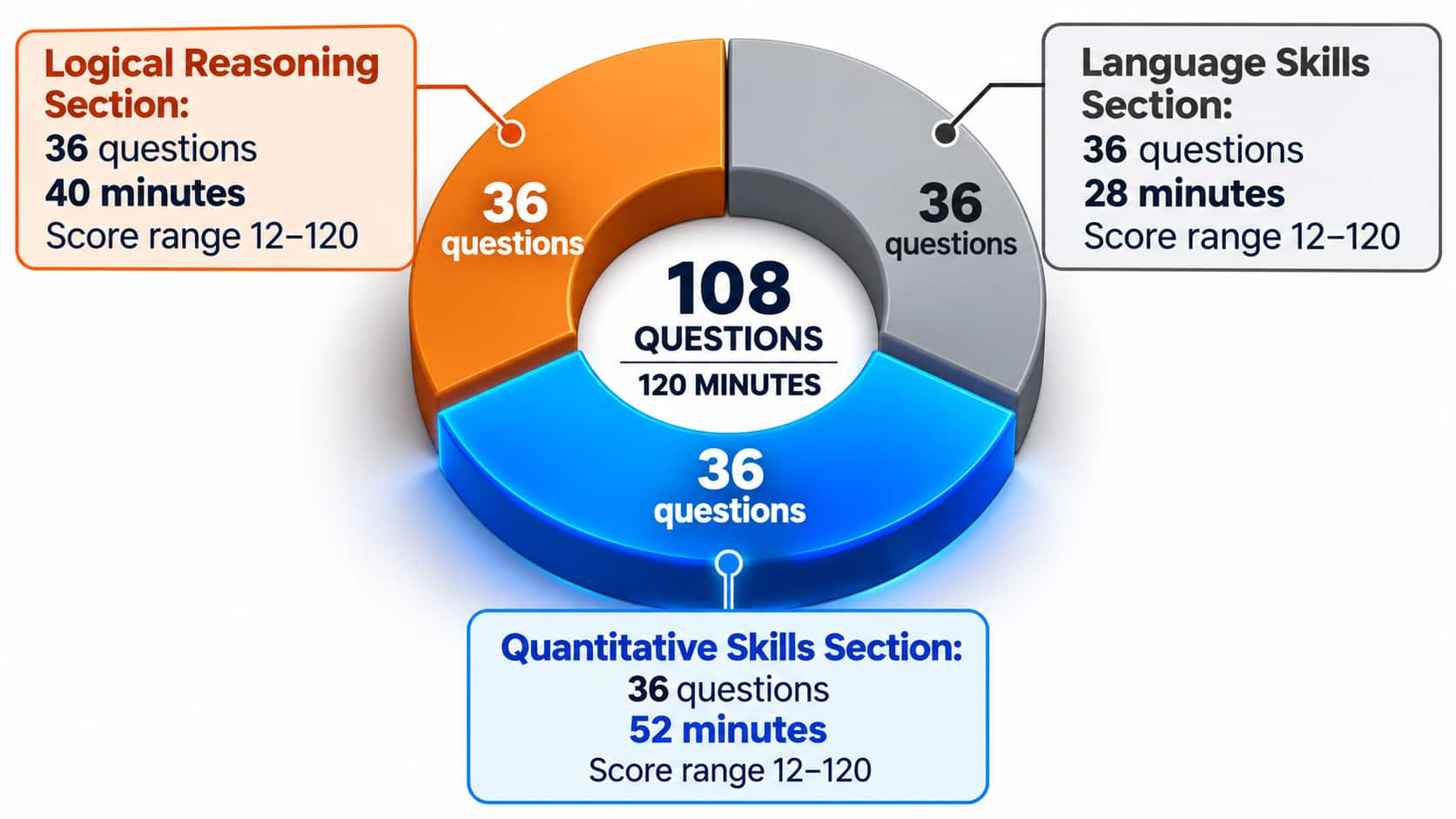
For the latest details, refer to the official NMAT exam structure. [https://www.mba.com/exams/nmat/about]
The official syllabus covers number properties, arithmetic, algebra and probability, data interpretation, and data sufficiency. Candidates should prepare the following subtopics to develop balanced coverage of the section.
Topic | Important subtopics |
Arithmetic | Percentages, ratios, averages, profit and loss, simple interest and compound interest, time and work |
Number Properties | Fractions, decimals, logarithms, factors, multiples, HCF, LCM and prime numbers |
Algebra | Linear equations and quadratic equations, inequalities, sequences and series |
Probability and Combinatorics | Probability, permutations and combinations |
Caselets, tables, graphs and charts | |
Data Sufficiency | Determining whether the given information is sufficient to answer a question |
Candidates should practise both direct formula-based problems and multi-step questions. Arithmetic and number properties also provide opportunities to improve calculation speed through regular mental-maths practice.
The NMAT 2025 memory-based analysis highlights Arithmetic and Data Interpretation as key areas, though topic distribution and difficulty varied across slots; use these reported trends to guide NMAT 2026 preparation, not as a guaranteed weightage.
Topic | Important subtopics | Estimated questions |
Arithmetic | Percentages, ratios, averages, profit and loss, SI-CI, time-speed-distance, time and work, simplification | 10-12 |
Data Interpretation (DI) | Tables, bar graphs, pie charts, caselets, combination charts, multi-step and geometry-based DI | Around 8 |
Data Sufficiency (DS) | Arithmetic-based and number-property sufficiency problems | 4-5 |
Modern Mathematics | Permutations and combinations, probability, set theory, Arithmetic Progression and Geometric Progression | 5-6 |
Algebra | Linear and quadratic equations, inequalities, logarithms, algebraic expressions, factorisation | 4-5 |
Number Systems | Integers, divisibility, remainders, unit digits, factors, multiples, cube roots and number patterns | 2-3 |
Geometry and Measurement | Area-based problems and geometry-related calculations | |
Total | Quantitative Skills section | 36 |
NMAT 2025 Question Paper and Exam Analysis: Review memory-based questions, exam difficulty and reported topic trends to prepare more effectively. Download PDF
Note: These are indicative estimates from reported patterns, not official GMAC figures. Topic counts and percentages may vary, and DI and DS classifications can depend on how questions are grouped.
The following shortcuts can reduce calculation time in common question types. Practise them with timed questions, so you know when they are useful.
For two successive percentage changes of a% and b%, the net percentage change is:
$a+b+\frac{ab}{100}$
Treat a decrease as a negative value. For example, a 20% increase followed by a 10% decrease gives:
$20-10+\frac{20(-10)}{100}=8%$
The overall result is an 8% increase.
When two equal distances are travelled at speeds a and b, use:
$\text{Average speed}=\frac{2ab}{a+b}$
For example, travelling equal distances at 40 km/h and 60 km/h gives an average speed of:
$\frac{2\times40\times60}{40+60}=48\text{ km/h}$
This is faster than calculating the total distance and total time separately.
If one value has been recorded incorrectly, calculate the corrected average using:
$\text{Correct average}=\text{Old average}+\frac{\text{Correct value}-\text{Recorded value}}{n}$
Here, n represents the total number of observations. This shortcut is useful when a question provides an incorrect value and asks for the revised average.
For two positive integers a and b:
$\text{HCF}(a,b)\times\text{LCM}(a,b)=a\times b$
Use this relationship when the two integers or their HCF and LCM values are given. It can eliminate unnecessary factorisation in straightforward questions.
For a quadratic equation ax2+bx+c=0, the sum and product of the roots are:
$\text{Sum of roots}=-\frac{b}{a}$
$\text{Product of roots}=\frac{c}{a}$
These formulas help when a question asks only for the sum or product of the roots, rather than their individual values.
Memorising common equivalents helps with arithmetic and data interpretation calculations.
Fraction | Percentage |
12 | 50% |
13 | Approximately 33.33% |
14 | 25% |
15 | 20% |
18 | 12.5% |
For example, 25% of 480 can be calculated as 4804=120, without multiplying 480 by 25 and dividing by 100.
For questions involving growth, decline or comparisons, use:
$\text{Percentage change}=\frac{\text{New value}-\text{Old value}}{\text{Old value}}\times100$
Always use the original value as the denominator. Check the units and labels in the table or graph before calculating.
NMAT 2026 Quant Formula PDF: Revise important quantitative formulas and learn shortcuts and tricks for faster calculations. Download PDF
A focused practice routine can help candidates improve speed without spending excessive time revising theory.
Strengthen calculation skills: Practise fractions, squares, percentage conversions and multiplication regularly.
Solve timed question sets: Begin with individual topics and gradually move to mixed-topic practice.
Analyse mock tests: Record incorrect answers and slow solutions, then revise the concepts responsible for those mistakes.
Practise data interpretation: Work with tables, graphs and caselets to improve both reading speed and calculation accuracy.
Manage the sectional timer: Use the average of approximately 87 seconds per question as a pacing guide, not a rigid limit for every question.
Because NMAT questions are delivered one at a time, candidates should make each response carefully and avoid depending on returning to earlier questions.
Practise with a free NMAT mock test to assess your preparation, identify weak areas and improve speed and accuracy. Attempt timed questions to evaluate your readiness for the actual exam.
NMAT Free Mock Test: Attempt a free mock test to evaluate your accuracy, speed and readiness for the exam.
MBA Specialisation | What the eBook Covers | Download eBook |
|---|---|---|
Healthcare & Hospital Management | Colleges, rankings, fees, salary and careers | |
Pharmaceutical Management | Pharma MBA colleges, rankings, fees, placements and career options | |
Supply Chain & Logistics | Colleges, rankings, fees, salary and careers | |
Retail Management | Colleges, rankings, fees, placements and career options | |
Insurance & Banking | Colleges, rankings, fees, placements and career opportunities | |
Aviation Management | Colleges, rankings, fees, placements and career paths | |
Travel & Tourism | Colleges, rankings, fees, placements and career opportunities |

On Question asked by student community
With an NMAT score of 194, you are in a good position to secure admission to several decent management schools (around the 30-41 percentile range). Top choices for this score include various campuses of Amity University, ITM Business School, ISBR Business School, and SRM University.
Attaining an NMAT score of 225 marks with sectional marks for VARC and QA around 73 marks, and LR at 79 marks, places you in a strong position for colleges like NMIMS Bengaluru, NMIMS Navi Mumbai, NMIMS Hyderabad, NMIMS Indore, KJ Somaiya, TAPMI, and more.
Hi there,
With an NMAT score of 216 (LR 76, VA 74, QA 66), you have a wide range of good options for admission. You can consider schools where your score is at par with the scores of admitted students, such as NMIMS campuses in Mumbai, Bangalore, and Hyderabad, Xavier
HELLO,
Here are some good MBA Colleges that you can target with an NMAT score around 204:-
1.SVKM's Narsee Monjee Institute of Management Studies (NMIMS), Hyderabad and Navi Mumbai
2.SDA Bocconi Asia Center, Mumbai
3.ICFAI Business School (IBS), Hyderabad
4.SOIL Institute of Management, Gurgaon
5.Great Lakes Institute of Management
6.Alliance
Hello
Your NMAT score of 189 is decent, but it is usually around a 40–45 percentile range, not among the very high percentiles.
With this score, top colleges like NMIMS' main campuses may be difficult, but you still have good options in private universities.
You can realistically target colleges like

Globally Recognized by AACSB (US) & AMBA (UK) | 18 LPA Avg. CTC for PGPM 2026
75+ years of legacy | #1 Entrance Exam | Score accepted by 250+ BSchools
Gateway to IBS Hyderabad & 8 other IBS campuses | Scholarships worth 10 CR
Highest Package 29.30 LPA | 12 LPA Median CTC | 230+ Recruiters | AACSB Accredited | Ranked 51 in Asia by QS International
Early Application Round Deadline: 27th Oct’26 | 400+ Recruiters | Highest CTC 17.2 LPA | Average CTC 8 LPA | 92% Avg. Placements | Awarded Best Business School of the Year
Last Date to Apply - 19th December 2026 | Highest CTC 68.66 LPA | Average CTC 18.08 LPA | Top 25% Average CTC 24.66 LPA