
Search Colleges, Exams, Schools & more


Login
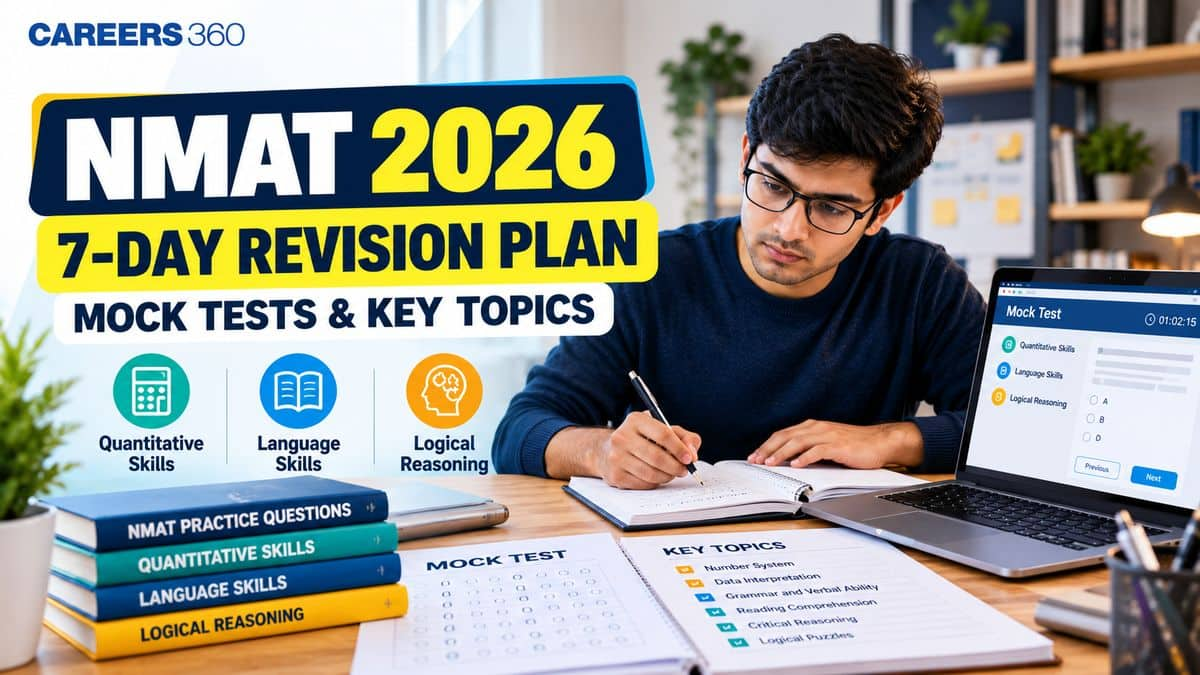
7 Days Revision Plan to Crack NMAT 2026 Exam - The NMAT 2026 exam window is scheduled from November 2 to December 20, 2026. If you have already covered most of the syllabus, the last seven days are the right time to revise important topics, solve questions, and work on your weak areas. You do not need to study every chapter again for NMAT 2026. Instead, focus on the topics where you lose marks, improve your speed, and learn to manage the time available for each section. This seven-day revision plan will help you prepare for Language Skills, Quantitative Skills, and Logical Reasoning before the exam.
This Story also Contains
- NMAT 2026 Exam Pattern: Section-Wise Questions and Time Limits
- 7-Day NMAT 2026 Revision Plan: What to Study Each Day
- How to Revise Quantitative Skills in the Last 7 Days
- How to Prepare for NMAT Language Skills in the Final Week
- How to Revise Logical Reasoning for NMAT 2026
- How to Analyse NMAT Mock Tests Before the Exam
- Other Resources to Ace NMAT 2026 Exam
NMAT 2026 Exam Pattern: Section-Wise Questions and Time Limits
Before starting your revision, check the NMAT exam pattern. The exam has three sections, with 36 questions in each section. You get a total of 120 minutes to complete all 108 questions.
Section | Number of Questions | Time Limit |
Language Skills | 36 | 28 minutes |
Quantitative Skills | 36 | 52 minutes |
Logical Reasoning | 36 | 40 minutes |
Total | 108 | 120 minutes |
7-Day NMAT 2026 Revision Plan: What to Study Each Day
The seven-day plan below is for students who have completed most of the NMAT syllabus. Each day has a clear goal, so you can revise the important topics without wasting time on chapters you already know well.
Day | Main focus | Suggested activities |
Day 1 | Full-length mock test | Attempt one timed mock, record section-wise performance and identify recurring errors. |
Day 2 | Quantitative Skills | Revise formulas, practise arithmetic and other weak topics, and review calculation errors. |
Day 3 | Language Skills | Practise Reading Comprehension, grammar, vocabulary and sentence-based questions. |
Day 4 | Logical Reasoning | Practise critical reasoning, deductions, syllogisms and analytical puzzles. |
Day 5 | Full-length mock test | Attempt a second timed mock and compare section-wise performance with Day 1. |
Day 6 | Weak areas | Revise the two or three topics responsible for the most errors or time loss. |
Day 7 | Light revision | Review formulas, notes and previous mistakes; confirm exam logistics and rest. |
Day 1: Take a Full-Length Mock Test
Start your revision with a full-length NMAT mock test. Follow the actual exam time limits and avoid taking breaks between sections.
Once you finish, check your score in each section. Note the questions you answered incorrectly, the ones that took too long, and the topics you found difficult.
For example, if you know how to solve percentage questions but make calculation errors, you need more calculation work rather than a complete revision of the topic.
Day 2: Revise Quantitative Skills
Begin with Arithmetic topics such as percentages, ratios, averages, profit and loss, interest, time and work, and time, speed and distance. Then revise Algebra, Number Properties, Probability, and Data Interpretation according to your needs.
Solve 40–60 questions from these topics, depending on their difficulty. Check every wrong answer and try to understand whether you made a calculation error or used the wrong method.
Day 3: Revise Language Skills
Divide your study time between grammar, vocabulary, and Reading Comprehension. Revise important grammar rules, common word meanings, sentence completion, and para forming.
Solve two or three RC passages with a time limit. Focus on the main idea, the author's tone, and questions based on information given in the passage.
Do not start memorising a large number of new words at this stage. Revise the words and grammar rules you have already studied.
Day 4: Revise Logical Reasoning
Focus on Critical Reasoning, syllogisms, deductions, analytical puzzles, and other reasoning topics in your preparation material.
Solve 40–50 questions and review your mistakes. For arrangement questions, write down the conditions and use a table or diagram to organise the information.
For Critical Reasoning, identify the main argument before looking at the answer options. This will help you avoid selecting an option that sounds correct but does not answer the question.
Day 5: Take Your Second Mock Test
Take another full-length NMAT mock test and compare your performance with Day 1.
Check whether you have improved your accuracy, solved questions faster, or made fewer mistakes. If your score has not improved, look at the individual sections instead of worrying only about the overall result.
Spend enough time reviewing the answers. Your aim is to understand what needs to change before the actual exam.
Day 6: Work on Your Weak Areas
Use your mock-test results to decide what you should revise. If you struggle with Data Interpretation, solve more questions involving tables and charts. If you lose marks in Reading Comprehension, work on understanding the passage and choosing the correct answer.
Revise your formula sheet, grammar notes, and reasoning methods. You should also decide which section you want to attempt first, based on your performance in mock tests.
Day 7: Keep Your Revision Light
On the last day, revise important formulas, grammar rules, vocabulary, and questions you got wrong earlier.
Avoid starting a completely new topic or spending the whole day studying. Get enough sleep so that you can concentrate during the exam.
How to Revise Quantitative Skills in the Last 7 Days
Quantitative Skills has 36 questions and a time limit of 52 minutes. You need to understand the formulas, solve calculations correctly, and choose the right method for each question.
Quantitative Skills Revision Plan
Topic | What to revise |
Arithmetic | Percentages, ratios, averages, profit and loss, interest, time and work, speed and distance |
Algebra | Equations and other important concepts |
Number Properties | Factors, multiples, divisibility, and remainders |
Data Interpretation | Tables, charts, graphs, and caselets |
Probability and Permutations and Combinations | Basic probability, arrangements, and selections |
Data Sufficiency | Questions based on whether the given information is enough |
How to Prepare for NMAT Language Skills in the Final Week
Language Skills has 36 questions and a time limit of 28 minutes. You need to read quickly, understand the question, and select the correct answer without spending too much time on a single problem.
Language Skills Revision Plan
Topic | What to revise |
Reading Comprehension | Main idea, inference, author's tone, and passage-based questions |
Grammar | Tenses, subject-verb agreement, prepositions, and sentence structure |
Vocabulary | Synonyms, antonyms, analogies, and word meanings |
Para Forming | Arranging sentences in the correct order |
Sentence Completion | Choosing words or phrases that fit the sentence |
How to Revise Logical Reasoning for NMAT 2026
Logical Reasoning has 36 questions and a time limit of 40 minutes. This section checks how well you understand information, find relationships, and draw conclusions from the given statements.
Logical Reasoning Revision Plan
Topic | What to revise |
Critical Reasoning | Assumptions, conclusions, and arguments |
Analytical Puzzles | Seating Arrangements and condition-based questions |
Deductions | Conclusions based on given statements |
Relationships between statements | |
Other Reasoning Topics | Question types covered in your preparation material |
How to Analyse NMAT Mock Tests Before the Exam
Mock tests help you understand your preparation level and show which topics need more attention. However, checking only your final score will not help you improve much. You should also review your mistakes and understand why you lost marks.
After each mock test, check the following:
What to check | What you should do |
Section-wise scores | Find out which section needs more revision |
Incorrect answers | Identify the concept or method behind each mistake |
Questions that took too long | Find a simpler way to solve similar questions |
Guessed answers | Check whether your reasoning was correct |
Repeated mistakes | Revise the topic and solve similar questions again |
Maintain an Error Log
Maintain a notebook or spreadsheet with four columns: topic, mistake, correct method, and next action.
For example, if you repeatedly make mistakes in percentage-change questions, revise the formula and solve a fresh set. If you struggle with RC inference questions, check why the correct answer follows from the passage.
Take two full-length mock tests during the seven-day revision period. After the first mock, use your results to plan your revision. After the second, check whether your accuracy and speed have improved.
Do not worry if your NMAT score does not increase immediately. Focus on correcting mistakes and improving the areas where you lose marks.
Other Resources to Ace NMAT 2026 Exam
Candidates can check out the different NMAT resources to ace the examination in the table below:
NMAT 2026 Sample Paper and Mock Test | |
NMAT 2025 Question Paper and Exam Analysis | |
NMAT 2026 Quant Formula PDF: Every Formula Asked Since 2016- Shortcuts & Tricks | |
NMAT 2026: Complete Revision Kit | |
NMAT 2026 Logical Reasoning PDF: Concept, Tricks and Practice Questions | |
NMAT 2026 Language Skills: Top 20 Topics to Score 90+ Marks |
Frequently Asked Questions (FAQs)
Q: Can I prepare for NMAT 2026 in seven days?
A:
Yes, you can improve your performance in seven days if you have already covered most of the syllabus. Focus on revising important concepts, solving questions, taking mock tests, and correcting mistakes. If you are starting from scratch, concentrate on familiar topics and basic concepts first.
Q: How many mock tests should I take in the last seven days before NMAT?
A:
Two full-length mock tests are a good starting point. Take one on Day 1 and another on Day 5. Use the remaining days to revise weak topics and solve section-wise question sets. Spend enough time reviewing your answers after each mock.
Q: Which NMAT section should I revise first?
A:
Start with a full-length mock test to find your weak areas. If you struggle with calculations, focus on Quantitative Skills. If you find passages and grammar questions difficult, give more time to Language Skills. If you make mistakes in puzzles or arguments, revise Logical Reasoning.
Q: Is there negative marking in NMAT 2026?
A:
No, NMAT does not have negative marking for incorrect answers. However, read every question carefully and use the given options to eliminate incorrect answers. Do not rush through questions simply because there is no penalty for wrong answers.
Q: What should I do on the last day before the NMAT exam?
A:
Revise your formula sheet, grammar rules, vocabulary notes, and mistakes from previous mock tests. Solve a few familiar questions and check your exam appointment and identification documents. Avoid starting new topics and get enough sleep before the exam.
Articles
Related Stories
|
Upcoming Mba Exams

Certifications By Top Providers
Explore Top Universities Across Globe
Popular Courses and Specializations
List of colleges accepting NMAT
Browse Mba Colleges by State
Questions related to NMAT
On Question asked by student community
Have a question related to NMAT ?
With an NMAT score of 194, you are in a good position to secure admission to several decent management schools (around the 30-41 percentile range). Top choices for this score include various campuses of Amity University, ITM Business School, ISBR Business School, and SRM University.
Attaining an NMAT score of 225 marks with sectional marks for VARC and QA around 73 marks, and LR at 79 marks, places you in a strong position for colleges like NMIMS Bengaluru, NMIMS Navi Mumbai, NMIMS Hyderabad, NMIMS Indore, KJ Somaiya, TAPMI, and more.
Hi there,
With an NMAT score of 216 (LR 76, VA 74, QA 66), you have a wide range of good options for admission. You can consider schools where your score is at par with the scores of admitted students, such as NMIMS campuses in Mumbai, Bangalore, and Hyderabad, Xavier
HELLO,
Here are some good MBA Colleges that you can target with an NMAT score around 204:-
1.SVKM's Narsee Monjee Institute of Management Studies (NMIMS), Hyderabad and Navi Mumbai
2.SDA Bocconi Asia Center, Mumbai
3.ICFAI Business School (IBS), Hyderabad
4.SOIL Institute of Management, Gurgaon
5.Great Lakes Institute of Management
6.Alliance
Hello
Your NMAT score of 189 is decent, but it is usually around a 40–45 percentile range, not among the very high percentiles.
With this score, top colleges like NMIMS' main campuses may be difficult, but you still have good options in private universities.
You can realistically target colleges like

Applications for Admissions are open.
Globally Recognized by AACSB (US) & AMBA (UK) | 18 LPA Avg. CTC for PGPM 2026
XAT
ApplyRegister for XAT 2027 by 28th Oct to become eligible to take the Mock Test | 75+ years of legacy | #1 Entrance Test | 100+ Test Cities | 250+ B-Schools accept XAT Score
K J Somaiya Institute of Management, Mumbai
ApplyHighest Package 29.30 LPA | 12 LPA Median CTC | 230+ Recruiters | AACSB Accredited | Ranked 51 in Asia by QS International
ISBR Business School, Bangalore
Apply400+ Recruiters | Highest CTC 17.2 LPA | Average CTC 8 LPA | 92% Avg. Placements | Awarded Best Business School of the Year
IMI, Delhi
ApplyLast Date to Apply - 19th December 2026 | Highest CTC 68.66 LPA | Average CTC 18.08 LPA | Top 25% Average CTC 24.66 LPA
Amity Global Business School, Noida
ApplyRanked #1 In Business & Economics among Indian Universities (Times Higher Education Rankings 2026)
NMAT Notifications
Never miss NMAT update
Get timely NMAT updates directly to your inbox. Stay informed!