Great Lakes Institute of Management, Chennai
Globally Recognized by AACSB (US) & AMBA (UK) | 18 LPA Avg. CTC for PGPM 2026


With XAT 2027 scheduled for January 3, 2027, understanding the previous XAT paper can help aspirants identify the topics and question types that deserve greater attention during preparation. The XAT 2026 paper featured 95 questions across QA-DI, Decision Making, VALR and GK, offering useful clues about the exam's section-wise distribution. Reading Comprehension formed a significant part of VALR, while Decision Making continued to test the distinctive reasoning approach associated with XAT. For XAT 2027 aspirants, analysing this distribution can help build a focused preparation strategy, prioritise important topics and understand where the exam is likely to demand greater accuracy and time management.
This Story also Contains
XAT 2027 registration is open until December 6, 2026, so complete your application in time and carefully check your academic, personal, document and fee details before submitting the form. Click to Register
For a detailed breakdown, start evaluating with XAT 2026 Master Analysis PDF: Topic-wise Question Distribution
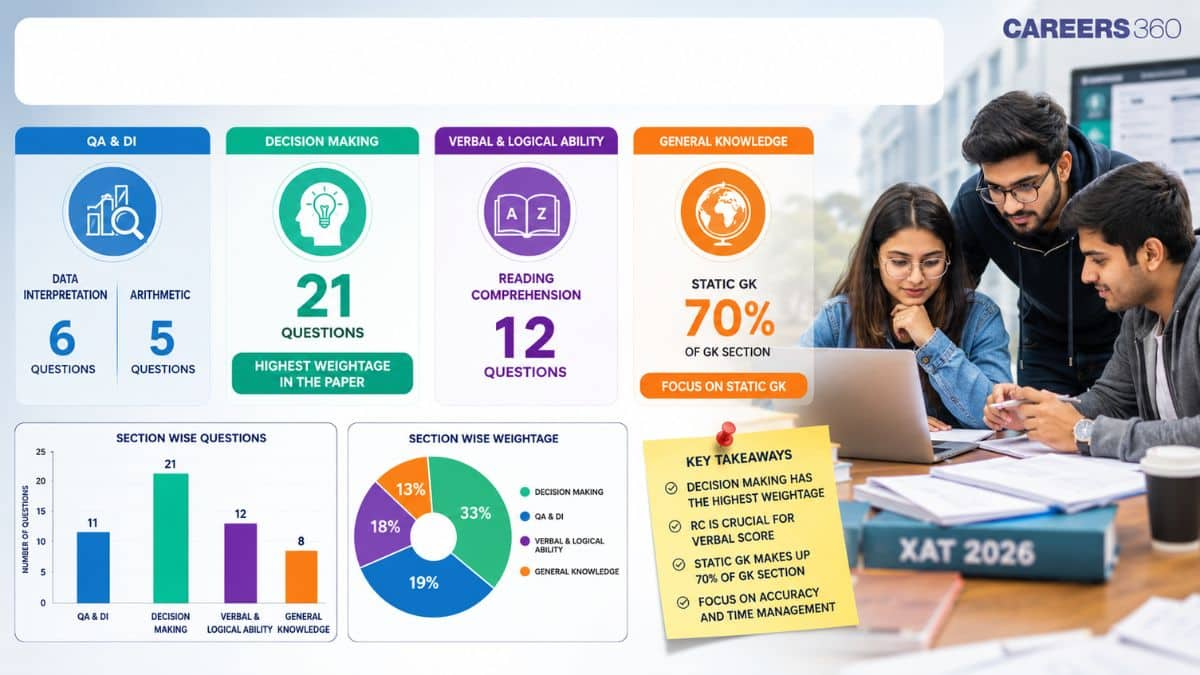
The XAT 2026 paper had 95 questions, spread out over four sections. In each part, they were checking a different skill set, from quantitative aptitude and decision making to verbal reasoning, plus general awareness too.
Section | Questions |
Quantitative Aptitude & Data Interpretation | 28 |
Decision Making | 21 |
Verbal & Logical Ability | 26 |
General Knowledge | 20 |
Total | 95 |
Overall, the distribution looked balanced, with quantitative aptitude, along with verbal ability, got the biggest chunk of questions, while decision-making remained the one differentiator of the XAT exam.
In the QA-DI section, there were seven big topics, and Data Interpretation with Arithmetic ended up getting the highest weightage.
Topic | Total Questions |
Arithmetic | 5 |
Geometry & Mensuration | 4 |
Number System | 3 |
Modern Math | 4 |
Algebra | 3 |
Trigonometry | 1 |
Data Interpretation | 6 |
Total | 28 |
The distribution shows that Data Interpretation and Arithmetic received the highest representation, while the remaining topics ensured broad coverage of the Quantitative Aptitude syllabus.
This table provides a detailed breakdown of the specific subtopics that contributed questions to the XAT 2026 QA-DI section.
Topic | Subtopic | Total |
Geometry | Circles & Circumference | 2 |
Geometry | Right Triangle / Area | 1 |
Geometry | Geometry Construction | 1 |
Arithmetic | 2 | |
Arithmetic | 2 | |
Arithmetic | 1 | |
Number System | 1 | |
Number System | Prime Factorization | 1 |
Number System | Prime Numbers | 1 |
Modern Math | Set Theory | 1 |
Modern Math | Probability | 1 |
Modern Math | Integer Solutions | 1 |
Modern Math | Permutations & Arrangements / Logic | 1 |
Algebra | 1 | |
Algebra | Functions & Recurrence | 1 |
Algebra | Algebraic Equations / Volume | 1 |
Trigonometry | Heights & Distances | 1 |
Data Interpretation | Sunburst Chart (Caselet) | 6 |
The subtopic distribution shows that XAT covered a wide range of concepts, making preparation across multiple Quant areas important for XAT 2027 aspirants.
The following table converts the QA-DI question distribution into the percentage weightage of each major topic.
Topic | Questions | Weightage |
Data Interpretation | 6 | 21.4% |
Arithmetic | 5 | 17.9% |
Geometry & Mensuration | 4 | 14.3% |
Modern Math | 4 | 14.3% |
Number System | 3 | 10.7% |
Algebra | 3 | 10.7% |
Trigonometry | 1 | 3.6% |
Key Insights
In the QA-DI part, Data Interpretation somehow ended up with the top number of questions (6) among everything.
Arithmetic stayed the most important single Quant subject, with 5 questions.
Geometry, Modern Math, Algebra and Number System all got solid representation, like it shows broad syllabus coverage instead of leaning on only a couple of chapters.
The Decision Making section was made up of 21 questions, split evenly across seven business caselets.
Topic | Total Questions |
Business Decision Making | 3 |
Human Resource Management | 3 |
Ethics & Corporate Governance | 3 |
Operations & Resource Allocation | 3 |
Sales & Marketing | 3 |
Finance & Investment Decisions | 3 |
Public Policy & Social Decision Making | 3 |
Total | 21 |
The equal distribution across all seven themes indicates that candidates needed exposure to varied managerial and decision-making situations rather than relying on one particular area.
This case-wise breakdown shows how the 21 Decision Making questions were distributed across the seven caselets in XAT 2026.
Case | Theme | Questions |
Case 1 | Business Strategy & Management | 3 |
Case 2 | Human Resource Management | 3 |
Case 3 | Ethics & Corporate Governance | 3 |
Case 4 | Operations & Resource Planning | 3 |
Case 5 | Sales, Customers & Marketing | 3 |
Case 6 | Financial Decision Making | 3 |
Case 7 | Public Administration & Social Issues | 3 |
With three questions from each caselet, the section maintained a consistent structure across different business and social situations.
The following table highlights the percentage contribution of each Decision Making theme to the overall section.
Theme | Questions | Weightage |
Business Strategy | 3 | 14.3% |
Human Resource Management | 3 | 14.3% |
Ethics & Corporate Governance | 3 | 14.3% |
Operations Management | 3 | 14.3% |
Sales & Marketing | 3 | 14.3% |
Finance | 3 | 14.3% |
Public Policy & Social Issues | 3 | 14.3% |
Unlike a few earlier years when certain themes took over, XAT 2026 stayed balanced in every managerial domain. So this hints that candidates should gear up for a mixture of business circumstances, rather than only zeroing in on ethics or corporate governance.
In the VALR section, reading comprehension kept dominating; then critical reasoning came right after.
Topic | Total Questions |
Reading Comprehension | 12 |
Critical Reasoning | 5 |
Para Jumbles | 3 |
Vocabulary | 3 |
Grammar & Usage | 3 |
Total | 26 |
Reading Comprehension accounted for the largest share of VALR, while Critical Reasoning and other verbal topics also contributed to the section.
This table shows how the 12 Reading Comprehension questions were distributed across the three passages in XAT 2026.
Passage | Questions |
RC 1 | 4 |
RC 2 | 4 |
RC 3 | 4 |
Total | 12 |
Each passage carried an equal number of questions, making all three RC sets equally important from a preparation perspective.
The following table provides a subtopic-wise view of the non-RC questions asked in the XAT 2026 VALR section.
Subtopic | Total |
Critical Reasoning | 5 |
Para Jumbles | 3 |
Vocabulary | 3 |
Grammar & Usage | 3 |
Critical Reasoning had the highest share among these topics, while Para Jumbles, Vocabulary and Grammar & Usage had equal representation.
The table below converts the VALR question distribution into the percentage weightage of each topic.
Topic | Questions | Weightage |
Reading Comprehension | 12 | 46.2% |
Critical Reasoning | 5 | 19.2% |
Para Jumbles | 3 | 11.5% |
Vocabulary | 3 | 11.5% |
Grammar & Usage | 3 | 11.5% |
Nearly 46% of the section was dedicated to Reading Comprehension, making it the most important verbal topic. But then, the rest of the questions were spread out in a fairly equal way across reasoning and the language-based topics, so this reinforced that you need balanced preparation.
In General Knowledge, there was more focus on Static GK than on Current Affairs.
Topic | Total Questions |
Current Affairs | 6 |
Economy & Business | 3 |
History | 2 |
Geography | 2 |
Science & Technology | 2 |
Polity & Government | 2 |
Sports | 1 |
Awards, Books & Personalities | 2 |
Total | 20 |
The distribution shows that both Current Affairs and Static GK featured prominently, with questions covering a broad range of general knowledge areas.
This table provides a detailed breakdown of the specific GK subtopics represented in the XAT 2026 paper.
Subtopic | Total |
Current Affairs | 6 |
Economy & Finance | 3 |
Indian History | 1 |
World History | 1 |
Indian Geography | 1 |
World Geography | 1 |
Science & Technology | 2 |
Indian Polity | 2 |
Sports | 1 |
Awards & Honours | 1 |
Books / Personalities | 1 |
The questions covered diverse areas including current affairs, economy, history, geography, science, polity, sports and awards.
The table below compares the contribution of Current Affairs and Static GK to the overall XAT 2026 GK section.
Category | Questions | Weightage |
Current Affairs | 6 | 30% |
Static GK | 14 | 70% |
Static GK contributed around 70% of the whole section; questions were spread all over history, geography,y economy, political science and some other domains too.
Data Interpretation showed up as the highest weighted theme in QA-DI, while Arithmetic stayed the most dominant part within Quant overall.
Reading Comprehension covered almost half of the VALR segment
Decision Making kept an even say-equal weightage across seven distinct business themes.
Static GK was way more than Current Affairs, like a clear advantage there.
In the end, the paper leaned on concepts from across the entire syllabus, so full preparation matters a lot more than only picking a few topics or being selective.
Prepare for XAT 2027 with these carefully selected eBooks and resources covering mock tests, Decision Making, GK, essay writing, previous-year papers and detailed exam analysis. Use them to strengthen concepts, practise different question types and build an exam-focused preparation strategy.
| eBook Title | Download Link |
|---|---|
| XAT 2027 Mock Test | Download Now |
| XAT 2027 Official Mock Test with Solutions | Download Now |
| XAT 2027 Essay Writing Practice Questions | Download Now |
| XAT 2026 Question Paper with Solutions | Download Now |
| XAT 2026 Memory Based Questions and Analysis | Download Now |
| XAT 2026 Response Sheet | Download Now |
| XAT June 2026 GK Capsule: Current Affairs & Static GK | Download Now |
| XAT 2026 Master Analysis: Topic-wise Question Distribution | Download Now |
| XAT July 2026 GK Capsule: Current Affairs & Static GK | Download Now |
| XAT 2027 Decision Making Handbook | Download Now |
| XAT August 2026 GK Capsule: Current Affairs & Static GK | Download Now |
Frequently Asked Questions (FAQs)
Data Interpretation seemed to carry the most weight in the QA-DI section; it had 6 questions, and then Arithmetic was next with 5 questions.
In XAT 2026, the Decision-Making part came with 21 questions, which were split into 7 caselets, and each caselet had three questions.
Reading Comprehension turned out to be the major chunk; it contributed 12 out of the 26 questions in the VALR section.
Yes, probably. Static GK had 14 questions, whereas Current Affairs had 6 questions, so Static GK clearly had the higher weightage.
Looking at the XAT 2026 paper, aspirants should prioritise Arithmetic, Data Interpretation, Geometry, Modern Math, Algebra, and Number System, but don’t treat it like a shortcut; make sure you don’t skip full syllabus coverage or end up leaving out anything important.

On Question asked by student community
Hello Student, exam-centre availability can change depending on the live slots shown during the XAT application process. I would suggest checking Chikkaballapura directly in the test-city selection before completing the application. If the city is not appearing, it may mean that the centre is unavailable or not offered for that
You can find all the information here:
CAT- https://www.careers360.com/mba/articles/cat-exam-dates
SNAP- https://www.careers360.com/mba/articles/snap-exam-dates
You can check the XIMB XAT Cutoff 2026 to determine the percentile for non-domicile female candidates.
The IRMA XAT 2026 cutoff is expected to be in the range of 55 to 60 percentile for ST category candidates. At an XAT score of 47 percentile, it is unlikely to get a PI call for the IRMA MBA admission 2026.

Globally Recognized by AACSB (US) & AMBA (UK) | 18 LPA Avg. CTC for PGPM 2026
75+ years of legacy | #1 Entrance Exam | Score accepted by 250+ BSchools
Gateway to IBS Hyderabad & 8 other IBS campuses | Scholarships worth 10 CR
Highest Package 29.30 LPA | 12 LPA Median CTC | 230+ Recruiters | AACSB Accredited | Ranked 51 in Asia by QS International
Early Application Round Deadline: 27th Oct’26 | 400+ Recruiters | Highest CTC 17.2 LPA | Average CTC 8 LPA | 92% Avg. Placements | Awarded Best Business School of the Year
Last Date to Apply - 19th December 2026 | Highest CTC 68.66 LPA | Average CTC 18.08 LPA | Top 25% Average CTC 24.66 LPA