Great Lakes Institute of Management, Chennai
Globally Recognized by AACSB (US) & AMBA (UK) | 18 LPA Avg. CTC for PGPM 2026


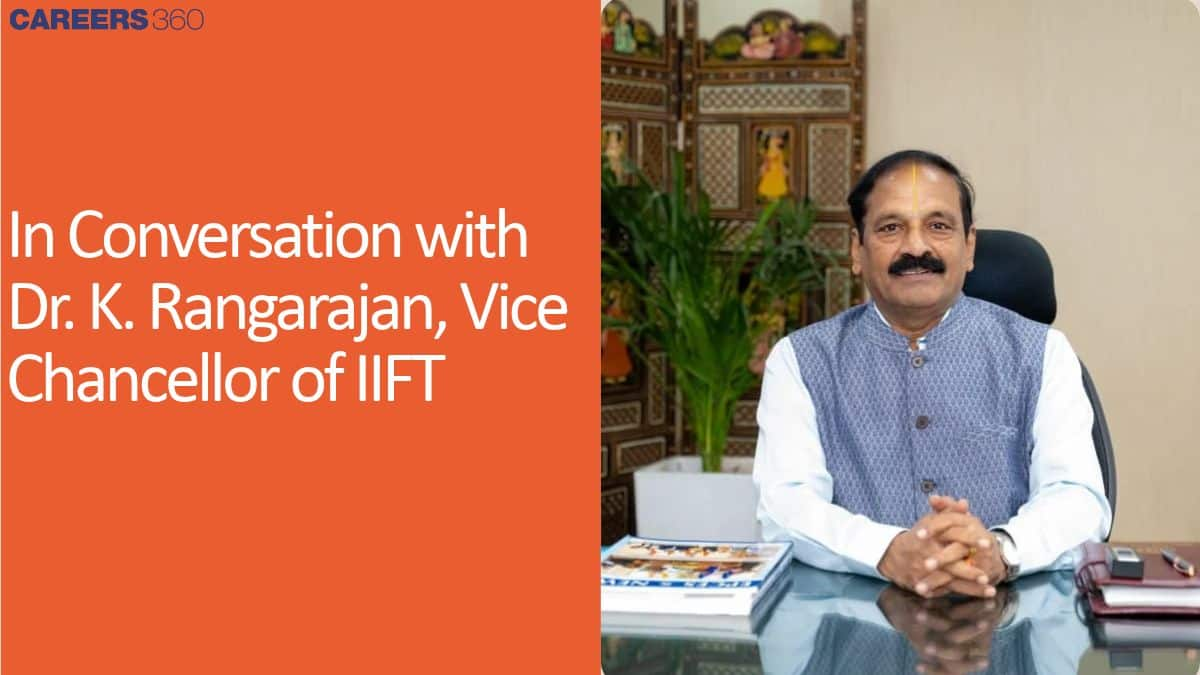
In this conversation with Careers360, Dr. K. Rangarajan, the Vice Chancellor and Professor of Strategy of Anurag University, shared the information regarding the institute and its functions. Dr. K. Rangarajan tells about the institute’s establishment, vision, mission, accreditations, and placements offered to the students, along with other details. To know more details about IIFT, read the article below.
Careers360: Please tell us about the institute, including its year of establishment, vision, mission, and key milestones.
Dr. K. Rangarajan: The Indian Institute of Foreign Trade (IIFT) was established in 1963 by the Government of India under the Ministry of Commerce and Industry, with the objective of developing professional expertise in international trade and strengthening India's capabilities in global business. Over the past six decades, IIFT has evolved into a premier institution of national importance in management education, research, policy engagement and capacity building, while remaining deeply rooted in its core specialisation of international business.
Our vision is "To be an Academic Center of Excellence in International Business research, training and education." This vision is complemented by our mission to create and nurture a learning environment that develops competent, responsible and globally oriented professionals and leaders in international business, with a strong sense of social responsibility and commitment to national development.
IIFT's journey is marked by several significant institutional milestones. It was accorded the status of a Deemed-to-be University in 2002, reflecting its growing academic stature and contribution to management education. The institute received the prestigious AACSB International accreditation in November 2021, placing it among globally recognised business schools committed to rigorous academic standards and continuous improvement. In 2023, IIFT was awarded an A+ grade by the National Assessment and Accreditation Council (NAAC), further reinforcing its commitment to academic excellence and institutional quality.
From its origins in New Delhi, IIFT has expanded its presence nationally and internationally, with campuses in Delhi, Kolkata, Kakinada and GIFT City, Gandhinagar, along with its international presence in Dubai. This expansion reflects our ambition to make high-quality management education accessible across different regions while leveraging the distinct economic and strategic opportunities offered by each location. It also positions IIFT to contribute more meaningfully to India's international trade, financial services, manufacturing, logistics and global business ecosystems.
Our academic portfolio has diversified in response to the changing needs of industry and the economy. In addition to our flagship MBA in International Business, we offer the MBA in Business Analytics, MA in Economics with specialisation in Trade and Finance, Integrated Programme in Management and doctoral programmes. Through these programmes, we seek to combine strong management fundamentals with specialised knowledge in international business, trade, economics, analytics and emerging technologies.
What distinguishes IIFT is its unique positioning at the intersection of management education, international trade, global business strategy and economic policy. Our close engagement with industry, government, international academic institutions and trade organisations enriches the learning experience and ensures that our academic initiatives remain relevant to contemporary business realities.
As India strengthens its position in global value chains, pursues new trade partnerships and aspires to become a leading global economic power, IIFT's role becomes increasingly significant. Going forward, our focus is on strengthening academic excellence, fostering research with real-world impact, deepening international collaborations, embracing technological transformation and nurturing responsible leaders who can navigate the complexities of an interconnected global economy.
Our aspiration is not merely to expand institutionally, but to strengthen IIFT's position as a globally recognised centre of excellence in international business education and research, contributing meaningfully to India's emergence as a leading participant in the global economy.
Also See: IIFT Admissions
Careers360: Could you elaborate on the admission process, eligibility criteria, and selection procedure for various programmes offered by the institute?
Dr. K. Rangarajan: At IIFT, our admission philosophy is centred on identifying candidates who demonstrate academic capability, intellectual curiosity, leadership potential and the ability to contribute meaningfully to the business ecosystem.
For the two-year MBA in International Business and MBA in Business Analytics programmes, admission to the 2027–29 batch is based on CAT 2026 scores, followed by Group Discussion and Personal Interview. The selection framework also considers parameters such as academic consistency, gender diversity and relevant work experience.
Our other programmes have distinct admission processes:
MA Economics (Trade and Finance): Admission is based on the prescribed eligibility requirements and programme-specific selection criteria.
Integrated Programme in Management (IPM): Designed for students after Class XII, with a selection process based on the notified entrance examination and other applicable criteria.
Ph.D. Programmes in Management and Economics: Admission is based on academic qualifications, applicable entrance examination or national eligibility requirements, research aptitude and the prescribed interview process.
Executive and certificate programmes: These have programme-specific eligibility and selection requirements, often taking into account professional experience.
We believe that diversity in academic backgrounds, professional experiences and perspectives enriches classroom learning. Accordingly, our admission processes seek to bring together students who can learn from one another and develop into responsible business leaders.
Read About: IIFT Courses
Careers360: What kind of infrastructure and facilities can students expect at the institute? Please elaborate on the academic facilities, laboratories, library, hostels, sports facilities, and other student amenities.
Dr. K. Rangarajan: IIFT recognises that quality management education requires an ecosystem that goes beyond classrooms. Our campuses are designed to provide an integrated learning environment that supports academic excellence, research, professional development and holistic student growth. We currently have four campuses across the country – Delhi, Kolkata, Kakinada and GIFT City. Each campus has its own distinct character while maintaining the academic standards and institutional ethos of IIFT.
Our academic infrastructure includes modern, technology-enabled classrooms, seminar and conference facilities, computer centres, high-speed internet connectivity and collaborative learning spaces. At the campus, we have a dedicated Data Analytics Lab equipped with specialised software such as SPSS, SAS and Hadoop, supporting the growing emphasis on data-driven management education.
Our library resources are another important strength. The library has an extensive collection of books, journals, research publications and international databases. It also houses a dedicated WTO Resource Centre, reflecting IIFT's longstanding expertise in international trade and policy research. Students have access to digital resources and research databases that support their academic and professional pursuits.
The residential facilities at our campuses provide students with an opportunity to experience a vibrant campus community. The MBA in International Business is a residential programme, and hostel facilities are supported by mess services, recreational areas, Wi-Fi, fitness facilities and other essential amenities. Sports and recreational facilities, including indoor games and outdoor sports infrastructure, encourage students to maintain a healthy balance between academics and extracurricular activities.
We also place considerable emphasis on student life through clubs, committees, cultural activities, sports events, industry interactions and student-led initiatives.
An important dimension of our infrastructure development is the expansion of the Kakinada campus. The permanent campus is being developed with modern academic and residential facilities, including a substantially expanded learning resource centre. Similarly, our GIFT City presence provides students with an opportunity to engage with an emerging international financial and business ecosystem.
Ultimately, our objective is to create campuses that are not merely physical learning spaces but vibrant communities where students develop intellectual capabilities, interpersonal skills, leadership qualities and a global outlook.
Read More About: IIFT Placements
Careers360: Industry interaction and corporate engagement play a crucial role in students' professional development. What initiatives has the institute undertaken to strengthen industry connections and provide students with corporate exposure?
Dr. K. Rangarajan: Industry engagement has been an integral part of IIFT's institutional identity since its establishment in 1963. Given our specialised focus on international business, we firmly believe that management education must be closely aligned with the realities of the corporate world, evolving global trade dynamics and emerging business practices. Our approach is to create a continuous interface between academia, industry and policy institutions so that our students develop both conceptual understanding and practical managerial capabilities.
We have institutionalised this engagement through the Corporate Relations and Career Advancement Division (CRCAD), which works towards building and nurturing long-term relationships with corporates, industry associations, business leaders, policymakers and other stakeholders, both in India and internationally.
Our industry engagement framework extends well beyond campus recruitment and encompasses several interconnected dimensions:
Corporate Leadership Interactions: We regularly facilitate interactions between students and CEOs, CXOs, senior corporate executives, entrepreneurs, policymakers and domain experts. These engagements provide first-hand insights into contemporary business challenges, strategic decision-making, leadership practices and the changing global business environment.
Live Projects and Industry Assignments: Students are encouraged to participate in live projects, consulting assignments, corporate competitions and problem-solving exercises. These initiatives enable them to apply classroom concepts to real-world business situations, develop analytical capabilities and gain exposure to organisational decision-making.
Industry Immersion and Experiential Learning: Our academic approach places considerable emphasis on experiential learning. Initiatives such as port visits and interactions with organisations engaged in international trade, logistics, export promotion and trade facilitation expose students to the operational dimensions of global commerce and international business.
Industry-linked Academic Initiatives: We maintain an ongoing dialogue with industry professionals to understand emerging business requirements and changing skill expectations. These insights inform our academic initiatives and curriculum development, particularly in areas such as artificial intelligence, digital transformation, business analytics, global supply chains, sustainability and international market strategy.
Alumni-led Career Mentorship Programme: One of our distinctive initiatives is our robust Career Mentorship Programme, led by IIFT alumni who hold professional and leadership positions across industries and geographies. Through structured mentoring, industry insights and career guidance, our alumni help students understand corporate expectations, navigate career choices and prepare for the transition from campus to the workplace. This initiative reflects the strength of the IIFT alumni network and the institution's enduring relationship with its graduates.
Corporate Events and Knowledge-sharing Platforms: Across our four campuses – Delhi, Kolkata, Kakinada and GIFT City, Gandhinagar – we organise conferences, seminars, workshops and corporate interaction platforms that bring together academia, industry leaders and government stakeholders. Initiatives such as Trade Winds, Nexus, Vivaan and Aarohan, along with campus-specific industry engagement activities, provide valuable opportunities for meaningful corporate interactions, knowledge exchange and deliberations on emerging business trends, economic developments and international trade issues. These platforms strengthen IIFT's engagement with the corporate ecosystem while fostering cross-campus collaboration and industry–academia partnerships.
Ultimately, our objective is to ensure that IIFT graduates possess much more than academic qualifications. We want them to develop the ability to analyse complex business environments, appreciate global perspectives, respond to emerging challenges and demonstrate responsible leadership. We view industry engagement not as a standalone institutional activity, but as a continuous process that enriches teaching, strengthens learning outcomes and enhances the professional readiness of our students.
Careers360: As per AICTE guidelines, internships play an important role in students' academic and professional development. How does the institute support students in securing internships and gaining practical industry experience?
Dr. K. Rangarajan: At IIFT, internships are viewed as an essential component of experiential learning rather than simply a recruitment exercise. We believe that students must have the opportunity to translate their academic learning into practical business applications.
The Summer Internship Programme (SIP) is an integral component of our full-time MBA programmes. Students undertake internships at the end of their first academic year, generally for a period of eight to ten weeks, during April, May and June.
The Corporate Relations and Career Advancement Division facilitates this process by engaging with established organisations, developing new corporate relationships, inviting internship opportunities and coordinating the selection process.
Students are exposed to internship opportunities across a wide range of sectors and functional areas, including:
Marketing, sales and brand management.
Finance, investment banking and financial services.
Consulting and strategy.
International business, exports and global trade.
Supply chain management and logistics.
Business analytics, technology and digital transformation.
General management and human resources.
Our approach is to ensure that internship assignments provide students with meaningful professional exposure, opportunities to work on real-world business challenges and an understanding of corporate expectations. Students are required to complete their internship assignments and submit evaluated internship reports, ensuring academic rigour and accountability alongside practical corporate learning.
The summer internship programme for the 2025–27 batches of MBA (International Business) and MBA (Business Analytics) reflect the institute’s strong corporate connect and the continued confidence of industry in IIFT students. Students across both programmes gain exposure to diverse sectors, business functions and organisational environments, enabling them to apply classroom concepts to practical business situations.
We also encourage students to undertake industry projects, corporate competitions, field assignments and research-based engagements. These opportunities help them develop professional confidence, problem-solving capabilities and an understanding of organisational culture. We see internships as an important bridge between the classroom and the workplace, and our continued engagement with corporate partners helps strengthen this bridge.
Also See: IIFT Facilities
Careers360: Does the institute have any international collaborations or partnerships with foreign universities? If yes, could you share details about student exchange programmes, international exposure, joint research, and other academic opportunities?
Dr. K. Rangarajan: Internationalisation is central to IIFT's academic philosophy. Given our specialisation in international business and global trade, it is important that our students and faculty remain connected with global academic developments, international markets and diverse business environments.
IIFT has developed an extensive network of international academic collaborations through its International Collaborations and Capacity Development Division. We have partnerships with leading universities and business schools across Europe, North America, Asia and other regions.
Some of our international academic partners include Grenoble Ecole de Management, Universidad Autónoma de Madrid, SolBridge International School of Business, Rennes School of Business, Hanken School of Economics, University of Western Australia, Ajou University, Bradley University, Brock University, Bocconi University and the University of International Business and Economics, among others.
These partnerships facilitate multiple forms of academic engagement:
Student exchange programmes: Students get opportunities to study at partner institutions, experience different academic environments and interact with international peers. Such exposure helps them develop cross-cultural understanding and a broader perspective on global business.
Faculty exchange and academic collaboration: Our international partnerships provide avenues for faculty interactions, collaborative teaching, research partnerships and knowledge exchange. Joint research and case development: We encourage collaborative research initiatives addressing contemporary issues in international trade, global business strategy, sustainability, international marketing and emerging economic developments.
International academic programmes: We also facilitate short-term academic immersion programmes, visiting faculty interactions, international seminars and executive education initiatives.
Our international engagement is further strengthened by our AACSB accreditation and membership of global academic networks such as EFMD and the Academy of International Business (AIB). However, our approach to internationalisation goes beyond signing institutional agreements. We want these collaborations to translate into tangible academic outcomes, research contributions, international exposure and opportunities for our students and faculty.
As global business becomes increasingly interconnected, the ability to work across cultures, understand different regulatory environments and appreciate international business practices will be an essential leadership competency. We are committed to nurturing these capabilities among our students.
Careers360: Could you share the latest placement statistics of the institute, including the average, highest, and lowest salary packages, the number of students placed, and details of prominent companies that have recruited students?
Dr. K. Rangarajan: At IIFT, placements are an important outcome of our academic ecosystem and our sustained engagement with industry. Our focus is not merely on securing employment opportunities but also on ensuring that students find meaningful roles aligned with their competencies, aspirations and long-term career goals. The institute has a strong legacy of corporate relationships across consulting, finance, banking, FMCG, technology, manufacturing, e-commerce, logistics and international trade.
The final placement outcomes for the 2024–26 batches of MBA (International Business) and MBA (Business Analytics) reflect the continued confidence of industry in IIFT’s academic programmes and the quality of its graduates. The flagship MBA (International Business) programme witnessed participation from a diverse range of recruiters across sectors, functions and geographies, reaffirming its strong industry connect and the relevance of its curriculum. Similarly, the MBA (Business Analytics) programme recorded encouraging placement outcomes, with recruiters from banking, technology, consumer, automotive, industrial and professional services sectors recognising the value of its industry-oriented and analytical approach. IIFT’s recruiter ecosystem includes several leading organisations such as JP Morgan Chase, Goldman Sachs, Morgan Stanley, Bank of America, HSBC, Deloitte, EY, PwC, Accenture Strategy & Consulting, Amazon, Flipkart, Airtel, Reliance, Tata Steel, ITC, HUL, Marico, Asian Paints, Maersk, Louis Dreyfus Company and Maruti Suzuki, among others. The continued engagement of these organisations underscores IIFT’s strong corporate relationships and its commitment to developing future-ready management professionals equipped to navigate an evolving global business environment.
An encouraging aspect of our placement performance is the diversity of roles offered. Students are recruited across consulting, finance, sales and marketing, general management, trade and operations, technology and analytics. This reflects the versatility of an IIFT graduate and the relevance of our curriculum across industries. Going forward, our focus is on deepening existing corporate partnerships, bringing new recruiters into the IIFT ecosystem, expanding international career opportunities and strengthening engagement with emerging sectors such as digital commerce, fintech, business analytics, AI-driven enterprises and global supply chain management. Our larger objective is to ensure that IIFT graduates are not just job-ready but future-ready professionals who can lead organisations in an increasingly interconnected global economy.
Disclaimer: This content was distributed by IIFT and has been published as part of the Careers360 marketing initiative.

On Question asked by student community
Hi Tanya,
The fees for MBA IB distance course range from Rs. 50,000 to Rs. 2,00,000. However, the MBA IB distance course fee at IIFT is Rs. 10,50,000 which includes an alumni fee of Rs. 10,000. SC, ST and PWD category candidates are given 50% concession in tuition fee only.
Admission to IIFT (Indian Institute of Foreign Trade) for its flagship MBA (International Business) is generally through the CAT exam (as per the latest admission process), and there is no regular direct admission without an entrance test. However, executive or certificate courses may have different criteria. With Bcom (Foreign Trade)
IIFT CAT Cutoff 2024
IIFT Delhi
General: 95–98 percentile
OBC: 90+
SC: 85–95
ST/PwD: 75–93
IIFT Kolkata
General: 85–95 percentile
OBC/SC/ST: 50–95 (varies)
Note: Final selection also includes WAT, GD, PI, academics, and work experience.
Greetings! Here's a detailed response to your query
Okay, so you're a bit confused about what to put in those CAT, FMS, DSE, and IIFT forms regarding your 12th scores. Since you did CBSE, they usually only consider your final 12th standard marks.
Even though you did great in 11th,
Hello aspirant,
The Indian Institute of Foreign Trade, Delhi, sets the syllabus for the IIFT exam, which covers subjects like Quantitative Aptitude (QA), Data Interpretation & Logical Reasoning (DILR), and Verbal Ability & Reading Comprehension (VARC). One of the few MBA entry exams that assesses applicants' general knowledge is the

Globally Recognized by AACSB (US) & AMBA (UK) | 18 LPA Avg. CTC for PGPM 2026
Ranked #1 In Business & Economics among Indian Universities (Times Higher Education Rankings 2026)
Applications Closing Soon! | 75+ years of legacy | #1 Entrance Test | 100+ Test Cities | 250+ B-Schools accept XAT Score
Ranked #36 amongst institutions in Management by NIRF | 100% Placement
Gateway to IBS Hyderabad & 8 other IBS campuses | Scholarships worth 10 CR
UG Scholar's Round Deadline: 1st Dec'26 | PG Early Decision Round Deadline: 24th Dec'26 | Earn upto 50% merit Scholarship + 10% for top performers | AACSB (USA) & AMDISA Member | Highest CTC 28 LPA