


Graham's Law: Diffusion And Effusion
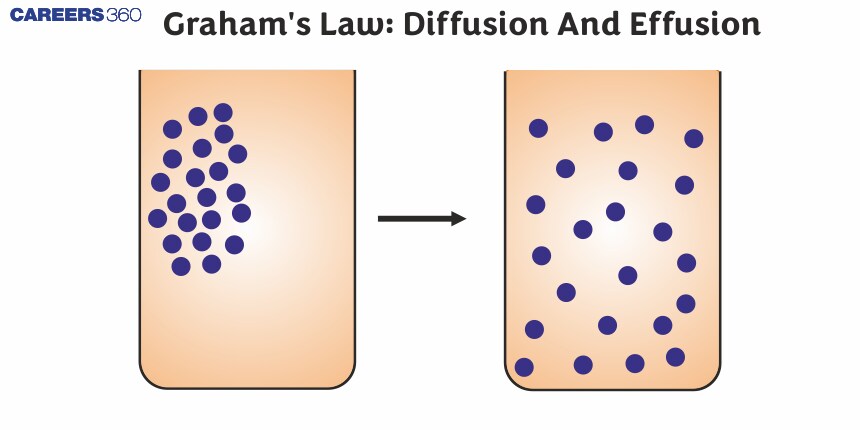
Graham's law refers to the behavior of gas molecules during such processes as diffusion and effusion. The term 'diffusion' means the spread of gas molecules from an area of its higher concentration to an area of its lower concentration until uniform distribution is attained. Effusion is the process by which the gas molecules stream out from a tiny hole into a vacuum or low pressure.
This Story also Contains
- Graham’s Law of Diffusion
- Some Solved Examples
- Summary
Graham’s Law of Diffusion
According to it "At constant temperature and pressure, the rate of diffusion of a gas is inversely proportional to the square root of its density or molecular weight". It is applicable only at low pressure.
$r \propto \frac{1}{\sqrt{M}}$ or $\frac{1}{\sqrt{d}}$
Here r = rate of diffusion or effusion of a gas or liquid. M and d are the molecular weight and density respectively.
For any two gases, the ratio of the rate of diffusion at constant pressure and temperature can be shown as
$\mathrm{r}_1 / \mathrm{r}_2=\sqrt{\mathrm{M}_2 / \mathrm{M}_1}$ or $\sqrt{\mathrm{d}_2 / \mathrm{d}_1}$
Hence diffusion or effusion of a gas or gaseous mixture is directly proportional to the pressure difference of the two sides and is inversely proportional to the square root of the gas or mixture effusing or diffusing out.
Some Other Relation Based on Graham’s law
As r = V/t = Volume/time, thus:
$\begin{aligned} & \frac{V_1 t_2}{\mathrm{~V}_2 \mathrm{t}_1}=\sqrt{\mathrm{M}_2 / \mathrm{M}_1} \\ & \text { As } \mathrm{r}=\frac{\mathrm{n}}{\mathrm{t}}=\frac{\mathrm{d}}{\mathrm{t}}=\frac{\mathrm{w}}{\mathrm{t}} \\ & \text { Thus, } \frac{\mathrm{n}_1 \mathrm{t}_2}{\mathrm{n}_2 \mathrm{t}_1}=\sqrt{\mathrm{M}_2 / \mathrm{M}_1} \\ & \frac{\mathrm{w}_1 \mathrm{t}_2}{\mathrm{w}_2 \mathrm{t}_1}=\sqrt{\mathrm{M}_2 / \mathrm{M}_1} \\ & \frac{\mathrm{d}_1 \mathrm{t}_2}{\mathrm{~d}_2 \mathrm{t}_1}=\sqrt{\mathrm{M}_2 / \mathrm{M}_1}\end{aligned}$
Here n represents the number of moles, w represents weight in gram and d represents the distance traveled by a particular gas or liquid.
Differentiation Between Diffusion and Effusion
Diffusion
It is the movement of gaseous or liquid molecules without any porous bars that are, the spreading of molecules in all directions.
Effusion
It is the movement of gases molecules or liquid molecules through a porous bar that is, a small hole or orifice.
Uses of Graham’s Law
- Detecting the presence of Marsh gas in mines.
- Separation of isotopes by different diffusion rates. For example, U-235 and U-238
- Detection of molecular weight and vapour density of gases using this relation.$\frac{\mathrm{r}_1}{\mathrm{r}_2}=\left(\frac{\mathrm{m}_2}{\mathrm{~m}_1}\right)^{1 / 2}$ or $\left(\frac{\mathrm{d}_2}{\mathrm{~d}_1}\right)^{1 / 2}$
Recommended topic video on (Graham's Law: Diffusion And Effusion)
Some Solved Examples
Example 1: A 4:1 molar mixture of He and CH4 is contained in a vessel at 20 bar pressure. Due to a hole in the vessel, the gas mixture leaks out. What is the ratio of moles of He : CH4 in the mixture effusing out initially?
1)1: 8
2) 8: 1
3)1: 5
4)7: 1
Solution
We have
The molar ratio of He and CH4 is 4:1
Again, the total pressure is given = 20bar
Thus, the partial pressure ratio of He and CH4 = 16: 4
$\begin{aligned} & \frac{\mathrm{n}_{\mathrm{He}}}{\mathrm{n}_{\mathrm{CH}_4}}=\sqrt{\frac{\mathrm{M}_{\mathrm{CH} 4}}{\mathrm{M}_{\mathrm{He}}}} \times \frac{\mathrm{P}_{\mathrm{He}}}{\mathrm{P}_{\mathrm{CH}_4}} \\ & \sqrt{\frac{16}{4}} \times \frac{16}{4}=8: 1\end{aligned}$
Hence, the answer is the option (2).
Example 2: A balloon is filled with ethylene is pricked with a needle and quickly dropped in a tank of $\mathrm{H}_2$ gas under identical conditions. After a while, the balloon will:
1)Shrunk
2) Enlarge
3)Remain Unchanged.
4)Can't say
Solution
Rate of diffusion $\alpha \sqrt{\frac{1}{M}}$
This will diffuse into the balloon and its size will increase.
Hence, the answer is the option (2).
Example 3: Pure O2 diffuses through an aperture in 224 seconds, whereas a mixture of O2 and another gas containing 80% O2 diffuses from the same in 234 seconds. The molecular mass of the gas will be
1) 46.6
2)48.6
3)55
4)51.5
Solution
As we learned in
Graham’s law of diffusion -
$r_1 / r_2=\sqrt{M_1 / M_2}$ where r is the rate of diffusion of gas, and M is molar mass.
$\begin{aligned} & \frac{t_{m i x}}{t_{O_2}}=\frac{r_{O_2}}{r_{m i x}}=\sqrt{\frac{M_{m i x}}{32}} \\ & \frac{234}{224}=\sqrt{\frac{M_{\text {mix }}}{32}} \\ & M_{\text {mix }}=34.92 \\ & \therefore \chi_{O_2} \times M_{O_2}+\chi_g \times M_g=34.92 \\ & \Rightarrow 0.8 \times 32+0.2 \times M_g=34.92 \\ & \Rightarrow M_g=46.6\end{aligned}$
Hence, the answer is the option (1).
Example 4: $20 \mathrm{~cm}^3$ of $\mathrm{SO}_2$ diffuses through a porous partition in 60 seconds. Volume (in L) of $\mathrm{O}_2$ diffuse under similar conditions in 30 seconds will be :
1)12.14
2) 14.14
3)18.14
4)28.14
Solution
As we learnt in Graham’s law of diffusion -
$r_1 / r_2=\sqrt{M_1 / M_2}$ where r is the rate of diffusion of gas and M is the molar mass.
So, the volume of $\mathrm{SO}_2=20 \mathrm{~cm}^3$ and time = 60 seconds
Therefore, rate $=20 / 60$
And for Oxygen, we have time = 30 seconds. Thus,
$\begin{aligned} & \frac{20}{60} \times \frac{30}{V}=\sqrt{\frac{32}{64}} \\ & \mathrm{~V}=14.14 \mathrm{~cm}^3\end{aligned}$
Hence, the answer is the option (2).
Example 5: A 100 ml mixture containing 72% of $\mathrm{CH}_4$ by volume and the rest an unknown gas X was kept in a vessel. Due to a very fine crack, the mixture effused out. 21 ml of the mixture was lost and the remaining mixture contained 68.35% of methane by volume. Calculate the molar mass of gas X. All the measurements are made at the same temperature and pressure.
1)85.4
2) 87.1
3)77.3
4)94.2
Solution
We have an initial volume of mixture = 100ml
Thus, the mixture has 72ml of and 28ml of X.
Thus, we have:
$\frac{P_{C H_4}}{P_X}=\frac{72}{28}$
After the crack, the volume left = 100-21 = 79ml
Thus, the volume left after the crack $=(79 \times 68.35) / 100=54 \mathrm{ml}$
Thus diffused volume of $\mathrm{CH}_4=72-54=10 \mathrm{ml}$And diffused volume of $X=21-18=3 m l$
Now, we know that:
$\frac{V_{C H_4}}{V_X}=\sqrt{\frac{M_X}{M_{C H_4}}} \times \frac{72}{28}$
Thus, $M_X=87.1$
Hence, the answer is the option (2).
Summary
Graham's Law has numerous applications in various fields. Environmental scientists use it to explain the mixing of gases in the atmosphere. In medical science, it explains the process of gases during respiratory procedures and anesthetic applications. This law is applied industrially in separating isotopes and designing devices whose functions are pegged on controlled gas diffusion and effusion.
