Symbiosis Institute of Business Management, Noida
1 Exam accepted by 17 Top Symbiosis Institutes for 32 MBA programmes.


CAT 2026 is scheduled for November 29, 2026. A difficult VARC section, an unexpected DILR set or lengthy Quant questions can affect confidence during the examination. However, one bad section does not automatically mean a poor overall percentile. CAT has separate sectional timers, so candidates cannot return to an earlier section once its time ends. The priority should be to stop thinking about the previous section and use the remaining time effectively. A simple 60-second mental reset can help control panic, prevent rushed decisions and protect performance in the next section.
This Story also Contains

CAT 2026 Official Mock Test Released!
The official CAT 2026 mock test was released on November 6, 2026. Candidates can attempt the mock test to understand the exam interface, familiarise themselves with the question format, and practise navigation before the actual examination.
CAT 2026 Admit Card Released!
Candidates can download the CAT 2026 admit card using their registered login credentials. Check the exam date, test centre address, reporting time, and important exam-day instructions mentioned on the hall ticket. Click Here for more details.
CAT has three sections: Verbal Ability and Reading Comprehension (VARC), Data Interpretation and Logical Reasoning (DILR), and Quantitative Aptitude (QA).
Each section has a fixed time limit. Once a section ends, the test moves forward. Candidates cannot return to unanswered questions or change previous responses.
A difficult section can create three problems:
Loss of confidence: A low number of attempts may create doubts about overall performance.
Poor question selection: Panic can lead to unnecessary guessing in the next section.
Time mismanagement: Candidates may rush through easier questions because of pressure from the previous section.
The biggest risk is allowing one difficult section to affect the remaining two.
Candidates must be familiar with the CAT 2026 exam pattern:
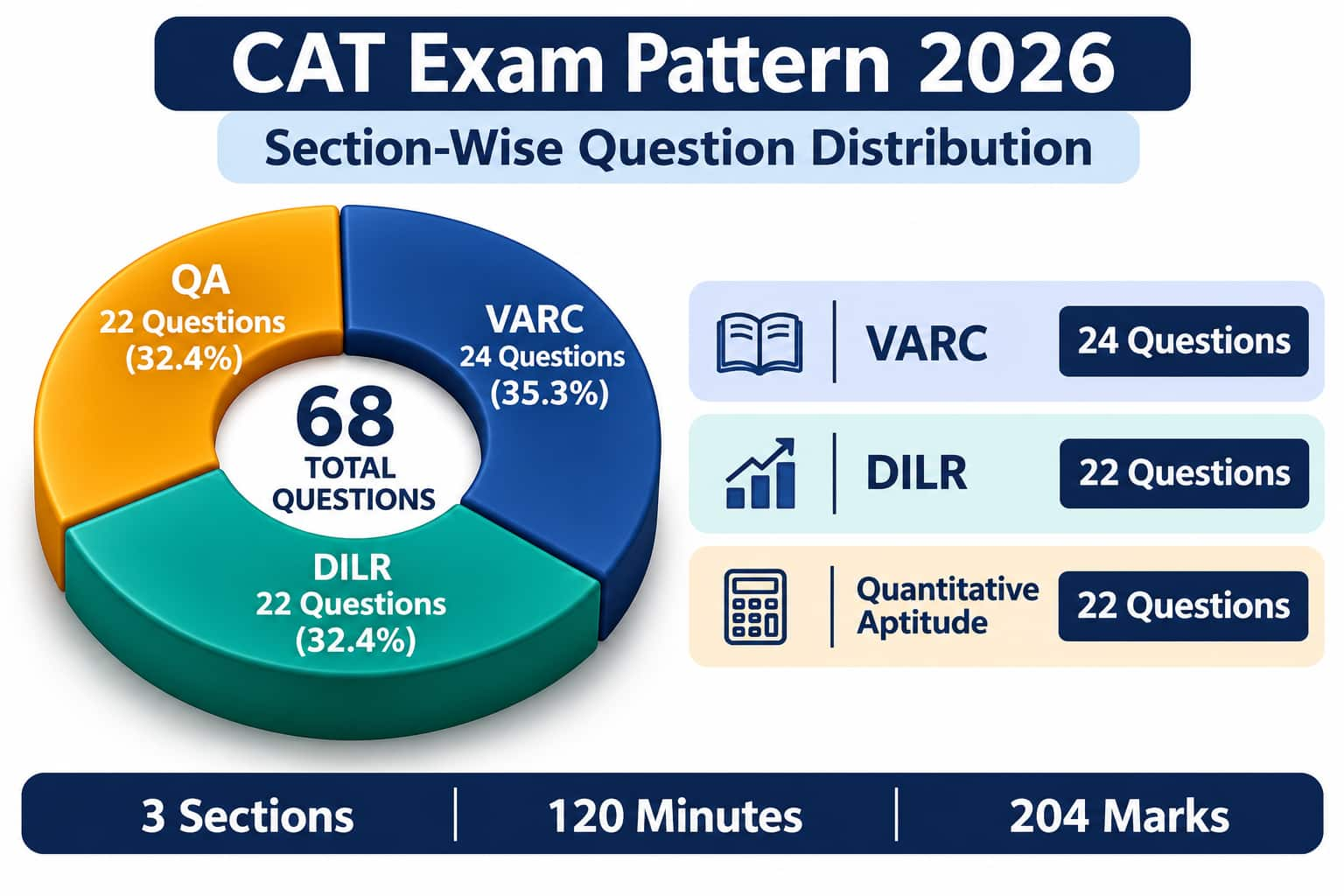
Candidates should note that this exam pattern is based on previous year question paper structure, stay updated on the official website for latest notification and updates.
Get the actual CAT previous year question papers here
The purpose of this reset is to separate the previous section from the next one. It is not a way to recover lost marks or change the submitted answers.
Avoid estimating the number of correct answers immediately after a difficult section.
Questions such as "How many answers were correct?" or "Did that set go wrong?" cannot improve the submitted section. They only consume attention.
Action: Stop mentally revisiting previous questions.
A difficult section can increase tension and affect concentration.
Take two or three slow breaths.
Relax the shoulders and hands.
Sit comfortably.
Avoid looking at other candidates for clues about their performance.
The objective is to settle attention before the next section begins.
Do not carry the previous section's attempt target into the next one.
For example, if DILR felt difficult, the next section is not the place to compensate by attempting every QA question.
Set a simple target:
Identify familiar questions first.
Avoid lengthy questions without a clear approach.
Maintain accuracy.
Move on when a question is consuming too much time.
Enter the next section with one instruction: solve the question in front of you.
Do not try to recover marks from the previous section. The next section deserves a fresh approach.
A difficult VARC section can affect confidence because Reading Comprehension options often appear similar. Candidates may also spend too much time analysing one passage.
The next section should not become an attempt to compensate for VARC.
If DILR comes next:
Scan all sets before selecting one.
Identify sets with familiar arrangements or clear data.
Avoid spending too much time on a set that does not open up.
Focus on completing a manageable set accurately.
Globally Recognized by AACSB (US) & AMBA (UK) | 18 LPA Avg. CTC for PGPM 2026 | Last Date to Apply: 26th November
Highest Package 29.30 LPA | 230+ Recruiters | AACSB Accredited | Ranked 51 in Asia by QS International | Last Date to Apply: 7th December
If QA comes next:
Start with familiar arithmetic, algebra or geometry questions.
Avoid lengthy calculations without a clear solution path.
Do not increase attempts simply because VARC felt difficult.
Download the Free CAT 2026 VARC, DILR and QA Revision Sheets
DILR can be unpredictable. A set may look familiar but become difficult after several calculations or deductions.
A common mistake is to spend too much time on one set and then carry that frustration into QA.
If QA comes next:
Read the question carefully before calculating.
Begin with direct and familiar questions.
Avoid difficult questions that require multiple uncertain steps.
Do not rush through easy questions to compensate for DILR.
If the next section is not yet open: Use the transition to reset rather than mentally solving the previous set again.
A difficult QA section can be frustrating, especially when familiar topics appear in unfamiliar formats.
However, once QA ends, the marks cannot be recovered by thinking about missed questions.
If QA is the final section, there is no next section to protect. The focus should shift to avoiding unnecessary post-exam assumptions. The actual score and percentile depend on the evaluated responses and the overall performance distribution.
Yes, but the effect depends on the overall score, sectional performance and the performance of other candidates.
CAT results include an overall percentile and sectional percentiles. A weak section can reduce the overall score and may also affect eligibility for institutes that apply sectional cut-offs.
For example:
Section | Candidate A | Candidate B |
VARC | 30 | 12 |
DILR | 20 | 27 |
QA | 28 | 30 |
Overall score | 78 | 69 |
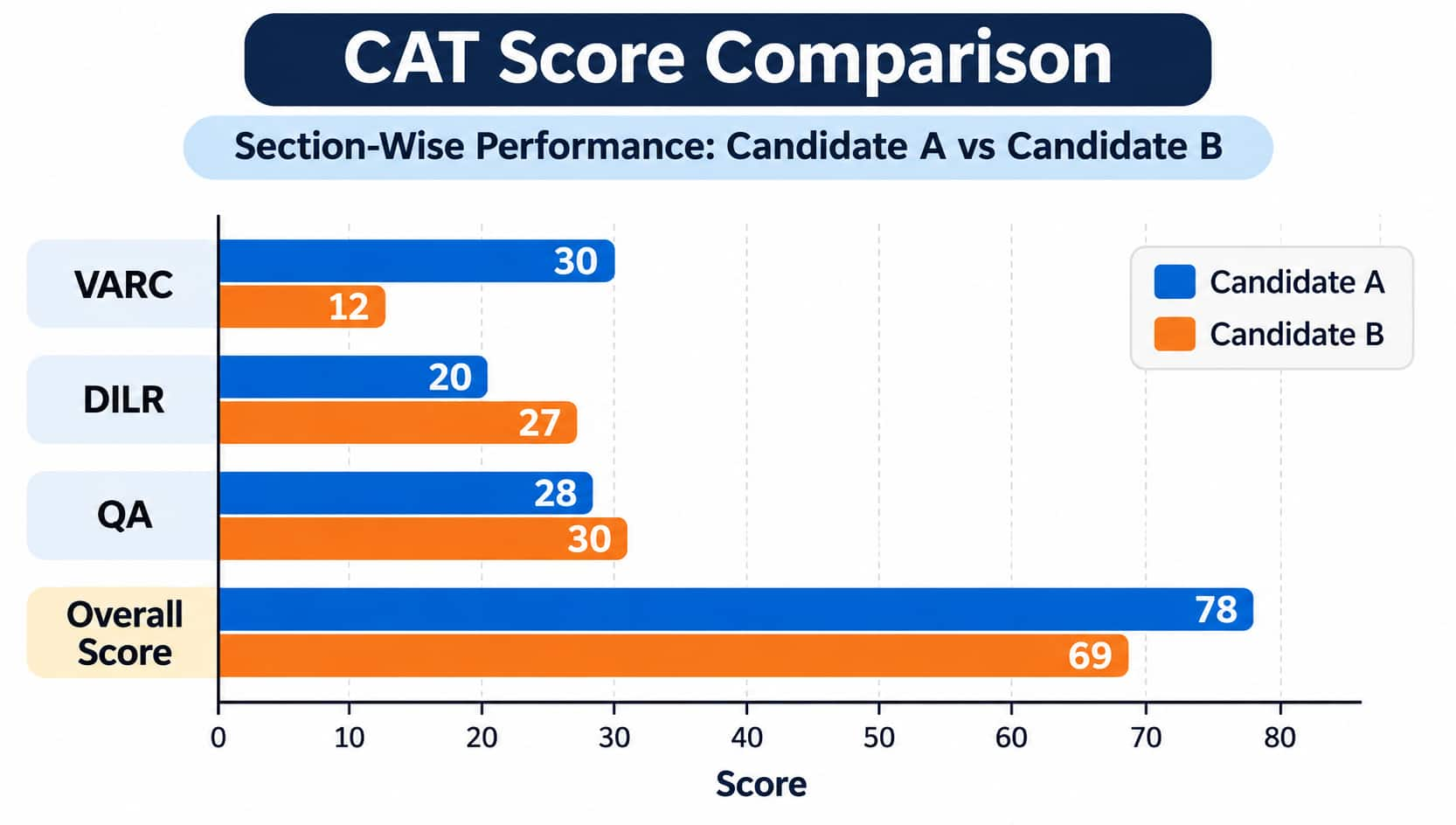
Candidate B performs better in DILR and QA but loses marks in VARC. Candidate A has a higher overall score despite a comparatively lower DILR score.
This illustrates why a difficult section should not automatically determine the remaining exam strategy. However, the table is only an illustrative raw-score comparison, not a percentile prediction.
A high overall score also does not guarantee admission if a candidate misses a required sectional cut-off.
A difficult CAT section can affect concentration and decision-making in the remaining sections. Avoid these common mistakes to maintain accuracy and make better use of the available time.
Mistake | Better approach |
Calculating the previous section's score | Focus on the next section |
Increasing attempts to compensate | Maintain accuracy and select questions carefully |
Rushing through easy questions | Read every question properly |
Spending too long on one difficult question | Move on when progress stops |
Assuming the entire exam is ruined | Evaluate each section independently |
Comparing performance with other candidates | Concentrate on the remaining questions |
The key is to treat every section as a fresh opportunity. A difficult start does not determine the final CAT score; the remaining sections still offer a chance to perform well.
A reset strategy should be practised during mock tests, not introduced for the first time on exam day.
Simulate difficult sections: Attempt mocks with unfamiliar or difficult sets to practise handling unexpected questions.
Practise sectional transitions: After completing one section, avoid discussing or calculating its score. Move directly to the next section.
Review question selection: Identify questions that consumed too much time without producing marks.
Track sectional performance: Analyse VARC, DILR and QA separately rather than focusing only on the overall score.
Build a recovery routine: Use the same breathing and focus routine after every difficult mock section.
The purpose is to make the reset automatic. During CAT, there should be no need to invent a new strategy under pressure.
A submitted section cannot be reopened.
Do not carry frustration from one section into another.
Avoid increasing attempts just to compensate for a low score.
Select questions based on familiarity, difficulty and available time.
Sectional cut-offs matter alongside the overall percentile.
One difficult section does not automatically mean the entire CAT attempt has gone badly.
Frequently Asked Questions (FAQs)
No. CAT follows sectional time limits. Once a section ends, candidates cannot return to it.
The weak section can reduce the overall score and sectional percentile. The final impact depends on performance in the other sections and the overall score distribution.
Not always. Institutes with sectional cut-offs may reject candidates who do not meet the minimum requirement in a particular section, even if the overall percentile is high.
No. Increasing attempts without considering accuracy can lead to more negative marks. The next section should be approached independently.
Slow breathing, a brief mental reset and focusing on one question at a time can help manage exam pressure. Practising this routine during mocks makes it easier to use on exam day.

On Question asked by student community
Hi Khushdeep
Several apps and online platforms are available for CAT (Common Admission Test) preparation. Students can choose a platform based on their preparation needs, such as video lectures, practice questions, mock tests, and performance analysis.
Hello, for AP NEET PG Category C seats, NRI documents are generally required if you are applying under the NRI quota, and eligibility depends on the applicable counselling rules. The fee payment currency and procedure should be confirmed from the current Dr. NTRUHS notification at its official website drntr.uhsap.in.
Hello, CAT aur B-school entrance exams ke baare mein aap exam dates, eligibility, registration, exam pattern, syllabus, colleges ya admission process ki information dekh sakte hain. Aapki requirement ke according relevant details yahan mil sakti hain: https://bschool.careers360.com/exams
You can download the latest CAT syllabus from here:
Hey there,
For a B.Sc. with Chemistry, Botany and Zoology (CBZ), if the CAT application asks separately for:
If the Discipline dropdown has a more specific option such as “Biological Sciences,” “Life Sciences,” or “Zoology/Botany,”
Directions for question:
The bar-graph given below shows the foreign exchange reserves of Nepal (in million Rupees) from 2014 to 2021. Answer the following questions based on the graph :

Question:
What was the percentage increase (rounded to the nearest integer, if deemed necessary) in the foreign exchange reserves in

Globally Recognized by AACSB (US) & AMBA (UK) | 18 LPA Avg. CTC for PGPM 2026 | Last Date to Apply: 26th November
Last Date to Apply : 27th Nov'26 | Merit-Based Scholarship | 100% Tuition Fee Waiver | AACSB, AMBA, NBA & SAQS Accredited | H-CTC 35 LPA | Average CTC 16.07 LPA
Applications Closing Soon! | 75+ years of legacy | #1 Entrance Test | 100+ Test Cities | 250+ B-Schools accept XAT Score
India’s only private university to be ranked for Graduate Employability | 6000+ Placements | 800+ Recruiters | 75 LPA-Highest Salary
1 Exam accepted by 17 Top Symbiosis Institutes for 32 MBA programmes.
Gateway to IBS Hyderabad & 8 other IBS campuses | Scholarships worth 10 CR