Great Lakes - PGDM & PGPM Admissions 2027
Globally Recognized by AACSB (US) & AMBA (UK) | 18 LPA Avg. CTC for PGPM 2026


CMAT 2027 will be conducted on February 7, 2027, giving aspirants preparing from September a clear preparation window before the exam. A four-month CMAT 4 month study plan can help you cover the syllabus, practise different question types, solve PYQs, take sectional tests and gradually increase full-length mocks.

This article breaks down the CMAT preparation strategy month by month, from building concepts in September to practice and revision in the later months.
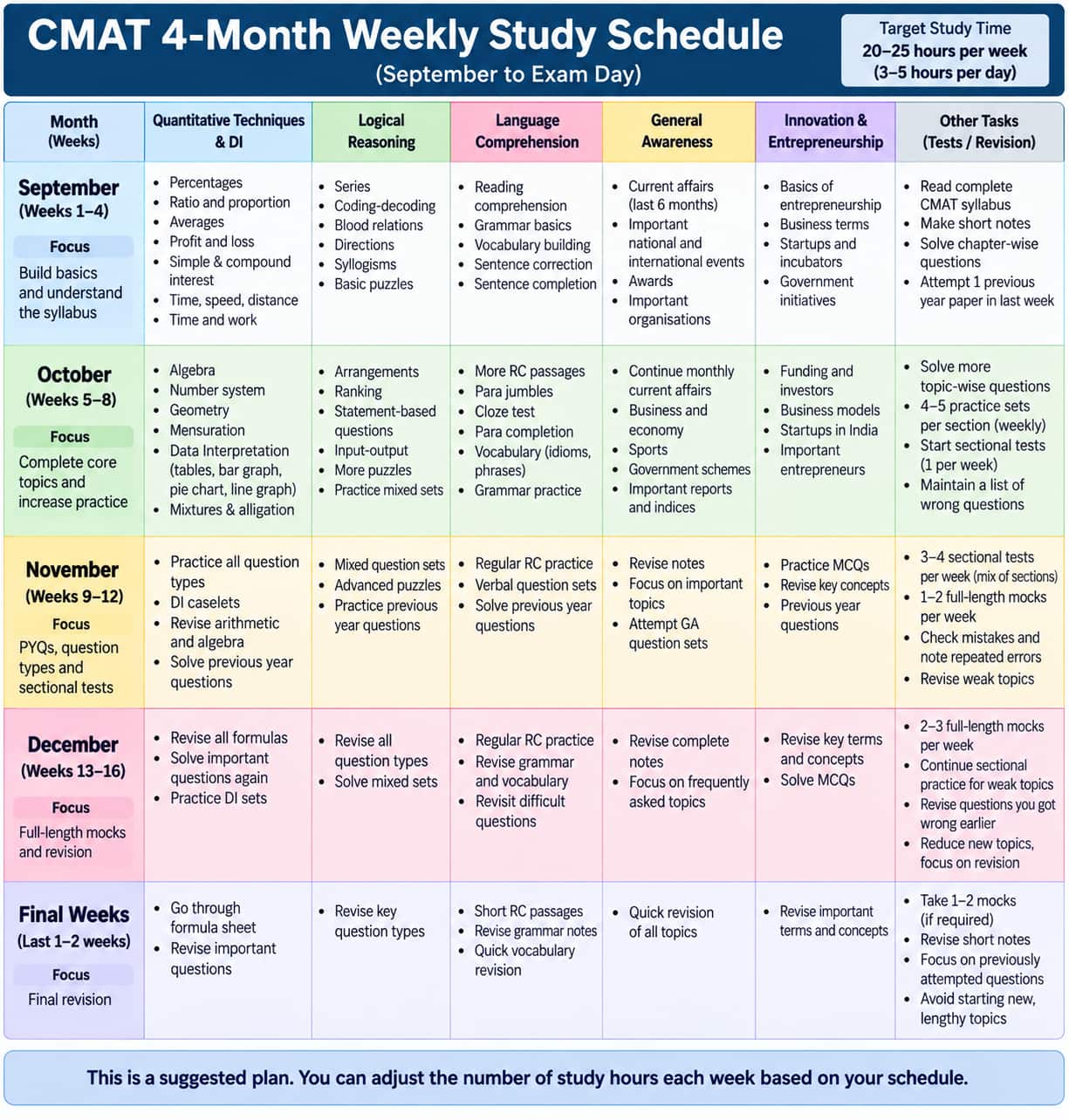
Four months are enough to prepare for CMAT if you follow a fixed study routine and use your time well. Instead of trying to complete everything at once, divide your CMAT preparation in 4 months into different stages. Start with the basic concepts, move to topic-wise practice, and then spend more time on mock tests and revision.
Here is a month-wise CMAT preparation timetable you can follow from September until the exam:
Month | Main Focus | What to Do |
September | Build the basics | Understand the syllabus, revise basic concepts and identify strong and weak topics |
October | Complete important topics | Cover the major topics and solve topic-wise questions |
November | Increase practice | Take sectional tests, solve questions with a timer and start full-length mocks |
December | Revision and mocks | Revise formulas, important concepts and mistakes; take regular full-length mocks |
Last few days | Final revision | Revise short notes, formulas and previously attempted questions; avoid starting difficult new topics |
A four-month preparation period gives you enough time to divide CMAT preparation into clear phases. The focus should change each month: September for concepts, October for completing core topics, November for timed practice and sectional tests, and December for full-length mocks and revision. Thus, it helps in CMAT preparation from zero as well.
The first month should be used to understand the CMAT syllabus, assess your current level and complete the basic concepts of each section.
Section | September Focus |
Quantitative Techniques & DI | Percentages, ratio and proportion, averages, profit and loss, simple and compound interest, time-speed-distance, time and work, basic algebra and arithmetic DI |
Logical Reasoning | Series, coding-decoding, blood relations, directions, arrangements, syllogisms, analogies and basic puzzles |
Language Comprehension | Reading comprehension, vocabulary, grammar, sentence correction, para jumbles and sentence completion |
General Awareness | Current affairs from the recent months, business and economy, awards, important organisations, sports and major national/international events |
Innovation & Entrepreneurship | Basic business terms, entrepreneurship concepts, startups, innovation, funding, business models and important government initiatives |
Spend the first week taking a previous CMAT question paper. Record your accuracy and the topics where you take the most time. This will help you decide how much time each section needs.
A practical daily target for September is 3–4 hours of study, divided between two or three sections. For example:
90 minutes: Quantitative Techniques and DI
60 minutes: Logical Reasoning
60 minutes: Language Comprehension
30–45 minutes: General Awareness or Innovation & Entrepreneurship
Do not leave General Awareness and Innovation & Entrepreneurship for December. These sections require regular revision because the information you study needs to be retained over several weeks.
October should be the month in which you finish most of the important CMAT topics and increase the number of questions you solve.
Aim to spend around 40% of your study time learning or revising concepts and 60% solving questions. After completing a topic, solve a timed set instead of moving directly to another chapter.
For Quantitative Techniques, give additional practice to arithmetic and other topics where calculations are frequent. In Logical Reasoning, practise different question types rather than solving only one type repeatedly. For Language Comprehension, combine RC practice with grammar and vocabulary. Continue adding to your General Awareness and Innovation & Entrepreneurship notes.
By the end of October, you should have:
Completed the major topics in Quantitative Techniques and DI
Covered the main Logical Reasoning question types
Practised regular RC passages and grammar-based questions
Built monthly General Awareness notes
Covered the basic concepts of Innovation & Entrepreneurship
Started sectional tests at least once a week
Maintained a mistake log for incorrect and time-consuming questions
Increase your daily practice to around 4–5 hours if your schedule allows. The important change from September is not simply studying for longer; it is spending more of the available time actually solving CMAT-level questions.
By November, the focus of your CMAT preparation strategy should move from learning individual concepts to solving questions with a time limit.
Start each week with a fixed number of CMAT practice sets. Use PYQs and CMAT-level questions to understand the way different topics are tested. While solving them, note which question types you can answer quickly and which ones repeatedly consume time.
A possible weekly target is:
Activity | Weekly Target |
Quantitative Techniques & DI practice | 4–5 timed sets |
Logical Reasoning practice | 4–5 timed sets |
Language Comprehension | 3–4 RC/Verbal sets |
Sectional tests | 3–4 |
Full-length mocks | 1–2 |
General Awareness revision | 3–4 sessions |
Innovation & Entrepreneurship revision | 2–3 sessions |
Do not treat sectional tests as just score-generating exercises. After each test, classify your errors as conceptual, calculation, interpretation, guessing or time-management errors.
For PYQs, maintain a separate list of recurring question types. If you notice that a particular type of arithmetic, arrangement, RC question or verbal question repeatedly causes mistakes, add it to your revision list.
December should be the most test-oriented month of your CMAT study plan. At this stage, full-length mocks should become a regular part of your preparation.
Aim for around 2–3 full-length mocks per week initially, depending on your available time. Do not increase the number of mocks at the cost of analysis. A three-hour mock followed by proper analysis can take considerably more time than simply attempting the paper.
After every mock, record:
What to Track | Why It Matters |
Total score | Measures overall progress |
Section-wise score | Shows where marks are coming from |
Accuracy | Identifies careless and conceptual errors |
Unattempted questions | Shows where you are losing possible attempts |
Time spent per section | Helps improve time allocation |
Questions taking too long | Helps identify questions to skip |
Repeated mistakes | Creates the final revision list |
Use the first half of December to identify and fix weak areas. During the second half, reduce new learning and focus more on mocks, revision and previously recorded mistakes.
General Awareness should also be revised repeatedly rather than studied in one sitting. Keep your notes short enough to revise within a limited amount of time.
The final weeks should be used to consolidate your preparation. Avoid beginning large new chapters unless they are short and have a clear chance of adding marks.
Your CMAT exam preparation plan for this period should include:
Revision of important Quantitative Techniques formulas
Re-solving questions previously marked as difficult
Revision of Logical Reasoning question types
Daily or alternate-day RC practice
Revision of grammar and vocabulary notes
Multiple rounds of General Awareness revision
Revision of Innovation & Entrepreneurship notes
Analysis of mistakes from previous mocks
Full-length mocks at regular intervals
Practice of your chosen section order and time allocation
Create a last-week revision list containing only the formulas, facts, question types and mistakes that you are most likely to forget. This is more useful than trying to reread your complete CMAT preparation material.
A section-wise plan is important when you have only four months because each CMAT section needs a different type of preparation.
For a four-month CMAT study plan, divide Quantitative Techniques and DI preparation into concepts, timed practice and mock-based revision.
September: Build your arithmetic base. Cover percentages, ratio and proportion, averages, profit and loss, simple and compound interest, time and work, time-speed-distance and mixtures. Add basic algebra, geometry and number-based topics according to your preparation level. Start with untimed questions and move to timed sets once the concepts are clear.
October: Complete the remaining important topics and increase question practice. Solve DI sets involving tables, bar graphs, line graphs, pie charts and caselets. Maintain a formula sheet and record questions that require lengthy calculations.
November: Use PYQs and sectional tests to identify frequently tested concepts and your weak areas. Practise calculation-heavy questions with a timer. During analysis, note whether a question was lost because of a concept gap, calculation error or excessive time.
December: Take Quantitative Techniques and DI as part of full-length mocks. Revise formulas and re-solve questions from your mistake log. Focus on accuracy and on identifying questions that should be skipped when they consume too much time.
A useful weekly routine is 4–5 Quant practice sessions, with at least two sessions dedicated to timed question sets or DI.
Logical Reasoning preparation should focus on recognising question patterns quickly. Do not spend the entire four months solving only one type of puzzle.
September: Cover basic topics such as series, analogy, coding-decoding, blood relations, directions, syllogisms and basic arrangements.
October: Move to more involved arrangements, puzzles, ranking, sequencing, statement-based questions and other important LR types. After learning each type, solve several questions consecutively to understand the different ways it can be presented.
November: Start regular timed LR sets and sectional tests. Use PYQs to understand the level and format of questions. Track the types where you spend the most time.
December: Practise LR through full-length mocks. Revisit the question types where your accuracy remains low. Do not spend excessive time trying to master one difficult puzzle type if it continues to consume your test time.
Aim for 4–5 LR practice sessions each week, with timed sets becoming more frequent from November.
Language Comprehension needs regular practice because reading speed, comprehension and accuracy improve gradually. A four-month plan should include both Reading Comprehension and verbal questions.
September: Start with daily reading and basic grammar. Practise sentence correction, vocabulary, sentence completion and para-based questions. Solve short RC passages and focus on understanding the author's argument rather than reading only for individual facts.
October: Increase RC practice and add more verbal question sets. Keep a vocabulary notebook for unfamiliar words encountered during reading and practice.
November: Solve RCs and verbal questions under a time limit. Take sectional tests and analyse incorrect answers. For every RC mistake, check whether the problem was misunderstanding the passage, misreading the question or selecting an option that was only partially supported by the passage.
December: Continue RC practice while using mocks to improve your reading and question-selection speed. Revise grammar rules and vocabulary from your notes instead of trying to learn a large number of new words in the final weeks.
A practical target is one or two RC passages on most study days, along with regular verbal practice.
General Awareness should not be treated as a last-week subject. The four-month CMAT preparation strategy should use short, repeated revision sessions.
September: Start collecting current affairs and important static GK. Cover business and economy, government schemes, awards, sports, important organisations, national and international events and other areas relevant to CMAT.
October: Continue adding current affairs while revising September notes. Keep the notes short and organised by month or topic.
November: Increase revision frequency. Use quizzes and question sets to test recall rather than repeatedly reading the same notes.
December: Focus mainly on revision. Divide your notes into high-priority facts and information that you are less likely to remember. Revise them several times before the exam.
Instead of allocating several hours to GA once a week, use 20–30 minutes on multiple days. Repeated recall is more practical for retaining a large number of facts.
Innovation & Entrepreneurship requires a different approach from Quant and LR. Build familiarity with business and entrepreneurship terminology first, then use repeated revision and MCQ practice.
September: Learn basic concepts such as entrepreneurship, innovation, startups, business models, funding, entrepreneurs, incubators, accelerators and related terminology.
October: Expand your notes to include important business concepts, startup-related developments, government initiatives and entrepreneurship-related organisations. Practise objective questions after each topic.
November: Use MCQs and sectional practice to check what you remember. Mark terms and concepts that you repeatedly confuse and revise them separately.
December: Shift towards short revision sessions and question practice. Avoid creating lengthy notes during the final month. Revise the material you have already collected and use mock-test analysis to identify gaps.
Candidates can find the best resources to ace the CMAT 2027 exam in the table below:
Ebook Title | Download Link |
CMAT 2027: Innovation and Entrepreneurship: All Chapters with Sample Questions, with Syllabus PDF | |
CMAT 2027: 10 Free Mock Tests PDF with Detailed Solutions | |
CMAT 2027 Language Comprehension Questions with Solutions PDF | |
CMAT 2027 General Awareness Questions with Answers PDF | |
CMAT Logical Reasoning Questions with Answers PDF | |
CMAT 2027 Quantitative Techniques & Data Interpretation Questions Answers PDF | |
CMAT 2026: Mastering All Sections with 1000+ Expertly Crafted Questions and Detailed Answers | |
Ultimate CMAT 2026 MCQs Guide: Master the Exam with Section-wise Practice Questions | |
CMAT 2027 Most Scoring Topics and High-Weightage Chapters |
Frequently Asked Questions (FAQs)
Yes. Four months can be enough if you follow a fixed CMAT 4 month study plan, cover the major topics first, and leave enough time for PYQs, sectional tests, mocks and revision.
Around 3–5 hours a day is a practical target. Students with less time can follow a 3-hour schedule, while those starting from the basics can aim for 4–5 hours. The weekly study time should be consistent.
Start with the basic concepts of Quantitative Techniques and DI, Logical Reasoning and Language Comprehension. At the same time, begin General Awareness and Innovation & Entrepreneurship preparation instead of leaving these sections for the last month.
You can start with sectional tests after covering the basic topics. Add full-length CMAT mocks once you have covered a substantial part of the syllabus, and increase their frequency during the final month.
Revise formulas, important concepts, vocabulary, General Awareness notes, Innovation & Entrepreneurship notes and questions you got wrong in earlier tests. Avoid starting lengthy new topics in the final weeks.

On Question asked by student community
Hello Sanya
Please check the link given below for the best books for CMAT preparation:
https://www.careers360.com/mba/articles/best-books-for-cmat-preparation
Hope it helps.
Hello Dear Student,
Yes, Utkal University in Bhubaneswar accepts the CMAT score for admission to its regular MBA in Financial Management. You must hold a bachelor’s degree with a minimum of 50% marks (45% for SC/ST candidates) and present a valid score in exams like CMAT, CAT, MAT, or XAT.
Hello Dear Student,
With an 89 CMAT percentile and an interest in Finance , you can target several good AICTE-approved MBA/PGDM colleges outside Mumbai and Pune.
Recommended Colleges
Hello Dear Student,
For SC category candidates aiming for top-tier MBA programs through CMAT and SNAP, a safe percentile typically ranges from 75 to 85. The exact cutoff required to get a shortlist depends on the specific institute’s prestige, as detailed below.
You can check, find and access more information
Yes, you can get a seat in the Institute of Management Studies DAVV with a CMAT score of 170. An expected percentile of 80 improves the chances of admission in the college in a course of your choice.
For safety, we advise you to check the cutoffs released by the

Globally Recognized by AACSB (US) & AMBA (UK) | 18 LPA Avg. CTC for PGPM 2026
AACSB Accredited | 40 LPA-Highest CTC | Scholarships worth 10 CR
75+ years of legacy | #1 Entrance Exam | Score accepted by 250+ BSchools
PGDM 2027 Early Bird Applications are open. Apply now using coupon code CAREER250 and get ₹250 off the application fee
1 Exam accepted by 17 Top Symbiosis Institutes for 29 MBA programmes.
Highest Package 29.30 LPA | 12 LPA Median CTC | AACSB Accredited | Ranked 52 by QS International