Great Lakes - PGDM & PGPM Admissions 2027
Globally Recognized by AACSB (US) & AMBA (UK) | 18 LPA Avg. CTC for PGPM 2026


A mock test can tell you where you stand, but mock analysis tells you what to do next. With CAT 2026 scheduled for November 29, 2026, this article explains how to analyse a CAT mock test beyond the final score, covering section-wise performance, accuracy, time management, question selection, DILR set selection, VARC and QA analysis, and the CAT error log. It also shows how to use these insights to build a focused CAT 2026 mock strategy and track improvement across multiple mocks.
This Story also Contains

Checking only the final score can hide the actual reason behind your CAT performance. A candidate may score poorly because of low accuracy, while another may lose marks by leaving manageable questions unattempted.
Before analysing your mock, make sure you understand the CAT 2026 exam pattern, including the sections, time limits and marking scheme.
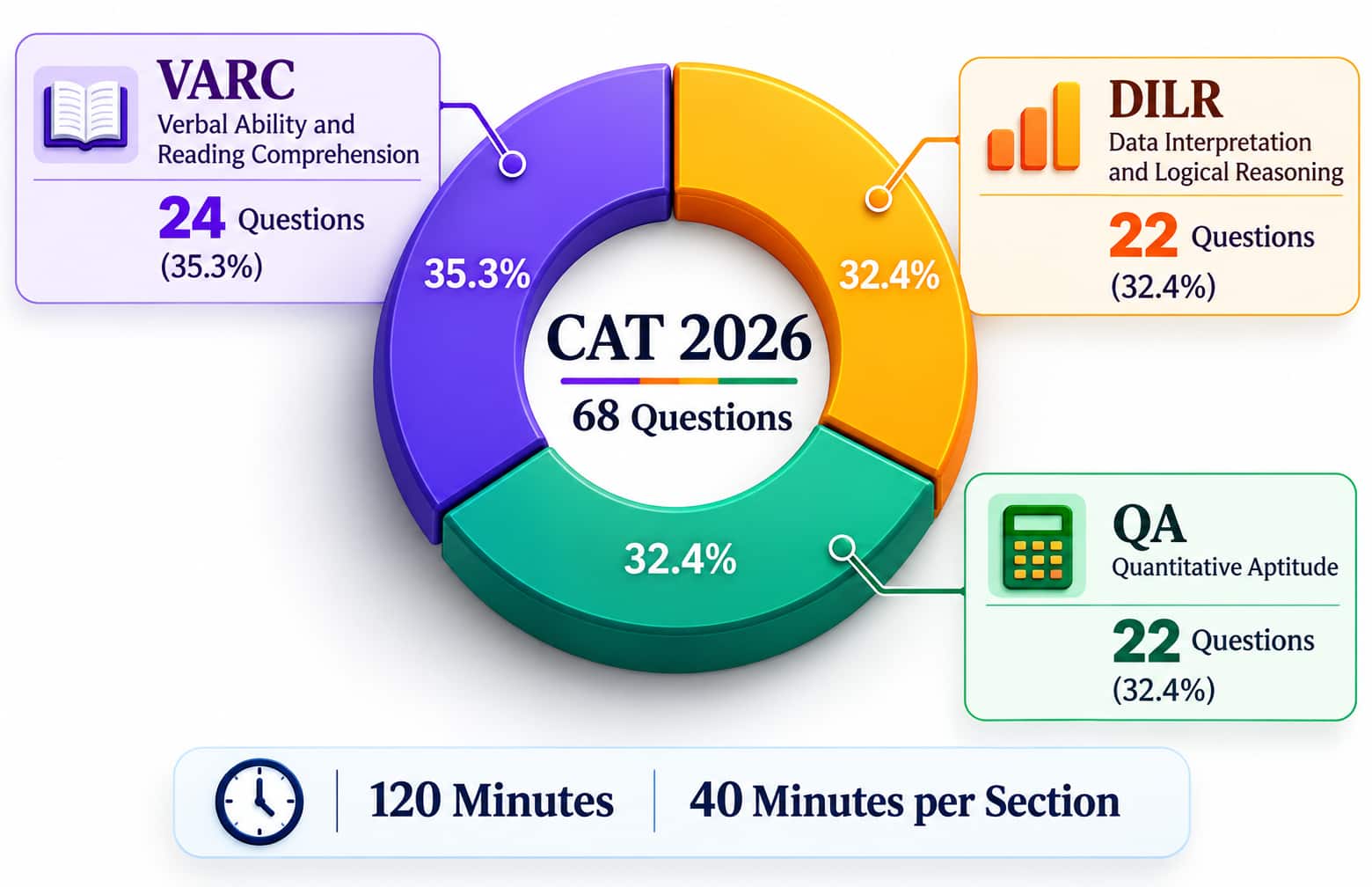
After every CAT 2026 mock test, check your:
Total attempts
Correct and incorrect answers
Section-wise accuracy
Unattempted questions
Easy questions missed
Questions that consumed excessive time
Repeated mistakes
The objective of CAT mock analysis is not simply to judge your score. It is to identify what needs to change before the next mock.
Understand the CAT 2025 slot-wise topic weightage with a consolidated matrix covering the distribution of questions across sections and topics. It can help you compare slot-level patterns while planning your CAT preparation.
Download the CAT 2025 Slot-Wise Master Weightage Matrix as a reference while analysing topic-level performance in your mocks.
Start your CAT mock test review by checking VARC, DILR and QA separately. Compare attempts, correct answers and accuracy to identify where your performance needs attention.
Take an example:
Section | Attempts | Correct | Accuracy |
VARC | 16 | 12 | 75% |
DILR | 11 | 7 | 63.6% |
QA | 13 | 9 | 69.2% |
Accuracy=CorrectAnswersTotalAttempts100
A lower accuracy in one section does not automatically mean a conceptual weakness. Check the questions and time spent before deciding what to improve.
Your CAT mock analysis should identify the reason behind each error. Classify mistakes as:
Conceptual
Calculation
Misreading
Interpretation
Carelessness
Question selection
Guesswork
Globally Recognized by AACSB (US) & AMBA (UK) | 18 LPA Avg. CTC for PGPM 2026
Test centres are available in 70+ cities across India | 75,000+ aspirants apply for the NMAT exam | Accepted by 58+ institutions like NMIMS, KJSIM, ISB, SPJIMR and Great Lakes.
This helps you choose the right corrective action instead of simply revising the entire topic.
Review unattempted questions after the mock to identify missed opportunities.
Classify them as:
Solved easily after the mock
Solved with considerable effort
Still unsolved after review
If several manageable questions were left unattempted, review your CAT question-selection and time-management strategy.
Check where your time was spent across the three sections.
For example:
Section | Time Used | Attempts | Correct |
VARC | 38 min | 16 | 12 |
DILR | 40 min | 11 | 7 |
QA | 39 min | 13 | 9 |
Then identify questions or sets that consumed excessive time without sufficient returns. Do not automatically treat every lengthy question as a bad decision; consider its difficulty and outcome.
CAT DILR mock analysis should also examine which sets you selected and how efficiently they converted into marks.
Take an example:
DILR Set | Time | Attempts | Correct |
Set 1 | 8 min | 4 | 3 |
Set 2 | 14 min | 2 | 1 |
Set 3 | 10 min | 4 | 3 |
Here, Set 2 took longer but produced fewer correct answers, making it worth reviewing. Across multiple mocks, this can help you identify whether your DILR challenge lies in set selection or solving ability.
Work through CAT Data Interpretation and Logical Reasoning PYQs from 2021 to 2025 to practise different sets and question formats. The resource can be used to build familiarity with previous-year DILR questions and support timed practice.
Your CAT mock test review should end with specific preparation tasks.
For example:
Keep the action list focused. There is little benefit in trying to fix every weakness before the next mock.
A CAT error log helps you identify mistakes that keep appearing across multiple mocks.
A useful entry could look like this:
Mock | Section | Topic | Error | Reason | Action |
Mock 3 | Arithmetic | Wrong answer | Calculation | Targeted practice | |
Mock 3 | VARC | RC | Wrong option | Interpretation | RC analysis |
Mock 3 | DILR | Set 2 | Low conversion | Selection | Set-selection practice |
Keep the explanation short. The purpose of the error log is to make recurring patterns visible.
One calculation error may simply be an isolated mistake. If calculation errors continue across four or five mocks, they become a much clearer preparation priority.
For CAT VARC mock analysis, separate Reading Comprehension from Verbal Ability instead of looking only at the combined score.
Track:
RC attempts
RC accuracy
VA attempts
VA accuracy
Time spent on individual RCs
Easy RC questions missed
Common incorrect-question types
For incorrect RC questions, identify whether the problem involved the main idea, inference, tone, author's viewpoint or option elimination.
This can help you determine whether you need more reading practice, better option analysis or improved time management.
Practise CAT VARC PYQs from 2021 to 2025 to work on Reading Comprehension and Verbal Ability questions from previous years. It can help you analyse question patterns and build consistent VARC practice.
For CAT QA mock analysis, record your performance topic-wise. For example:
QA Topic | Attempts | Correct | Accuracy |
Arithmetic | 5 | 4 | 80% |
Algebra | 4 | 2 | 50% |
Geometry | 2 | 2 | 100% |
Number System | 1 | 1 | 100% |
Modern Mathematics | 1 | 0 | 0% |
The numbers should guide your next step.
For example, a topic with high accuracy but very few attempts may indicate that you need more speed or better question recognition. A topic with many attempts but low accuracy may require conceptual revision or better question selection.
Avoid deciding that a topic is weak from one mock alone. Look for the same pattern across multiple CAT 2026 mocks.
Practise CAT Quantitative Aptitude PYQs from 2021 to 2025 to understand the types of questions asked across five years. Use the question bank to strengthen topic-wise practice and identify concepts that need more revision.
Practise with a CAT 2026 free mock test to experience the exam format and assess your preparation under timed conditions. Use your mock performance to identify weak areas, improve question selection and refine your CAT 2026 preparation strategy before the exam.
Attempt Now: CAT 2026 Free Mock Test
One mock provides a snapshot. Several mocks can show whether your CAT preparation strategy is actually changing your performance.
For example:
Mock | Attempts | Accuracy | Score | Easy Questions Missed |
Mock 1 | 34 | 65% | 70 | 5 |
Mock 2 | 36 | 69% | 76 | 4 |
Mock 3 | 37 | 73% | 84 | 3 |
Mock 4 | 38 | 75% | 89 | 2 |
These figures are illustrative example data, not CAT 2026 benchmarks.
This gives you a more meaningful picture of CAT score improvement.
Practise with 20 CAT mock tests to improve speed, accuracy and question selection before CAT 2026. The resource also includes expert solutions, helping you review your performance and understand the approach to different questions.
Avoid following a simple mock → score → next mock cycle.
Instead, use:
Mock → Analyse → Identify → Practise → Re-test
For example, if your analysis shows four calculation errors in QA, revise the relevant areas and practise similar questions before the next mock. Then check whether the same error appears again.
The next mock should help you determine whether your corrective action worked.
CAT mock analysis is useful only when it changes what you do next. Instead of repeatedly chasing a higher score, examine your accuracy, question selection, time usage and recurring errors to understand where marks are being lost. With CAT 2026 on November 29, 2026, use every mock to identify specific problems, work on them between tests and check whether your next set of numbers shows improvement.
Frequently Asked Questions (FAQs)
Start your CAT mock analysis by checking VARC, DILR and QA attempts, accuracy, incorrect answers, unattempted questions and time spent. Then identify the mistakes that need attention before your next CAT 2026 mock.
A CAT mock test review should examine more than the final score. Check your accuracy, question selection, easy questions missed, time-consuming questions and recurring mistakes to understand where marks are being lost.
Use your CAT mock analysis to identify specific problems and turn them into preparation tasks. Repeated calculation errors, low VARC accuracy or inefficient DILR set selection can each become targeted areas for improvement.
Your CAT error log should include the mock number, section, topic, type of error, reason for the mistake and corrective action. Reviewing these entries across multiple CAT 2026 mocks can help identify recurring problems.
Yes. Reviewing unattempted questions can show whether you missed manageable questions because of time pressure or question selection. Tracking easy questions missed across mocks can help you identify whether your CAT 2026 mock strategy needs adjustment.

On Question asked by student community
Hello, CAT aur B-school entrance exams ke baare mein aap exam dates, eligibility, registration, exam pattern, syllabus, colleges ya admission process ki information dekh sakte hain. Aapki requirement ke according relevant details yahan mil sakti hain: https://bschool.careers360.com/exams
You can download the latest CAT syllabus from here:
Hey there,
For a B.Sc. with Chemistry, Botany and Zoology (CBZ), if the CAT application asks separately for:
If the Discipline dropdown has a more specific option such as “Biological Sciences,” “Life Sciences,” or “Zoology/Botany,”
Hey there,
Yes. With 2 years of work experience, you are eligible to target the regular 2-year MBA at IIM Calcutta as long as you have a bachelor's degree with at least 50% marks (45% for SC/ST/PwD). Work experience is not required for eligibility.
For
Hey there,
For NIT Hamirpur MBA, the General-category CAT cutoff is not a fixed official percentile. NIT Hamirpur's 2026–27 admission process gives CAT a 10/10 weightage in the test component, followed by an interview; it accepts CAT, CMAT and MAT.
As a practical target, 80+ percentile is worth considering, while
Directions for question:
The bar-graph given below shows the foreign exchange reserves of Nepal (in million Rupees) from 2014 to 2021. Answer the following questions based on the graph :

Question:
What was the percentage increase (rounded to the nearest integer, if deemed necessary) in the foreign exchange reserves in

Globally Recognized by AACSB (US) & AMBA (UK) | 18 LPA Avg. CTC for PGPM 2026
Gateway to IBS Hyderabad & 8 other IBS campuses | Scholarships worth 10 CR
Among top 6% B-Schools globally to be accredited by AACSB | Highest Package-35 LPA
1 Exam accepted by 17 Top Symbiosis Institutes for 32 MBA programmes.
Test centres are available in 70+ cities across India | 75,000+ aspirants apply for the NMAT exam | Accepted by 58+ institutions like NMIMS, KJSIM, ISB, SPJIMR and Great Lakes.
Highest CTC- 21 LPA | Average CTC- 10.38 LPA Scholarships Available | MBA in Forestry Management MBA in Sustainability Management MBA in Sustainable Development MBA in Development and Sustainable Finance