Birla Institute of Management Technology, Greater Noida
AACSB Accredited | Highest CTC: 22 LPA


Functions and Graphs is an important Algebra topic for CAT 2026 Quantitative Aptitude, testing how well candidates understand mathematical relationships, function properties and graphical behaviour. The CAT 2026 examination will be conducted on November 29, 2026. With the exam approaching, candidates should revise domain and range, composite functions, inverse functions, modulus functions and graph transformations while practising CAT-level questions.
This Story also Contains
CAT 2026 Admit Card Released: The CAT 2026 admit card has been released on November 6, 2026. Registered candidates can download their admit card/hall tickets by visiting the official website, iimcat.ac.in, and logging in with their CAT credentials. Candidates should check their examination date, test slot, reporting time and examination centre details printed on the admit card.
Functions and Graphs falls under Algebra in the CAT Quantitative Aptitude section. Questions from this topic assess whether candidates can interpret mathematical expressions, identify restrictions on variables and analyse how a function behaves over a given domain.
CAT does not publish a fixed, detailed topic-wise syllabus. Therefore, the topics discussed here are based on commonly practised CAT concepts and patterns observed in previous examination papers. The number of Functions and Graphs questions can vary across years and slots.
Candidates should understand both the algebraic and graphical approaches. A question that appears lengthy may become easier when candidates identify symmetry, use a suitable substitution or examine the function's domain.
Get the actual CAT previous year question papers here
Explore the key concepts of functions, graphs, domain, range, transformations and equations frequently tested in the CAT Quantitative Aptitude section.
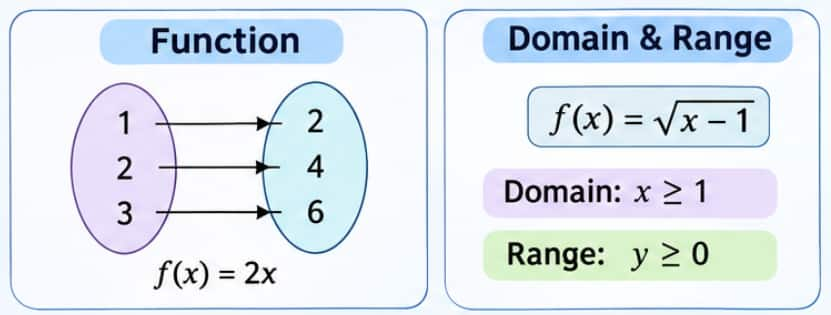
The domain represents all permissible input values of a function, while the range represents the corresponding output values.
Questions may involve identifying restrictions arising from:
Denominators that cannot equal zero.
Square roots that require non-negative expressions.
Logarithmic expressions that require positive arguments.
Composite expressions with multiple restrictions.
For example, consider:
$
f(x)=\frac{1}{\sqrt{x-2}}
$
Here, the expression under the square root must be positive because it appears in the denominator. Therefore, the domain is x>2.
Candidates should understand different function classifications, including:
One-one functions: Different inputs produce different outputs.
Onto functions: Every element in the codomain has at least one corresponding input.
Many-one functions: Two or more inputs may produce the same output.
Even functions: f(-x)=f(x).
Odd functions: f(-x)=-f(x).
Periodic functions: Function values repeat after a fixed interval.
These properties can help eliminate options quickly in CAT function-based questions.
Composite functions involve applying one function to the output of another. They are generally represented as:
$
(f\circ g)(x)=f(g(x))
$
Candidates should practise questions involving f(g(x)), g(f(x)), and expressions in which the functions are defined separately.
Remember that the order of composition matters. In general, f(g(x)) is not equal to g(f(x)).
The inverse of a function reverses its input-output relationship. It is represented by f-1(x).
To find an inverse, candidates generally need to:
Write y=f(x).
Interchange x and y.
Solve the resulting expression for y.
Check the domain and range restrictions.
An inverse function exists when the original function is one-one over the specified domain.
Modulus functions involve absolute values and can create piecewise expressions.
For example:
$
f(x)=|x-3|
$
This can be written as:
$
f(x)=
\begin{cases}
x-3, & x\geq 3\\
3-x, & x<3
\end{cases}
$
Candidates should practise equations and inequalities involving absolute values, intersections of modulus graphs and the number of solutions.
Graph transformations involve changes in the position, direction or shape of a function's graph.
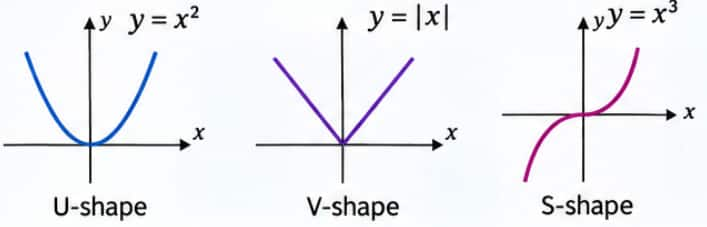
Important transformations include:
f(x)+a: Vertical shift upwards by a units when a>0.
f(x-a): Horizontal shift to the right by a units when a>0.
-f(x): Reflection across the x-axis.
f(-x): Reflection across the y-axis.
af(x): Vertical scaling by a factor determined by a.
Understanding these transformations helps candidates solve graphical questions without plotting every point.
The following question formats are useful for CAT Quantitative Aptitude preparation.
Question type | What candidates need to solve |
Domain and range | Identify permissible inputs and possible outputs |
Functional equations | Determine unknown function values or expressions |
Composite functions | Evaluate functions applied in succession |
Inverse functions | Find or verify the inverse of a function |
Modulus functions | Solve absolute-value equations and inequalities |
Graph interpretation | Identify properties from a given graph |
Maximum and minimum | Determine extreme values over a specified domain |
Number of solutions | Count intersections or roots of function equations |
Download Free Practice Tests & Solutions and Ace the CAT Exam 2026
Use these shortcuts and preparation tips to understand function behaviour, identify domain and range restrictions, simplify composite functions and solve CAT-level Functions and Graphs questions more efficiently.
Do not begin lengthy calculations without checking the domain. Identify values that make denominators zero, square-root expressions negative or logarithmic arguments non-positive.
For an even function, the graph is symmetric about the y-axis. For an odd function, it is symmetric about the origin. These properties can reduce calculations in questions involving positive and negative inputs.
In functional equations, try values such as 0, 1 or -1 whenever they are permitted. These substitutions can reveal relationships between unknown function values.
However, do not assume that a pattern holds for every input unless it follows from the given conditions.
Learn how shifts and reflections affect a graph. Instead of drawing a completely new graph, use the original function and apply the stated transformation.
When a question asks for the number of solutions of f(x)=g(x), interpret the solutions as intersection points of the two graphs. Check whether the graphs touch, cross or overlap within the specified domain.
Functions and Graphs questions can involve multiple steps. Practise identifying the shortest valid approach rather than attempting every question through direct substitution or expansion.
The following original CAT-level practice questions cover important concepts from Functions and Graphs. They are designed in the style of CAT Quantitative Aptitude questions and are not presented as verbatim previous-year questions.
Question 1. If f(x)=x2-4x+7, what is the minimum value of f(x) for all real values of x?
A. 2
B. 3
C. 4
D. 5
Question 2. Let f(x)=2x+3 and g(x)=x2-1. Find the value of (fg)(2).
A. 7
B. 9
C. 11
D. 13
Question 3. If f(x)=|2x-6|, how many real solutions does the equation f(x)=4 have?
A. 0
B. 1
C. 2
D. 3
Question 4. The function f(x)=x+2x-3 is defined for all real values of x except one. Identify the excluded value.
A. -3
B. -2
C. 2
D. 3
Question 5. If f(x)=x2+2x, calculate f(a+1)-f(a).
A. 2a+1
B. 2a+2
C. 2a+3
D. a+2
Question 6. If f(x)=3x-5, what is f-1(x)?
A. x-53
B. x+53
C. 3x+5
D. 5-3x
Question 7. A function is defined as f(x)=x2-6x+5. At which value of x does the function attain its minimum?
A. 2
B. 3
C. 4
D. 5
Question 8. If f(x)=x+1 and g(x)=2x-3, find the value of g(f(4)).
A. 5
B. 6
C. 7
D. 8
Question 9. For the function f(x)=x2, which of the following statements is true over the real numbers?
A. It is an odd function.
B. It is an even function.
C. It is a one-one function.
D. It is a decreasing function.
Question 10. The graph of y=x2 is shifted three units to the right and two units upwards. Which equation represents the new graph?
A. y=(x+3)2+2
B. y=(x-3)2+2
C. y=(x-3)2-2
D. y=(x+3)2-2
Question | Answer |
1 | B. 3 |
2 | B. 9 |
3 | C. 2 |
4 | D. 3 |
5 | C. 2a+3 |
6 | B. x+53 |
7 | B. 3 |
8 | C. 7 |
9 | B. It is an even function |
10 | B. y=(x-3)2+2 |
CAT 2026 Functions Practice Questions: Strengthen your understanding of functions with topic-wise CAT-level practice questions to improve accuracy and problem-solving skills in Quantitative Aptitude.
Download the CAT 2026 Functions Practice Questions PDF:
Candidates should begin with basic function properties and gradually move towards composite functions, inverse functions, modulus equations and graph-based problems. Attempting difficult questions without understanding domain restrictions can lead to avoidable errors.
A practical preparation strategy is to:
Revise the basic properties and definitions of functions.
Practise domain and range questions regularly.
Solve previous CAT question papers to understand the level and presentation of questions.
Attempt mixed Algebra practice sets instead of studying Functions and Graphs in isolation.
Maintain a record of incorrect answers and revise the concepts behind them.
Include timed Quantitative Aptitude sectional tests in the final preparation phase.
Since CAT does not guarantee a fixed number of questions from any individual topic, candidates should not depend exclusively on Functions and Graphs. Build a balanced Quantitative Aptitude preparation plan covering Arithmetic, Algebra, Geometry, Number Systems and other recurring areas.
Prepare for the CAT Quantitative Aptitude section with these ebooks covering important concepts, chapter-wise practice questions, previous-year questions (PYQs), sectional tests and full-length sample papers.
Ebook | Download |
The CAT Arithmetic Hackbook PDF: Concepts and Practice Questions | |
CAT Algebra Handbook 2026: Concepts and Practice Questions | |
CAT 2026 Number System PDF Handbook: Concepts, Practice Questions and Solutions | |
CAT 2026 Geometry and Mensuration: Concepts, Shortcuts and Practice Questions | |
CAT 2026 Modern Maths PDF Handbook: Concepts, Tricks and PYQ-Based Practice | |
CAT Quant PYQs: Complete 5-Year Question Bank (2021-2025) | |
CAT 2026 Quantitative Aptitude: 20 Free Sectional Tests | |
CAT 2026 Quant Sample Paper | |
CAT 2026 Time and Work Practice Questions | |
CAT 2026 Average and Mixture Practice Questions | |
CAT 2026 Quadratic Equations Practice Questions |
Functions and Graphs preparation for CAT 2026 requires a combination of conceptual clarity, algebraic accuracy and problem-solving speed. Candidates should focus on domain and range, composite functions, inverse functions, modulus equations and graph transformations. Regular practice of CAT-level questions and previous-year papers can help improve accuracy and confidence in the Quantitative Aptitude section.
Frequently Asked Questions (FAQs)
Domain and range, composite functions, functional equations, maximum and minimum values, and questions involving specially defined functions are important practice areas. CAT 2025 also included questions on function domains and ranges.
Yes. Candidates may need to find the permissible values of x in expressions such as f(g(x))+g(f(x)), considering restrictions from both functions and their compositions.
Yes. Graph-related preparation includes identifying function behaviour, interpreting ranges, finding maximum or minimum values and analysing intersections. Candidates should also practise algebraic questions that can be simplified through graphical properties.
The difficulty is generally moderate to difficult. Questions can involve multiple function conditions, restricted domains, greatest integer functions and functional equations rather than simple function substitution.
Exact questions should not be expected to repeat, but concepts and question formats recur. Practising CAT PYQs from 2020-2025 can help candidates become familiar with function-based problems and their variations.

On Question asked by student community
Hi Khushdeep
Several apps and online platforms are available for CAT (Common Admission Test) preparation. Students can choose a platform based on their preparation needs, such as video lectures, practice questions, mock tests, and performance analysis.
Hello, for AP NEET PG Category C seats, NRI documents are generally required if you are applying under the NRI quota, and eligibility depends on the applicable counselling rules. The fee payment currency and procedure should be confirmed from the current Dr. NTRUHS notification at its official website drntr.uhsap.in.
Hello, CAT aur B-school entrance exams ke baare mein aap exam dates, eligibility, registration, exam pattern, syllabus, colleges ya admission process ki information dekh sakte hain. Aapki requirement ke according relevant details yahan mil sakti hain: https://bschool.careers360.com/exams
You can download the latest CAT syllabus from here:
Hey there,
For a B.Sc. with Chemistry, Botany and Zoology (CBZ), if the CAT application asks separately for:
If the Discipline dropdown has a more specific option such as “Biological Sciences,” “Life Sciences,” or “Zoology/Botany,”
Directions for question:
The bar-graph given below shows the foreign exchange reserves of Nepal (in million Rupees) from 2014 to 2021. Answer the following questions based on the graph :

Question:
What was the percentage increase (rounded to the nearest integer, if deemed necessary) in the foreign exchange reserves in

Globally Recognized by AACSB (US) & AMBA (UK) | 18 LPA Avg. CTC for PGPM 2026
Complete your XAT Application by 11th Nov & get more preparation support | 75+ years of legacy | #1 Entrance Test | 100+ Test Cities | 250+ B-Schools accept XAT Score
Gateway to IBS Hyderabad & 8 other IBS campuses | Scholarships worth 10 CR
India’s only private university to be ranked for Graduate Employability | 6000+ Placements | 800+ Recruiters | 75 LPA-Highest Salary
Highest Package 29.30 LPA | 230+ Recruiters | AACSB Accredited | Ranked 51 in Asia by QS International
Among top 6% B-Schools globally to be accredited by AACSB | Highest Package-35 LPA