Birla Institute of Management Technology, Greater Noida
AACSB Accredited | Highest CTC: 22 LPA


With IIM Indore taking charge of CAT 2026, a familiar question has come back among MBA aspirants: Does the conducting IIM leave its fingerprint on the CAT question paper? Starting from CAT 2013 and CAT 2014 to the pandemic-era CAT 2020, IIM Indore has handled some memorable versions of the exam. CAT 2026 is scheduled for November 29, 2026, and CAT 2026. No one can truly predict the exact CAT 2026 paper, but past years can show patterns worth noticing.
To learn more about the insights of the previous years where IIM Indore conducted the CAT exam, check out IIM Indore is Back for CAT 2026! Big Pattern Changes Incoming?
With IIM Indore conducting CAT 2026, many aspirants are asking whether the CAT exam pattern could look different this year. The curiosity comes from CAT 2013, CAT 2014 and CAT 2020, when IIM Indore conducted the exam and notable changes were seen in the paper.
While the conducting institute cannot completely decide the CAT paper, its previous editions offer useful insights for CAT 2026 preparation.
Candidates can register for CAT, by clicking here.
CAT 2026 will be the fourth time IIM Indore conducts the Common Admission Test. The table below summarises the key highlights of its previous editions.
| CAT Year | Key Highlight |
|---|---|
| CAT 2013 | Concept-focused approach |
| CAT 2014 | Increased question count |
| CAT 2020 | Reduced duration |
| CAT 2026 | November 29, 2026 - three slots |
The differences across these editions explain the interest around IIM Indore conducting CAT 2026.
Aspirants follow the conducting institute to understand possible CAT 2026 difficulty level, question selection and sectional emphasis. However, CAT continues to follow a standardized national-level framework.
The previous editions show which skills were particularly important in each year.
| CAT Year | Key Skill Rewarded |
|---|---|
| CAT 2013 | Conceptual Strength |
| CAT 2014 | Question Selection |
| CAT 2020 | Adaptability |
The focus varied across years, making flexibility an important part of CAT preparation.
The conducting IIM may influence question selection, sectional emphasis and difficulty distribution to some extent. However, it cannot completely redesign CAT.
The table below separates areas that may vary from elements that remain part of the CAT framework.
| Can Influence | Cannot Easily Change |
|---|---|
| Question Selection | Core CAT Structure |
| Sectional Emphasis | Percentile System |
| Difficulty Distribution | Purpose of CAT |
| Exam Philosophy | National Standards |
IIM Indore's previous CAT papers show changes in the skills tested rather than a consistent increase in difficulty.
The main takeaway from these editions is summarised below.
| Year | What the Exam Rewarded |
|---|---|
| CAT 2013 | Solving challenging problems |
| CAT 2014 | Managing a larger paper efficiently |
| CAT 2020 | Adapting to a changed format |
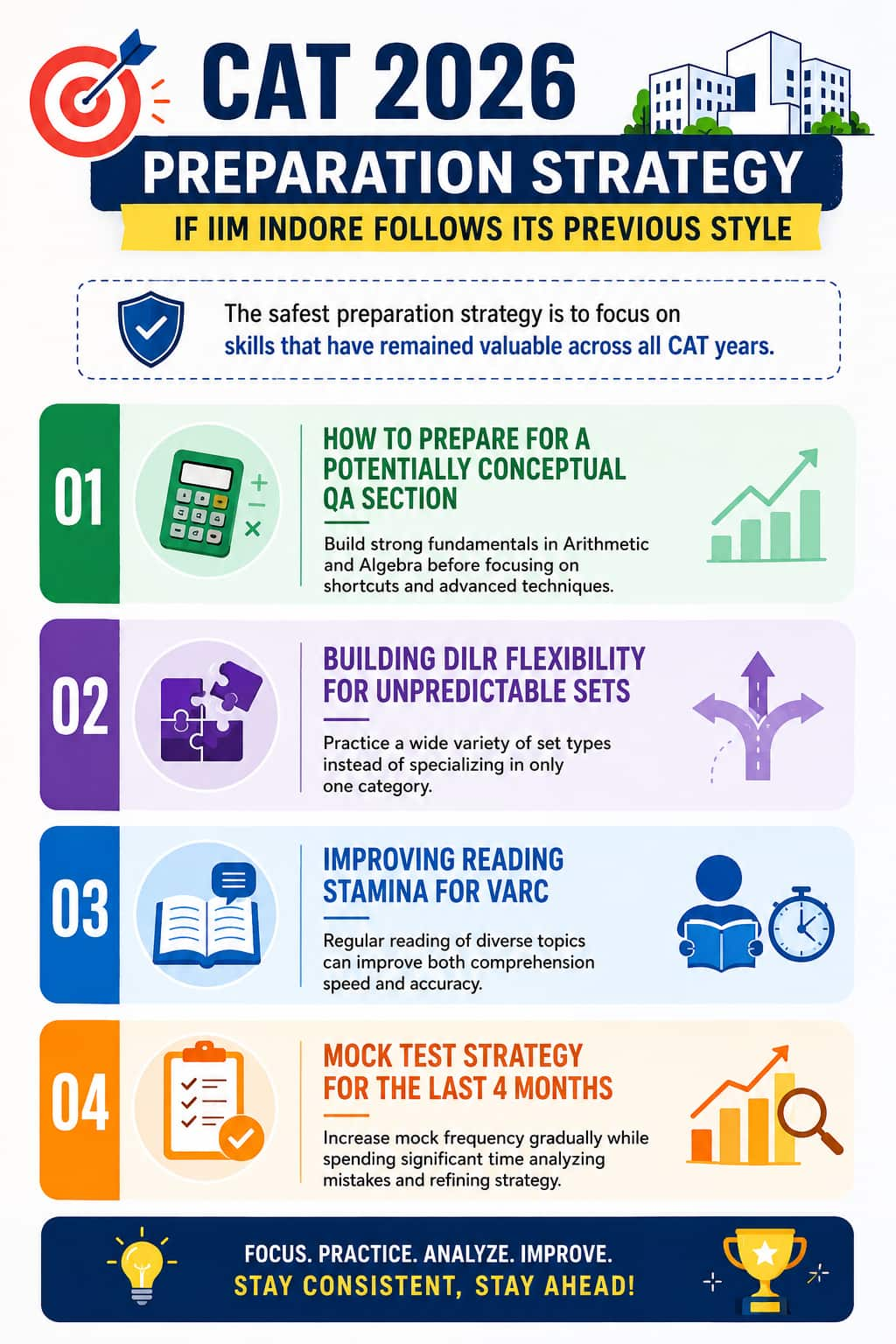
For CAT 2026 preparation, aspirants should focus on strong fundamentals and a flexible test-taking strategy rather than trying to predict the exact paper.
IIM Indore has conducted CAT three times before: 2013, 2014 and 2020. These editions differed in structure and difficulty, offering useful context for understanding IIM Indore CAT history.
CAT 2013 was a concept-oriented exam that tested reasoning and core Quantitative Aptitude concepts. Its main features are given below.
| Feature | CAT 2013 |
|---|---|
| Total Questions | 60 |
| Duration | 140 Minutes |
| QA Focus | Concepts and calculations |
| DILR Style | Traditional sets |
| VARC Style | Conventional RC and VA |
Conceptual understanding and accuracy were important, with Arithmetic, Algebra and Geometry playing meaningful roles.
Strong fundamentals and accuracy were important for CAT 2013, making conceptual preparation a key focus.
CAT 2014 brought a major change in the CAT exam pattern, with an increase in the number of questions. The main changes are summarised below.
| Feature | CAT 2014 |
|---|---|
| Total Questions | 100 |
| Duration | 170 Minutes |
| Major Change | Increased question count |
| Focus | Strategy and time management |
The larger paper increased the importance of time management and question selection.
More questions required quicker decisions.
Time management became more important.
Question selection played a greater role in scoring.
CAT 2020 was conducted during the pandemic with a shorter exam duration. The key features are shown below.
| Feature | CAT 2020 |
|---|---|
| Total Questions | 76 |
| Duration | 120 Minutes |
| Major Change | Reduced duration |
| Focus | Adaptability |
The shorter duration increased the need for quick decisions and efficient solving.
Less time was available per question.
VARC remained reading-intensive.
Efficient problem-solving was important.
Despite differences between the papers, some common skills remained important. The table below highlights these trends.
| Trend | Observation |
|---|---|
| Analytical Thinking | Consistently important |
| Aptitude-Based Testing | Strong focus throughout |
| Strategic Decision-Making | Valuable in every year |
| Adaptability | Increasingly important |
Overall, the papers focused on reasoning, analytical ability and decision-making rather than rote learning.
The earlier CAT papers conducted by IIM Indore do not show one fixed CAT exam pattern, but they offer useful trends across Quant, DILR, VARC and question selection.
The Quant sections appeared to favour understanding over memorization. The main topic areas are shown below.
| Topic Area | Importance |
|---|---|
| Arithmetic | High |
| Algebra | High |
| Geometry | Moderate |
| Modern Math | Moderate |
Arithmetic and Algebra were particularly important areas for CAT Quant preparation.
DILR evolved across the three years, with changes in set types and interpretation requirements. The table shows this progression.
| Year | DILR Characteristics |
|---|---|
| 2013 | Conventional reasoning sets |
| 2014 | Greater variety |
| 2020 | More complex interpretations |
The progression shows increasing importance of interpretation and flexible problem-solving.
VARC remained an important scoring area, but its focus changed across the three papers. The table below compares the main VARC focus.
| Year | VARC Focus |
|---|---|
| 2013 | Traditional RC and VA |
| 2014 | Broader verbal coverage |
| 2020 | Reading-heavy and inference-based |
Reading comprehension and interpretation became increasingly important.
The balance between speed and accuracy also varied across the three editions. The table summarises the main requirement in each year.
| CAT Year | What Mattered Most |
|---|---|
| CAT 2013 | Accuracy |
| CAT 2014 | Speed and Selection |
| CAT 2020 | Adaptability and Execution |
This highlights the need to balance accuracy, speed and question selection during CAT preparation.
AI can make your MBA exam preparation faster and more personalised. This video breaks down 4 AI tools every CAT, XAT and NMAT aspirant should know in 2026, along with how they can be used for smarter practice and revision.
Must-Watch for MBA Aspirants: 4 AI Tools Every CAT/XAT/NMAT Aspirant MUST Use in 2026
CAT 2013, CAT 2014 and CAT 2020 show how the CAT exam pattern evolved across IIM Indore's editions. Each paper placed a different emphasis on solving skills.
The table below compares the major focus areas across QA, DILR and VARC.
| Feature | CAT 2013 | CAT 2014 | CAT 2020 |
|---|---|---|---|
| QA Focus | Concepts & Calculations | Broad Topic Coverage | Efficient Solving |
| DILR Focus | Traditional Sets | Diverse Set Types | Complex Interpretation |
| VARC Focus | Traditional RC | Expanded Coverage | Reading Intensive |
The comparison shows clear differences in the focus of each CAT paper.
The source of difficulty varied across the three papers. CAT 2013 tested conceptual understanding, CAT 2014 placed greater pressure on time management, while CAT 2020 required faster decision-making.
CAT 2014 had the highest question count, while CAT 2020 had a shorter duration and fewer questions. This shows why aspirants should be prepared for changes in exam conditions.
CAT 2013 highlighted strong fundamentals, while CAT 2020 highlighted adaptability. Together, these editions show that CAT preparation requires both subject knowledge and exam-day strategy.
This question is really common among CAT aspirants. However, history does not suggest that IIM Indore automatically produces tougher CAT papers.
Many students think that the organizing institute, like straight up directly, decides whether CAT will be easy or difficult. But that is not exactly how it works. CAT is actually formed through a multi-level academic process, with several rounds of scrutiny, plus standardization that keeps things fairly consistent.
Even if the convening institute manages the examination process, it still cannot really overhaul CAT’s core intent. The test has to keep judging aptitude, logical reasoning, and comprehension skills, for a large group of candidates. So no, one institute doesn’t just redesign the whole thing overnight, or with a single decision.
Difficulty is often influenced by:
Question quality and complexity.
Sectional balance.
Time available per question.
Candidate preparedness.
Overall performance of the test-taking population.
Because CAT is percentile-based, even a difficult paper may not significantly change admission outcomes.
Probably not, but, the earlier CAT years under IIM Indore kinda show that the institute has been linked with some notable shifts in exam structure and emphasis. So aspirants should, you know, be ready for moderate changes, don’t assume it will be a total overhaul.
Past patterns can’t really predict CAT 2026, yet they can hint at what might stay relevant.
CAT 2013 showed that concept oriented Quant sections can separate strong candidates from the average, in a very real way. A similar focus on understanding rather than doing shortcuts would not feel surprising at all.
In most CAT papers, including ones under IIM Indore, Arithmetic and Algebra keep contributing the biggest chunk of questions. Those areas will likely stay at the center of CAT 2026 preparation too.
Candidates should be comfortable with, or at least familiar enough to not freeze on:
Caselets
Arrangements
Games and tournaments
Data interpretation-based reasoning
Hybrid DI-LR sets
Also, recent CAT trends point toward versatility being more important than perfecting just one kind.
VARC is likely to keep centring on reading comprehension, inference-based questions, para summaries, and logical flow-type questions. Solid reading routines will remain one of the biggest advantages for aspirants; honestly, it’s like a quiet multiplier.
If you want to prepare and strengthen your concepts, you can check out: CAT Algebra PDF Handbook 2026: Everything You Need to Master
For practising questions and strengthening concepts, check this out: The CAT Arithmetic Hackbook PDF: Zero Math Background? No Problem
The three CAT years conducted by IIM Indore offer valuable lessons that remain relevant today.
Lesson 1 - Fundamentals Beat Shortcuts, when the paper becomes conceptual, a strong understanding of fundamentals provides a much bigger advantage than memorized tricks.
Lesson 2 - Percentile relies on relative results, not some fixed score, so your outcome is compared with other candidates, somehow, and it really does not matter as much “where you land” in absolute terms.
Lesson 3 - Adaptability matters way more than guesses or predictions. Most aspirants keep trying to forecast the paper, but high performers just adjust to whatever shows up on exam day.
Lesson 4 - Balanced preparation is what usually wins, because people who keep working all three sections consistently tend to be in a better stance when something unexpected turns up.
Looking for the best CAT 2026 preparation resources? Check out these carefully selected CAT 2026 eBooks, study material, and some preparation guides that can really help you strengthen your concepts, and also boost your probability of getting a high percentile. Take a look and compare them before you commit to just one thing.
| Ebook | Download |
|---|---|
| CAT 2025 Slot-by-Slot Master Weightage Matrix PDF | Download Now |
| 15 CAT Myths That Waste Months of Preparation | Download Now |
| 8 Expert-Curated Philosophy Editorials with CAT-Style Questions | Download Now |
| CAT Quant PYQs - Complete 5-Year Question Bank (2021 - 2025) PDF | Download Now |
| CAT 2026: AI VS Coaching - Which is Better | Download Now |
| CAT DILR PYQs Complete 5-Year Question Bank (2021 - 2025) | Download Now |
| CAT VARC PYQs - Complete 5-Year Question Bank (2021 - 2025) PDF | Download Now |
| CAT RC 2026: 12 Tones That Can Change Your Answer | Download Now |
| CAT 2026: 10 Most Repeated Concepts in Quant | Download Now |
| CAT Time & Work: Top 30 Practice Questions with Answer Key & Detailed Solutions | Download Now |
| CAT Quadratic Equations: Top 30 Practice Questions with Answer Key & Detailed Solutions | Download Now |
The short answer is no.
What History Suggests
Previous IIM Indore CAT editions rewarded different skills and saw some exam changes.
What History Cannot Predict
History cannot predict the exact CAT 2026 exam pattern or difficulty level.
The Smartest Approach for CAT 2026 Aspirants
Focus on fundamentals, mock tests, adaptability and balanced preparation. These skills remain important across CAT editions.
Frequently Asked Questions (FAQs)
Yes, IIM Indore will conduct CAT 2026. It will be the fourth time the institute will conduct the exam, after handling CAT in 2013, 2014 and 2020.
Not really. Those earlier CAT years under IIM Indore had a different structure, and different emphasis, but there is no clear proof that they were always more difficult than the other CAT years.
No. The conducting IIM may influence some aspects of the paper, but major changes depend on broader CAT decisions.
They show that CAT can change its structure and focus. Aspirants should therefore prepare strong fundamentals while staying adaptable.
No. Candidates should just keep working on solid basics, raise their mock test scores, and maintain a stable balanced routine instead of switching everything around every time, for example because which IIM is conducting it this round.

On Question asked by student community
Hello, for AP NEET PG Category C seats, NRI documents are generally required if you are applying under the NRI quota, and eligibility depends on the applicable counselling rules. The fee payment currency and procedure should be confirmed from the current Dr. NTRUHS notification at its official website drntr.uhsap.in.
Hello, CAT aur B-school entrance exams ke baare mein aap exam dates, eligibility, registration, exam pattern, syllabus, colleges ya admission process ki information dekh sakte hain. Aapki requirement ke according relevant details yahan mil sakti hain: https://bschool.careers360.com/exams
You can download the latest CAT syllabus from here:
Hey there,
For a B.Sc. with Chemistry, Botany and Zoology (CBZ), if the CAT application asks separately for:
If the Discipline dropdown has a more specific option such as “Biological Sciences,” “Life Sciences,” or “Zoology/Botany,”
Hey there,
Yes. With 2 years of work experience, you are eligible to target the regular 2-year MBA at IIM Calcutta as long as you have a bachelor's degree with at least 50% marks (45% for SC/ST/PwD). Work experience is not required for eligibility.
For
Directions for question:
The bar-graph given below shows the foreign exchange reserves of Nepal (in million Rupees) from 2014 to 2021. Answer the following questions based on the graph :

Question:
What was the percentage increase (rounded to the nearest integer, if deemed necessary) in the foreign exchange reserves in

Globally Recognized by AACSB (US) & AMBA (UK) | 18 LPA Avg. CTC for PGPM 2026
75+ years of legacy | #1 Entrance Exam | Score accepted by 250+ BSchools
Gateway to IBS Hyderabad & 8 other IBS campuses | Scholarships worth 10 CR
Highest Package 29.30 LPA | 12 LPA Median CTC | 230+ Recruiters | AACSB Accredited | Ranked 51 in Asia by QS International
Early Application Round Deadline: 27th Oct’26 | 400+ Recruiters | Highest CTC 17.2 LPA | Average CTC 8 LPA | 92% Avg. Placements | Awarded Best Business School of the Year
Last Date to Apply - 19th December 2026 | Highest CTC 68.66 LPA | Average CTC 18.08 LPA | Top 25% Average CTC 24.66 LPA