Great Lakes - PGDM & PGPM Admissions 2027
Globally Recognized by AACSB (US) & AMBA (UK) | 18 LPA Avg. CTC for PGPM 2026


CAT 2026 preparation becomes more effective when you know which topics deserve greater attention and which can be covered later. CAT 2025 data show clear differences across the three sections, with Arithmetic leading QA, Logical Reasoning accounting for the largest share of DILR questions, and Reading Comprehension contributing 48 of the 72 VARC questions across all three slots. With CAT 2026 scheduled for November 29, 2026, this analysis uses recent question trends to help candidates structure their preparation, while recognising that past frequency does not guarantee the same distribution in the upcoming exam.
This Story also Contains

CAT 2025 had 22 QA questions in each of its three slots, giving a total of 66 questions. The CAT 2025 section-wise breakdown provides a slot-wise comparison of the major QA areas.
QA Topic | Questions Across 3 Slots | Share of 66 Questions | Priority |
Arithmetic | 27 | 40.9% | Very High |
Algebra | 20 | 30.3% | Very High |
Geometry & Mensuration | 10 | 15.2% | High |
Number System | 5 | 7.6% | Moderate |
Modern Mathematics | 4 | 6.1% | Lower |
Arithmetic was the most frequently represented QA area with 27 questions, followed by Algebra with 20. Together, they contributed 47 of the 66 QA questions, accounting for about 71.2% of the total QA questions across the three slots.
This makes Arithmetic and Algebra the highest-priority areas for candidates with limited preparation time, while Geometry & Mensuration should remain part of the core preparation.
CAT 2025 weightage can help candidates allocate preparation time, but it should not be treated as a prediction of the CAT 2026 paper. A practical approach is to:
Strengthen high-frequency areas such as Arithmetic and Algebra.
Cover Geometry and Mensuration as part of core QA preparation.
Practise recurring DILR structures rather than skipping entire topics.
Give consistent time to Reading Comprehension because of its larger share in VARC.
Use PYQs, sectional tests and mock analysis to adjust priorities based on individual performance.
If you want to understand the CAT 2025 question trends and prioritise your CAT 2026 preparation? Refer to the complete slot-wise weightage analysis below.
Download Now: CAT 2025 Slot-by-Slot Master Weightage Matrix
The data does not suggest completely removing major topics from your preparation. Instead, it can help you decide where to spend more or less time.
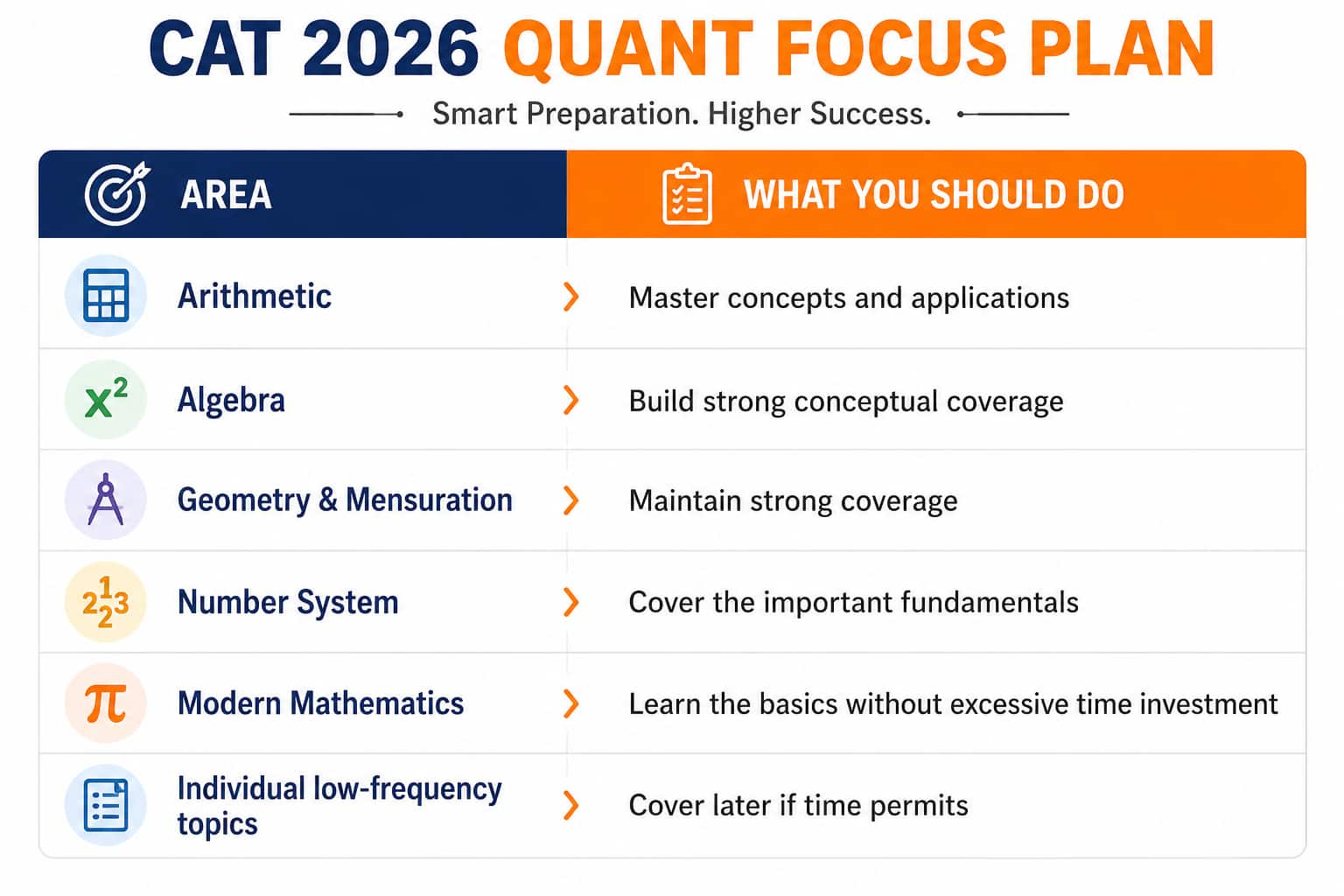
The purpose of using weightage data is time allocation, not predicting the next CAT paper. The source eBook emphasises that previous-year analysis should help aspirants prioritise preparation and identify recurring trends rather than predict the next examination.
Had 4 questions across CAT 2025. Keep it a lower priority and focus on the basics.
Had 5 questions across CAT 2025. Prioritise Divisibility/Factors and Digits/Number Properties.
The detailed Quantitative Aptitude data becomes even more useful when individual topics are considered instead of only broad categories.
The CAT 2025 matrix shows the following topics appearing once across all three slots:
Individual Topic | Slot 1 | Slot 2 | Slot 3 | Total |
Arithmetic Progression / Series | 1 | 0 | 0 | 1 |
Algebraic Expressions | 0 | 1 | 0 | 1 |
Integer Equations | 0 | 1 | 0 | 1 |
Regular Polygons / Hexagon | 0 | 1 | 0 | 1 |
Rhombus / Quadrilaterals | 1 | 0 | 0 | 1 |
Mensuration | 0 | 0 | 1 | 1 |
These topics can be placed at a lower preparation priority when major portions of Arithmetic and Algebra are still incomplete.
But there is an important distinction: one question is still a potential scoring opportunity. Therefore, lower priority should mean spending less time on a topic, not assuming that it will not appear in CAT 2026.
Looking for CAT Quant practice from recent years? Use the complete PYQ question bank to strengthen your CAT 2026 preparation.
Download Now: CAT Quant PYQs: Complete 5-Year Question Bank (2021–2025)
Focus first on the QA areas that had the highest question frequency in CAT 2025, while keeping moderate-frequency topics in your preparation plan.
Arithmetic had 27 questions across CAT 2025, making it the highest-priority QA area. Focus on:
Profit, Loss & Discount
Time, Speed & Distance / Boats & Streams
Partnership / Investment
Arithmetic Progression / Series
Globally Recognized by AACSB (US) & AMBA (UK) | 18 LPA Avg. CTC for PGPM 2026
Test centres are available in 70+ cities across India | 75,000+ aspirants apply for the NMAT exam | Accepted by 58+ institutions like NMIMS, KJSIM, ISB, SPJIMR and Great Lakes.
Priority: Master Arithmetic before moving to lower-frequency topics.
Algebra had 20 questions across CAT 2025, making it the second-highest QA category. Key areas include:
Logarithms
Quadratic Functions / Optimization
Linear Inequalities
Functions / Greatest Integer Function
Exponents / Powers
Algebraic Expressions
Integer Equations
Priority: Build strong conceptual coverage of core Algebra.
Geometry & Mensuration had 10 questions across CAT 2025, making it more important than Number System and Modern Mathematics.
Circles
Triangles
Coordinate Geometry
Regular Polygons / Hexagon
Rhombus / Quadrilaterals
Mensuration
Priority: Cover Geometry well rather than treating it as a skippable area.
CAT Quant preparation can become more focused with the right concepts. Explore these 10 most repeated Quant concepts from recent CAT trends and strengthen the areas that matter most.
DILR requires a different prioritisation strategy because the CAT 2025 matrix shows a combination of Logical Reasoning, Data Interpretation and mixed DI-LR caselets rather than a single uniform topic distribution.
The overall topic-frequency data provides an even clearer picture:
DILR Topic | Questions |
Logical Reasoning | 39 |
Mixed DI-LR Caselets | 15 |
Pure Data Interpretation | 12 |
Ranking / Promotions | 10 |
Scheduling / Timeline Caselets | 10 |
Trade / Business DI | 9 |
Arrangement & Seating | 8 |
Table-based DI | 8 |
Comparison / Ordering | 4 |
Logical Matrix | 4 |
Distribution / Assignment | 4 |
Sequencing / Movement | 4 |
Graph-based DI | 4 |
This suggests that candidates with limited time should give greater attention to Logical Reasoning and mixed DI-LR caselets, followed by commonly represented DI and LR formats.
Not completely.
The better strategy is to become comfortable with the recurring structures rather than trying to eliminate entire categories.
Prioritise:
Logical Reasoning
Mixed DI-LR Caselets
Data Interpretation
Ranking / Promotions
Scheduling / Timeline Caselets
Trade / Business DI
Arrangement & Seating
The matrix also shows that traditional Data Interpretation was limited to 4 questions per slot, while the remaining DILR questions involved Logical Reasoning or mixed reasoning and data interpretation.
The CAT 2025 data show that DILR preparation cannot rely only on topic frequency. Candidates should also practise identifying which sets are manageable within the available time. Regular practice should include Logical Reasoning, mixed DI-LR caselets, ranking, scheduling, arrangements and commonly recurring DI formats. During mocks, track not only accuracy but also the time spent deciding which set to attempt.
Want to strengthen your DILR preparation with recent CAT questions? Practise with this five-year PYQ question bank for focused CAT 2026 preparation.
Download Now: CAT DILR PYQs: Complete 5-Year Question Bank (2021–2025)
VARC should also be prioritised differently from QA.
Can You Skip VARC Topics?
Across all three CAT 2025 slots, the section contained 72 questions:
Reading Comprehension: 48
Verbal Ability: 24
This means RC represented two-thirds of the VARC questions in the CAT 2025 pattern.
Want to improve your RC accuracy by understanding how tone influences the correct answer? Explore this focused CAT 2026 resource.
Download Now: CAT RC 2026: 12 Tones That Can Change Your Answer
Reading Comprehension should remain a core part of CAT preparation. The matrix records 16 RC questions in each slot, compared with 8 VA questions.
The RC passages covered a broad range of domains, including Humanities, Science, Economics, Technology, Society, Philosophy and Culture. Therefore, instead of trying to skip certain RC subjects, build the ability to handle passages from different domains.
Avoid common preparation mistakes and misconceptions that can cost you valuable CAT preparation time.
Download Now: 15 CAT Myths That Waste Months of Preparation
The VA distribution was remarkably consistent across all three CAT 2025 slots:
VA Topic | Questions Across 3 Slots |
Para Summary | 6 |
Para Completion | 6 |
Para Jumbles | 6 |
Odd One Out | 6 |
Since each format contributed equally to VA in the matrix, there is no single VA format that stands out as a low-frequency area to eliminate.
The CAT 2025 pattern shows that Reading Comprehension contributed 48 of the 72 VARC questions across the three slots, while the four major VA formats each contributed six questions. Candidates should therefore maintain regular RC practice while also covering Para Summary, Para Completion, Para Jumbles and Odd One Out. Since RC passages can cover varied subjects, preparation should focus on comprehension, inference and identifying the author's central argument rather than limiting practice to familiar topics.
Looking to improve your VARC preparation with recent CAT questions? Practise with this five-year PYQ question bank to strengthen your CAT 2026 preparation.
Download Now: CAT VARC PYQs: Complete 5-Year Question Bank (2021–2025)
When your preparation window is short, use a:
High-frequency → moderate-frequency → lower-frequency
Approach.
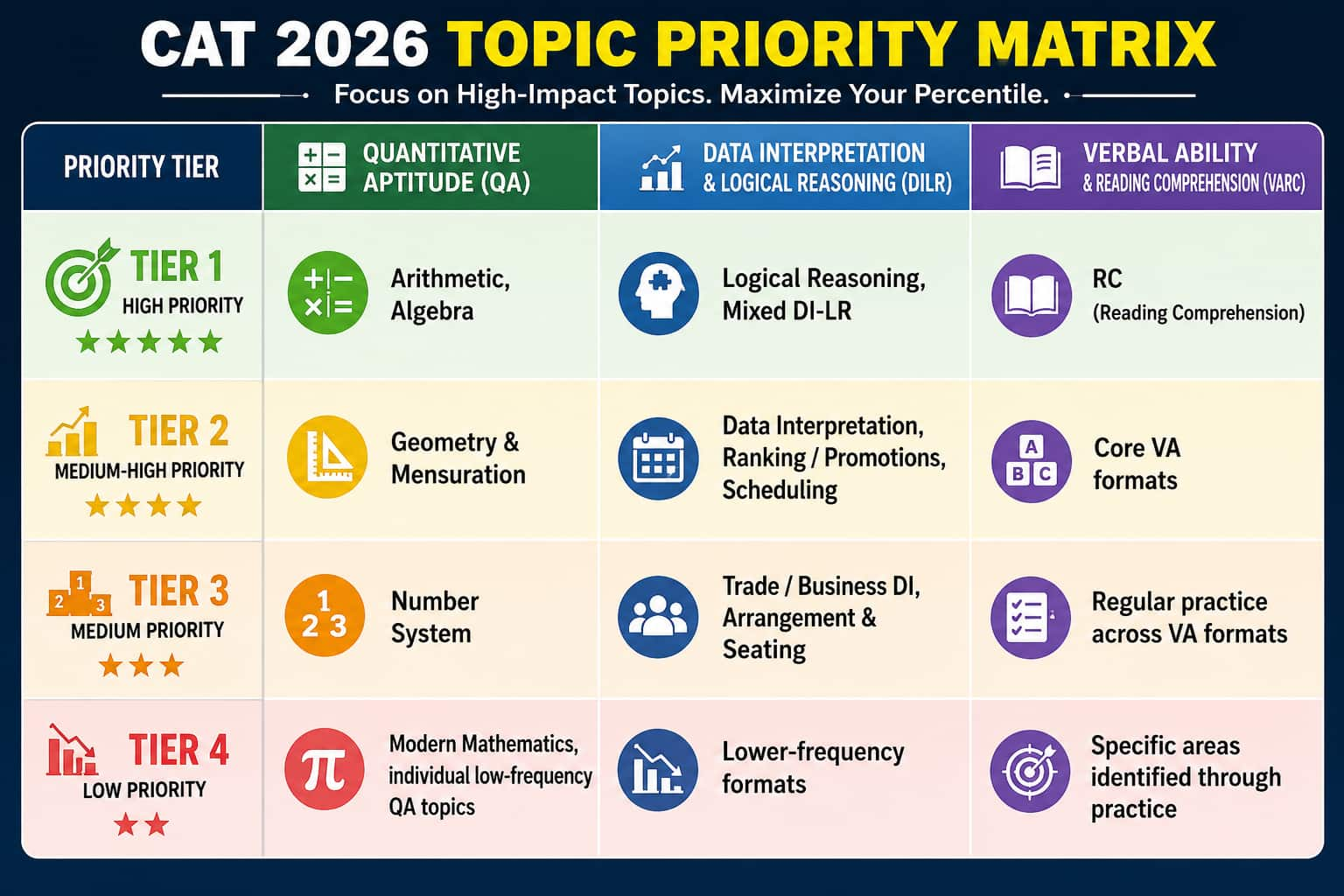
This does not mean medium and low priority topics should be ignored. It means they should receive less preparation time when higher-priority areas are still incomplete.
The CAT Arithmetic Hackbook PDF: Zero Math Background? No Problem- Concepts, Questions | |
CAT Algebra Handbook 2026: Everything You Need to Master Algebra-Concepts, Practice Questions | |
CAT 2026 Number System PDF Handbook: Complete Concepts, Practice Questions & Solutions | |
CAT 2026 Geometry & Mensuration PDF: Important Concepts, Shortcuts & Practice Questions | |
CAT 2026 Modern Maths PDF Handbook: Key Concepts, Tricks & PYQ-Based Practice |
With three months left, use a phased approach: build coverage → expand preparation → focus on performance.
Focus on:
Arithmetic and Algebra
Geometry & Mensuration basics
Logical Reasoning and mixed DI-LR sets
Reading Comprehension
Core VA formats
Add the remaining Number System, Geometry & Mensuration and DILR areas. Increase sectional practice, CAT-level questions and coverage of lower-priority QA topics.
Shift towards full-length mocks, sectional tests, mistake analysis, weak-area revision, question selection, accuracy and time management.
With one month left, avoid trying to complete every topic equally. Focus on high-return areas and exam-oriented practice.
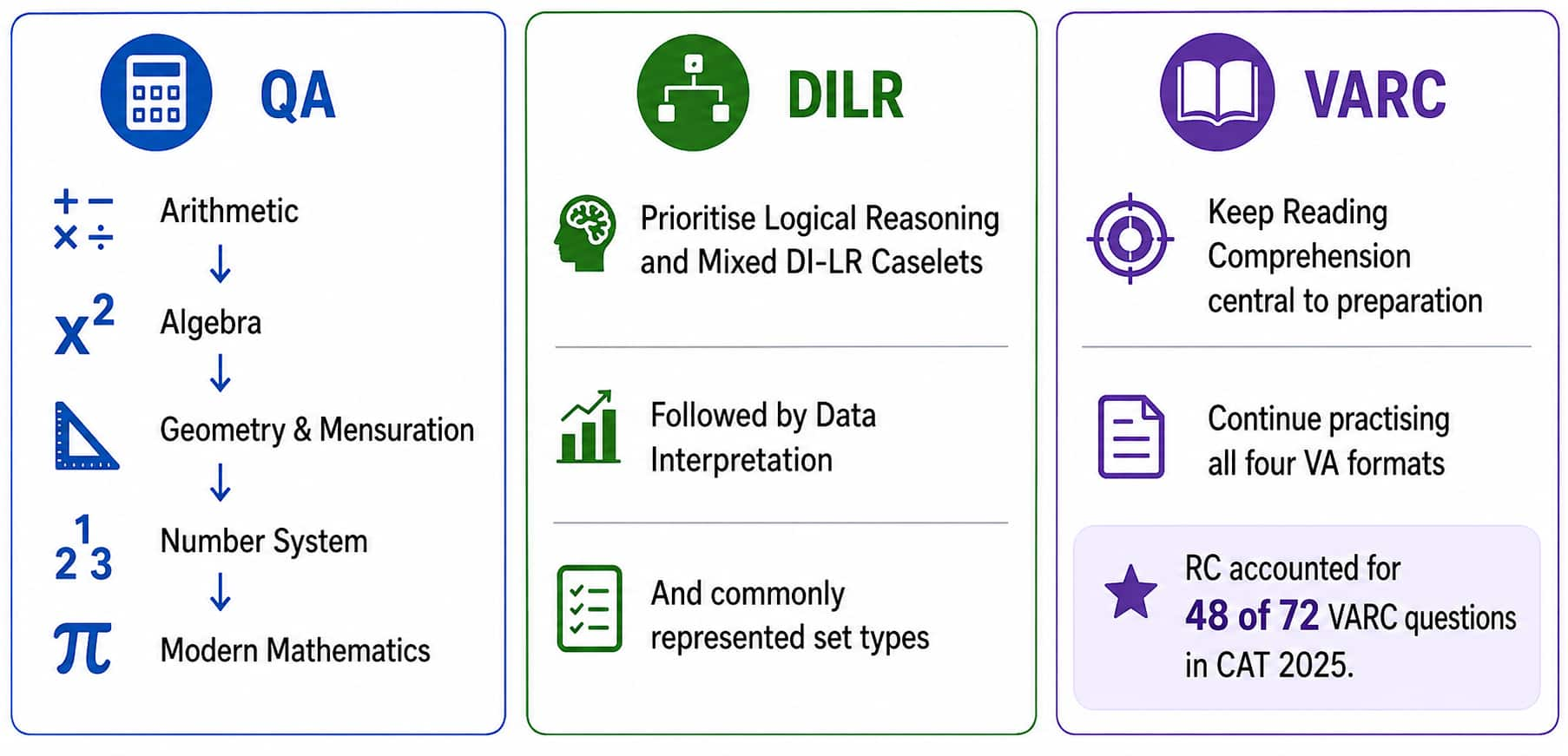
Past frequency can guide preparation, but your accuracy, speed, and mock performance should also determine your priority.
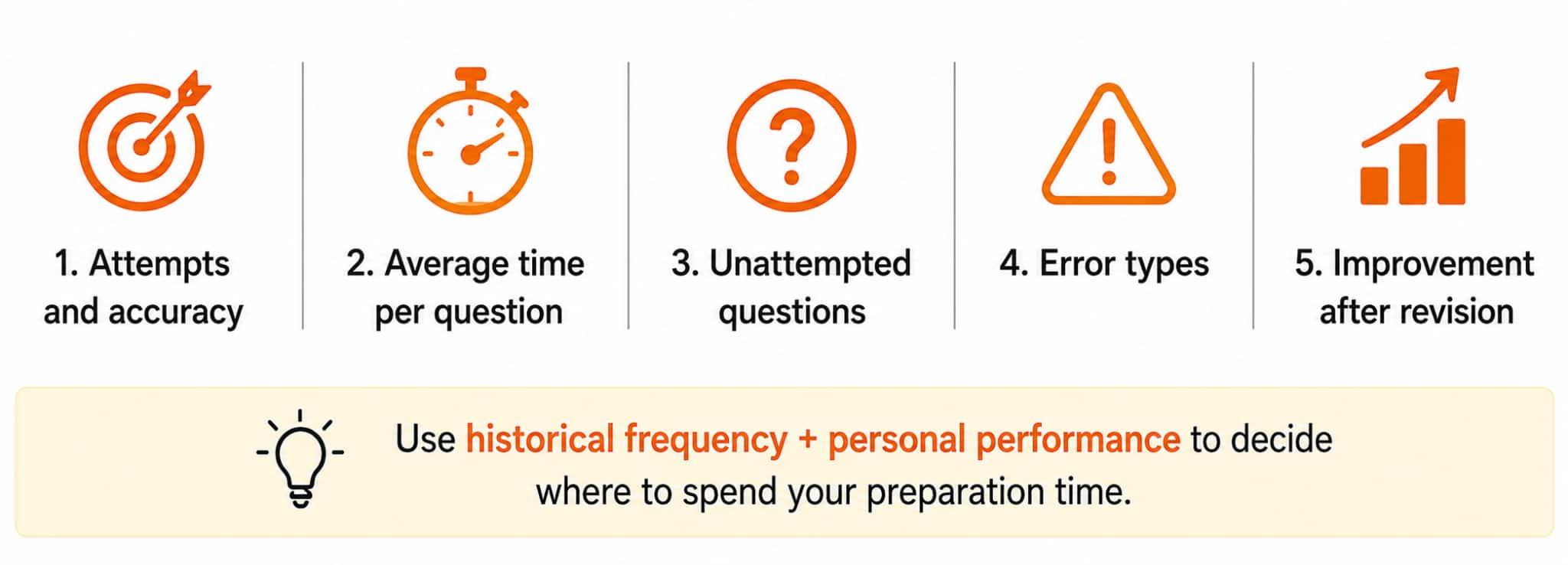
Completely skipping topics is risky. Instead, deprioritise lower-frequency areas when time is limited.
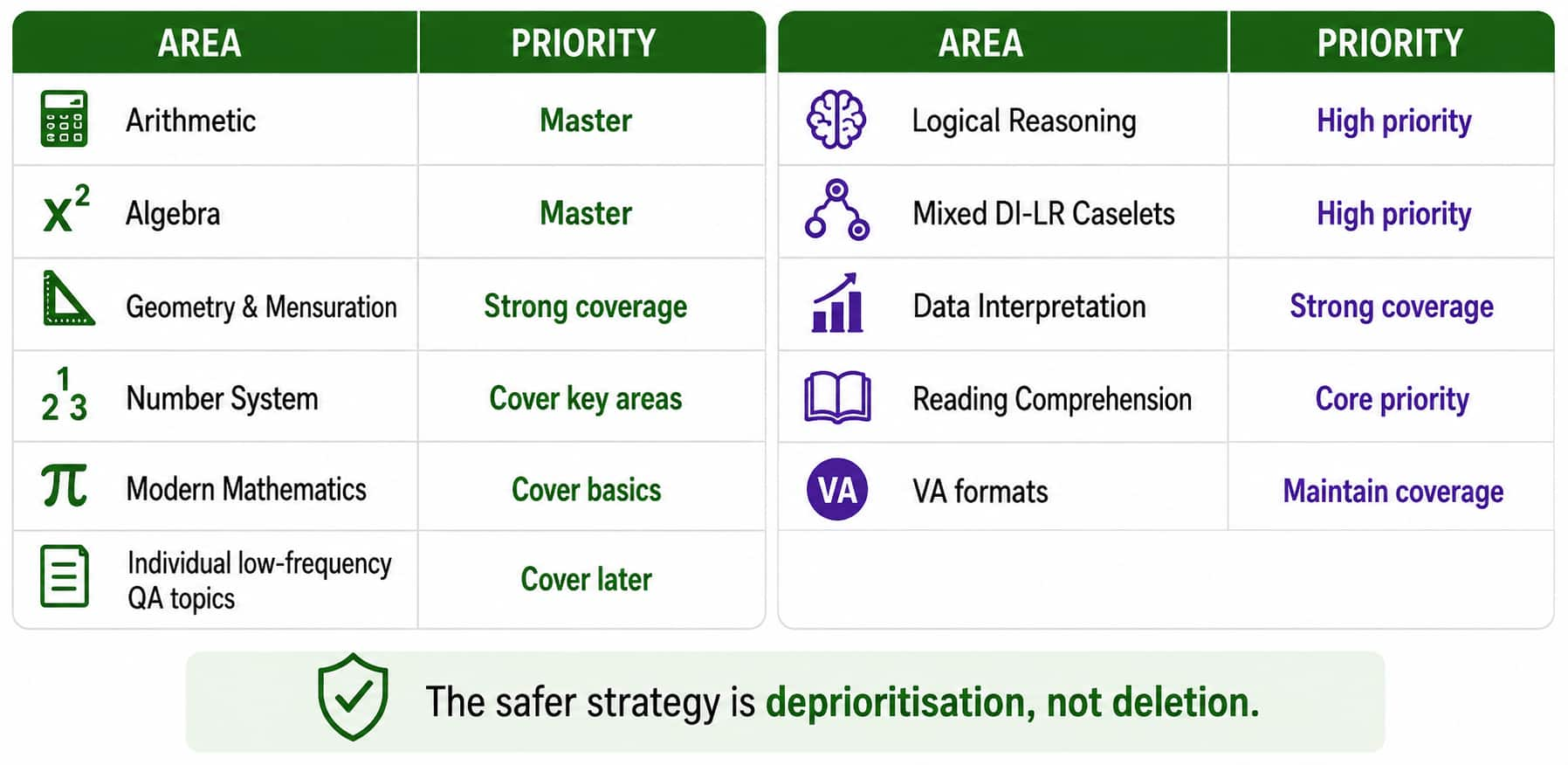
Adjust your time based on frequency, importance, proficiency and expected return.
Give more time to high-frequency areas, cover the basics of lower-frequency topics, and adjust your allocation based on practice and mock performance.
For CAT 2026, the safer approach is:
Master high-frequency topics → cover moderate-frequency areas → learn the basics of lower-frequency topics → use practice and mocks to personalise your final priority.
After you are done with your preparation, you can attempt the mock test.
Frequently Asked Questions (FAQs)
You should avoid completely skipping major areas. If you are short on time, Modern Mathematics and individual low-frequency QA topics can receive less preparation time, while Arithmetic, Algebra and Geometry & Mensuration should receive greater attention based on the CAT 2025 data.
For QA, Arithmetic and Algebra should be the first priorities, followed by Geometry & Mensuration. Together, Arithmetic and Algebra accounted for 47 of the 66 QA questions in the CAT 2025 analysis.
Arithmetic had the highest frequency with 27 questions, followed by Algebra with 20 and Geometry & Mensuration with 10 across the three slots.
Yes. Number System accounted for 5 questions across the three CAT 2025 slots. The matrix includes Divisibility / Factors and Digits / Number Properties among the detailed Number System areas.
You cannot completely skip it, but yes, you can keep it at a lower priority because it accounts for 4 questions across the three CAT 2025 slots. However, it is better to cover the basics rather than completely ignore the area.

On Question asked by student community
Hello, for AP NEET PG Category C seats, NRI documents are generally required if you are applying under the NRI quota, and eligibility depends on the applicable counselling rules. The fee payment currency and procedure should be confirmed from the current Dr. NTRUHS notification at its official website drntr.uhsap.in.
Hello, CAT aur B-school entrance exams ke baare mein aap exam dates, eligibility, registration, exam pattern, syllabus, colleges ya admission process ki information dekh sakte hain. Aapki requirement ke according relevant details yahan mil sakti hain: https://bschool.careers360.com/exams
You can download the latest CAT syllabus from here:
Hey there,
For a B.Sc. with Chemistry, Botany and Zoology (CBZ), if the CAT application asks separately for:
If the Discipline dropdown has a more specific option such as “Biological Sciences,” “Life Sciences,” or “Zoology/Botany,”
Hey there,
Yes. With 2 years of work experience, you are eligible to target the regular 2-year MBA at IIM Calcutta as long as you have a bachelor's degree with at least 50% marks (45% for SC/ST/PwD). Work experience is not required for eligibility.
For
Directions for question:
The bar-graph given below shows the foreign exchange reserves of Nepal (in million Rupees) from 2014 to 2021. Answer the following questions based on the graph :

Question:
What was the percentage increase (rounded to the nearest integer, if deemed necessary) in the foreign exchange reserves in

Globally Recognized by AACSB (US) & AMBA (UK) | 18 LPA Avg. CTC for PGPM 2026
Gateway to IBS Hyderabad & 8 other IBS campuses | Scholarships worth 10 CR
Among top 6% B-Schools globally to be accredited by AACSB | Highest Package-35 LPA
1 Exam accepted by 17 Top Symbiosis Institutes for 32 MBA programmes.
Test centres are available in 70+ cities across India | 75,000+ aspirants apply for the NMAT exam | Accepted by 58+ institutions like NMIMS, KJSIM, ISB, SPJIMR and Great Lakes.
Highest CTC- 21 LPA | Average CTC- 10.38 LPA Scholarships Available | MBA in Forestry Management MBA in Sustainability Management MBA in Sustainable Development MBA in Development and Sustainable Finance