Birla Institute of Management Technology, Greater Noida
AACSB Accredited | Highest CTC: 22 LPA


Negative marking in CAT 2026 can affect your overall score if you attempt questions without sufficient confidence or make avoidable errors. The key to managing negative marks in CAT 2026 is to understand the marking scheme, identify questions you can solve accurately, and make informed decisions when you are unsure of an answer.
This Story also Contains
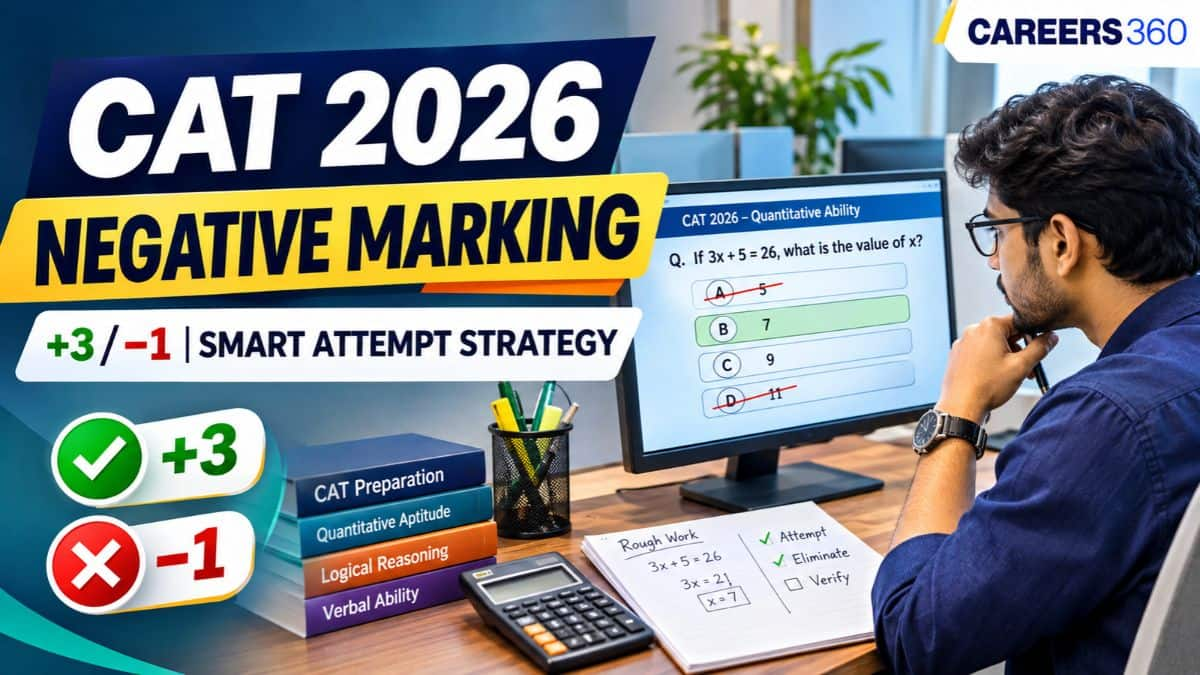
The CAT 2026 exam is scheduled for November 29, 2026. With limited time in each section, candidates must balance speed and accuracy across Verbal Ability and Reading Comprehension (VARC), Data Interpretation and Logical Reasoning (DILR), and Quantitative Aptitude (QA).
This guide explains the CAT 2026 negative marking scheme, how incorrect answers affect your score, when guessing may be worthwhile, and how to develop an attempt strategy using mock tests.
CAT follows different marking rules for multiple-choice questions (MCQs) and CAT TITA questions. Understanding this difference helps candidates decide which questions to attempt and which ones to skip.
Response type | Correct answer | Incorrect answer | Unattempted |
MCQ | +3 | −1 | 0 |
Non-MCQ (TITA) | +3 | 0 | 0 |
Get the actual CAT previous year question papers here
CAT negative marking directly affects your raw score. Even if you answer several questions correctly, unnecessary incorrect attempts can reduce the marks you earn.
Consider the following examples to understand how CAT negative marking works.
Correct MCQ answers | Incorrect MCQ answers | Score from MCQs |
15 | 3 | 42 |
15 | 6 | 39 |
15 | 9 | 36 |
18 | 6 | 48 |
The score is calculated using the formula:
Net MCQ score = (3 × Correct MCQs) − Incorrect MCQs
Correct CAT TITA answers also earn 3 marks each and do not attract negative marking when incorrect. Add the marks earned from correct TITA responses to the MCQ score to calculate the total raw score.
For example, if you answer 15 MCQs correctly and get 6 MCQs wrong, your score from those questions is 45 − 6 = 39. If you also answer 3 TITA questions correctly, your total score becomes 48.
Read Here, Top 25 Reading Comprehension Passages to Practice for CAT 2026
Guessing in CAT 2026 is not always a bad decision. The important factor is how many answer options you can eliminate and whether you have a logical basis for choosing an answer.
In an MCQ with four options, the expected score changes depending on the probability of selecting the correct answer.
Guessing scenario | Chance of a correct answer | Expected marks per attempt |
Blind guess among four options | 25% | 0 |
One option eliminated | 33.3% | Approximately +0.33 |
Two options eliminated | 50% | +1 |
The expected score is calculated using the formula:
Expected score = (Probability of correct answer × 3) − Probability of wrong answer
For example, if you eliminate two options, you have a 50% chance of answering correctly, assuming the two remaining options are equally likely. Your expected score is:
(0.5 × 3) − (0.5 × 1) = +1 mark.
Attempt Now, CAT VARC Sample Paper
Download Free Practice Tests & Solutions and Ace the CAT Exam 2026
Situation | Recommended action |
You know the concept and can solve the question | Attempt |
You have eliminated two options using logical reasoning | Consider attempting |
You have eliminated one option and have a reasonable basis for your choice | Consider attempting if time permits |
You cannot understand the question or eliminate any option | Skip and move ahead |
You have made a calculation error and cannot verify the result | Recheck before submitting |
You are running out of time and have other solvable questions | Prioritise those questions |
The approach to negative marking should differ across VARC, DILR and Quant because each section tests different skills. Candidates should focus on the errors most likely to affect their performance in each section.
In VARC, incorrect answers often result from choosing an option that sounds relevant but does not accurately reflect the passage. Reading comprehension requires you to understand the author's argument, distinguish facts from inferences and evaluate the options carefully.
Reject answers that introduce information not mentioned or reasonably implied in the passage.
Words such as always, never and only can make an option incorrect if the passage presents a more qualified argument. However, do not reject an option simply because it contains an extreme word.
A correct inference must follow from the passage. An option that requires outside knowledge or an additional assumption may be incorrect.
Do not select the first option that appears relevant. Compare the remaining choices to identify the one best supported by the text.
For para-jumbles, identify sentence links and the logical sequence. For odd-sentence-out questions, check which sentence does not fit the paragraph's central idea.
In Data Interpretation and Logical Reasoning, negative marking can result from selecting an unsuitable set, making an incorrect deduction or rushing through calculations.
A practical CAT DILR strategy involves selecting the right sets before attempting their questions.
Use the initial few minutes to understand the available sets and identify those with clear conditions or manageable data.
Choose a set where you can establish relationships, organise the information or begin making deductions.
If you cannot make progress after a reasonable amount of time, consider moving to another set.
A small error in a table, arrangement or case can affect several answers. Check the data before marking your responses.
If a set is partially solved, answer the questions you can establish confidently rather than guessing the remaining MCQs.
In Quantitative Aptitude, incorrect answers often arise from calculation mistakes, misreading the question or using an unsuitable method under time pressure.
Begin with questions where you understand the concept and can identify a clear solution method.
Check what the question asks you to calculate, including units, ranges, percentages and ratios.
Substitution and back-solving can save time in suitable MCQs.
If time permits, verify arithmetic and signs before submitting an answer.
CAT TITA questions do not have negative marking under the standard CAT scheme. A correct response earns three marks, while an incorrect or unattempted response earns zero.
This makes TITA questions different from MCQs when you are deciding whether to attempt an uncertain answer.
Attempt CAT TITA questions you can solve, even if the solution requires a few additional steps.
If you have completed most of the calculation but are uncertain about the result, recheck your working before entering the answer.
Check the required answer format, including whether the response needs an integer or a particular numerical value.
If you have very little time left, consider entering an answer for a TITA question you have partially solved rather than leaving it blank.
Here are top ebooks that help in strengthening your CAT 2026 exam preparations:
CAT 2026 Last 2 Months Revision Plan PDF | |
CAT 2026: 35, 40 or 50 Attempts? Historical Data Reveals the Ideal Strategy | |
CAT 2026 Preparation Plan for the Last 45 Days: Day-wise Targets Till November 29 | |
CAT 2026 Reading Comprehension Practice Questions | |
CAT 2026 Parajumbles Practice Questions |
Frequently Asked Questions (FAQs)
Under the standard CAT marking scheme, TITA questions carry no negative marking. A correct answer earns 3 marks, while an incorrect or unattempted response earns zero.
One correct answer earns 3 marks, while one incorrect MCQ costs 1 mark. Therefore, three incorrect MCQ responses cancel the marks earned from one correct response.
No. You should select MCQs based on your understanding of the question, ability to eliminate options and available time. A blind guess among four equally likely options has an expected score of zero under the standard +3/−1 scheme.
Track your correct, incorrect and unattempted questions separately for VARC, DILR and Quant. Review each incorrect answer to identify whether the cause was a conceptual gap, calculation error, misreading or guessing.

On Question asked by student community
Hi Khushdeep
Several apps and online platforms are available for CAT (Common Admission Test) preparation. Students can choose a platform based on their preparation needs, such as video lectures, practice questions, mock tests, and performance analysis.
Hello, for AP NEET PG Category C seats, NRI documents are generally required if you are applying under the NRI quota, and eligibility depends on the applicable counselling rules. The fee payment currency and procedure should be confirmed from the current Dr. NTRUHS notification at its official website drntr.uhsap.in.
Hello, CAT aur B-school entrance exams ke baare mein aap exam dates, eligibility, registration, exam pattern, syllabus, colleges ya admission process ki information dekh sakte hain. Aapki requirement ke according relevant details yahan mil sakti hain: https://bschool.careers360.com/exams
You can download the latest CAT syllabus from here:
Hey there,
For a B.Sc. with Chemistry, Botany and Zoology (CBZ), if the CAT application asks separately for:
If the Discipline dropdown has a more specific option such as “Biological Sciences,” “Life Sciences,” or “Zoology/Botany,”
Directions for question:
The bar-graph given below shows the foreign exchange reserves of Nepal (in million Rupees) from 2014 to 2021. Answer the following questions based on the graph :

Question:
What was the percentage increase (rounded to the nearest integer, if deemed necessary) in the foreign exchange reserves in

Globally Recognized by AACSB (US) & AMBA (UK) | 18 LPA Avg. CTC for PGPM 2026
Complete your XAT Application by 11th Nov & get more preparation support | 75+ years of legacy | #1 Entrance Test | 100+ Test Cities | 250+ B-Schools accept XAT Score
India’s only private university to be ranked for Graduate Employability | 6000+ Placements | 800+ Recruiters | 75 LPA-Highest Salary
Gateway to IBS Hyderabad & 8 other IBS campuses | Scholarships worth 10 CR
Highest Package 29.30 LPA | 230+ Recruiters | AACSB Accredited | Ranked 51 in Asia by QS International
Among top 6% B-Schools globally to be accredited by AACSB | Highest Package-35 LPA