Birla Institute of Management Technology, Greater Noida
AACSB Accredited | Highest CTC: 22 LPA


IIM Indore will conduct the CAT 2026 exam on November 29, 2026 (Sunday), in three sessions at test centres across India. The CAT 2026 admit card is available on iimcat.ac.in from November 4, 2026.
With less than four weeks remaining, aspirants should focus on revising high-scoring topics rather than starting new chapters. Set theory is one such topic. It appears in the Quantitative Ability section as a standalone question, and the same concepts are tested through Venn diagram sets in DILR. Preparing for this topic therefore benefits two sections of the exam.
In this article, aspirants can check the important set theory formulas, the common question types asked in CAT, the solved set theory questions from previous years' CAT, and a step-by-step approach to LRDI Venn diagram sets.
Also Read: CAT 2026 Exam Pattern
Particulars | Details |
Exam name | Common Admission Test (CAT) 2026 |
Conducting body | IIM Indore |
CAT 2026 exam date | November 29, 2026 (Sunday) |
Admit card release | November 4, 2026 |
Exam mode | Computer-based test, three sessions |
Sections | VARC, DILR, Quant |
Duration | 120 minutes (40 minutes per section) |
Marking scheme | +3 for correct, −1 for wrong MCQ, no negative marking for TITA |
Official website | iimcat.ac.in |
Get the actual CAT previous year question papers here
A set is simply a well-defined collection of objects. “Students in your batch who chose Finance” is a set. “Good students in your batch” is not, because two people could disagree on who belongs in it. That clear definition is what makes set theory work, and CAT relies on it in every question.
The objects in a set are called its elements. A set is usually written with curly brackets, such as A = {2, 4, 6, 8}, and n(A) stands for the number of elements in it. Here, n(A) = 4.
Aspirants can check the basic terms below before moving to the formulas as per the CAT Question Paper:
Term | Meaning | Example |
Universal set (U) | Everything under consideration | All 150 students in a class |
Subset | Every element of one set is also in another | Finance students who are also in the class |
Null set (∅) | A set with no elements | Students who chose a subject nobody took |
Union (A ∪ B) | Elements in A, in B, or in both | Students who chose at least one of two subjects |
Intersection (A ∩ B) | Elements common to both sets | Students who chose both subjects |
Complement (A′) | Elements of U that are not in A | Students who did not choose Finance |
Disjoint sets | Sets with nothing in common | Students in Section A and Section B |
A Venn diagram is a picture of sets. Each set is drawn as a circle inside a rectangle, and the rectangle is the universal set. Where circles overlap, the elements belong to more than one set. The British logician John Venn made the idea popular in the 1880s, and it still works better than any formula for CAT.
Why draw at all, when the formulas exist? Because a diagram shows you every region at once. You can see which numbers you know, which ones are missing, and which clue fills which gap. In DILR especially, the diagram turns six scattered clues into one organised picture.
Two-set Venn diagram: Two overlapping circles create four regions:
Only A
Only B
Both A and B
Neither (outside both circles, inside the rectangle)
 CAT Set Theory Weightage in Quant and DILR
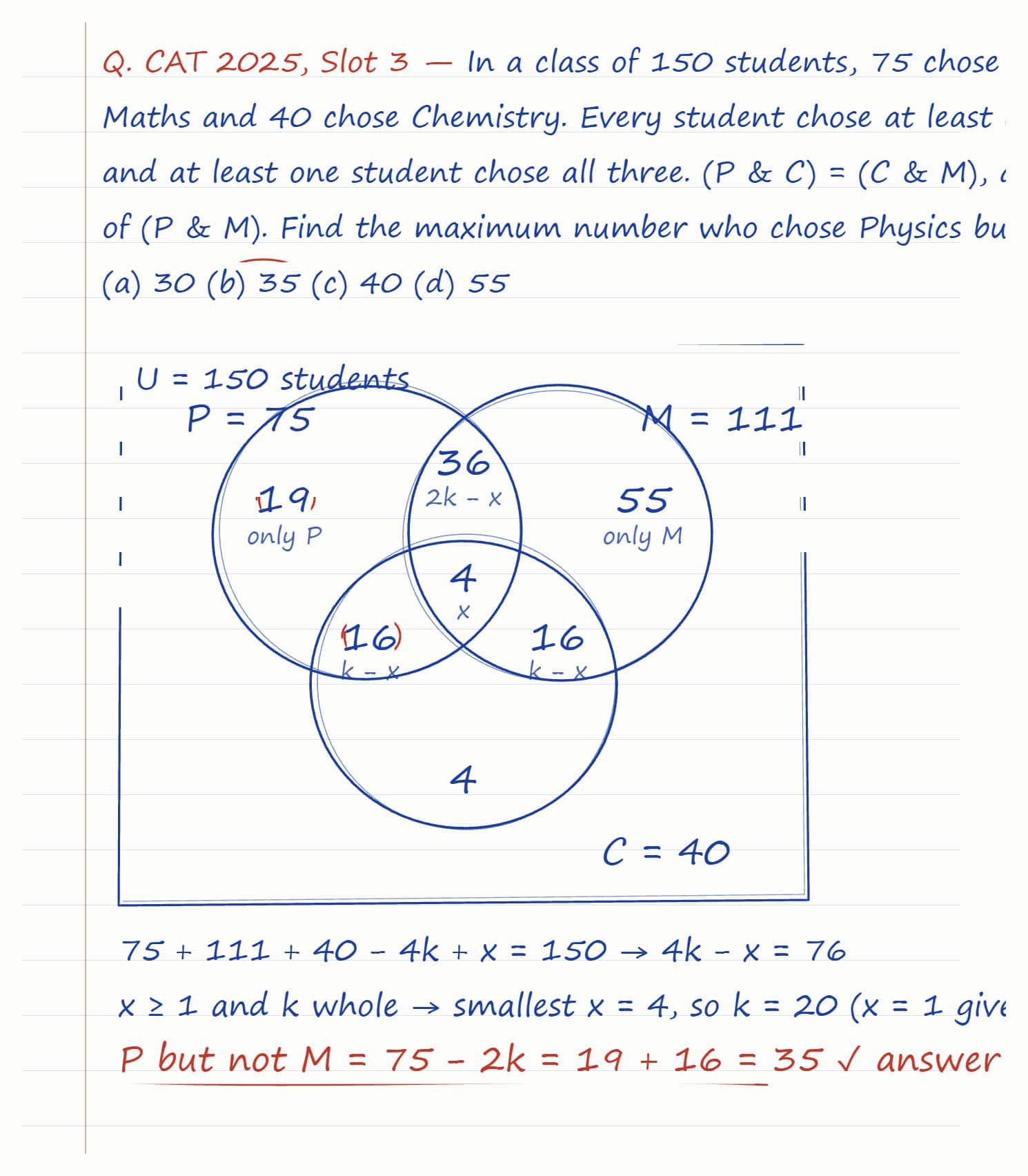
On paper, set theory looks minor: one question in a slot, sometimes none. But it keeps coming back. Two of the three CAT 2025 slots had a set-based question in Quant, and neither was a sitter.
CAT 2025 slot | Set theory in Quant | What was asked |
Slot 1 | 1 question | Finding a valid subset of values that satisfy a greatest-integer condition |
Slot 2 | None | — |
Slot 3 | 1 question | Three-subject Venn diagram with a maximum value to find |
Download Free Practice Tests & Solutions and Ace the CAT Exam 2026
This chapter doesn't need a long CAT formula sheet. The terms and formulas below handle nearly every set question CAT has asked so far.
Term | Meaning | Common wording in CAT |
Union (A ∪ B) | In A, in B, or in both | "At least one" |
Intersection (A ∩ B) | In both A and B | "Both", "A and B" |
Complement (A′) | Not in A | "Did not choose A" |
Only A | In A, not in any other set | "Only A", "A but not B" |
None | Outside all sets | "Neither", "none of the three" |
Two-set formula:
n(A \cup B) = n(A) + n(B) - n(A \cap B)
Three-set formula:
n(A \cup B \cup C) = n(A) + n(B) + n(C) - n(A \cap B) - n(B \cap C) - n(C \cap A) + n(A \cap B \cap C)
"Exactly" formulas (most useful in CAT):
Let E1, E2 and E3 be the number of people in exactly one, exactly two and all three sets.
n(A) + n(B) + n(C) = E_1 + 2E_2 + 3E_3
Also Attempt: CAT Mock Test 2026
Almost every CAT Quant question is one of four types. Spot the type in the first ten seconds, and you already know your first step.
Everything is given except one value. Apply the formula, then subtract from the total. The only real danger is stopping at the union and forgetting the "neither" group.
Example: In a batch of 120 students, 70 play cricket, 55 play football and 25 play both. How many play neither?
Solution: Union = 70 + 55 − 25 = 100. Neither = 120 − 100 = 20.
Here the overlap is missing, and you're asked how large or small it can be. CAT 2025 Slot 3 used this type. It's also where careful students pull ahead of fast ones.
Example: Out of 100 people, 72 drink tea and 65 drink coffee. Find the minimum and maximum number who drink both.
Solution:
Minimum = 72 + 65 − 100 = 37
Maximum = smaller of the two sets = 65
When a question asks for "exactly two" or "more than one", resist the urge to solve all seven regions. The E1 + 2E2 + 3E3 relation gets you there in half the time.
Sometimes set theory hides inside Number Systems. "How many numbers from 1 to 300 are divisible by 2, 3 or 5?" is plain inclusion-exclusion, with numbers in place of people.
Solution: 150 + 100 + 60 − 50 − 30 − 20 + 10 = 220.
Also Read: CAT Number System Questions | CAT Quant Formulas PDF
Candidates can check out the questions asked in CAT 2025 question papers along with the approach from the section below:
Question: Let 3 ≤ x ≤ 6 and [x²] = [x]², where [x] is the greatest integer not exceeding x. If set S represents all feasible values of x, then a possible subset of S is:
(4, √18) ∪ [5, √27) ∪ {6}
[3, √10] ∪ [4, √17] ∪ {6}
[3, √10] ∪ [5, √26]
(3, √10) ∪ [5, √26) ∪ {6}
Answer: Option 4
Solution:
Start with what the condition says. If [x] = n, then [x]² = n². For [x²] to equal n², x² has to stay at or above n² but below n² + 1. In other words:
n ≤ x < √(n² + 1)
Now apply this to each whole-number part between 3 and 6:
[x] | Condition on x² | Valid range of x |
3 | 9 ≤ x² < 10 | 3 ≤ x < √10 |
4 | 16 ≤ x² < 17 | 4 ≤ x < √17 |
5 | 25 ≤ x² < 26 | 5 ≤ x < √26 |
6 | x² = 36 | x = 6 only |
x stops at 6 because the question limits x ≤ 6.
So S = [3, √10) ∪ [4, √17) ∪ [5, √26) ∪ {6}
A subset can leave out parts of S, but it can’t include anything outside S. Check each option:
Option 1: (4, √18) goes past √17. A value like x = 4.2 gives x² = 17.64, so [x²] = 17, not 16. ✗
Option 2: [3, √10] includes √10 itself. At x = √10, x² = 10, so [x²] = 10, not 9. ✗
Option 3: It has the same closed-bracket problem at √10, and at √26 as well. ✗
Option 4: (3, √10) lies inside [3, √10), [5, √26) matches exactly, and {6} is in S. ✓
Question: In the set of consecutive odd numbers {1, 3, 5, …, 57}, there is a number k such that the sum of all the elements less than k is equal to the sum of all the elements greater than k. Then, k equals:
41
39
37
43
Answer: Option 1 (41)
Solution:
Use one well-known fact: the sum of the first m odd numbers is m². For example, 1 + 3 + 5 = 9 = 3².
Step 1: Count the terms. The set runs from 1 to 57, so it has (57 + 1) ÷ 2 = 29 terms. Its total sum is 29² = 841.
Step 2: Write k in terms of m. If m odd numbers come before k, then k is the (m + 1)th odd number, so k = 2m + 1.
Step 3: Set up the equation.
Sum before k = m²
Sum after k = 841 − m² − k
These two sums are equal:
m² = 841 − m² − (2m + 1)
2m² + 2m − 840 = 0
m² + m − 420 = 0
(m + 21)(m − 20) = 0
So m = 20, which gives k = 2 × 20 + 1 = 41.
Check: The sum before 41 is 20² = 400. The sum after 41 is 841 − 400 − 41 = 400. ✓
Faster method for the exam: Since sum before = sum after, each one is (841 − k) ÷ 2. The sum before must also be a perfect square. Try the options:
k = 41 gives (841 − 41) ÷ 2 = 400 = 20². ✓
Also Read: CAT 2025 Question Paper with Solutions | CAT Previous Year Papers PDF
A CAT Data Interpretation and Logical Reasoning Venn set rarely gives its numbers in a neat order. The clues come in pieces, and some are useless until others are filled in. So the real skill here is the order you work in, not the formulas.
Choose the right diagram. Use circles for two or three categories. For four or more, use a table with a yes/no column for each category.
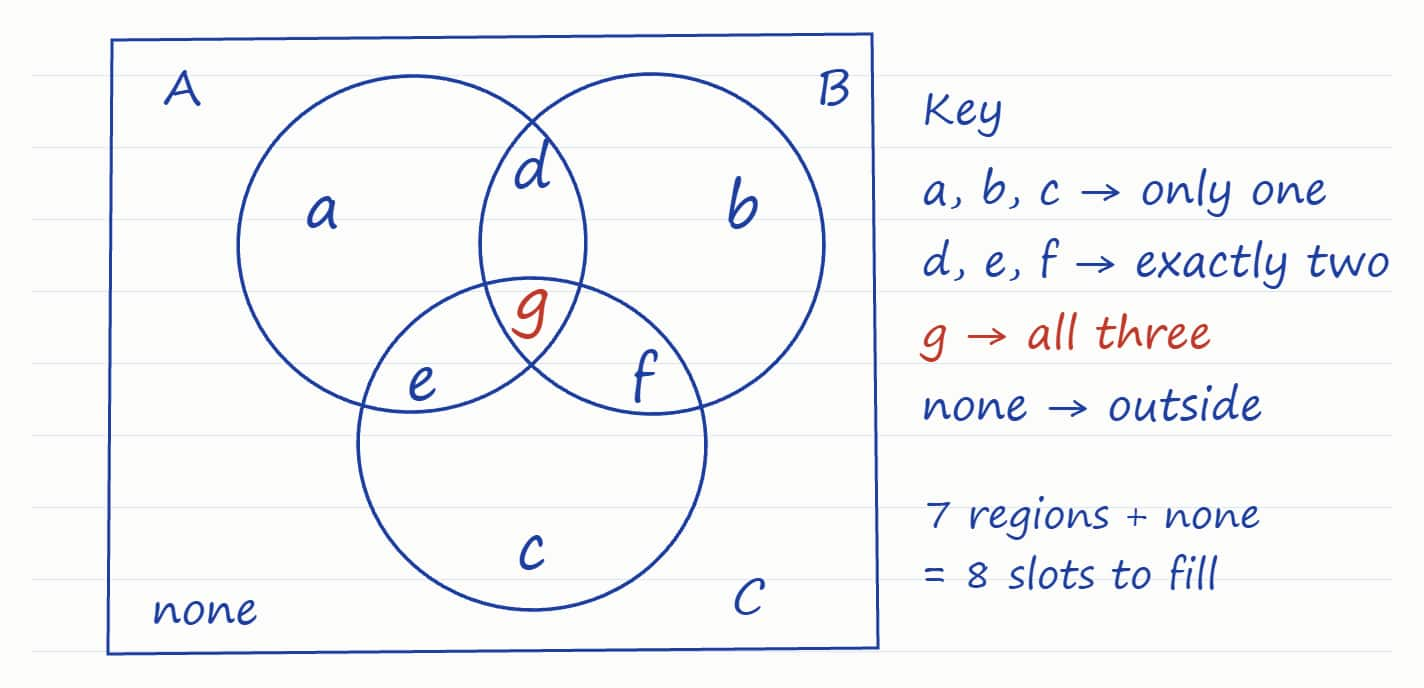
2. Label every region first. Name the seven regions of a three-set diagram, plus “none”, before reading the clues.
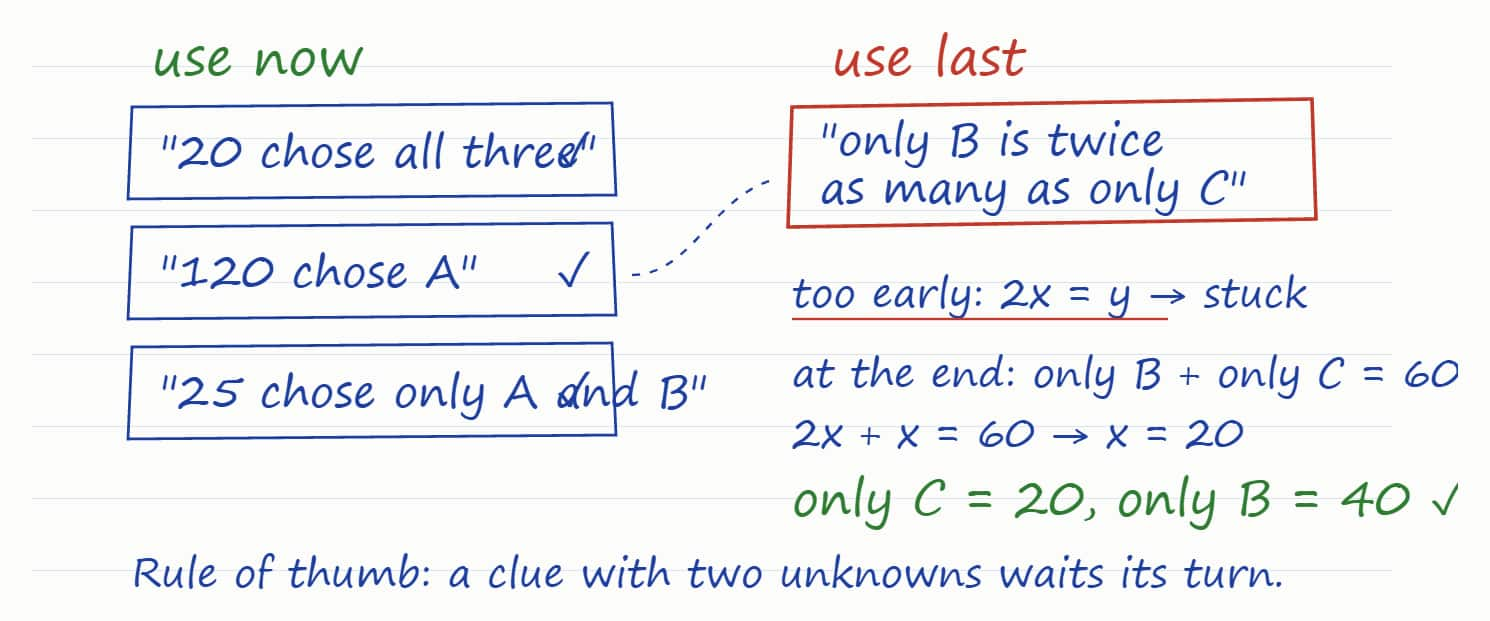
3. Start with the anchor clue. This is the clue that fixes one region directly, such as “all three” or “only A and B”.
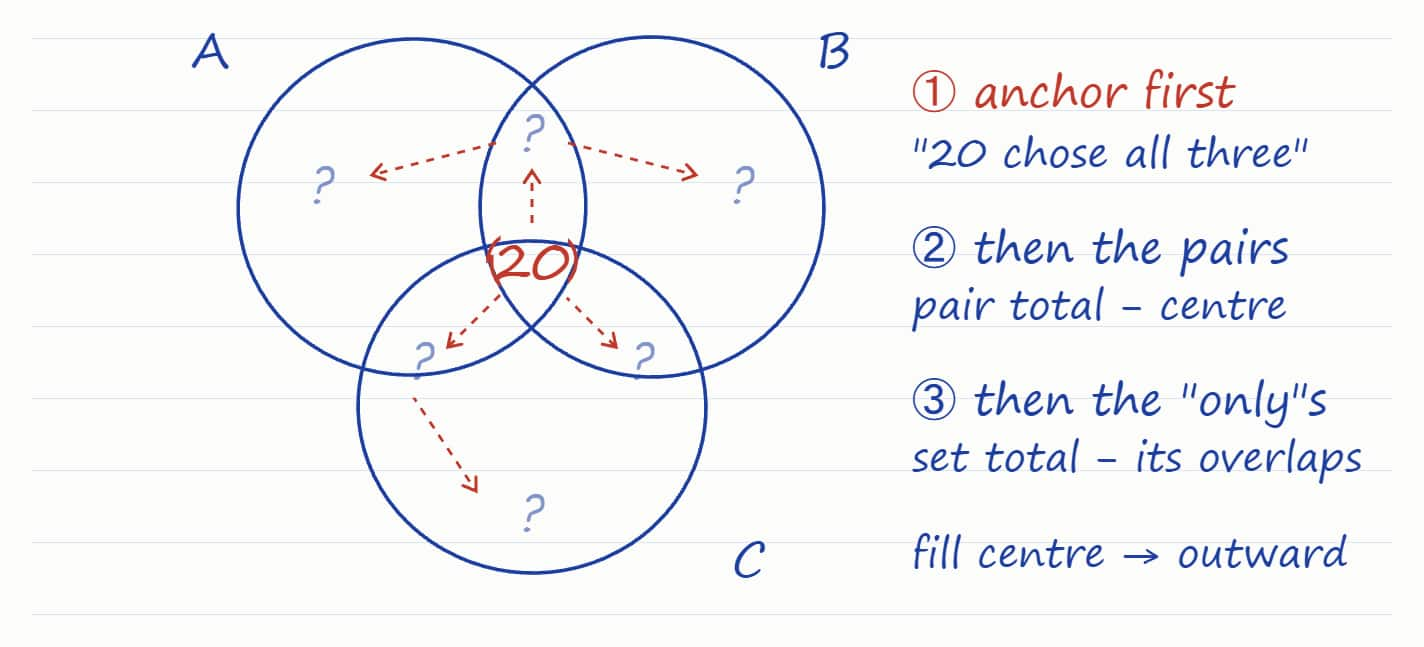
4. Keep ratio clues for the end. Clues like “twice as many” work only once the other regions are known.
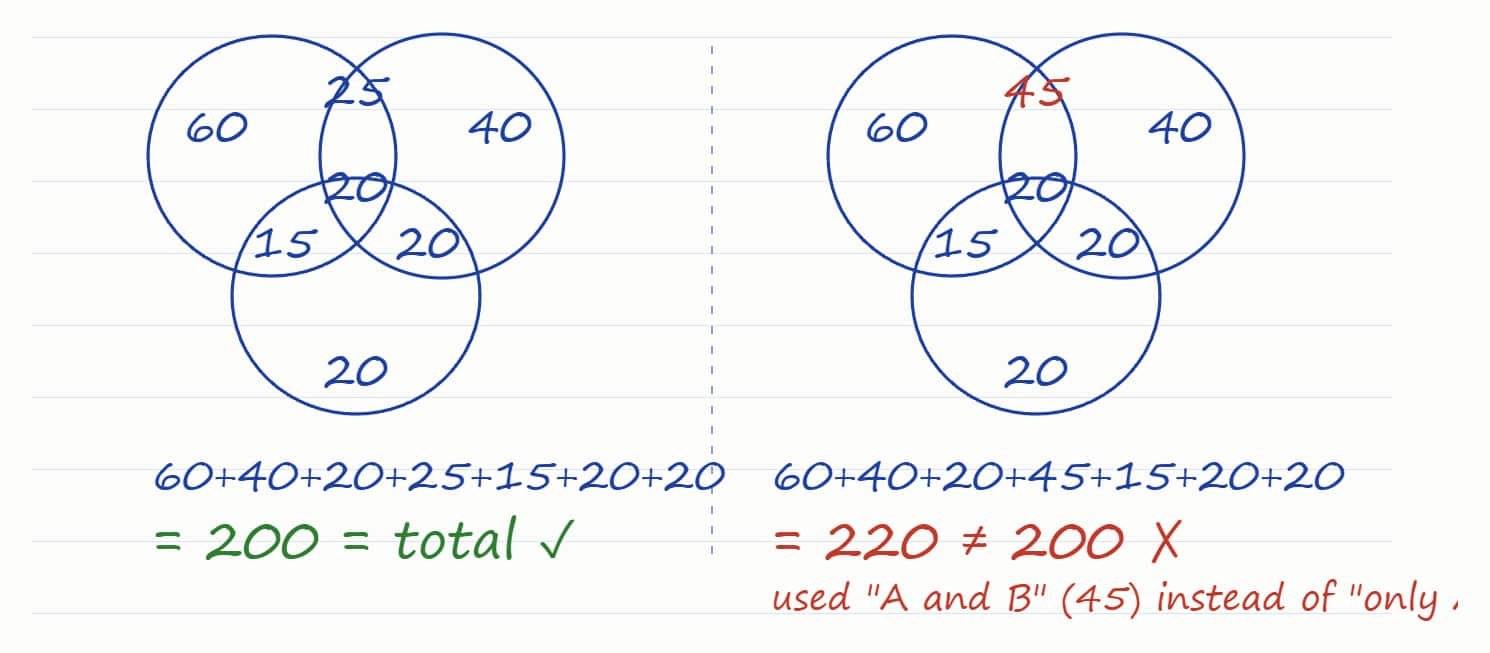
5. Check the total. All regions together must add up to the total given.
Get the download links of the latest CAT 2026 ebooks from the table below:
CAT 2026 Quantitative Aptitude 20 Free Sectional Tests | |
CAT 2026 DILR Masterbook - Practice 100 DILR Sets to score 90+ Percentile | |
100 Quant Facts Every CAT Aspirant Must Know | |
CAT 2026 Modern Maths PDF Handbook: Key Concepts, Tricks & PYQ-Based Practice | |
CAT Quant PYQs- Complete 5-Year Question Bank (2021 - 2025) PDF | |
CAT DILR PYQs Complete 5-Year Question Bank (2021 - 2025) | |
CAT 2026: 10 Most Repeated Concepts in Quant | |
CAT 2026 DILR SAMPLE PAPER | |
CAT 2026 Quant SAMPLE PAPER |
Frequently Asked Questions (FAQs)
CAT 2026 is on Sunday, November 29, 2026, in three sessions, and IIM Indore is conducting it. Admit cards are available on iimcat.ac.in from November 4.
Usually one per slot. In CAT 2025, Slot 1 and Slot 3 each had one set-based question, and Slot 2 had none. It’s an easy 3 marks if you prepare.
No. But Venn sets appeared in CAT 2018, 2019, 2020 and 2022, so practise at least two or three before the exam.
Yes, along with permutations, combinations and probability. It’s the simplest topic of the group. Most marks are lost to misreading the question, not to the concepts.
n(A) + n(B) + n(C) = E1 + 2E2 + 3E3, where E1, E2 and E3 are the people in exactly one, exactly two and all three sets. It solves most “exactly two” and “more than one” questions in two lines.
Use the official question papers that IIMs release through the CAT candidate login after each exam. Solve every set theory question from the last five or six years with a timer. For each one you get wrong, note the word you misread, usually “only”, “exactly” or “at least”.

On Question asked by student community
Hi Khushdeep
Several apps and online platforms are available for CAT (Common Admission Test) preparation. Students can choose a platform based on their preparation needs, such as video lectures, practice questions, mock tests, and performance analysis.
Hello, for AP NEET PG Category C seats, NRI documents are generally required if you are applying under the NRI quota, and eligibility depends on the applicable counselling rules. The fee payment currency and procedure should be confirmed from the current Dr. NTRUHS notification at its official website drntr.uhsap.in.
Hello, CAT aur B-school entrance exams ke baare mein aap exam dates, eligibility, registration, exam pattern, syllabus, colleges ya admission process ki information dekh sakte hain. Aapki requirement ke according relevant details yahan mil sakti hain: https://bschool.careers360.com/exams
You can download the latest CAT syllabus from here:
Hey there,
For a B.Sc. with Chemistry, Botany and Zoology (CBZ), if the CAT application asks separately for:
If the Discipline dropdown has a more specific option such as “Biological Sciences,” “Life Sciences,” or “Zoology/Botany,”
Directions for question:
The bar-graph given below shows the foreign exchange reserves of Nepal (in million Rupees) from 2014 to 2021. Answer the following questions based on the graph :

Question:
What was the percentage increase (rounded to the nearest integer, if deemed necessary) in the foreign exchange reserves in

Globally Recognized by AACSB (US) & AMBA (UK) | 18 LPA Avg. CTC for PGPM 2026 | Last Date to Apply: 26th November
Applications Closing Soon! | 75+ years of legacy | #1 Entrance Test | 100+ Test Cities | 250+ B-Schools accept XAT Score
Gateway to IBS Hyderabad & 8 other IBS campuses | Scholarships worth 10 CR
Highest Package 29.30 LPA | 230+ Recruiters | AACSB Accredited | Ranked 51 in Asia by QS International | Last Date to Apply: 7th December
Elite round PGDM applications are closing on 27th Nov 2026 | Highest CTC 28 LPA | Average CTC 10.67 LPA
UG Scholar's Round Deadline: 1st Dec'26 | Earn upto 50% merit Scholarship + 10% for top performers | Highest CTC 18 LPA