Great Lakes - PGDM & PGPM Admissions 2027
Globally Recognized by AACSB (US) & AMBA (UK) | 18 LPA Avg. CTC for PGPM 2026


CAT does not publish a detailed topic-wise syllabus, so previous years' question papers are an important source for identifying recurring concepts and question types. An analysis of CAT papers from 2016 to 2025 shows consistent importance for areas such as Arithmetic, Algebra, Reading Comprehension and different DILR set formats, although their weightage can vary across years and slots. With CAT 2026 scheduled for November 29, 2026, this article analyses the most important topics from the past 10 years and explains how candidates can use these trends during the final phase of preparation.

Get access to previous CAT question papers with answers to understand exam trends, improve accuracy, and strengthen your CAT 2026 preparation.
Before looking at topics, it helps to know how the exam itself has changed. Here is the exam pattern data over the years.
Year | Total Questions | VARC | DILR | QA | Section Time |
2024-25 | 68 | 24 | 22 | 22 | 40 min each |
2021-23 | 66 | 24 | 20 | 22 | 40 min each |
2020 | 76 | 26 | 24 | 26 | 40 min each |
2016-19 | 100 | 34 | 32 | 34 | 60 min each |
The number of questions and section timings have changed over the years, while the three-section structure and +3/-1 marking scheme have remained broadly consistent.TITA/non-MCQ questions do not have negative marking. CAT shifted from a 180-minute exam in 2019 to a 120-minute exam from 2020 onward.
See what previous CAT papers under IIM Indore reveal about possible exam trends for CAT 2026. CAT 2026 Under IIM Indore
One thing that we saw across CAT topic-wise weightage analyses is that Arithmetic has consistently dominated the Quantitative Aptitude section.
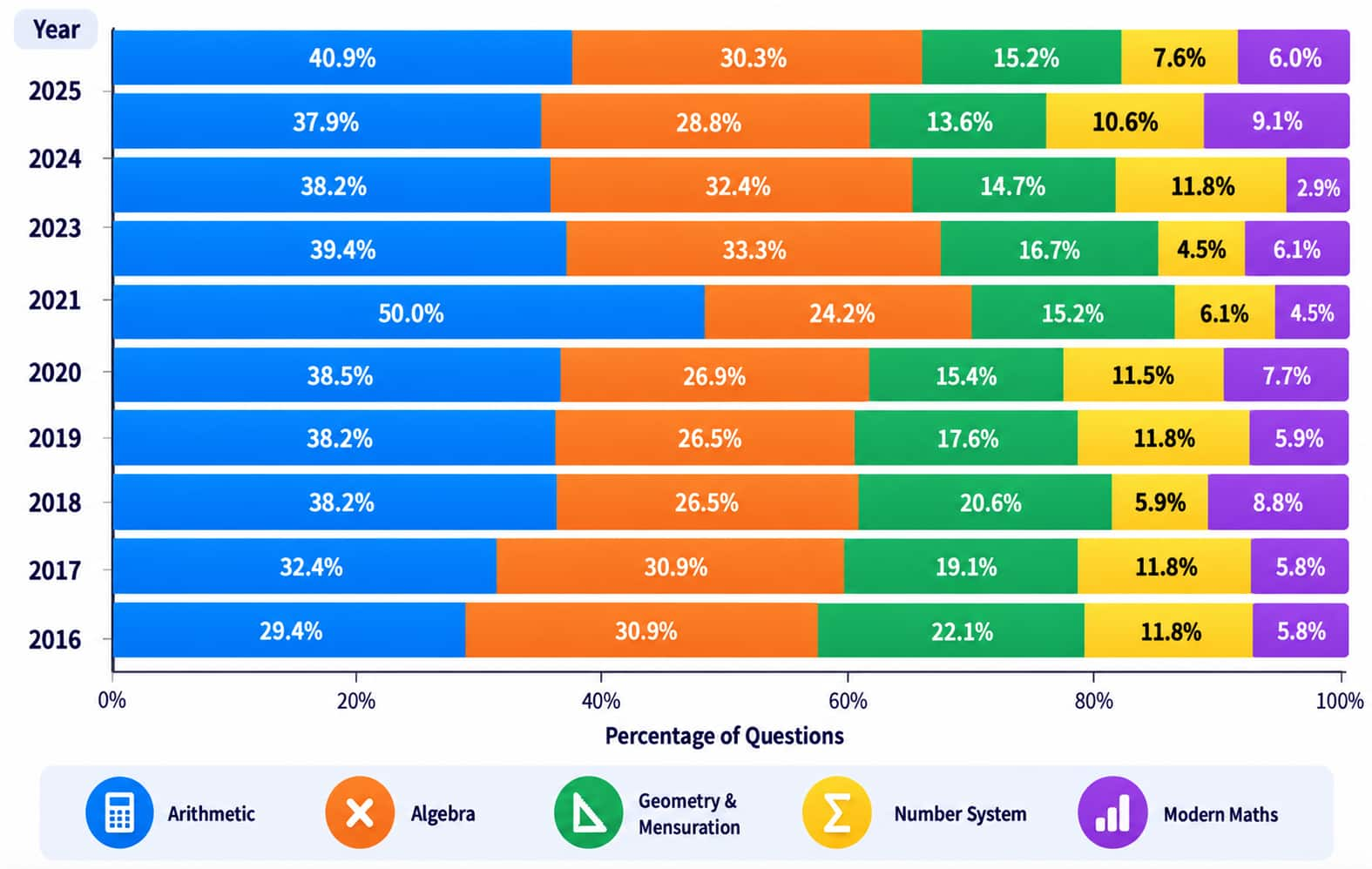
In the latest CAT papers, Arithmetic and Algebra combined would constitute roughly two-thirds to three-fourths of QA, but it varies from year to year and from slot to slot. Arithmetic comprises topics such as percentages, ratios, averages, time-speed-distance, and profit and loss while Algebra is made up of equations, functions, and inequalities.
Geometry and Number System make an appearance, but they are present in smaller proportions. Modern Maths (permutations, combinations, probability) also has a minuscule share.
Key takeaway for CAT aspirants: Arithmetic and Algebra are the key areas that have to be focused on as they dominate the QA section. You must do well in these two areas if you want to score high in the CAT QA.
CAT Quant PYQ Practice: Prepare for the upcoming CAT 2025 with this meticulously crafted CAT Quantitative Aptitude question bank covering last 5 years (2021-2025) of CAT Exam
VARC shows the most consistent pattern of all three sections. Reading Comprehension (RC) has made up roughly two-thirds of VARC questions in most recent years.
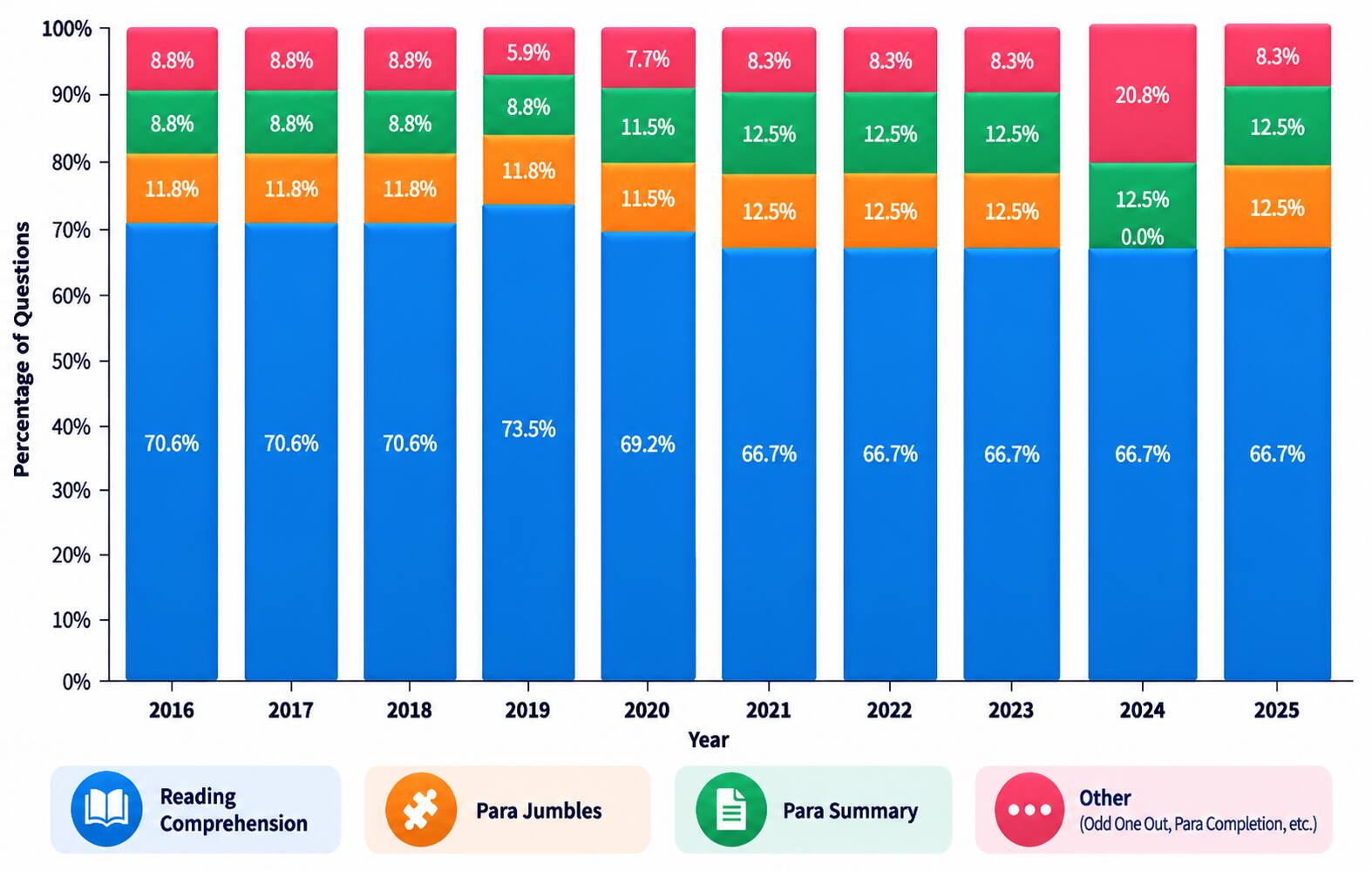
The remaining Verbal Ability questions rotate between para jumbles, para summary, odd sentence out, and para completion - but the exact mix of these four types changes almost every year. RC does not.
What this means for your prep: since RC is worth close to two-thirds of VARC marks, reading speed and comprehension accuracy matter more than grammar rules. CAT does not typically test direct grammar or vocabulary questions - it tests how well you understand and reason through a passage.
CAT VARC PYQ Practice: Improve your reading and verbal skills with this 5-year VARC question bank covering CAT 2021-2025.
DILR is the section coaching institutes call the hardest to predict, and the data backs that up. Unlike QA and VARC, the exact topic mix in DILR shifts every year - 2022 had a near-even split between reasoning-based DI and table-graph sets, while 2023 leaned almost entirely on tables, graphs, and arrangement-style sets.
A few formats return again and again across the last several years:
Arrangements and puzzles - seating arrangements, distribution problems, and logic-based sequencing
Games and tournaments - a format that has appeared in recent CAT papers
Bar graphs, line graphs, and Venn diagrams - the standard data-reading sets
Data sufficiency - a smaller but recurring format
The one thing that stays constant is the difficulty. Slot-wise analyses of recent CAT papers, including CAT 2025, consistently rank DILR as the toughest of the three sections, mainly because it is time-intensive rather than concept-heavy.
Unlike QA and VARC, DILR is particularly difficult to represent with one fixed 10-year percentage table because CAT questions are presented as sets, and many sets combine DI and LR concepts. Different analyses therefore classify the same set differently.
What this means for your prep: in DILR, set selection matters as much as accuracy. Strong candidates typically scan the sets first and choose the most solvable ones.
CAT DILR PYQ Practice: Build speed and accuracy with this 5-year DILR question bank covering CAT 2021-2025.
Pulling all three sections together, here are the areas that have remained consistently important across CAT papers in the last 10 years:
Arithmetic (QA) - percentages, ratios, averages, time-speed-distance
Algebra (QA) - equations, functions, inequalities
Reading Comprehension (VARC) - passage-based questions across varied topics
Arrangement and puzzle-based sets (DILR) - logic-driven, not calculation-driven
Data reading sets (DILR) - bar graphs, line graphs, tables
Globally Recognized by AACSB (US) & AMBA (UK) | 18 LPA Avg. CTC for PGPM 2026
Test centres are available in 70+ cities across India | 75,000+ aspirants apply for the NMAT exam | Accepted by 58+ institutions like NMIMS, KJSIM, ISB, SPJIMR and Great Lakes.
These five areas form a strong backbone for CAT preparation. Everything else - Geometry, Number Systems, Modern Maths, Para Jumbles, Data Sufficiency - adds up to meaningful marks too, but none of them have shown the same year-on-year consistency as this core group.
With limited preparation time remaining, candidates can use the past 10-year trends to structure revision rather than attempting to cover every topic equally. The priority should be based on recurring question areas as well as individual performance in PYQs and mock tests.
| Section | Areas to Prioritise | How to Practise |
|---|---|---|
| QA | Arithmetic and Algebra | Revise concepts and solve CAT-level PYQs |
| VARC | Reading Comprehension | Practise passages and analyse incorrect answers |
| DILR | Arrangements, puzzles and data-based sets | Practise set selection and timed solving |
| QA | Geometry and Number System | Revise key concepts and solve representative PYQs |
| VARC | Para Summary, Para Jumbles and other VA types | Practise regularly alongside RC |
The objective is to strengthen recurring areas while using mock-test analysis to identify topics that require additional revision.
Analyse the CAT 2025 slot-wise weightage matrix to understand section and topic-level trends across slots.
Download Now: CAT 2025 Slot-wise Weightage Matrix
Past CAT papers can show which topics have appeared frequently, but they cannot establish the exact topic-wise distribution of CAT 2026. Question counts and difficulty can vary across years and slots, and CAT does not publish an official topic-wise breakup.
Candidates should therefore use historical weightage as a preparation reference rather than a prediction of the upcoming paper. PYQs, sectional tests and mock-test analysis can help determine whether a topic needs further practice.
You do not need to memorise every percentage in the tables above. Use this data the way toppers do:
Spend the largest share of your Quant prep time on Arithmetic and Algebra, not spread equally across all topics.
In VARC, prioritise RC practice over grammar rules, since RC accounts for most of the VARC section.
In DILR, practice picking the right sets quickly instead of trying to solve every set in a mock.
Revisit this weightage pattern after every mock test, and check whether your accuracy in these five core areas is improving.
With CAT 2026 approaching, previous year questions can be used for targeted revision instead of only completing large question sets. Focus on understanding how familiar concepts are framed and identify the types of questions that repeatedly lead to errors.
QA: Revise recurring Arithmetic and Algebra concepts through PYQs.
VARC: Solve RC passages regularly and analyse why an option is correct or incorrect.
DILR: Practise different set formats and focus on identifying solvable sets quickly.
Error analysis: Maintain a short record of recurring conceptual, calculation and interpretation mistakes.
Mock integration: After each mock, return to PYQs or practice questions from topics where performance was weak.
This approach allows candidates to use the 10-year analysis as a revision framework while keeping preparation aligned with their actual performance.
Take a free CAT mock test to assess your preparation and improve your exam readiness.
Attempt Now: Free CAT 2026 Mock Test
Practise with 20 CAT mock tests featuring questions, solutions, and expert guidance.
Download Now: 20 CAT Mock Test Series
CAT does not publish an official topic-wise breakup. The percentages here are based on analyses of actual and memory-based CAT papers from 2016 to 2025, cross-checked across multiple sources. Minor variations are normal because CAT papers differ across slots.

On Question asked by student community
Hello, for AP NEET PG Category C seats, NRI documents are generally required if you are applying under the NRI quota, and eligibility depends on the applicable counselling rules. The fee payment currency and procedure should be confirmed from the current Dr. NTRUHS notification at its official website drntr.uhsap.in.
Hello, CAT aur B-school entrance exams ke baare mein aap exam dates, eligibility, registration, exam pattern, syllabus, colleges ya admission process ki information dekh sakte hain. Aapki requirement ke according relevant details yahan mil sakti hain: https://bschool.careers360.com/exams
You can download the latest CAT syllabus from here:
Hey there,
For a B.Sc. with Chemistry, Botany and Zoology (CBZ), if the CAT application asks separately for:
If the Discipline dropdown has a more specific option such as “Biological Sciences,” “Life Sciences,” or “Zoology/Botany,”
Hey there,
Yes. With 2 years of work experience, you are eligible to target the regular 2-year MBA at IIM Calcutta as long as you have a bachelor's degree with at least 50% marks (45% for SC/ST/PwD). Work experience is not required for eligibility.
For
Directions for question:
The bar-graph given below shows the foreign exchange reserves of Nepal (in million Rupees) from 2014 to 2021. Answer the following questions based on the graph :

Question:
What was the percentage increase (rounded to the nearest integer, if deemed necessary) in the foreign exchange reserves in

Globally Recognized by AACSB (US) & AMBA (UK) | 18 LPA Avg. CTC for PGPM 2026
Gateway to IBS Hyderabad & 8 other IBS campuses | Scholarships worth 10 CR
Among top 6% B-Schools globally to be accredited by AACSB | Highest Package-35 LPA
1 Exam accepted by 17 Top Symbiosis Institutes for 32 MBA programmes.
Test centres are available in 70+ cities across India | 75,000+ aspirants apply for the NMAT exam | Accepted by 58+ institutions like NMIMS, KJSIM, ISB, SPJIMR and Great Lakes.
Highest CTC- 21 LPA | Average CTC- 10.38 LPA Scholarships Available | MBA in Forestry Management MBA in Sustainability Management MBA in Sustainable Development MBA in Development and Sustainable Finance