Birla Institute of Management Technology, Greater Noida
AACSB Accredited | Highest CTC: 22 LPA


Preparing for CAT alongside a government exam can be practical when both exams share a strong aptitude foundation, but the preparation cannot remain identical throughout. CAT places greater emphasis on conceptual application, while exams such as SSC CGL and banking exams also require speed, accuracy and familiarity with recurring question formats. With CAT 2026 scheduled for November 29, 2026, candidates with limited time should focus on common topics first and then give targeted attention to the exam-specific areas, mock tests and revision required for each exam. An effective CAT 2026 preparation strategy is to build a common aptitude base first before moving to exam-specific topics.
This Story also Contains
Mocks don't just measure your preparation - they reveal how you'll think under pressure on the actual CAT. Attempt Now
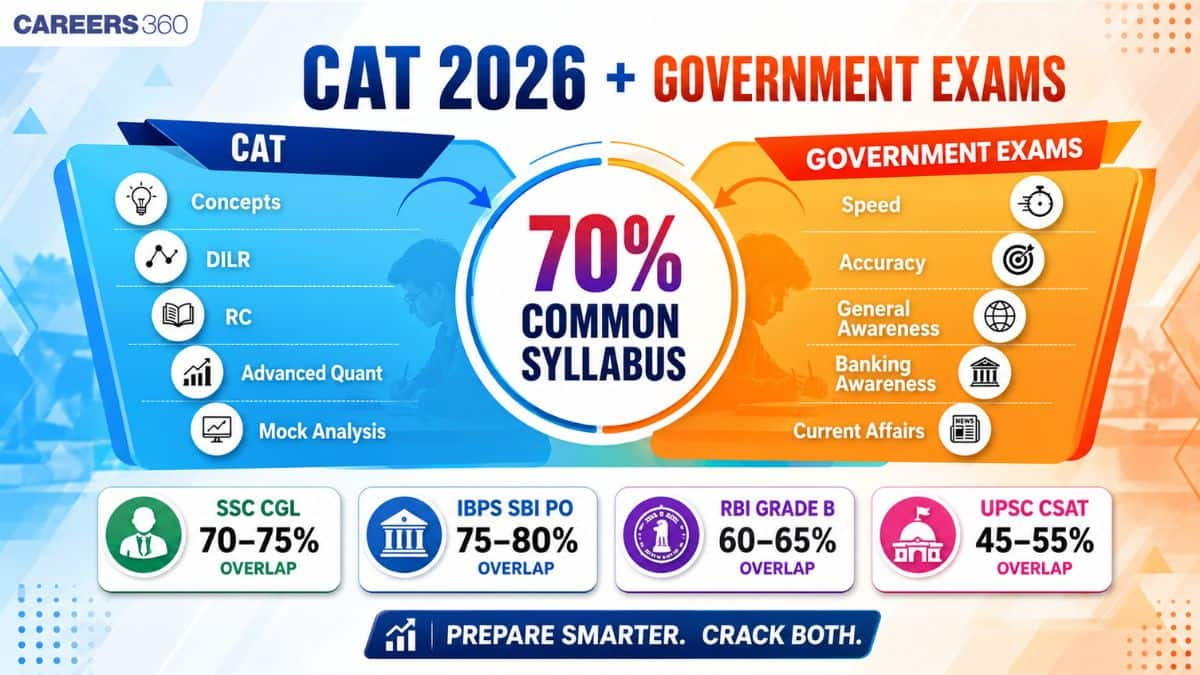
Yes, but your success depends less on managing two exams and more on understanding how much of the preparation is shared. While CAT 2026 and government exams have different objectives.
CAT = concepts
Government exams = speed
What’s common, what’s different:
Government Exam | Approx. Syllabus Overlap with CAT | Common Subjects | Additional Preparation Required | Dual Preparation Suitability |
75-80% | Quantitative Aptitude, Data Interpretation, Logical Reasoning, English | Banking Awareness | Highly Recommended | |
70-75% | Arithmetic, Algebra, English, Logical Reasoning | General Awareness | Highly Recommended | |
RBI Grade B (Phase I) | 60-65% | Quantitative Aptitude, English, Logical Reasoning | Economics, Finance, Current Affairs | Recommended with Additional Preparation |
UPSC CSE (CSAT) | 45-55% | Reading Comprehension, Aptitude, Logical Reasoning | General Studies, Essay, Optional Subject | Suitable with Careful Planning |
Banking exams are the closest match to CAT, so they end up being one of the best picks for dual preparation.
Should I prepare for CAT along with SSC? SSC CGL also lines up well since the aptitude base stays strong, and General Awareness becomes the main extra subject you have to handle.
RBI Grade B is still manageable alongside CAT till Phase II kicks in, and then Economics, plus Finance, start demanding attention.
UPSC CSAT overlaps with CAT on aptitude, but the huge General Studies syllabus means balancing both noticeably tougher.
If you're preparing for... | Is CAT preparation a good parallel choice? | Why? |
SSC CGL | Yes | High overlap in Quant, English, and Reasoning with limited additional subjects. |
IBPS PO / SBI PO | Yes | Strongest overlap across aptitude sections; only Banking Awareness needs separate focus. |
RBI Grade B | Yes, with planning | Phase I overlaps well, but Phase II requires dedicated subject preparation. |
UPSC CSE | Depends | Suitable if your aptitude foundation is strong and you can separately manage General Studies. |
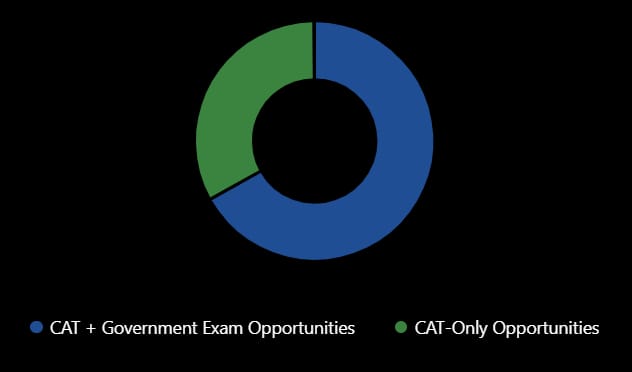 CAT vs Government Exams: Where Does the Preparation Overlap?
One of the biggest misconceptions among aspirants is that CAT and government exams have completely different syllabuses. In reality, there is overlap in the fundamentals, and the difference is in the level of application, the question style and also time management.
The following topics form the core of both CAT and most aptitude-based government exams, so you don’t have to start from scratch twice.
Topic | CAT | SSC CGL | Banking Exams | RBI Grade B | UPSC CSAT | Can Be Prepared Together? |
Arithmetic | Yes | Yes | Yes | Yes | Yes | Yes |
Algebra | Yes | Yes | Partial | Partial | Partial | Mostly |
Number System | Yes | Yes | Yes | Yes | Yes | Yes |
Yes | Yes | Yes | Yes | Yes | Yes | |
Reading Comprehension | Advanced | Basic | Moderate | Advanced | Advanced | Yes |
Vocabulary & Grammar | Advanced | Standard | Standard | Standard | Basic | Yes |
Insight: Roughly 60-80% of your aptitude preparation can be reused between CAT and exams such as SSC CGL or IBPS PO.
Think of a mock series as your performance dashboard, highlighting strengths, weak spots, and section-wise growth. Start Practising.
Even if the foundation stays the same, these other areas still need dedicated prep, depending on what exam you’re aiming for.
Get the actual CAT previous year question papers here
A significant part of aptitude preparation can be shared across CAT and several government exams. The extent of overlap varies by examination, so candidates should use the common areas to save preparation time while separately covering topics that are specific to their target exam.
| Common Area | CAT | Government Exams | Preparation Approach |
|---|---|---|---|
| Arithmetic | High-level application | Speed-based questions | Build concepts first, then practise under time limits |
| Logical Reasoning | DILR-based reasoning | Standalone reasoning questions | Practise both sets and individual questions |
| Reading Comprehension | Major part of VARC | Varies by exam | Regular reading and timed comprehension practice |
| Data Interpretation | Often integrated with DILR | Common in aptitude sections | Practise tables, graphs and calculation-based sets |
| English | RC, para-based questions and verbal reasoning | Grammar, vocabulary and comprehension vary by exam | Add exam-specific English practice |
| Current Affairs / Awareness | Not a core CAT section | Important in several government exams | Prepare separately according to the target exam |
The shared foundation can reduce duplicated effort, but the level, format and time pressure should be practised separately for each examination.
Aspect | CAT | Government Exams |
Focus | Conceptual problem-solving | Speed and accuracy |
Question Pattern | Fewer but more challenging questions | More questions with shorter solving time |
Difficulty Level | Moderate to High | Easy to Moderate (varies by exam) |
Preparation Style | Deep understanding and analysis | Extensive practice and quick execution |
Success Depends On | Selection of the right questions and accuracy | Attempt rate, speed, and consistency |
Download Free Practice Tests & Solutions and Ace the CAT Exam 2026
Build a common aptitude foundation during the initial months, then gradually increase exam-specific preparation as the exam dates approach.
Align your preparation with the exam calendar, not staying the same all year.
| Timeline | Primary Focus | Secondary Focus |
|---|---|---|
| Around 2 months before CAT | CAT mocks, PYQs, revision and weak-area improvement | Maintain essential government-exam aptitude and exam-specific topics |
| Last 4-6 weeks before CAT | Full-length CAT mocks, sectional tests, analysis and time management | Targeted revision for the government exam |
| Last 2 weeks before CAT | CAT exam strategy, mock analysis and final revision | Maintain only essential practice for the government exam |
| After CAT, before the government exam | Government-exam-specific syllabus, mocks and speed-based practice | Revise common aptitude concepts as required |
Shift your focus towards whichever examination is scheduled first while maintaining light revision for the other.
With around two months remaining for CAT 2026, candidates preparing for a government exam at the same time should avoid splitting their preparation equally by default. The schedule should reflect the examination dates and the amount of preparation already completed.
CAT: Prioritise full-length mocks, sectional tests, PYQs, revision and analysis of recurring mistakes.
Shared aptitude: Continue practising Quant, Reasoning and Reading Comprehension through questions relevant to both exams.
Government exam-specific topics: Reserve dedicated time for areas such as General Awareness, Banking Awareness, Economics or other subjects required by the target examination.
Time management: Practise each exam using its actual format and time limits rather than assuming one timing strategy will work for both.
Mock analysis: Maintain separate performance records for CAT and the government exam to identify exam-specific weaknesses.
The closer examination should receive greater attention, while the other exam can be maintained through targeted revision and practice.
If you’re aiming for CAT preparation without coaching and at the same time prepping for government exams, then picking the right resources matters more than counting study hours; The hours are there, but selection steers everything.
A practical self-study could look like this:
- Stick to one Quant and Reasoning source instead of juggling separate books for CAT and for government exams.
- Do Reading Comprehension practice daily, because it really helps both CAT and RBI Grade B and UPSC CSAT exams; you’ll notice the pattern sooner rather than later.
- Take separate mock tests for each exam, so you can spot the differences in question layout and how you manage time, especially under pressure.
- Keep short notes for formulas, vocab, and current affairs, rather than re-reading multiple resources again and again.
Time | Focus |
1.5 hrs | Quant |
1 hr | Reasoning |
45 min | RC |
30 min | Current Affairs |
45 min | Mock Analysis |
Solve previous CAT papers to experience how concepts are tested - not just what concepts are important. Practice now: Past 10 years' CAT Question Papers with Solutions
Instead of following a fixed percentage throughout the preparation period, candidates can adjust their study time according to the exam calendar. A practical split for the final phase can look like this:
| Preparation Area | Suggested Focus |
|---|---|
| CAT Quant and VARC | PYQs, revision and timed practice |
| CAT DILR | Regular set practice and mock analysis |
| Government exam aptitude | Speed-based practice and exam-specific questions |
| Government exam subjects | General Awareness, Banking Awareness, Economics or other required areas |
| Mocks and analysis | Separate mocks for each examination |
If CAT is the nearer examination, increase CAT-focused testing and revision while maintaining the government exam through essential practice. Once CAT is over, the available study time can be redirected towards the remaining government-exam syllabus.
Rather than dividing your schedule by exams, divide it by preparation purpose.
Allocation | Focus |
70% | Shared aptitude topics common to CAT and government exams |
20% | Exam-specific subjects such as DILR, General Awareness, Banking Awareness, or Economics |
10% | CAT Mock tests, performance analysis, and revision |
How to Prepare for CAT and Government Exams in 6 Months
Dual preparation is most effective for aspirants targeting CAT alongside banking or SSC exams because of the significant syllabus overlap. UPSC aspirants should attempt it only if their General Studies preparation is already well structured.
Who Should Consider Dual Preparation?
When Should You Avoid Dual Preparation?
Trying to prepare for both exams might not be the best idea if you’ve got less than 3-4 months before your first big exam, or if you’re still forming basic aptitude concepts from scratch (you’re starting again). Also, when your target government exam has a very syllabus-heavy, subject-oriented structure that really needs dedicated grind, juggling both plans can end up messing with your mock test flow, or at least your consistency.
Frequently Asked Questions (FAQs)
Yes. CAT and SSC CGL share a solid base in Quantitative Aptitude, Logical Reasoning, and English. If you prepare these parts conceptually for CAT and then add General Awareness, plus SSC-style practice becomes practical and time-efficient too.
UPSC aspirants usually get edge in Reading Comprehension, reasoning, and aptitude because of CSAT. Still, CAT needs stronger Data Interpretation, Logical Reasoning, and more advanced Quantitative Aptitude.
The exact study duration depends on where you are right now and what percentile you’re aiming for. For people aiming at CAT as well as government exams, around 5 to 7 focused hours a day tend to be enough if the basic aptitude portion is studied together and the exam-specific work is handled a bit differently, later on. Not everything should be mashed in the same session; otherwise, too much at once, so a separate plan for each exam helps.
Yes, banking exams have one of the highest syllabus overlaps with CAT, especially around Quantitative Aptitude, Data Interpretation and Logical Reasoning, plus English. Usually, banking aspirants need extra practice with those difficult DILR sets and also CAT-like Reading Comprehension.
The main common areas are Arithmetic, Number System, Algebra, Logical Reasoning, Reading Comprehension, Vocabulary, and basic Data Interpretation. The real differences show up in General Awareness, Banking Awareness, Economics, General Studies, and CAT’s advanced DILR section.

On Question asked by student community
Hi Khushdeep
Several apps and online platforms are available for CAT (Common Admission Test) preparation. Students can choose a platform based on their preparation needs, such as video lectures, practice questions, mock tests, and performance analysis.
Hello, for AP NEET PG Category C seats, NRI documents are generally required if you are applying under the NRI quota, and eligibility depends on the applicable counselling rules. The fee payment currency and procedure should be confirmed from the current Dr. NTRUHS notification at its official website drntr.uhsap.in.
Hello, CAT aur B-school entrance exams ke baare mein aap exam dates, eligibility, registration, exam pattern, syllabus, colleges ya admission process ki information dekh sakte hain. Aapki requirement ke according relevant details yahan mil sakti hain: https://bschool.careers360.com/exams
You can download the latest CAT syllabus from here:
Hey there,
For a B.Sc. with Chemistry, Botany and Zoology (CBZ), if the CAT application asks separately for:
If the Discipline dropdown has a more specific option such as “Biological Sciences,” “Life Sciences,” or “Zoology/Botany,”
Directions for question:
The bar-graph given below shows the foreign exchange reserves of Nepal (in million Rupees) from 2014 to 2021. Answer the following questions based on the graph :

Question:
What was the percentage increase (rounded to the nearest integer, if deemed necessary) in the foreign exchange reserves in

Globally Recognized by AACSB (US) & AMBA (UK) | 18 LPA Avg. CTC for PGPM 2026
Complete your XAT Application by 11th Nov & get more preparation support | 75+ years of legacy | #1 Entrance Test | 100+ Test Cities | 250+ B-Schools accept XAT Score
Gateway to IBS Hyderabad & 8 other IBS campuses | Scholarships worth 10 CR
Highest Package 29.30 LPA | 230+ Recruiters | AACSB Accredited | Ranked 51 in Asia by QS International
Among top 6% B-Schools globally to be accredited by AACSB | Highest Package-35 LPA
Last Date to Apply: 15th December 2026 | Average CTC: 16.4 LPA | Up to 100% Tuition Fee Waiver