Great Lakes - PGDM & PGPM Admissions 2027
Globally Recognized by AACSB (US) & AMBA (UK) | 18 LPA Avg. CTC for PGPM 2026


Seating arrangement questions are an important part of the CAT 2026 DILR section, testing how well candidates can organise information and draw logical conclusions. These CAT 2026 DILR questions may involve people sitting in a linear row, circular arrangement, square or rectangular table, with conditions related to positions, directions, or relative placement. Unlike questions that depend mainly on calculations, seating arrangements require candidates to interpret multiple clues and connect them systematically.

In this article, we have discussed important CAT DILR concepts and seating arrangement sample questions with solutions and the correct approach to solve them.
CAT DILR seating arrangement questions require candidates to determine the positions of people or objects using a set of logical conditions. These sets may include 5–10 or more entities, with clues based on position, direction, adjacency, order or relative placement. CAT 2026 can frame them as linear, circular, two-row or mixed arrangements, sometimes combining seating with attributes such as professions, cities or colours.
Candidates need to identify fixed positions, interpret left-right directions, track relationships and eliminate impossible cases. Linear arrangements use a row, while circular arrangements involve centre-facing or outward-facing positions, making direction an important part of the solution.
CAT 2026 DILR seating arrangement sets are not limited to simply placing people in seats. The difficulty usually comes from how the arrangement is presented and how multiple conditions interact. A set may involve a straight line, a circle, two parallel rows or a combination of seating with another variable.
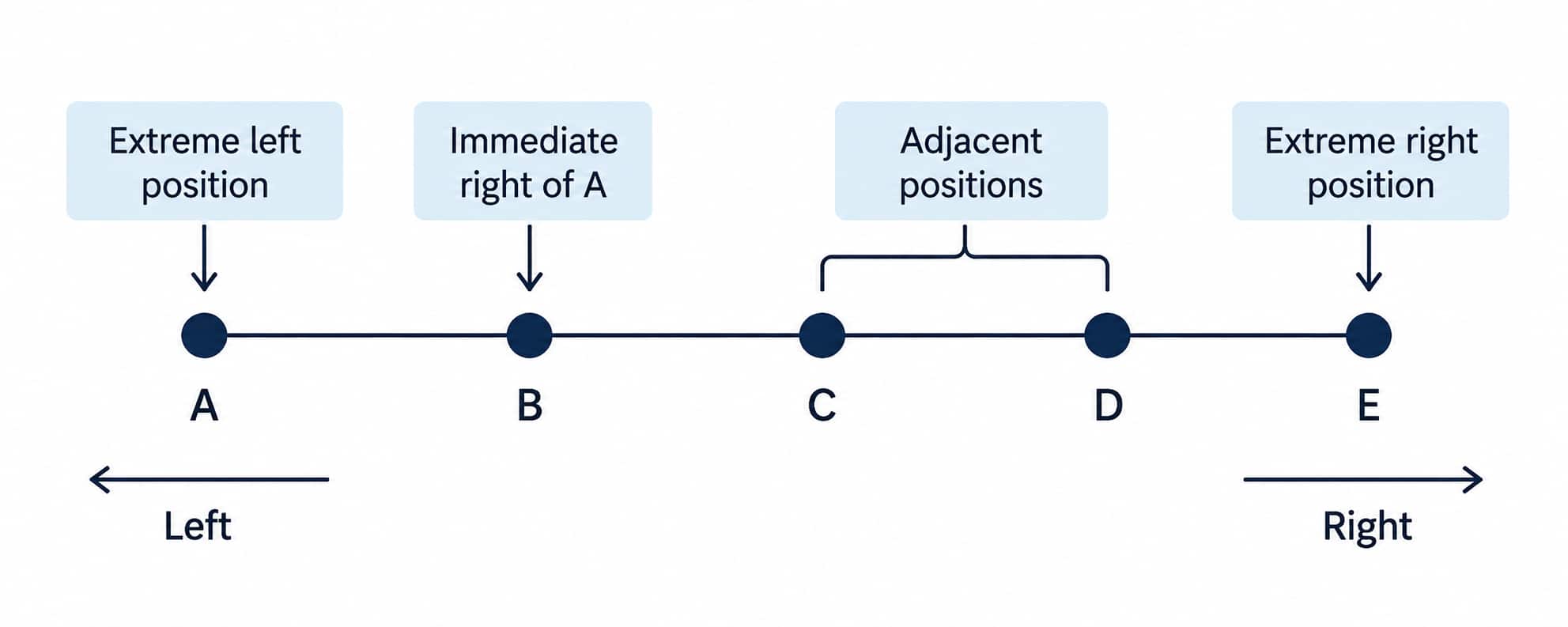
In a linear seating arrangement, people, objects or candidates are placed in a single row. The set may specify whether everyone faces the same direction or whether some people face opposite directions. Questions can involve positions such as the extreme left or right, immediate neighbours, people sitting between two candidates or the person occupying a particular position.
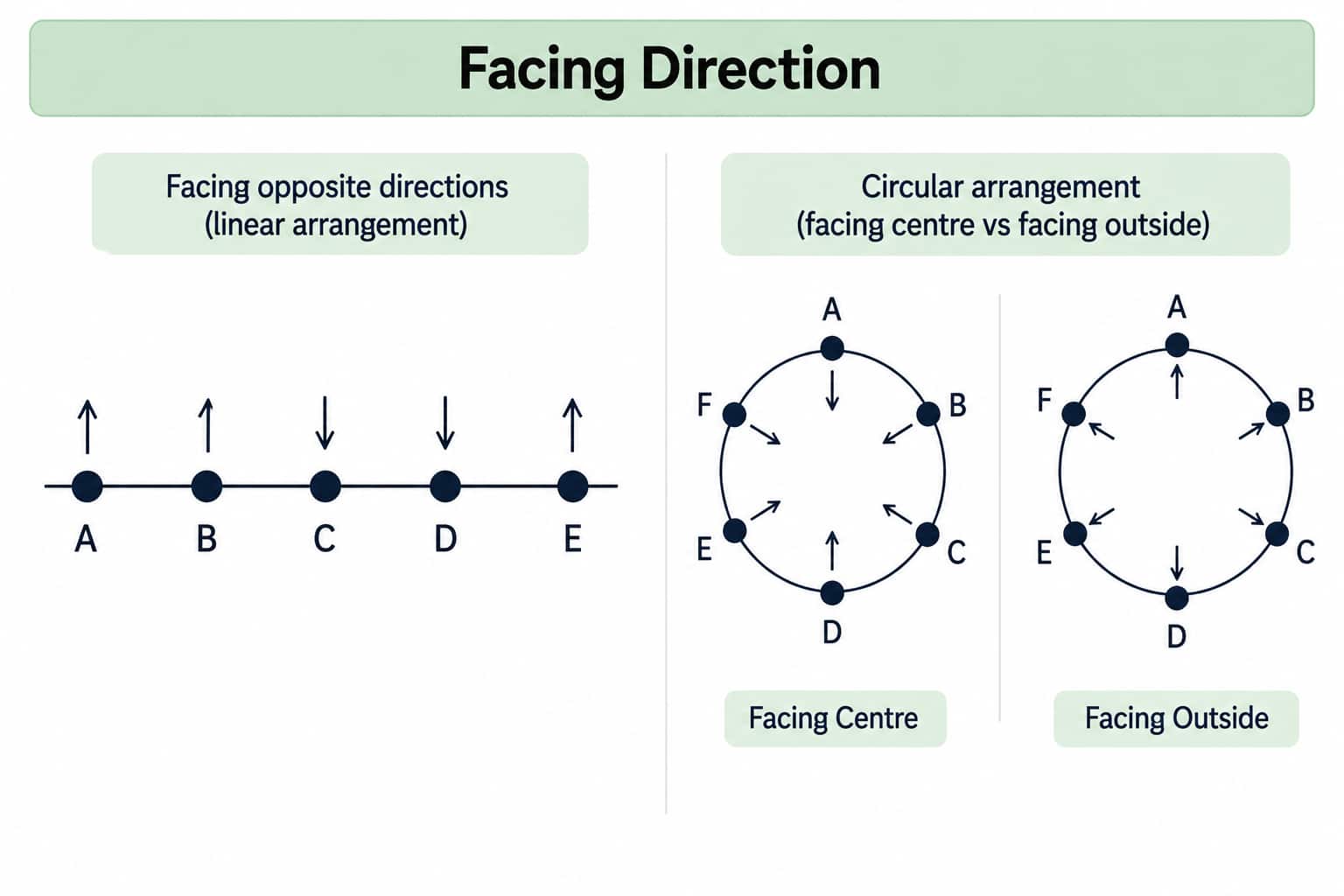
When everyone faces the same direction, left and right remain consistent throughout the row. If people face different directions, however, their individual left and right sides change. This makes direction tracking an important part of linear arrangement questions.
A typical CAT-style linear set may provide 5–8 people and several conditions such as:
A sits third to the left of B.
C sits immediately to the right of D.
E is not adjacent to A.
F occupies one of the extreme positions.
Globally Recognized by AACSB (US) & AMBA (UK) | 18 LPA Avg. CTC for PGPM 2026
Test centres are available in 70+ cities across India | 75,000+ aspirants apply for the NMAT exam | Accepted by 58+ institutions like NMIMS, KJSIM, ISB, SPJIMR and Great Lakes.
The key is to place the strongest positional clues first and use the remaining conditions to eliminate possibilities.
A circular seating arrangement places people around a circle rather than in a straight line. These questions commonly involve candidates facing the centre or outside and use terms such as clockwise, anticlockwise, immediate neighbour and opposite position.
The biggest difference from a linear arrangement is that there are no fixed extreme positions. A person sitting at the top of the diagram can be treated as a reference point, and the remaining people can then be placed relative to that position.
For example, a CAT DILR set may state that:
A sits second to the left of B.
C sits immediately clockwise from D.
E sits opposite F.
G does not sit next to A.
Candidates must account for the facing direction before interpreting left and right. In centre-facing arrangements, a person's left and right follow the circular direction differently from an outward-facing arrangement. Therefore, clockwise/anticlockwise movement and facing direction should be marked clearly before solving the set.
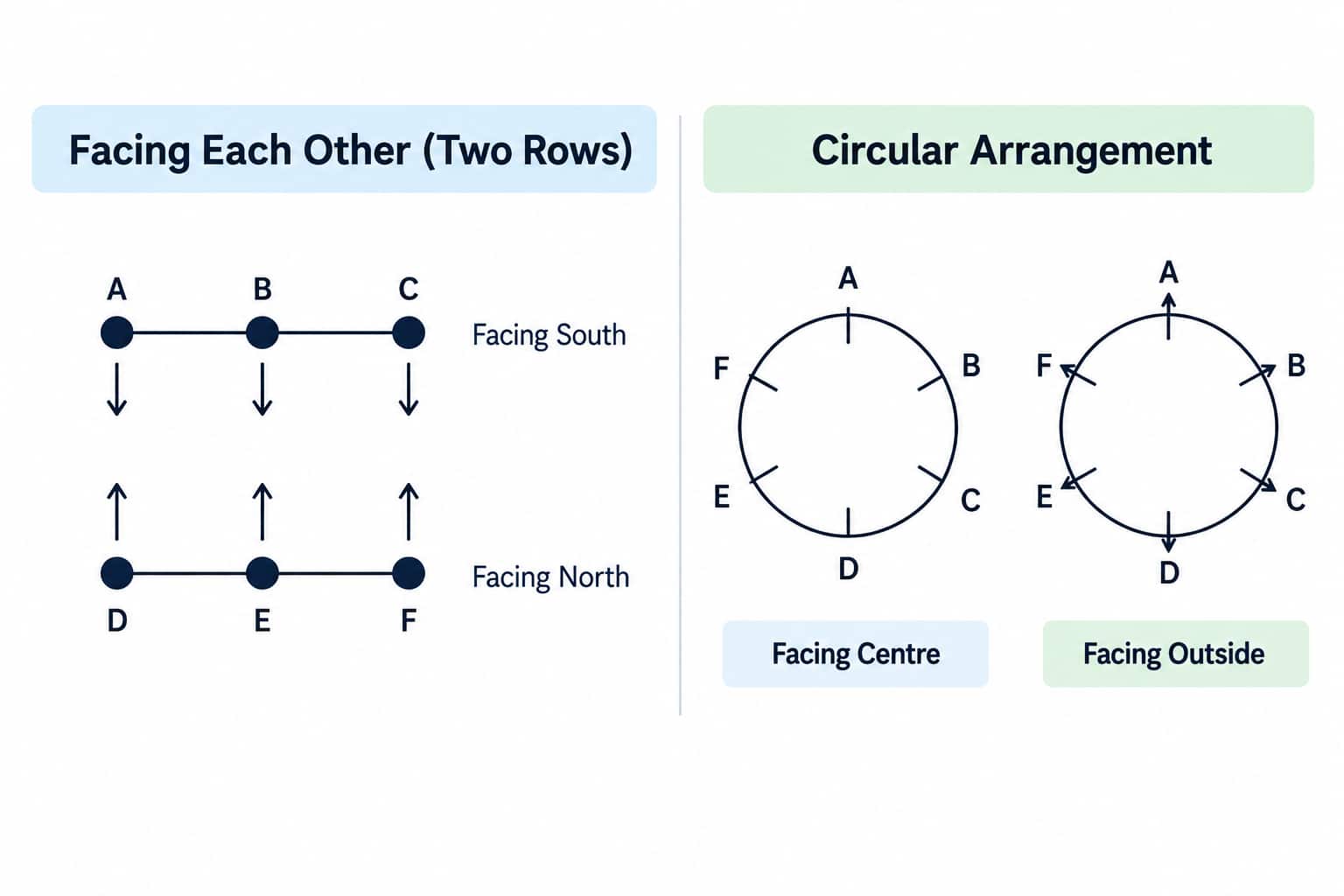
In a two-row seating arrangement, candidates are placed in two parallel rows, generally facing each other or facing opposite directions. The number of people in each row may be equal, although some sets can introduce vacant positions or additional conditions.
These questions require candidates to track both position and direction. If A in the first row faces B in the second row, their positions are directly related. However, determining who sits to the left or right of a person depends on the direction in which that person is facing.
A two-row set may involve conditions such as:
A sits opposite B.
C sits second to the right of A.
D is not opposite E.
F sits at an extreme position.
G sits immediately to the left of the person facing H.
A useful approach is to draw both rows first and mark the facing directions. Then fill the fixed or opposite positions before applying relative-position clues.
Complex seating arrangement sets are particularly important for CAT DILR preparation because the exam can combine seating positions with one or more additional variables. Instead of determining only who sits where, candidates may have to identify the person, profession, city, colour, rank, age or another attribute associated with each position.
For example, a single set could involve 8 people sitting in two rows, with each person belonging to a different city and working in a different profession. The clues may connect these variables:
The person from Delhi sits opposite the banker.
A sits second to the left of the person from Mumbai.
C is neither a doctor nor from Jaipur.
The engineer sits immediately next to B.
The person from Pune sits opposite the person ranked third.
Such sets require candidates to maintain multiple layers of information simultaneously. The seating arrangement forms the base, while the additional variables help eliminate possible cases.
Before attempting CAT DILR seating arrangement questions, candidates should be comfortable with basic positional terms and direction-based relationships. Most errors occur when a statement is interpreted incorrectly rather than because the underlying logic is difficult. Understanding these concepts also makes it easier to convert lengthy conditions into a simple diagram.
Position-based clues tell you where one person sits in relation to another. Terms such as immediate left, immediate right, adjacent, opposite and next to should be interpreted precisely.
For example, if A sits immediately to the left of B, there cannot be another person between A and B. Similarly, if A sits opposite B in a circular arrangement, their seats must be directly across the circle.
Facing direction changes how left and right should be interpreted. In a linear arrangement, a person facing north and another facing south will have opposite left-right orientations. In a circular arrangement, first determine whether people face towards the centre or away from the centre before applying directional clues.
A simple rule is to mark an arrow showing the direction each person faces before placing any left or right condition. This prevents one of the most common errors in seating arrangement questions.
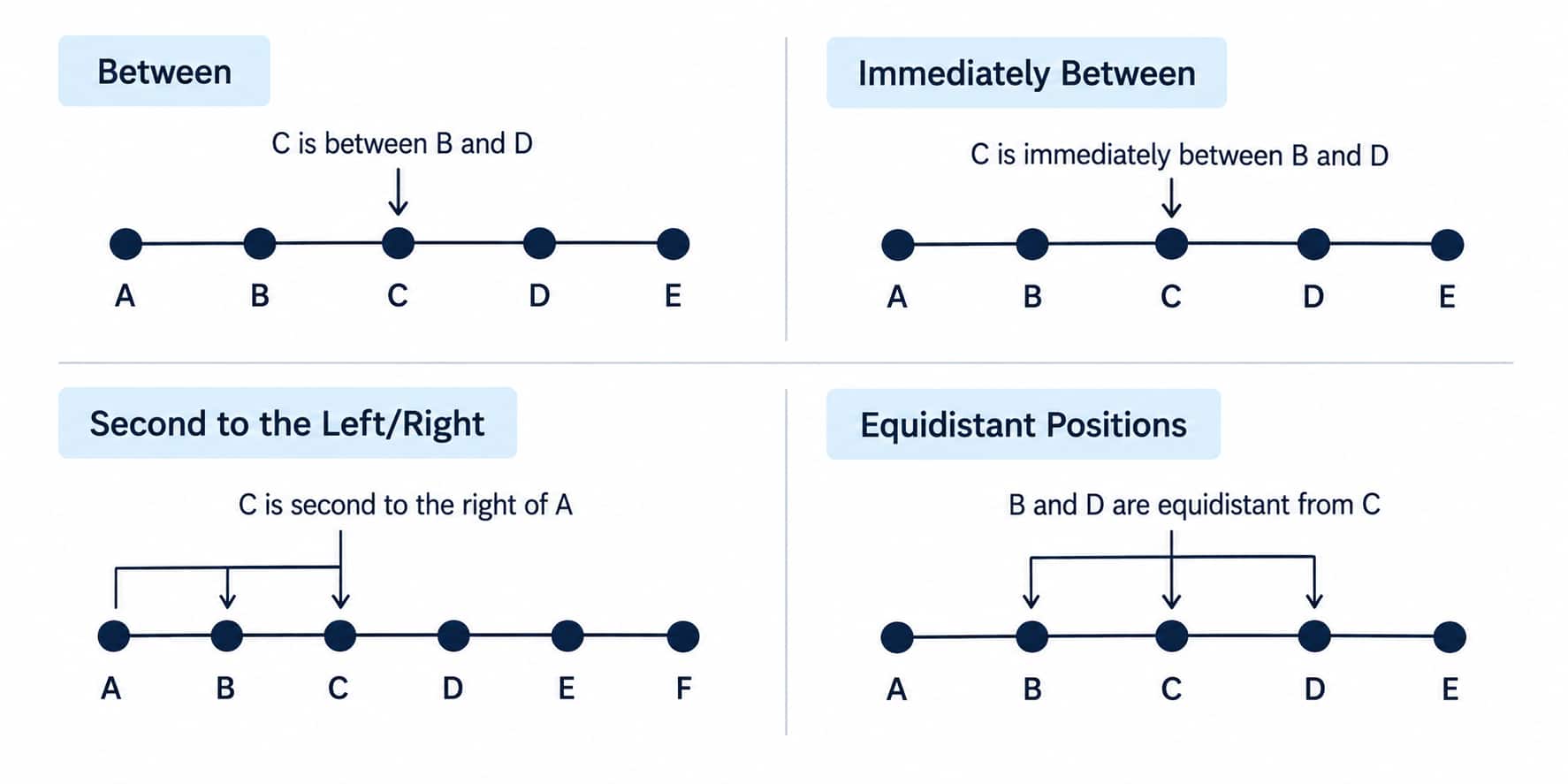
Relative-position clues describe where one person is located compared with another. Common expressions include between, immediately between, second to the left, second to the right and equidistant.
For example, "A sits between B and C" indicates that A has B and C as neighbours, while "A sits second to the right of B" means one position lies between B and A. These distinctions become particularly important when several conditions are combined in the same DILR set.
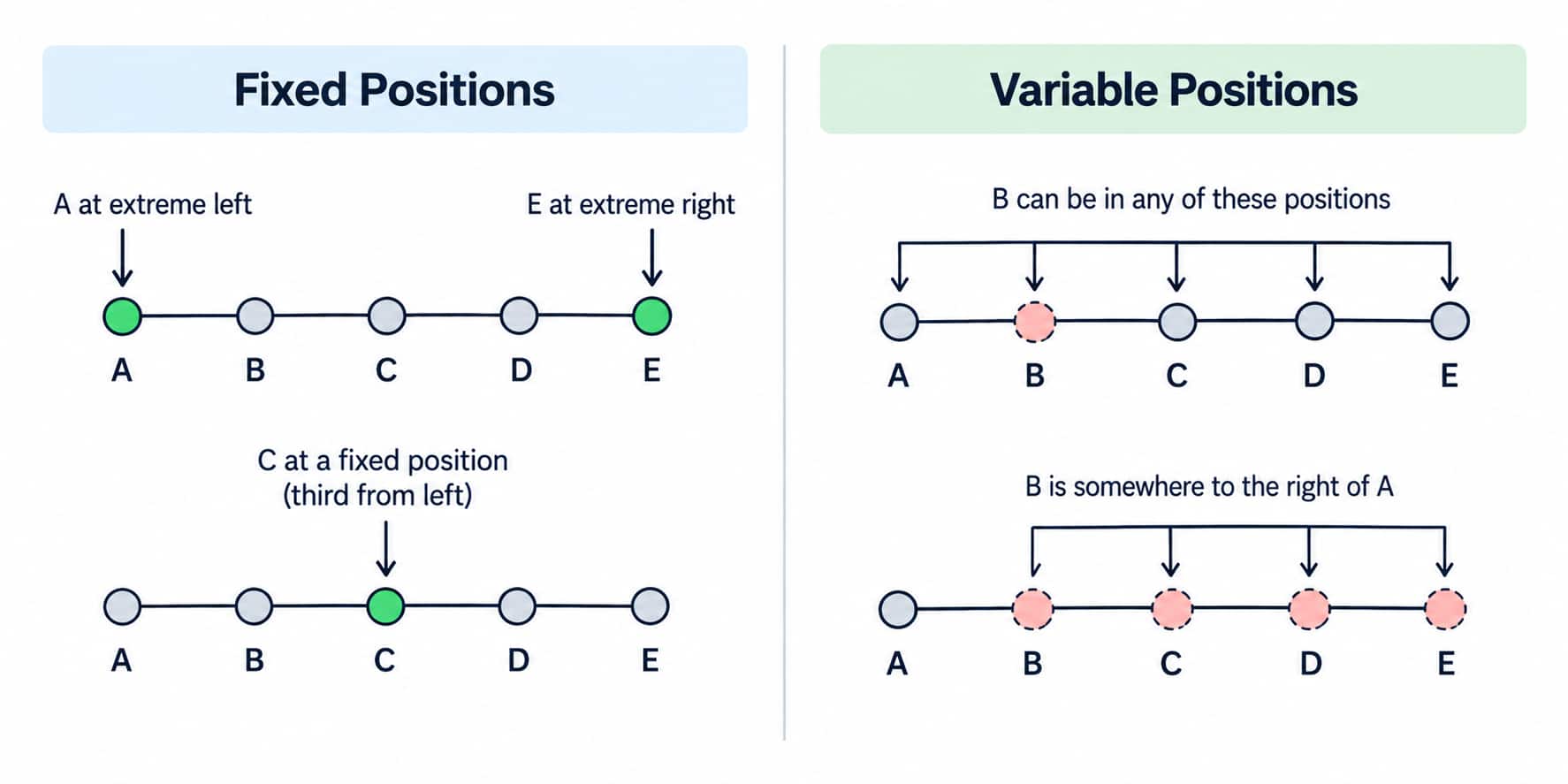
Separate information into fixed positions and possible positions before solving the set. A clue such as "A occupies the extreme left position" gives a fixed position, while "B sits somewhere to the right of C" leaves several possibilities.
Place fixed information first because it reduces the number of possible arrangements. For variable positions, keep the alternatives open and use additional clues to eliminate them. If two or more possibilities remain, create clearly labelled cases rather than making an unsupported assumption.
Also Check, CAT DILR Topic Wise Weightage
62, 68, 71, 75, 79, 84, 91 and 96
The following information is known:
B sits immediately to the right of A, and C sits third to the right of A.
H sits at one of the two extreme ends of the row.
D sits between C and H.
G sits second to the left of F.
F has scored 84 marks.
The candidate who scored 91 marks sits immediately to the left of H.
E has scored more marks than D.
G sits to the left of C.
Q1. Which of the following must be true?
A. A sits at the extreme left end
B. B sits third from the left
C. C sits fifth from the left
D. D sits sixth from the left
E. H sits at the extreme right end
Q2. Which of the following positions can be occupied by E?
A. Second from the left
B. Fourth from the left
C. Fifth from the left
D. Sixth from the left
E. Eighth from the left
Q3. If C sits fifth from the left, which of the following must be true?
A. A sits second from the left
B. D sits sixth from the left
C. F sits seventh from the left
D. G sits third from the left
E. E sits at the extreme left
Q4. If the candidate scoring 96 marks sits immediately to the right of F, which of the following can be true?
A. A sits at the extreme left
B. C sits fifth from the left
C. D sits sixth from the left
D. G sits third from the left
E. E sits seventh from the left
Q5. Which of the following pairs cannot occupy consecutive positions?
A. A and B
B. C and D
C. F and G
D. D and H
E. E and G
Each employee belongs to one of four departments:
Finance: A, E
HR: B, F
Marketing: C, G
Operations: D, H
Each employee also handles a different number of projects, ranging from 3 to 10. Thus, the eight project counts are:
3, 4, 5, 6, 7, 8, 9 and 10.
The following information is known:
A sits in a cabin with an even number, while E sits in a cabin with an odd number.
Employees belonging to the same department do not sit adjacent to each other.
C sits exactly three cabins to the right of A.
The number of projects handled by C is two more than that handled by A.
G sits immediately to the right of F.
H sits somewhere to the right of E.
The employees sitting in cabins 1 and 8 together handle 15 projects.
B handles more projects than F but fewer than D.
The employee sitting immediately to the right of A handles one more project than A.
E handles an odd number of projects.
Q1. Which of the following could be the sequence of departments from Cabin 1 to Cabin 8?
A. Finance – HR – Marketing – Operations – Finance – HR – Marketing – Operations
B. HR – Finance – Operations – Marketing – HR – Operations – Finance – Marketing
C. Operations – Finance – HR – Marketing – Operations – Finance – HR – Marketing
D. Marketing – HR – Finance – Operations – Marketing – HR – Operations – Finance
E. HR – Marketing – Finance – Operations – HR – Marketing – Finance – Operations
Q2. What is the maximum possible number of projects handled by the employee sitting in Cabin 8?
A. 6
B. 7
C. 8
D. 9
E. 10
Q3. If E sits in Cabin 3, which of the following must be true?
A. A sits in Cabin 2
B. C sits in Cabin 5
C. F sits in Cabin 6
D. H sits in Cabin 7
E. G sits in Cabin 8
Q4. If the employee handling 8 projects sits immediately to the right of the employee handling 6 projects, which of the following can be true?
A. A handles 3 projects
B. B handles 5 projects
C. C handles 7 projects
D. D handles 9 projects
E. E handles 10 projects
Q5. Suppose that A and E exchange their cabins, while all other employees remain in their original cabins. Which of the following statements is necessarily true about the resulting arrangement?
A. Both Finance employees now occupy even-numbered cabins.
B. The number of adjacent pairs belonging to different departments decreases by one.
C. C is still exactly three cabins to the right of A.
D. The employee immediately to the right of E belongs to HR.
E. The employee handling the maximum number of projects now sits next to a Finance employee.
Eight candidates — A, B, C, D, E, F, G and H — are seated around a circular table, all facing the centre. Each candidate occupies one of eight equally spaced positions. The following information is known:
B sits second to the left of A.
C sits immediately to the right of B.
D sits opposite A.
E sits immediately to the left of D.
F sits second to the right of H.
G does not sit adjacent to A.
Q1. Which of the following must be true?
A. C sits opposite E
B. F sits opposite B
C. G sits immediately to the left of D
D. H sits immediately to the right of E
E. E sits second to the left of A
Q2. If F sits opposite C, who sits immediately to the left of H?
A. A
B. B
C. D
D. E
E. G
Q3. If G and E exchange their positions, which statement will necessarily remain true?
A. D sits opposite A
B. B sits second to the left of A
C. C sits immediately to the right of B
D. F sits second to the right of H
E. G sits opposite H
Q4. Which of the following pairs can occupy positions opposite each other?
A. B and D
B. C and F
C. E and G
D. A and E
E. F and G
Q5. If A moves two positions clockwise while everyone else remains fixed, which of the following relationships is necessarily broken?
A. B is second to the left of A
B. C is immediately right of B
C. D is opposite A
D. E is immediately left of D
E. F is second right of H
Seven people — P, Q, R, S, T, U and V — are seated around a circular table, all facing the centre. The seats are numbered clockwise from 1 to 7 only for reference. The following information is known:
Q sits immediately clockwise of P.
R sits second anticlockwise from Q.
S sits third clockwise from P.
T sits immediately clockwise of S.
U does not sit adjacent to P.
V sits somewhere between R and T when moving clockwise from R.
Q1. Which person sits immediately anticlockwise of P?
A. Q
B. R
C. T
D. U
E. V
Q2. If U and V exchange their positions, which of the following must be true?
A. U sits adjacent to P
B. V sits adjacent to T
C. R sits immediately clockwise of Q
D. T sits immediately clockwise of S
E. Q sits second anticlockwise of P
Q3. If R is moved one position clockwise, which of the following could occupy the position immediately anticlockwise of R?
A. P
B. Q
C. S
D. T
E. V
Q4. Which of the following statements must be true?
A. P and T are adjacent
B. Q and S are separated by one person
C. R and U are adjacent
D. S and V are opposite
E. T and V are adjacent
Q5. If P and S exchange positions, which of the following is necessarily true about Q?
A. Q becomes immediately clockwise of S
B. Q becomes immediately anticlockwise of S
C. Q becomes second clockwise of S
D. Q becomes second anticlockwise of S
E. Q becomes third clockwise of S
Eight candidates — A, B, C, D in Row 1 and P, Q, R, S in Row 2 — occupy four corresponding positions in two parallel rows. Candidates in Row 1 face south, while candidates in Row 2 face north. Thus, A faces P, B faces Q, C faces R and D faces S. The following information is known:
B sits immediately to the right of A.
C sits immediately to the right of B.
P does not face A.
Q faces the person sitting immediately to the right of C.
R sits immediately to the left of Q.
S does not face C.
Q1. Who faces B?
A. P
B. Q
C. R
D. S
E. Cannot be determined
Q2. Which of the following pairs occupies corresponding positions?
A. A and Q
B. B and R
C. C and S
D. D and P
E. A and S
Q3. If P and S exchange positions, who will face C?
A. P
B. Q
C. R
D. S
E. Cannot be determined
Q4. Which statement must be true?
A. P sits immediately to the left of Q
B. Q sits immediately to the right of R
C. S faces A
D. R faces C
E. P faces D
Q5. If C and D exchange their positions, which candidate will face C?
A. P
B. Q
C. R
D. S
E. Cannot be determined
Five candidates — A, B, C, D and E — sit in Row 1, while P, Q, R, S and T sit in Row 2. Both rows have five positions. Row 1 candidates face south and Row 2 candidates face north. Each candidate has a different score from 60, 65, 70, 75, 80, 85, 90, 95, 100 and 105.
The following information is known:
A sits immediately to the left of B.
C sits in the middle position of Row 1.
D sits immediately to the right of E.
P faces C.
Q sits immediately to the left of P.
R faces A.
The candidate facing B has a score 10 marks higher than B.
C scores more than A but less than B.
P scores less than Q.
Q1. Which of the following must be true?
A. A scores 65
B. B scores 80
C. C scores 75
D. P scores less than R
E. Q scores more than R
Q2. If B scores 85, what is the score of C?
A. 65
B. 70
C. 75
D. 80
E. 90
Q3. If Q scores 90, which of the following can be true?
A. P scores 65
B. A scores 70
C. B scores 75
D. C scores 85
E. R scores 95
Q4. If D and E exchange their positions, which of the following relationships is necessarily unaffected?
A. A's position relative to B
B. P's position relative to Q
C. P's position relative to C
D. R's position relative to A
E. D's position relative to E
Q5. If the candidate scoring 100 faces D, which of the following must be true?
A. D scores 90
B. E scores 95
C. A scores 75
D. B scores 85
E. C scores 80
Eight candidates — A, B, C, D, E, F, G and H — are seated in a row facing north. Each candidate has a different score from 60, 65, 70, 75, 80, 85, 90 and 95.
B sits immediately to the right of A.
C sits third to the right of A.
D sits somewhere to the left of A.
E sits immediately to the right of F.
G sits somewhere between C and H.
B scores 10 marks more than A.
C scores more than B but less than H.
F scores 5 marks less than E.
D scores less than A.
The person sitting at the extreme right scores 95.
Q1. Which of the following could be the order of the candidates from left to right?
A. D A B C F E G H
B. D F E A B C G H
C. F E D A B C H G
D. D A B F E C G H
E. F D E A B C G H
Q2. If B scores 80, what is the score of H?
A. 85
B. 90
C. 95
D. 75
E. 70
Q3. If F sits at the extreme left, which of the following must be true?
A. D sits immediately to the right of F
B. E sits immediately to the right of F
C. A sits fourth from the left
D. C sits sixth from the left
E. H sits at the extreme right
Q4. If the candidates scoring 70 and 90 exchange their positions, which of the following remains necessarily true?
A. A sits immediately to the left of B
B. B sits immediately to the left of C
C. F sits immediately to the left of E
D. C sits to the left of H
E. D sits to the left of A
Q5. If H and C exchange their positions, which of the following can be true?
A. H scores 95
B. C scores more than B
C. H sits immediately to the right of G
D. C sits immediately to the left of B
E. F scores more than A
Nine employees — P, Q, R, S, T, U, V, W and X — occupy nine consecutive cabins numbered 1 to 9. Each belongs to one of three departments: Finance, HR or Marketing. Each department has exactly three employees. Each employee handles a different workload from 20, 25, 30, 35, 40, 45, 50, 55 and 60 units.
Q occupies the fourth cabin.
R sits immediately to the right of Q.
P sits two cabins to the left of Q.
S sits somewhere to the right of R.
T and U occupy consecutive cabins, with T to the left of U.
P and Q belong to different departments.
R and S belong to the same department.
W belongs to Finance and occupies an odd-numbered cabin.
The workload of R is 10 units more than that of Q.
S handles more work than R but less than W
Q1. Which of the following could be the sequence of departments from Cabin 1 to Cabin 9?
A. Finance – HR – Marketing – Finance – Marketing – HR – Finance – HR – Marketing
B. HR – Finance – Marketing – HR – Marketing – Finance – HR – Marketing – Finance
C. Finance – Marketing – HR – Finance – HR – Marketing – Finance – HR – Marketing
D. Marketing – Finance – HR – Marketing – HR – Finance – Marketing – HR – Finance
E. HR – Marketing – Finance – HR – Finance – Marketing – HR – Finance – Marketing
Q2. What is the maximum possible workload of W?
A. 40
B. 45
C. 50
D. 55
E. 60
Q3. If P handles 30 units, which of the following must be true?
A. Q handles 35 units
B. R handles 45 units
C. S handles 50 units
D. W handles 55 units
E. W handles 60 units
Q4. If W occupies Cabin 7, which of the following must be true?
A. P belongs to Finance
B. Q belongs to Finance
C. R belongs to Finance
D. S belongs to Finance
E. W is adjacent to S
Q5. If the employees in Cabins 2 and 8 exchange positions, which of the following conditions is necessarily affected?
A. The department of the employee in Cabin 4
B. The relative position of Q and R
C. The number of employees between P and S
D. The department distribution across the nine cabins
E. The workload relationship between R and Q
CAT 2026 DILR Seating Arrangement Solution PDF - Download Here
Seating arrangement sets become manageable when you follow a fixed sequence instead of trying to solve every clue at once. The aim is to reduce the number of possible arrangements step by step and reach a valid configuration with minimum trial and error.
Start by identifying the number of seats and draw the basic layout required for the set. Use a straight line for linear arrangements, parallel lines for two-row arrangements and a circle for circular seating. Convert statements such as "A sits third to the right of B" directly into the diagram instead of keeping them in memory. Mark fixed positions and immediate neighbours first.
Some statements may leave two or more possible positions. Do not choose one randomly. First place all definite information and then identify the remaining possibilities. If a clue says that A can occupy one of two positions, keep both possibilities open until another condition helps eliminate one.
When the information does not lead to a single arrangement, create separate cases. Label them clearly, such as Case 1 and Case 2, and apply the remaining conditions to each case. Avoid creating cases for every minor possibility. A useful case should help you test several conditions together and eliminate an arrangement quickly.
Use negative conditions and positional restrictions to remove incorrect cases. For example, if A cannot sit beside B, immediately discard any arrangement where they are adjacent. Continue applying the strongest restrictions until only valid arrangements remain. This is usually faster than trying to construct the complete arrangement through random placement.
Not every DILR set needs to be solved immediately. If you are repeatedly rereading clues, creating several unresolved cases or making no progress after a reasonable attempt, move to another set.
Regular practice helps you become familiar with different seating patterns and reduces the time spent translating statements into diagrams. Instead of solving random questions without analysis, follow a practice routine that covers basic concepts, previous CAT sets and timed tests.
Begin with linear seating arrangements before moving to circular, two-row and mixed-condition sets. Practise one type at a time until you can identify the required diagram and approach quickly. Once the basics are clear, combine different arrangement types to improve adaptability.
Include seating arrangement sets from previous CAT question papers in your practice. These sets help you understand the level of information, number of conditions and reasoning required in the actual examination. After solving a set, compare your approach with the official or reliable solution rather than checking only whether your final answer was correct.
Use CAT sectional tests to practise seating arrangements under a time limit. Track how long you spend reading the set, creating the arrangement and answering individual questions. If a set consistently takes too long, identify whether the issue is diagram formation, interpretation of clues or case handling.
Full-length CAT mock test help you practise seating arrangements alongside other DILR topics. You may not know beforehand which type of set will appear, so mock tests help you decide whether a seating arrangement is worth attempting based on its complexity and the time available.
Keep a record of seating arrangement sets that you could not solve, solved incorrectly or took too long to complete. Re-attempt these sets after a gap without looking at the solution. Compare your second attempt with the first and note whether you improved in diagram formation, case elimination, accuracy or solving time.
CAT DILR is tough, but proper practice helps candidates to ace the basic concepts and practice easily. Get the download links of DILR ebooks for CAT exam 2026 below.
Ultimate DILR CAT 2026 Guide: Concepts, Practice Sets and Detailed Solutions | |
CAT 2026 Mastery: Chapter-wise MCQs for Success for VARC, DILR, Quant | |
CAT DILR Questions with Solution, Download LRDI Questions for CAT Pdf | |
CAT 2025 DILR Masterbook - Practice 100 DILR Sets to score 90+ Percentile | |
CAT DILR PYQs Complete 5-Year Question Bank (2021 - 2025) |
Frequently Asked Questions (FAQs)
Yes, seating arrangement questions can appear in the DILR section of CAT. They may be presented as standalone seating arrangement sets or combined with other concepts such as rankings, preferences, or distribution. Since CAT does not follow a fixed topic-wise question pattern, candidates should prepare seating arrangements along with other important DILR topics.
For CAT 2026, prepare linear, circular and row-based seating arrangements. You should also practise sets involving people facing the same or opposite directions, multiple rows, relative positions, and conditions based on neighbours or distances.
Circular seating arrangement questions can seem difficult initially because you need to track relative positions and, in some cases, different facing directions. However, regular practice can make them easier to handle.
To improve speed, practise identifying the strongest clues first and use tables, diagrams or symbols to organise information quickly. Avoid repeatedly rereading the conditions. After solving a set, review your approach and check whether you could have reduced unnecessary cases.
There is no fixed number of seating arrangement questions that guarantees CAT readiness. A practical approach is to solve 20–30 good-quality sets initially, covering different formats and difficulty levels. Once you are comfortable, include mixed DILR sets and timed practice so that you learn to identify when a seating arrangement set is worth attempting in the actual exam.

On Question asked by student community
Hello, CAT aur B-school entrance exams ke baare mein aap exam dates, eligibility, registration, exam pattern, syllabus, colleges ya admission process ki information dekh sakte hain. Aapki requirement ke according relevant details yahan mil sakti hain: https://bschool.careers360.com/exams
You can download the latest CAT syllabus from here:
Hey there,
For a B.Sc. with Chemistry, Botany and Zoology (CBZ), if the CAT application asks separately for:
If the Discipline dropdown has a more specific option such as “Biological Sciences,” “Life Sciences,” or “Zoology/Botany,”
Hey there,
Yes. With 2 years of work experience, you are eligible to target the regular 2-year MBA at IIM Calcutta as long as you have a bachelor's degree with at least 50% marks (45% for SC/ST/PwD). Work experience is not required for eligibility.
For
Hey there,
For NIT Hamirpur MBA, the General-category CAT cutoff is not a fixed official percentile. NIT Hamirpur's 2026–27 admission process gives CAT a 10/10 weightage in the test component, followed by an interview; it accepts CAT, CMAT and MAT.
As a practical target, 80+ percentile is worth considering, while
Directions for question:
The bar-graph given below shows the foreign exchange reserves of Nepal (in million Rupees) from 2014 to 2021. Answer the following questions based on the graph :

Question:
What was the percentage increase (rounded to the nearest integer, if deemed necessary) in the foreign exchange reserves in

Globally Recognized by AACSB (US) & AMBA (UK) | 18 LPA Avg. CTC for PGPM 2026
Gateway to IBS Hyderabad & 8 other IBS campuses | Scholarships worth 10 CR
Among top 6% B-Schools globally to be accredited by AACSB | Highest Package-35 LPA
Test centres are available in 70+ cities across India | 75,000+ aspirants apply for the NMAT exam | Accepted by 58+ institutions like NMIMS, KJSIM, ISB, SPJIMR and Great Lakes.
400+ Recruiters | Highest CTC 17.2 LPA | Average CTC 8 LPA | 92% Avg. Placements | Ranked as Platinum Institute | Awarded Best Business School of the Year
Application Open | Scholars’ Round Deadline: 14th Nov’26 | Earn upto 50% merit Scholarship + 10% for top performers | EFMD Accredited | AACSB & Business Graduates Association Member | Highest CTC 28 LPA