Birla Institute of Management Technology, Greater Noida
AACSB Accredited | Highest CTC: 22 LPA


With CAT 2026 approaching, aspirants need more than formula revision to improve their performance across Quantitative Aptitude, Data Interpretation and Logical Reasoning (DILR), and Verbal Ability and Reading Comprehension (VARC). Scheduled for November 29, 2026, the CAT exam requires strong conceptual understanding, accurate problem-solving, and effective question selection. In Day 26 of the CAT 2026 Success Roadmap, we explore Ratio and Proportion questions, a previous-year selection-based DILR puzzle, and Reading Comprehension practice, along with targeted revision techniques to help candidates prepare more effectively for the upcoming examination.
This Story also Contains
Ratio and Proportion is an important topic in the CAT 2026 QA section, often used to test your conceptual clarity and calculation speed. It forms the base for many arithmetic questions, including time, work, and mixtures. A clear understanding of ratios helps in comparing quantities, solving real-life word problems, and interpreting data effectively. Before diving into advanced questions, make sure your basics are strong and well-practiced.
Comparing the quantities ($a:b$)
Dividing in the ratio by the parts method
Learn the concept of the compounded ratio.
Duplicate ratio of a:b is a2:b2.
Triplicate ratio of a:b is a3:b3.
Sub-duplicate ratio of a:b is $a^{½}:b^{½}$.
Sub-triplicate ratio of a:b is $a^{⅓}:b^{⅓}$.
Practice complex problems.
Ratio and Proportion are fundamental concepts used to compare quantities and establish relationships between them. They are extensively used in various fields, including arithmetic, algebra, geometry, and real-life problem-solving. We have to learn the ratio and proportion formula, the difference between ratio and proportion, and practice various ratio and proportion problems on the ratio and proportion worksheet to have more grasp on this topic.
Examples of Ratio:
Fruit Basket : In a fruit basket, there are 4 apples and 6 oranges. The ratio of apples to oranges is 4 : 6, which can be simplified as 2 : 3.
Students in a Classroom: In a classroom, there are 30 boys and 20 girls. The ratio of boys to girls is 30 : 20, which can be simplified as 3 : 2.
Examples of Proportion:
Mixing Juice: To make a fruit juice mixture, you need to mix 2 cups of apple juice with 3 cups of orange juice. The proportion of apple juice to orange juice is 2 : 3.
Speed and Time: A car travels 300 miles in 5 hours. To find the proportion of speed to time, we divide the distance by time, which gives us 300 miles / 5 hours = 60 miles per hour.
Q1. The product of two positive numbers is 616. If the ratio of the difference of their cubes to the cube of their difference is $157:3$, then the sum of the two numbers is:
[CAT Exam: 2019]
58
95
85
50
Answer: (D)
Let the two positive numbers be $x$ and $y$, where $x>y$.
Given, $xy=616$
According to the question,
$ \frac{x^3-y^3}{(x-y)^3}=\frac{157}{3} $
Using the identity $x^3-y^3=(x-y)(x^2+xy+y^2)$,
$ \frac{x^2+xy+y^2}{(x-y)^2}=\frac{157}{3} $
Cross-multiplying,
$ 3(x^2+xy+y^2)=157(x-y)^2 $
Expanding both sides,
$ 3x^2+3xy+3y^2=157(x^2-2xy+y^2) $
$ 3x^2+3xy+3y^2=157x^2-314xy+157y^2 $
Rearranging,
$ 154x^2+154y^2=317xy $
Substituting $xy=616$,
$ 154(x^2+y^2)=317\times616 $
$ x^2+y^2=\frac{317\times616}{154} $
$ x^2+y^2=1268 $
We know that $(x+y)^2=x^2+y^2+2xy$.
$ (x+y)^2=1268+2\times616 $
$ (x+y)^2=2500 $
Since $x$ and $y$ are positive,
$ x+y=\sqrt{2500}=50 $
Hence, the correct answer is 50.
Q2. Raju and Lalitha originally had marbles in the ratio $4:9$. Then Lalitha gave some of her marbles to Raju. As a result, the ratio of the number of marbles with Raju to that with Lalitha became $5:6$. What fraction of her original number of marbles did Lalitha give to Raju?
[CAT Exam: 2018]
$\frac15$
$\frac14$
$\frac733$
$\frac619$
Solution: (C)
Let the original number of marbles with Raju and Lalitha be $4x$ and $9x$, respectively.
Suppose Lalitha gave $y$ marbles to Raju.
After giving the marbles:
Raju has $4x+y$ marbles.
Lalitha has $9x-y$ marbles.
According to the question, the new ratio is $5:6$.
$ \frac{4x+y}{9x-y}=\frac{5}{6} $
Cross-multiplying,
$ 6(4x+y)=5(9x-y) $
$ 24x+6y=45x-5y $
$ 11y=21x $
$ y=\frac{21x}{11} $
The fraction of Lalitha's original marbles that she gave to Raju is
$ \frac{y}{9x} =\frac{\frac{21x}{11}}{9x} $
$ =\frac{21x}{99x} =\frac{7}{33} $
Hence, the correct answer is $\frac733$.
Q3. If the valuations of companies A and B are in the ratio $3:4$, while those of companies B and C are in the ratio $2:1$, which of the following is a possible valuation of company A if the difference between the valuations of companies B and C is a multiple of 14?
323 crores
268 crores
423 crores
420 crores
Solution: (D)
Given,
$A:B=3:4$ and $B:C=2:1$
Combining the ratios,
$A:B:C=3:4:2$
Let the valuations of companies A, B, and C be $3y$, $4y$, and $2y$, respectively, where $y$ is a positive integer.
According to the question,
$4y-2y=2y$
Since $2y$ is a multiple of 14, $y$ must be a multiple of 7.
Therefore, the valuation of company A, $3y$, must be a multiple of 21.
Among the given options, 420 satisfies this condition.
Hence, the correct answer is 420 crores.
Q4. In a bag, there are coins of three denominations: Re. 1, Rs. 2, and Rs. 5. The numbers of Re. 1 and Rs. 2 coins are in the ratio $2:3$, and the numbers of Rs. 2 and Rs. 5 coins are in the ratio $4:5$. If the total number of coins in the bag is less than 100, the total value of the coins in the bag can be Rs. ________.
107
214
321
Cannot be determined
Solution: (D)
In terms of the number of coins,
Re. 1 coins : Rs. 2 coins $=2:3$
Rs. 2 coins : Rs. 5 coins $=4:5$
Combining the ratios,
Re. 1 coins : Rs. 2 coins : Rs. 5 coins $=8:12:15$
Total number of coins $=8+12+15=35$ units.
Since the total number of coins is less than 100, the possible totals are 35 or 70 coins.
Case 1: Total number of coins = 35
Re. 1 coins = 8, Rs. 2 coins = 12, and Rs. 5 coins = 15.
Total value $=8\times1+12\times2+15\times5$
$=8+24+75=\text107$
Case 2: Total number of coins = 70
Re. 1 coins = 16, Rs. 2 coins = 24, and Rs. 5 coins = 30.
Total value $=16\times1+24\times2+30\times5$
$=16+48+150=\text214$
Both values appear in the options. Therefore, the total value cannot be uniquely determined.
Hence, the correct answer is Option 4: Cannot be determined.
CAT 2026: Prerequisites
Fractions and comparison
Basic calculations
Master CAT 2026 DILR by practising puzzles, caselets, and data sets daily. Focus on logical clarity, visual representation, and time management to boost accuracy and speed in complex reasoning problems. However, you should prepare all the topics prescribed in the CAT 2026 Syllabus.
Comprehension:
Princess, Queen, Rani and Samragni were the four finalists in a dance competition. Ashman, Badal, Gagan and Dyu were the four music composers who individually assigned items to the dancers. Each dancer had to individually perform in two dance items assigned by the different composers. The first items performed by the four dancers were all assigned by different music composers. No dancer performed her second item before the performance of the first item by any other dancers. The dancers performed their second items in the same sequence as their performance of their first items. [CAT exam: 2019]
The following additional facts are known.
No composer who assigned the item to the Princess assigned any item to the Queen.
No composer who assigned the item to Rani assigned any item to Samragni.
The first performance was by Princess; this item was assigned by Badal.
The last performance was by Rani; this item was assigned by Gagan.
The items assigned by Ashman were performed consecutively. The number of performances between items assigned by each of the remaining composers was the same.
Q1. Which of the following is true?
The second performance was composed by Dyu.
The third performance was composed by Ashman.
The second performance was composed by Gagan.
The third performance was composed by Dyu.
Q2. Which of the following is FALSE?
Samragni did not perform in any item composed by Ashman.
Princess did not perform in any item composed by Dyu.
Queen did not perform in any item composed by Gagan.
Rani did not perform in any item composed by Badal.
Q3. The sixth performance was composed of
Badal
Ashman
Dyu
Gagan
Q4. Which pair of performances were composed by the same composer?
The second and the sixth
The first and the seventh
The third and the seventh
The first and the sixth
Solution:
Trick 1: Look for concrete information first
P, Q, R, S (Four finalists)
A, B, G, D (Four Composers)
Each dancer performed on items by two different composers.
P and Q have no composer in common.
R and S have no composer in common.
First four performances on items by four different composers and so the last four.
Items by A for two consecutive performances i.e., Dance 4 and Dance 5.
P performed 1st (Item by B) and 5th.
R Performed 4th and 8th (Item by G).
Trick 2: Using the above information, draw a table for the selection.
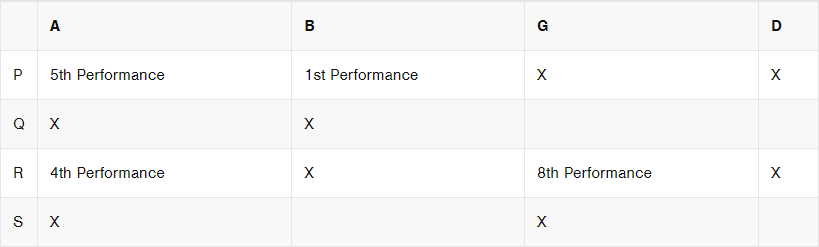
D (2nd or 3rd item and 6th or 7th item)
G (2nd or 3rd)
B (6th or 7th)
Trick 3: Elimination of Possibilities
Clue:
The number of performances between items assigned by each of the remaining composers was the same.
Case 1: If item 2 is composed of G which is performed by Q (From table) then item 3 will be composed of D which is to be performed by S. Then item 6 is performed by Q and must be composed by D. Item 7 is performed by S and must be composed by B.
Now Sequence of items should be B G D A A D B G which is a violation of the above condition.
Case 2: If item 3 is composed of G which is performed by Q (From table) then item 2 will be composed of D which is to be performed by S. Then item 7 is performed by Q and must be composed by D. Item 6 is performed by S and must be composed by B.
Now Sequence of items should be B D G A A B D G which is a violation of the above condition.
The number of items between B and B is 4.
The number of items between D and D is 4.
The number of items between G and G is 4.
All conditions are satisfied.
Trick 4: Draw Final Table.
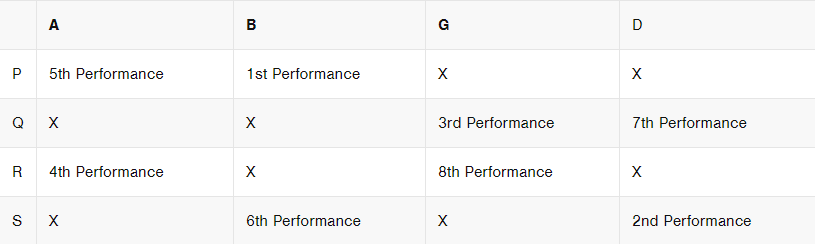
Answers:
Q1. (1)
Q2. (3)
Q3. (1)
Q4. (4)
CAT preparation: Prerequisite:
Ranking, Blood Relations, Directions
Puzzles on Selection (Basics)
Selection-based puzzles in CAT DILR often involve several people, objects, events, or assignments that must satisfy a collection of conditions. The challenge is not simply to identify a possible arrangement but to determine which arrangements satisfy all the information provided.
In the selection-based puzzle discussed above, the performers and music composers must be assigned according to restrictions involving performance order, composer allocation, and the relationship between different performers. Such questions demonstrate why candidates need to organise conditions carefully before attempting individual questions.
The first step is to distinguish information that is definitely true from information that still allows multiple possibilities.
Fixed conditions directly establish a position, assignment, or relationship. Other conditions may restrict the possibilities without determining a unique arrangement immediately.
For example, a statement that a particular event occurs first establishes a fixed position. A statement that two events must be consecutive restricts their placement but may still allow more than one arrangement.
Candidates can organise the information as follows:
Fixed conditions: Record positions or assignments that are explicitly stated.
Relative conditions: Note which events must occur before, after, or next to other events.
Restrictions: Identify combinations that are prohibited.
Unresolved possibilities: Record alternatives that remain valid until further information is applied.
This classification reduces the risk of treating an assumption as a confirmed fact.
When the available information does not produce an immediate solution, divide the problem into separate cases. Each case should be based on a meaningful alternative, such as the possible position of a performer or the assignment of a composer.
Consider the following procedure:
Identify a condition that creates two or more possible cases.
Select one case and apply the remaining conditions systematically.
Check whether the resulting arrangement violates any explicit restriction.
Eliminate inconsistent cases and continue with the alternatives that remain valid.
Verify the final arrangement against all the original clues.
A case should be eliminated only when it contradicts the question's conditions. Candidates should not discard an arrangement simply because it appears less convenient.
Complex DILR sets can become time-consuming when candidates revisit the same possibilities without recording what has already been established.
Maintain a clear record of confirmed assignments, rejected cases, and unresolved conditions. If a new deduction contradicts an earlier assumption, revisit the relevant case rather than rebuilding the entire arrangement from the beginning.
For CAT 2026 preparation, aspirants should review not only whether they obtained the correct answer but also whether their reasoning was complete. This is particularly important when a single arrangement is used to answer several questions in a set.
Strengthen CAT 2026 VARC by reading diverse articles daily, improving vocabulary, and practising RC passages. Focus on inference-based questions, grammar accuracy, and time-bound practice to enhance comprehension and precision. Know about the previous year's questions on Reading Comprehension for CAT 2026.
Read the passage and answer the question based on it.
Understanding where you are in the world is a basic survival skill, which is why we, like most species, come hard-wired with specialized brain areas to create cognitive maps of our surroundings. Where humans are unique, though, with the possible exception of honeybees, is that we try to communicate this understanding of the world with others. We have a long history of doing this by drawing maps – the earliest version yet discovered was scrawled on cave walls 14,000 years ago. Human cultures have been drawing them on stone tablets, papyrus, paper, and now computer screens ever since.
Given such a long history of human map-making, it is perhaps surprising that it is only within the last few hundred years that North has been consistently considered to be at the top. In fact, for much of human history, the north almost never appeared at the top, according to Jerry Brotton, a map historian. “North was rarely put at the top for the simple fact that north is where the darkness comes from,” he says. “West is also very unlikely to be put at the top because the west is where the sun disappears.”
Confusingly, early Chinese maps seem to buck this trend. But, Brotton says, even though they did have compasses at the time, that isn’t the reason they placed north at the top. Early Chinese compasses were actually oriented to point south, which was considered to be more desirable than the deepest, darkest north. But in Chinese maps, the emperor, who lived in the north of the country, was always put at the top of the map, with everyone else, his loyal subjects, looking up towards him. “In Chinese culture, the emperor looks south because it’s where the winds come from; it’s a good direction. North is not very good, but you are in a position of subjection to the emperor, so you look up to him,” says Brotton.
Given that each culture has a very different idea of who, or what, they should look up to, it’s perhaps not surprising that there is very little consistency in which way early maps pointed. In ancient Egyptian times, the top of the world was east, the position of sunrise. Early Islamic maps favoured south at the top because most of the early Muslim cultures were north of Mecca, so they imagined looking up (south) towards it. Christian maps from the same era (called Mappa Mundi) put east at the top, towards the Garden of Eden, with Jerusalem in the centre.
So, when did everyone get together and decide that the north was the top? It’s tempting to put it down to European explorers like Christopher Columbus and Ferdinand Magellan, who were navigating by the North Star. But Brotton argues that these early explorers didn’t think of the world like that at all. “When Columbus describes the world, it is in accordance with the east being at the top,” he says. “Columbus says he is going towards paradise, so his mentality is from a medieval Mappa Mundi.” We’ve got to remember, adds Brotton, that at the time, “no one knows what they are doing and where they are going.”
Q1. Which one of the following best describes what the passage is trying to do?
It questions an explanation of how maps are designed.
It corrects a misconception about the way maps are designed.
It critiques a methodology used to create maps.
It explores some myths about maps.
Answer: B
Trick: See the first 2–3 lines of the first paragraph and the last 2–3 lines of the last paragraph to get an idea of the passage.
Q2. Early maps did NOT put the north at the top for all the following reasons EXCEPT:
The north was the source of darkness.
The south was favoured by some emperors.
East and south were more important for religious reasons for some civilisations.
East was considered by some civilisations to be a more positive direction.
Answer: B
Trick: Search for the relevant lines in the passage.
Option A: Given in the second paragraph (True).
Option C: From the third paragraph (True).
Option D: From the third and fourth paragraphs (True).
Q3. According to the passage, early Chinese maps placed north at the top because:
The Chinese invented the compass and were aware of magnetic north.
They wanted to show respect to the emperor.
The Chinese emperor appreciated the winds from the south.
North was considered the most desirable direction.
Answer: B
Trick: Search for the relevant information in the passage.
See the third paragraph to find the answer.
CAT 2026: Prerequisite:
Tenses and Parts of Speech
Comprehension reading skills
Read first then attempt
After reading the questions, refer to the paragraph.
Rationale (Eliminate wrong options generally with words like ‘never’, ‘always’, and ‘maybe’
Reading Comprehension passages in CAT may discuss unfamiliar subjects, present competing viewpoints, or develop an argument across several paragraphs. Candidates who focus only on individual sentences may overlook how the passage develops its central idea.
A passage-based evidence map helps organise the information by identifying the purpose of each paragraph and the relationship between supporting points. This technique can be particularly useful when answering questions that require an understanding of the complete passage.
Each paragraph generally contributes to the discussion in a particular way. It may introduce the topic, explain an idea, provide evidence, present a counterargument, or draw a conclusion.
Passage Component | What Candidates Should Identify |
Introduction | The topic, central issue, or question being discussed |
Explanation | The reasoning used to develop the main argument |
Supporting evidence | Examples, facts, or illustrations that support an idea |
Counterargument | An opposing view or limitation introduced by the author |
Conclusion | The final position or broader implication of the discussion |
Not every passage follows this structure exactly. Some passages introduce the central idea gradually, while others move between examples and arguments. Candidates should identify the actual function of each paragraph rather than force every passage into a fixed pattern.
After reading the passage, candidates should connect each question to the relevant statement, paragraph, or argument. The purpose is to establish whether the selected option is supported by the passage as a whole or by a specific part of it.
For example, a question about the author's main argument requires a broader reading of the passage. A question about a particular example may depend on one paragraph, while an inference question may require connecting information from multiple paragraphs.
A useful approach is to:
Identify the main subject or argument being tested.
Locate the paragraph that discusses the relevant idea.
Check whether the question asks for an explicit detail, an inference, or the overall argument.
Verify that the chosen answer preserves the author's intended meaning.
Some RC passages introduce an idea and later qualify or challenge it. A statement in the opening paragraph may provide background rather than represent the author's final position.
Ratio and proportion questions are a staple in CAT’s Quantitative Aptitude section, and solving them quickly can significantly improve your score. The following tips with examples will help you approach these problems efficiently.
Always simplify ratios to their lowest terms before attempting to solve problems. Simplification reduces complexity and helps avoid errors during calculations. For example, if a problem gives the ratio 12:18, simplify it to 2:3. Working with 2:3 instead of 12:18 makes subsequent steps easier and faster.
Cross multiplication is a powerful method to find unknown quantities in ratio equations. For instance, if the equation gives ab=34 and you know b=16, cross-multiplying gives a=3416=12. This method is quicker than setting up equations or guessing values.
Treat ratios as fractions when you need to add, subtract, or compare them. This simplifies calculations significantly. For example, to add 23 and 14, convert them into fractions with a common denominator:
$\frac23+\frac14=\frac812+\frac312=\frac1112$
This technique is especially helpful in mixture or work problems.
Sometimes, scaling ratios by multiplying or dividing both terms by the same number can make calculations simpler. For example, the ratio 5:7 can be converted to 10:14 by multiplying both terms by 2. This helps when you need to compare or combine ratios with different bases.
The alligation method is a quick way to solve mixture problems involving different concentrations or ratios. Suppose you mix two solutions with 20% and 50% concentrations in the ratio 3:2. Using the weighted average method, the final concentration is calculated as: $\frac{(20\times 3)+(50\times 2)}{3+2} =\frac{60+100}{5} =32\% $
Complex problems involving multiple ratios can be simplified by breaking them into parts. For example, if $A = 2:3$ and $B = 4:5$, find $A:B$ by equalising the common term B. Scale $A$ to 8:12 and $B$ to 12:15, resulting in $A:B = 8:12:15$. This step-by-step approach reduces confusion and errors.
Regular practice with word problems involving ages, work, speed, and mixtures will solidify your understanding of ratios. For example, if A and B’s ages are in the ratio 3:5 and their combined age is 40 years, then A’s age is 33+540=15 years.
Ratio and Proportion questions in CAT can involve more than comparing two quantities. Some problems require candidates to interpret changes in quantities, connect multiple ratios, or establish relationships between original and revised values. Understanding these applications helps aspirants approach unfamiliar arithmetic questions without depending entirely on memorised formulas.
In certain questions, two quantities are initially given in a fixed ratio, but one or both quantities change later. Candidates must calculate the revised relationship while keeping the original values consistent.
For example, suppose the number of students in two groups is initially in the ratio 3:5. If additional students join only the first group, the ratio changes. Representing the original quantities as 3x and 5x allows the new quantities to be expressed using the same variable, making it easier to form an equation.
The following steps can help solve such questions:
Represent the original quantities using a common multiplier.
Apply the stated increase or decrease to the appropriate quantity.
Express the new ratio using the revised quantities.
Solve the equation and verify whether the resulting values satisfy the original conditions.
This method is useful for questions involving changes in population, students, salaries, investments, or other measurable quantities.
Ratio-based problems may also include percentage increases and decreases. In such cases, candidates should first identify the original quantity and then calculate the revised value before forming the new ratio.
Percentage Change | Multiplication Factor |
Increase by 10% | 1.10 |
Increase by 20% | 1.20 |
Increase by 25% | 1.25 |
Decrease by 10% | 0.90 |
Decrease by 20% | 0.80 |
Decrease by 25% | 0.75 |
For example, if a quantity represented by 100 increases by 20%, its new value becomes 120. If another quantity represented by 150 decreases by 20%, its revised value becomes 120. The original ratio of 100:150 is therefore different from the revised ratio of 120:120.
Candidates should avoid applying a percentage change directly to the ratio without first identifying which quantities are changing.
Some CAT questions provide two or more related ratios and require candidates to determine a combined relationship. The common quantity must be made equal before the ratios can be combined.
For instance, if A = 2:3 and B = 4:5, the value assigned to B must be the same in both ratios. After adjusting the ratios to obtain a common value for B, the combined relationship can be established.
While solving such questions, candidates should verify that the common term represents the same quantity in each relationship. This prevents errors when combining ratios involving three or more variables.
Practising these applications can help CAT 2026 aspirants handle unfamiliar Ratio and Proportion questions more confidently and connect the topic with other arithmetic concepts.
Discover the best books for CAT 2026 preparation for Quantitative Aptitude, Data Interpretation and Logical Reasoning (DILR), and Verbal Ability and Reading Comprehension (VARC). Explore recommended books, their authors, and how they can help you strengthen concepts and practise CAT-level questions.
CAT Section | Book Title | Author | Best For |
VARC | How to Prepare for Verbal Ability and Reading Comprehension for CAT | Arun Sharma and Meenakshi Upadhyay | Reading comprehension and verbal ability practice |
VARC | Verbal Ability and Reading Comprehension for CAT | Nishit K. Sinha | Concept building and CAT-level practice |
VARC | Word Power Made Easy | Norman Lewis | Vocabulary development |
VARC | RC 99: The Verbal Ability and Reading Comprehension Book for CAT | Aristotle Prep | Focused reading comprehension practice |
DILR | How to Prepare for Data Interpretation for CAT | Arun Sharma | Tables, charts, graphs and data interpretation sets |
DILR | How to Prepare for Logical Reasoning for CAT | Arun Sharma | Logical reasoning puzzles and arrangements |
DILR | Logical Reasoning and Data Interpretation for the CAT | Nishit K. Sinha | Integrated DILR practice |
DILR | CAT Data Interpretation and Logical Reasoning | Gautam Puri | Advanced DILR sets |
Quantitative Aptitude | How to Prepare for Quantitative Aptitude for CAT | Arun Sharma | Concepts and graded practice questions |
Quantitative Aptitude | Quantitative Aptitude for CAT | Nishit K. Sinha | CAT-level mathematical concepts and questions |
Quantitative Aptitude | Quantitative Aptitude Quantum CAT | Sarvesh K. Verma | Extensive quantitative aptitude practice |
Quantitative Aptitude | Quantitative Aptitude for Competitive Examinations | R. S. Aggarwal | Strengthening mathematical fundamentals |
Preparing for the CAT 2026 exam becomes easier with the right ebooks. These books cover all key areas like QA, VARC, and DILR. Easy to carry and read anywhere, ebooks help you study smartly and revise important topics at your own pace. Go through the table below to get download links for different topics.
eBook Title | Download Link |
CAT 2025 Slot-by-Slot Master Weightage Matrix PDF | |
15 CAT Myths That Waste Months of Preparation | |
8 Expert-Curated Philosophy Editorials with CAT-Style Questions | |
CAT Quant PYQs- Complete 5-Year Question Bank (2021 - 2025) PDF | |
CAT 2026: AI VS Coaching - Which is Better | |
CAT DILR PYQs Complete 5-Year Question Bank (2021 - 2025) | |
CAT VARC PYQs- Complete 5-Year Question Bank (2021 - 2025) PDF | |
CAT RC 2026: 12 Tones That Can Change Your Answer | |
CAT 2026: 10 Most Repeated Concepts in Quant | |
CAT Time & Work: Top 30 Practice Questions with Answer Key & Detailed Solutions | |
CAT Quadratic Equations: Top 30 Practice Questions with Answer Key & Detailed Solutions | |
Top 25 Reading Comprehension Passages to Practice for CAT 2026 | |
CAT 2026 VARC SAMPLE PAPER | |
CAT 2026 DILR SAMPLE PAPER | |
CAT 2026 Quant SAMPLE PAPER | |
CAT 2026 Last 2 Months Revision Plan PDF |
Frequently Asked Questions (FAQs)
PYQs provide insight into the exam’s question patterns, difficulty levels, and frequently tested topics. It helps candidates tailor their preparation and develop time management strategies.
Effective RC strategies, such as skimming, identifying key points, and understanding question types, enable quicker comprehension and accurate answers, which are critical in the Verbal Ability section.
Selection-based puzzles involve logical reasoning and arranging or selecting items based on given conditions. Practising different puzzle types and understanding common patterns enhances problem-solving skills in this area.
Ratio and proportion problems frequently appear in the Quantitative Aptitude section of the CAT. Mastering these concepts helps solve a wide variety of problems efficiently, improving speed and accuracy.

On Question asked by student community
Hello, for AP NEET PG Category C seats, NRI documents are generally required if you are applying under the NRI quota, and eligibility depends on the applicable counselling rules. The fee payment currency and procedure should be confirmed from the current Dr. NTRUHS notification at its official website drntr.uhsap.in.
Hello, CAT aur B-school entrance exams ke baare mein aap exam dates, eligibility, registration, exam pattern, syllabus, colleges ya admission process ki information dekh sakte hain. Aapki requirement ke according relevant details yahan mil sakti hain: https://bschool.careers360.com/exams
You can download the latest CAT syllabus from here:
Hey there,
For a B.Sc. with Chemistry, Botany and Zoology (CBZ), if the CAT application asks separately for:
If the Discipline dropdown has a more specific option such as “Biological Sciences,” “Life Sciences,” or “Zoology/Botany,”
Hey there,
Yes. With 2 years of work experience, you are eligible to target the regular 2-year MBA at IIM Calcutta as long as you have a bachelor's degree with at least 50% marks (45% for SC/ST/PwD). Work experience is not required for eligibility.
For
Directions for question:
The bar-graph given below shows the foreign exchange reserves of Nepal (in million Rupees) from 2014 to 2021. Answer the following questions based on the graph :

Question:
What was the percentage increase (rounded to the nearest integer, if deemed necessary) in the foreign exchange reserves in

Globally Recognized by AACSB (US) & AMBA (UK) | 18 LPA Avg. CTC for PGPM 2026
75+ years of legacy | #1 Entrance Exam | Score accepted by 250+ BSchools
Gateway to IBS Hyderabad & 8 other IBS campuses | Scholarships worth 10 CR
Highest Package 29.30 LPA | 12 LPA Median CTC | 230+ Recruiters | AACSB Accredited | Ranked 51 in Asia by QS International
Early Application Round Deadline: 27th Oct’26 | 400+ Recruiters | Highest CTC 17.2 LPA | Average CTC 8 LPA | 92% Avg. Placements | Awarded Best Business School of the Year
Last Date to Apply - 19th December 2026 | Highest CTC 68.66 LPA | Average CTC 18.08 LPA | Top 25% Average CTC 24.66 LPA