Birla Institute of Management Technology, Greater Noida
AACSB Accredited | Highest CTC: 22 LPA


With the CAT 2026 examination scheduled for November 29, 2026, aspirants should focus on sharpening their arithmetic skills, strengthening data interpretation abilities, and improving reading comprehension. Day 9 of the CAT 2026 Success Roadmap brings together three essential preparation areas: Profit and Loss in Quantitative Aptitude, miscellaneous Data Interpretation sets involving multiple charts, and strategies to develop stronger reading skills for VARC. This session combines previous-year CAT questions, worked examples, and targeted practice guidance to help candidates recognise complex problem patterns, interpret information accurately, and build a more structured approach to exam preparation.

Profit and Loss is an extension of the concept of percentages, which forms the foundation of Arithmetic. Before solving CAT Profit and Loss questions, understand the basic terms and formulas. The following diagram illustrates the relationship between cost price, marked price, and selling price. The Percentage topic is a useful prerequisite.
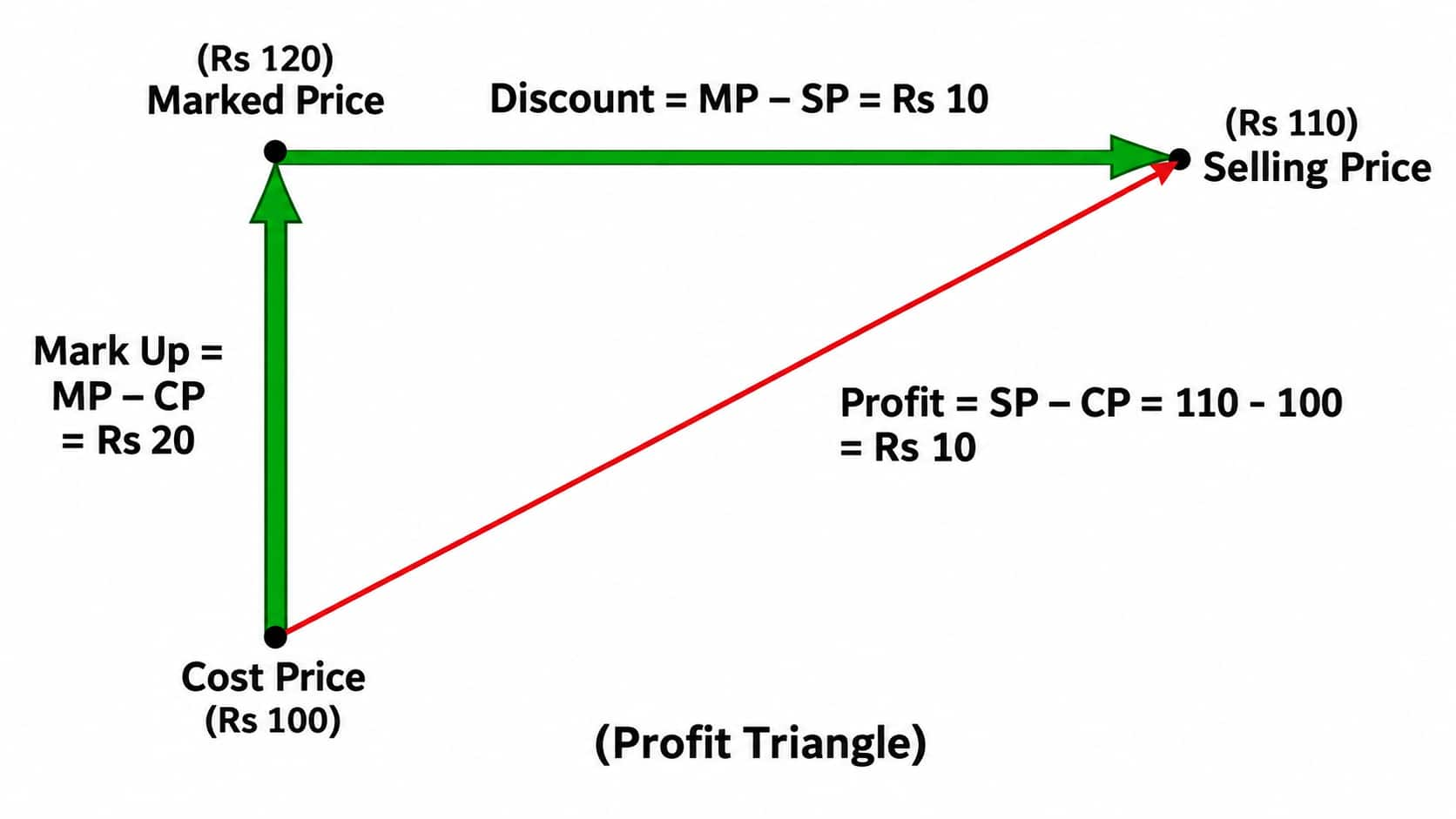
Typically, two of these values are given, and the third must be calculated.
Practise each question type separately before moving on to mixed problems.
The following previous-year CAT questions illustrate how Profit and Loss concepts are tested.
Q1. If a seller gives a discount of 15% on the retail price, she still makes a profit of 2%. Which of the following ensures that she makes a profit of 20%?[CAT Question Paper 2017 Slot 1]
Answer: Option 4
A 15% discount means that if $MP=100$, then $SP=85$.
A 2% profit means that if $CP=100$, then $SP=102$.
The selling price in both representations must be equal. Equating them gives:
$SP=510$, $CP=500$, and $MP=600$.
For a 20% profit, the selling price must be $600$, which equals the marked (retail) price. Therefore, Option 4 is correct.
Q2. On selling a pen at 5% loss and a book at 15% gain, Karim gains Rs. 7. If he sells the pen at 5% gain and the book at 10% gain, he gains Rs. 13. What is the cost price of the book in Rupees? [CAT Question Paper 2019, Slot 1]
Answer: Option 3
Let the cost price of the pen be $100x$ and that of the book be $100y$.
Case 1:
$-5x+15y=7$
Case 2:
$5x+10y=13$
Solving the equations gives $y=\frac45$.
Therefore, the book's cost price is $100y=100\times\frac45=\text{₹}80$.
Prerequisite Before Practising CAT Profit and Loss Questions :
Before practising CAT Profit and Loss questions, students should be comfortable with:
Miscellaneous CAT Data Interpretation (DI) sets may include the following formats:
Examples include a table combined with a pie chart or a line graph combined with a bar graph.
Such graphs are used to represent more data on a single graph.
Data Interpretation is an important component of CAT and other management entrance exams.
The multi-layered pie-chart below shows the sales of LED television sets for a big retail electronics outlet during 2016 and 2017. The outer layer shows the monthly sales during this period, with each label showing the month followed by the sales figure of that month. For some months, the sales figures are not given in the chart. The middle-layer shows quarter-wise aggregate sales figures (in some cases, aggregate quarter-wise sales numbers are not given next to the quarter). The innermost layer shows annual sales. It is known that the sales figures during the three months of the second quarter (April, May, June) of 2016 form an arithmetic progression, as do the three monthly sales figures in the fourth quarter (October, November, December) of that year. [CAT Question Paper 2018]
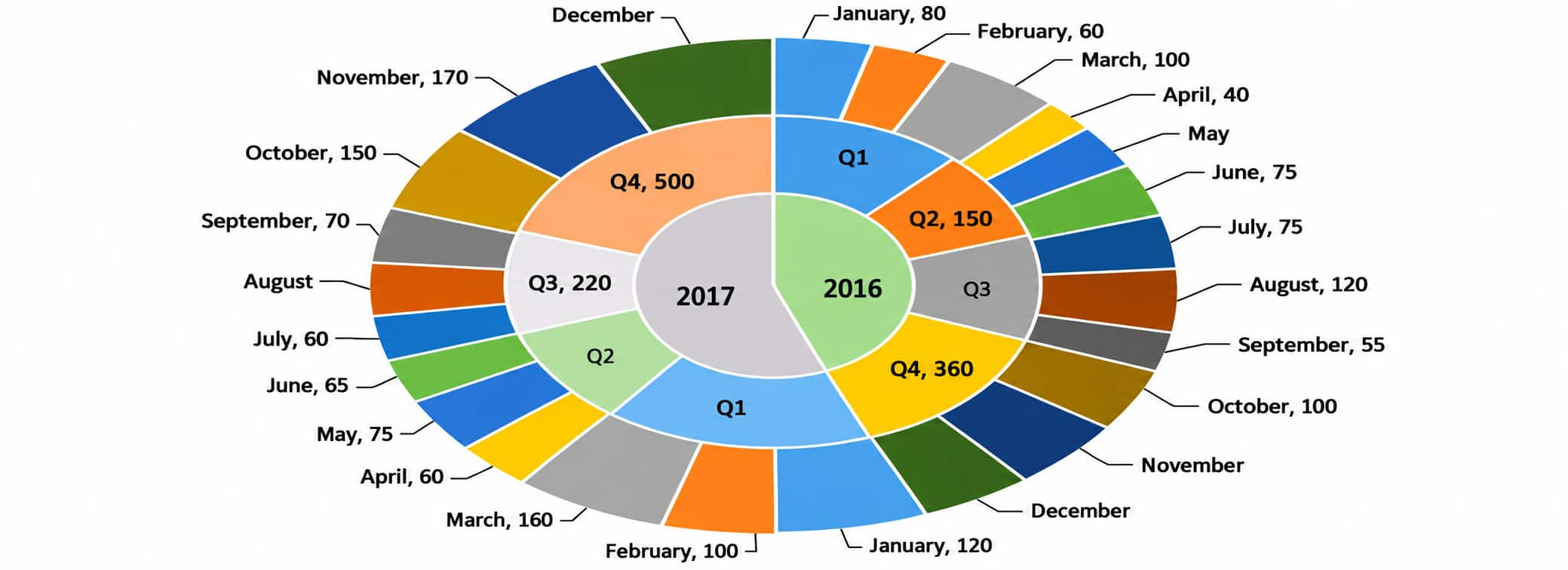
Q1. What is the percentage increase in sales in December 2017 as compared to the sales in December 2016?
Solution: Option 4
Sales in December 2017 = $500-150-170=180$.
Sales in Q4 of 2016 are in AP:
Sales in October 2016 = $100$.
Sales in November 2016 = $100+x$.
Sales in December 2016 = $100+2x$.
So,
$100+(100+x)+(100+2x)=360$
$300+3x=360$
$3x=60$
$x=20$
Sales in December 2016 = $100+2(20)=140$.
Percentage increase = $\frac{180-140}{140}\times100=28.57%$.
Q2. In which quarter of 2017 was the percentage increase in sales from the same quarter of 2016 the highest?
Answer: Option 1 (Q1)
| Quarter | Sales in 2016 | Sales in 2017 | Percentage change |
|---|---|---|---|
| Q1 | 240 | 380 | $\frac{380-240}{240}\times100=58.33%$ |
| Q2 | 150 | 200 | $\frac{200-150}{150}\times100=33.33%$ |
| Q3 | 250 | 220 | $\frac{220-250}{250}\times100=-12%$ (12% decrease) |
| Q4 | 360 | 500 | $\frac{500-360}{360}\times100=38.89%$ |
Prerequisite:
Before practising CAT DI sets, students should be comfortable with:
Miscellaneous Data Interpretation sets can present the same information through multiple layers, tables, or graphical representations. A value obtained from one part of a set may be needed to calculate an unknown value elsewhere. Candidates must therefore understand how the different components relate to one another rather than treating every chart as an independent question.
In a multi-layered pie chart, monthly figures may contribute to quarterly totals, while quarterly totals contribute to annual sales. These relationships create useful checks for verifying calculations.
For example, if monthly sales figures are provided for some months and the quarterly total is known, the missing monthly value can be calculated by subtracting the known figures from the quarterly total.
The calculated value should then be checked against the annual total or any other relevant information provided in the chart.
Candidates should verify that:
These checks can help identify arithmetic errors before they affect subsequent questions.
Some DI sets provide incomplete information but include additional relationships that allow the missing values to be determined. For example, a question may state that three monthly sales figures follow an arithmetic progression.
If the first value is $a$ and the common difference is $d$, the three terms of the arithmetic progression are:
$a,\quad a+d,\quad a+2d$
If their total is $S$, then:
$a+(a+d)+(a+2d)=S$
Therefore,
$3a+3d=S$
The equation can be combined with any other information given in the set to determine the unknown values.
The important point is to use the stated mathematical relationship together with the available totals. Candidates should not assume that missing values can be determined from the graph alone.
Reading is a skill used in many contexts, from understanding everyday information to engaging with complex arguments.
People read newspapers, technical books, novels, and other material for different purposes. Effective reading involves understanding, interpreting, and retaining the information.
The first step to improving your reading skills. The reading ability questions for CAT exam are to develop reading habits by reading any of the following:
Newspapers
Read the book of your interest.
Read the articles of interest.
Once the reading habit is developed, half of the work is done. Now start to analyse the information.
Always get an idea of every passage. Try to find out the keywords.
Always underline the important words or the words that are new to you.
Learn the underlined words and try to find an alternate for these words.
Try to find the uses of idioms and phrases while reading a novel or a book.
Try to avoid non-useful information while reading.
Such practices will lead to improved reading skills.
Developing a regular reading habit is an important part of CAT VARC preparation, but reading more material does not automatically translate into better comprehension. Candidates must also evaluate how well they understand an author's argument, identify relevant information, and interpret the passage accurately.
A structured review of reading practice can help aspirants recognise whether their comprehension is improving and identify the areas that still need attention.
After completing a reading passage or editorial, record a few details about the reading session. This provides a consistent basis for evaluating progress over time.
| Metric | What to Record | Purpose |
|---|---|---|
| Reading time | Time taken to complete the passage | Tracks reading pace |
| Main-idea accuracy | Whether the central argument was identified correctly | Assesses overall comprehension |
| Detail recall | Accuracy in identifying important supporting information | Checks understanding of the passage |
| Inference accuracy | Whether conclusions were supported by the text | Evaluates interpretation |
| Vocabulary difficulties | Unfamiliar words that affected understanding | Identifies areas for vocabulary development |
The objective is not to make every reading session a timed test. Instead, use the record to identify patterns and determine which aspects of reading require more focused practice.
Reading quickly is useful only when the reader can retain and interpret the relevant information. If faster reading consistently leads to incorrect answers or an inability to explain the central argument, comprehension should take priority.
Candidates can begin by reading a passage at a comfortable pace and summarising its main argument in their own words. They can then gradually introduce time limits while checking whether the quality of their understanding remains consistent.
A useful practice routine is to:
This process makes it easier to distinguish a genuine comprehension problem from a simple lack of reading speed.
Profit and Loss questions often test whether candidates can select the right formula and apply it efficiently. The following seven methods can help improve speed and accuracy.
Profit or loss is the difference between the selling price (SP) and cost price (CP).
Profit or loss percentage is calculated by dividing the profit or loss amount by CP and multiplying by $100$.
Example: An item bought for ₹500 and sold for ₹600 earns a profit of ₹100. Therefore, profit percentage is $\frac{100}{500}\times100=20\%$.
Selling Price can be found by adjusting the Cost Price based on profit or loss percentage.
$SP=CP\left(1+\frac{\text{Profit}\%}{100}\right)$
$SP=CP\left(1-\frac{\text{Loss}\%}{100}\right)$
Example: If $CP=₹400$ and the profit is $25\%$, then $SP=400\left(1+\frac{25}{100}\right)=\text{₹}500$.
When multiple discounts are given one after the other, calculate the combined discount using the formula:
$\text{Effective discount}=1-(1-d_1)(1-d_2)$
Here, $d_1$ and $d_2$ are the discounts expressed as decimals.
Example: Successive discounts of $20%$ and $10%$ give an effective discount of $1-(1-0.20)(1-0.10)=0.28=28%$.
Taking CP as 100 simplifies calculations of profit or loss percentages.
Example: If $CP=100$ and the profit is $15\%$, then $SP=115$.
The marked price can be calculated by adjusting the cost price for profit and discount percentages.
$MP=\frac{CP\left(1+\frac{\text{Profit}\%}{100}\right)}{1-\frac{\text{Discount}\%}{100}}$
Example: If $CP=\text{₹}400$, profit is $20\%$, and discount is $10\%$, then $MP=\frac{400(1.20)}{0.90}=\text{₹}533.33$ (approximately).
When profit or loss amount is known, divide it by the cost price and multiply by 100 to get the percentage.
Example: If $CP=\text{₹}250$ and $SP=\text{₹}225$, the loss is ₹25. The loss percentage is $\frac{25}{250}\times100=10\%$.
Calculate profit or loss on each item individually, then add or subtract to find overall profit or loss.
Example: A gain of ₹30 on one item and a loss of ₹20 on another result in a net gain of $30-20=₹10$.
Profit and Loss questions in CAT can combine several conditions in a single problem. A question may involve a change in the selling price, a discount on the marked price, or different transactions involving multiple products. In these situations, the main challenge is to identify which values remain unchanged and which conditions apply to each transaction.
Before calculating the answer, separate the information given in the question into individual conditions. This is particularly useful when two selling scenarios are compared or when the profit earned on one product is combined with the loss incurred on another.
For example, consider a question in which a seller earns a profit under one selling condition and a different profit after changing the selling price. The cost price may remain constant, even though the selling price changes. Identifying this distinction helps candidates establish the correct relationship between the two situations.
Use the following approach:
A calculated answer should satisfy every condition stated in the question. Obtaining a numerical value is not sufficient if that value contradicts another part of the problem.
Candidates should check whether the calculated selling price corresponds to the stated profit or loss, whether a discount is applied to the correct marked price, and whether the final result is consistent with all the given transactions.
For multiple-product questions, verify the combined result instead of checking only one product in isolation. A correct individual calculation may still lead to an incorrect overall answer if the gains and losses are combined improperly.
Access section-wise resources for VARC, DILR, and Quantitative Aptitude to strengthen your preparation and improve exam performance.
eBook Title | Download Link |
CAT 2025 Slot-by-Slot Master Weightage Matrix PDF | |
15 CAT Myths That Waste Months of Preparation | |
8 Expert-Curated Philosophy Editorials with CAT-Style Questions | |
CAT Quant PYQs- Complete 5-Year Question Bank (2021 - 2025) PDF | |
CAT 2026: AI VS Coaching - Which is Better | |
CAT DILR PYQs Complete 5-Year Question Bank (2021 - 2025) | |
CAT VARC PYQs- Complete 5-Year Question Bank (2021 - 2025) PDF | |
CAT RC 2026: 12 Tones That Can Change Your Answer | |
CAT 2026: 10 Most Repeated Concepts in Quant | |
CAT Time & Work: Top 30 Practice Questions with Answer Key & Detailed Solutions | |
CAT Quadratic Equations: Top 30 Practice Questions with Answer Key & Detailed Solutions | |
Top 25 Reading Comprehension Passages to Practice for CAT 2026 | |
CAT 2026 VARC SAMPLE PAPER | |
CAT 2026 DILR SAMPLE PAPER | |
CAT 2026 Quant SAMPLE PAPER | |
CAT 2026 Last 2 Months Revision Plan PDF |
Frequently Asked Questions (FAQs)
Focus on understanding core concepts, practice a variety of solved examples, and attempt timed quizzes on Profit & Loss and LR & DI to build accuracy and speed.
Yes, PYQs provide insight into question patterns and difficulty levels, helping you strategise your approach and manage time effectively during the exam.
Questions often include calculating profit/loss percentages, marked price, discounts, successive discounts, and mixture problems involving multiple items.
Regular practice in LR & DI enhances critical thinking, pattern recognition, and data analysis skills, all essential for solving complex problems quickly and accurately.
Profit & Loss questions are a staple in the Quantitative Aptitude section and often carry good scoring potential. Understanding these concepts helps improve accuracy and speed in the exam.
Three months might be enough if you are already well-versed in Quant, Verbal, and Logical Reasoning. But beginners might find it difficult to go through the entire syllabus and take enough mock tests within a short period of 3 months.
Getting 99 percentile in three months is achievable but needs rigorous preparation, daily mock tests, and clear conceptual understanding. Candidates with experience in aptitude tests or very good problem-solving skills have a higher chance.
Yes, it is possible to prepare for CAT in 9 months. For effective preparation, follow our 60-day CAT preparation series in which we cover all the topics required for CAT.
CAT's unpredictable level of difficulty is known to everyone, but it also usually stays demanding with time limitation and stiff competition. With good preparation, firm concepts, and test-taking strategy, you are capable of mastering it effectively.
Optimally, you should begin prepping at least 9-12 months beforehand the examination. There should be plenty of time during this period to establish solid foundations, practice mocks, and finalize your strategy.

On Question asked by student community
Hello, for AP NEET PG Category C seats, NRI documents are generally required if you are applying under the NRI quota, and eligibility depends on the applicable counselling rules. The fee payment currency and procedure should be confirmed from the current Dr. NTRUHS notification at its official website drntr.uhsap.in.
Hello, CAT aur B-school entrance exams ke baare mein aap exam dates, eligibility, registration, exam pattern, syllabus, colleges ya admission process ki information dekh sakte hain. Aapki requirement ke according relevant details yahan mil sakti hain: https://bschool.careers360.com/exams
You can download the latest CAT syllabus from here:
Hey there,
For a B.Sc. with Chemistry, Botany and Zoology (CBZ), if the CAT application asks separately for:
If the Discipline dropdown has a more specific option such as “Biological Sciences,” “Life Sciences,” or “Zoology/Botany,”
Hey there,
Yes. With 2 years of work experience, you are eligible to target the regular 2-year MBA at IIM Calcutta as long as you have a bachelor's degree with at least 50% marks (45% for SC/ST/PwD). Work experience is not required for eligibility.
For
Directions for question:
The bar-graph given below shows the foreign exchange reserves of Nepal (in million Rupees) from 2014 to 2021. Answer the following questions based on the graph :

Question:
What was the percentage increase (rounded to the nearest integer, if deemed necessary) in the foreign exchange reserves in

Globally Recognized by AACSB (US) & AMBA (UK) | 18 LPA Avg. CTC for PGPM 2026
75+ years of legacy | #1 Entrance Exam | Score accepted by 250+ BSchools
Gateway to IBS Hyderabad & 8 other IBS campuses | Scholarships worth 10 CR
Highest Package 29.30 LPA | 12 LPA Median CTC | 230+ Recruiters | AACSB Accredited | Ranked 51 in Asia by QS International
Early Application Round Deadline: 27th Oct’26 | 400+ Recruiters | Highest CTC 17.2 LPA | Average CTC 8 LPA | 92% Avg. Placements | Awarded Best Business School of the Year
Last Date to Apply - 19th December 2026 | Highest CTC 68.66 LPA | Average CTC 18.08 LPA | Top 25% Average CTC 24.66 LPA