Birla Institute of Management Technology, Greater Noida
AACSB Accredited | Highest CTC: 22 LPA


Profit and Loss is an important topic in CAT 2026 Quantitative Aptitude, testing how well candidates handle changing prices, multiple transactions and percentage-based calculations. The CAT 2026 examination is scheduled for November 29, 2026. Questions may involve a product being sold at different prices, an article passing through multiple sellers, or finding an original cost price from a final transaction. These problems require more than formula application; candidates must identify the correct price at each stage and understand how one transaction affects the next. This article covers important formulas, CAT question patterns, solved previous-year questions and practice resources to help candidates prepare for the exam.
This Story also Contains
To understand the topic, you must understand the basic definitions first, like:
| Term | Definition |
|---|---|
| CP (Cost Price) | It is the price at which an article is purchased. |
| SP (Selling Price) | It is the price at which an article is sold. |
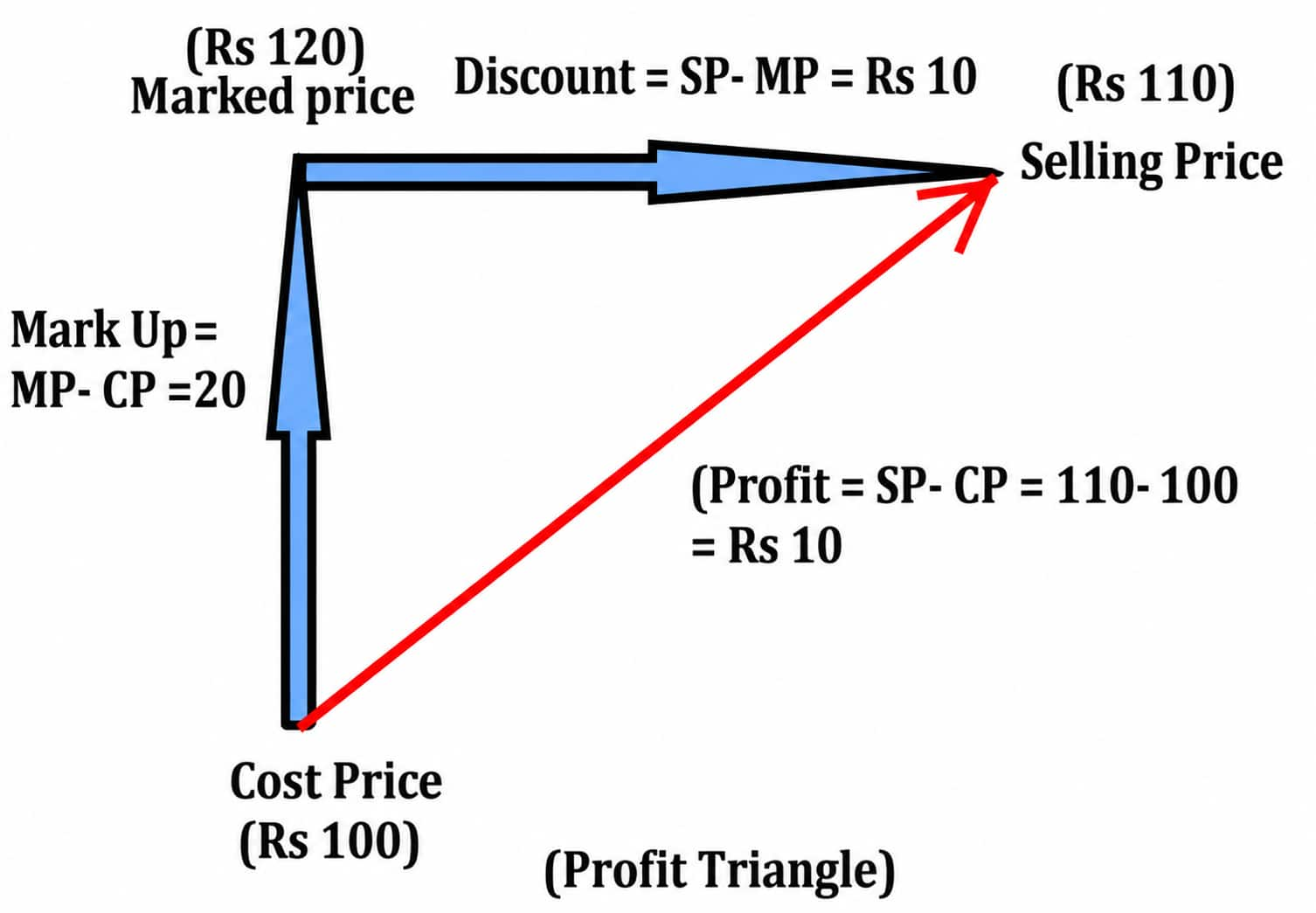
| MP (Marked Price or List Price) | It is the price marked on the article. Discounts are generally calculated on this price. |
| Profit or Gain | When $SP > CP$, the seller makes a profit. Profit $= SP - CP$ |
| Loss | When $CP > SP$, the seller incurs a loss. Loss $= CP - SP$ |
| Discount | It is a reduction given on the marked price (MP). Discount $= MP - SP$ |
Also, you should understand the question types that are being asked in the CAT:
| Question Type | Description |
|---|---|
| Questions based on CP, SP, and MP | When CP, discount%, Profit% are given, and other variables like SP, MP, etc. need to be calculated. |
| Questions based on successive discounts | When two or more discounts are given successively, and you have been asked to calculate the SP, MP, or net discount percent. |
| Questions based on faulty weight and adulteration | In these types of questions, the final profit% is asked after adulteration, or sometimes the adulteration percent is asked when the final profit percent is given. |
The number of Profit and Loss questions varies across CAT years and slots, ranging in difficulty from medium to high level. So, this topic should be practised more.
From the analysis of CAT previous years' question papers, we noticed that, along with direct questions from Profit and Loss, Caselet Data Interpretation based on this is also asked.
We have analysed the previous 6 years' papers of CAT to find out the weightage and CAT exam pattern of the questions from profit and loss that are asked in the exam. Here is a summary of the weightage of questions of profit and loss year-wise and slot-wise.
| Year | Slot | Number of Questions |
|---|---|---|
| 2020 | 1 | 1 |
| 2020 | 2 | 1 |
| 2020 | 3 | 1 |
| 2021 | 1 | 1 |
| 2021 | 2 | 2 |
| 2021 | 3 | 1 |
| 2022 | 1 | 2 |
| 2022 | 2 | 0 |
| 2022 | 3 | 0 |
| 2023 | 1 | 1 |
| 2023 | 2 | 2 |
| 2023 | 3 | 1 |
| 2024 | 1 | 1 |
| 2024 | 2 | 1 |
| 2024 | 3 | 1 |
| 2025 | 1 | 1 |
| 2025 | 2 | 1 |
| 2025 | 3 | 1 |
Get the actual CAT previous year question papers here
Some CAT questions provide the final selling price, profit percentage or discount but hide the original cost price or marked price. Instead of calculating forward from the cost price, candidates must work backwards to identify the starting value.
Suppose an article is sold for ₹1,080 after a discount of 10%. Find its marked price.
$MP = \frac{1080 \times 100}{90} = ₹1,200$
If the same article was marked 20% above its cost price, its original cost price would be:
$CP = \frac{1200 \times 100}{120} = ₹1,000$
Consider an article whose price is increased by 25% and then reduced by 20%. The final selling price is ₹1,000. What was its original price?
Let the original price be $x$.
$x \times 1.25 \times 0.80 = 1000$
$x = \frac{1000}{1} = ₹1,000$
The increase and decrease cancel each other in this particular case. However, this does not happen with every pair of percentage changes.
When the final value is given, reverse the operations in the opposite order:
| Price Change | Reverse Operation |
|---|---|
| 20% increase | Divide by $1.20$ |
| 15% decrease | Divide by $0.85$ |
| 25% increase | Divide by $1.25$ |
This approach is useful when a question contains multiple price changes and asks for the original value.
There are 3 basic formulas in profit and loss that need to be understood to solve any question in Profit and Loss. The rest are the variations of the questions.
$\text{Profit %} = \frac{\text{Profit}}{\text{CP}} \times 100$, where CP is the cost price.
$\text{Loss %} = \frac{\text{Loss}}{\text{CP}} \times 100$, where CP is the cost price.
Profit $= SP - CP$, Loss $= CP - SP$
Other variations of this formula:
$\text{SP} = \text{CP} \times \frac{100 + \text{Profit %}}{100}$
Key Usage: Basic P&L questions, cost-price/selling-price direct problems.
Example: A shopkeeper buys a book for ₹400 and sells it at ₹460. Find profit %.
Profit $= 60$, CP $= 400$
$\text{Profit %} = \frac{60}{400} \times 100 = 15%$
$\text{Discount %} = \frac{\text{Discount}}{\text{MP}} \times 100$, where MP is the marked price.
Discount $= MP - SP$
Other variation:
$SP = MP \times \frac{100 - \text{Discount %}}{100}$
Key Usage: Marked price, successive discounts, successive profit/loss.
Example: A shopkeeper gives two successive discounts of $40%$ and $30%$ respectively. Find the effective discount %.
Let MP $= 100$. After the 1st discount, price $= 60$. After the second discount of $30%$, final SP $= 60 \times 0.7 = 42$.
$\text{Net Discount %} = \frac{100 - 42}{100} \times 100 = 58%$
Alternate solution (Trick):
$\text{Net discount %} = 40 + 30 - \frac{40 \times 30}{100} = 70 - 12 = 58%$
$\text{Markup %} = \frac{\text{Markup value}}{\text{CP}} \times 100$
Other variation:
$SP = MP \times \frac{100 - \text{Discount %}}{100}$
Key Usage: Marked price, hike in the price of value, successive increase in the price.
Example: A man marked up the price on one article by $20%$ and lost $10%$ on the marked price while selling. Find net % gain/loss.
Let CP $= 100$. After an increase of $20%$, price $= 120$. After the second transaction, final SP $= 120 \times 0.9 = 108$.
$\text{Net gain %} = \frac{108 - 100}{100} \times 100 = 8%$
A few points must be remembered before solving questions using these 3 formulas:
| Point to Remember |
|---|
| Profit or loss percent is always calculated on the cost price. |
| Discount percent is always calculated on the marked price. |
| The markup percent is always calculated on the cost price. |
Also, there are some prerequisite conditions:
Consider the following example:
Question: A man buys 35 kg of sugar and sets a marked price in order to make a 20% profit. He sells 5 kg at this price, and 15 kg at a 10% discount. Accidentally, 3 kg of sugar is wasted. He sells the remaining sugar by raising the marked price by $p$ percent so as to make an overall profit of 15%. Then $p$ is nearest to: [CAT 2024]
Solution:
Step 1: First, understand the problem statement and the information given in the question.
In this question, the markup percent is to be calculated.
Given:
Now, we need to find the percentage increase in the price of the remaining sugar so that the total profit is 15%.
Step 2: Identify the concept required to solve the question.
Formula 1 should be used in between:
$\text{Profit/Loss %} = \frac{\text{Profit or Loss}}{\text{CP}} \times 100%$, where CP is the cost price.
Formula 2 used in between:
$\text{Discount %} = \frac{\text{Discount}}{\text{MP}} \times 100%$, where MP is the marked price.
Formula 3 used in the end:
$\text{Markup %} = \frac{\text{Markup Value}}{\text{CP}} \times 100%$, where CP is the cost price.
Step 3: Apply the concept/formula to find the unknown.
Final Solution:
Let the cost price of 1 kg of sugar $= ₹100$.
The total cost price of 35 kg $= ₹3500$.
Marked price per kg $= ₹120$.
Given, the final profit is 15%. So, final SP of 35 kg $= 3500 \times 1.15 = ₹4025$.
First 5 kg are sold at 20% marked-up price:
$SP_1 = 5 \times 100 \times 1.2 = ₹600$
Next 15 kg are sold after giving 10% discount:
$SP_2 = 15 \times 100 \times 1.2 \times 0.9 = ₹1620$
3 kg of sugar got wasted.
23 kg of sugar was sold at:
$₹(600 + 1620) = ₹2220$
The remaining 12 kg should be sold at:
$₹(4025 - 2220) = ₹1805$
$\Rightarrow \text{SP of 1 kg} = \frac{1805}{12} \approx ₹150$
Hence, the seller should further mark up by:
$\frac{150 - 120}{120} \times 100 = 25%$
Here are a few shortcuts that can be helpful to solve the questions effectively and save time during the exam.
| Concept | Shortcut |
|---|---|
| To find the net profit or loss percent if the cost price of $n$ articles is the same | Average of all profit and loss percentages. Profit percentages are taken as positive, while loss percentage is taken as negative. |
| To find the net profit or loss percent if the selling price of 2 articles is the same and the profit % $(x%)$ and loss % $(x%)$ are the same | $\text{Net Loss %} = \frac{x^2}{100}$ |
| Net discount if there are two successive discounts of $R_1%$ and $R_2%$ | $\text{Net %} = R_1 + R_2 - \frac{R_1R_2}{100}$ |
Download Free Practice Tests & Solutions and Ace the CAT Exam 2026
Q.1) Bina incurs 19% loss when she sells a product at Rs. 4860 to Shyam, who in turn sells this product to Hari. If Bina would have sold this product to Shyam at the purchase price of Hari, she would have obtained 17% profit. Then, the profit, in rupees, made by Shyam is:
Solution: [Expected time to be taken: 45 to 60 seconds, Level of Difficulty: Moderate]
Let the cost price for Bina be $x$.
Bina sells to Shyam at a 19% loss:
$4860 = x - \frac{19}{100}x = \frac{81}{100}x$
So, $x = \frac{4860 \times 100}{81} = 6000$
Now, let the selling price to Hari be $y$.
If Bina had sold to Shyam at Hari's price and made 17% profit:
$y = x + \frac{17}{100}x = \frac{117}{100} \times 6000 = 7020$
So, Shyam bought at Rs. 4860 and sold at Rs. 7020.
Therefore, his profit is:
$7020 - 4860 = 2160$
Hence, the correct answer is 2160.
Q.2) Gopi marks a price on a product in order to make 20% profit. Ravi gets 10% discount on this marked price, and thus saves Rs 15. Then, the profit, in rupees, made by Gopi by selling the product to Ravi, is:
| Option | Profit |
|---|---|
| A | ₹15 |
| B | ₹25 |
| C | ₹10 |
| D | ₹12 |
Solution: [Expected time to be taken: 45 seconds, Level of Difficulty: Easy]
Let the cost price of the product be $100x$.
Gopi wants to make a $20%$ profit, so the marked price (MP) is:
$\text{MP} = 100x \times \left(1 + \frac{20}{100}\right) = 120x$
Ravi gets 10% discount on the marked price, so the selling price (SP) is:
$\text{SP} = 120x \times \left(1 - \frac{10}{100}\right) = 120 \times \frac{90}{100} = 108x$
Now, the discount Ravi gets:
$120x - 108x = 12x$
But the question says Ravi saves Rs 15, so:
$12x = 15$
$\Rightarrow x = \frac{15}{12} = \frac{5}{4}$
The profit made by Gopi:
$108x - 100x = 8x = 10$ rupees.
Hence, the correct answer is option 3.
Q.3) Gita sells two objects A and B at the same price such that she makes a profit of 20% on object A and a loss of 10% on object B. If she increases the selling price such that objects A and B are still sold at an equal price and a profit of 10% is made on object B, then the profit made on object A will be nearest to:
| Option | Profit |
|---|---|
| A | $42%$ |
| B | $47%$ |
| C | $49%$ |
| D | $45%$ |
Solution: [Expected time to be taken: 75 to 90 seconds, Level of Difficulty: Moderate to Hard]
Let the original selling price of both A and B be Rs 100.
So, the cost price of A, with a profit of 20%, is:
$\frac{5}{6} \times 100 = \frac{250}{3}$
And, the cost price of B, with a loss of 10%, is:
$\frac{100}{0.9} = \frac{1000}{9}$
After an increase in the selling price by some value, the profit on object B is 10%.
So, the new selling price is 110% of the cost price of B:
$= \frac{1000}{9} \times \frac{110}{100} = \frac{1100}{9}$
Profit of A:
$\frac{1100}{9} - \frac{250}{3} = \frac{350}{9}$
Profit percentage of A:
$\frac{\frac{350}{9}}{\frac{250}{3}} \times 100 = 46.67%$
Nearest to $47%$.
Hence, the correct answer is option (2).
Q.4) Minu purchased a pair of sunglasses for Rs. 1000 and sold them to Kanu for 20% profit. Then, Kanu sells it back to Minu at a 20% loss. Finally, Minu sells the same pair of sunglasses to Tanu. If the total profit made by Minu from all her transactions is Rs. 500, then the percentage of profit made by Minu when she sold the pair of sunglasses to Tanu is:
| Option | Profit Percentage |
|---|---|
| A | $35.42%$ |
| B | $31.25%$ |
| C | $52%$ |
| D | $54%$ |
Solution: [Expected time to be taken: 60 to 75 seconds, Level of Difficulty: Moderate]
Initial Cost Price for Minu $= 1000$
Cost Price to Kanu $= 120%$ of $1000 = 1200$
Profit made by Minu $= 1200 - 1000 = 200$
Again, Minu purchased at 80% of 1200:
$= 960$
The total profit made by Minu is 500. So, profit made when she sold it to Tanu:
$= 500 - 200 = 300$
Final Selling Price for Minu when sold to Tanu:
$= 960 + 300 = 1260$
Profit percent:
$\frac{300}{960} \times 100 = 31.25%$
Hence, the correct answer is option (2).
Q.5) Ankita buys 4 kg cashews, 14 kg peanuts and 6 kg almonds when the cost of 7 kg cashews is the same as that of 30 kg peanuts or 9 kg almonds. She mixes all the three nuts and marks a price for the mixture in order to make a profit of Rs. 1752. She sells 4 kg of the mixture at this marked price and the remaining at a 20% discount on the marked price, thus making a total profit of Rs. 744. Then the amount, in rupees, that she had spent in buying almonds is:
| Option | Amount |
|---|---|
| A | ₹1680 |
| B | ₹1176 |
| C | ₹2520 |
| D | ₹2522 |
Solution: [Expected time to be taken: 90 to 120 seconds, Level of Difficulty: Hard]
It is given, $7C = 30P = 9A$ and Ankita bought $4C$, $14P$ and $6A$.
Let:
$7C = 30P = 9A = 630k$
$\Rightarrow C = 90k$, $P = 21k$, and $A = 70k$
Cost price of $4C$, $14P$ and $6A$:
$= 4(90k) + 14(21k) + 6(70k) = 1074k$
Marked-up price:
$= 1074k + 1752$
So,
$\text{S.P.} = \frac{1}{6}(1074k + 1752) + \left(\frac{4}{5}\right)\left(\frac{5}{6}\right)(1074k + 1752) = \frac{5}{6}(1074k + 1752)$
$\Rightarrow \text{S.P.} - \text{C.P.} = \text{profit}$
$\Rightarrow 1460 - \frac{1074k}{6} = 744$
$\Rightarrow \frac{1074k}{6} = 716$
$\Rightarrow k = 4$
Money spent on buying almonds:
$= 420k = 420 \times 4 = ₹1680$
The correct answer is Rs. 1680.
Q.6) Amal buys 110 kg of syrup and 120 kg of juice, syrup being 20% less costly than juice, per kg. He sells 10 kg of syrup at 10% profit and 20 kg of juice at 20% profit. Mixing the remaining juice and syrup, Amal sells the mixture at Rs 308.32 per kg and makes an overall profit of 64%. Then, Amal’s cost price for syrup, in rupees per kg, is:
| Option | Cost Price |
|---|---|
| A | ₹160 |
| B | ₹180 |
| C | ₹220 |
| D | ₹224 |
Solution: [Expected time to be taken: 90 to 120 seconds, Level of Difficulty: Hard]
Let the price of juice be Rs. $x$ per kg.
Since the cost price of syrup is 20% less than the cost price of juice, the cost price of syrup is $0.8x$ per kg.
Total cost price of syrup:
$= 110 \times 0.8x = 88x$
Total cost price of juice:
$= 120 \times x = 120x$
Total cost price:
$= 88x + 120x = 208x$
Since the overall profit percentage is 64%:
Total profit $= 0.64(208x) = 133.12x$
Profit generated by selling 10 kg of syrup, which costs Rs $0.8x$ per kg, at 10% profit:
$= 0.1 \times 10 \times 0.8x = 0.8x$
Profit generated on selling 20 kg of juice, which costs Rs $x$ per kg, at 20% profit:
$= 0.2 \times 20x = 4x$
The remaining profit:
$133.12x - (0.8x + 4x) = 128.32x$
This is generated by selling 100 kg of syrup and 100 kg of juice at Rs 308.32 per kg.
The total selling price of 100 kg of syrup and 100 kg of juice:
$= 200 \times 308.32 = 2 \times 30832$
The cost price of 100 kg of syrup:
$= 0.8x \times 100 = 80x$
Cost price of 100 kg of juice:
$= 100x$
Total cost price:
$= 80x + 100x = 180x$
Profit = Selling price – Cost price
$\Rightarrow 128.32x = 2 \times 30832 - 180x$
$\Rightarrow 308.32x = 2 \times 30832$
$\Rightarrow x = 200$
Cost price of syrup per kg:
$= 0.8 \times 200 = ₹160$
Hence, the correct answer is option (1).
It is important to understand the common mistakes in the CAT exam that a student makes while solving the Profit and Loss questions.
| Common Mistakes | How to Rectify |
|---|---|
| Ignoring basic concepts | Understand all the basic definitions and formulas, and practise questions based on them. |
| Misinterpreting the base | Usually, students calculate the profit percent on the selling price instead of the cost price. So, it is very important to understand that profit is always calculated on CP, and discount is always calculated on MP. |
| Mistakes in converting percentages into fractions | Practise the percentage-to-fraction conversion and vice versa. |
| Errors in finding successive discounts | It is important to understand whether the successive discounts are needed or not. You should focus more and practise more. |
| When questions involve two or more concepts, students often make mistakes | Practise questions based on the concept amalgam. |
The most important CAT quantitative aptitude topics, along with the CAT quantitative aptitude practice questions, are provided in the table below. The candidates are encouraged to practise CAT quantitative aptitude questions from these topics as they have a high probability of being asked in the CAT examination.
| Section | Title | Download Link |
|---|---|---|
| Arithmetic | Time, Speed and Distance | Download Now |
| Arithmetic | Ratio and Proportion | Download Now |
| Arithmetic | Time and Work | Download Now |
| Arithmetic | Percentages | Download Now |
| Algebra | Surds and Indices | Download Now |
| Algebra | Logarithms | Download Now |
| Algebra | Linear and Quadratic Equations and Mixtures and Alligations | Download Now |
| Algebra | Sequence and Series | Download Now |
| Geometry | Triangles | Download Now |
| Geometry | Circle | Download Now |
| Modern Maths | Permutations and Combinations | Download Now |
| Number Systems | Remainders | Download Now |
| Coordinate Geometry | Download Now |
A seller may sell one portion of the stock at a particular price and change the price for the remaining quantity. Such questions require candidates to calculate the revenue from each transaction separately before finding the overall profit.
A shopkeeper purchases 50 notebooks at ₹40 each. He sells 20 notebooks at ₹50 each and the remaining 30 notebooks at ₹45 each. Find his overall profit percentage.
| Particulars | Calculation | Amount |
|---|---|---|
| Total Cost Price | $50 \times 40$ | ₹2,000 |
| Revenue from first sale | $20 \times 50$ | ₹1,000 |
| Revenue from second sale | $30 \times 45$ | ₹1,350 |
| Total Selling Price | $1,000 + 1,350$ | ₹2,350 |
| Overall Profit | $2,350 - 2,000$ | ₹350 |
$\text{Profit %} = \frac{350}{2000} \times 100 = 17.5%$
Suppose the shopkeeper wants to earn an overall profit of 20% instead. How much should he charge for each of the remaining 30 notebooks if the first 20 are already sold at ₹50 each?
Required total revenue:
$2000 \times 1.20 = ₹2,400$
Revenue already earned:
$20 \times 50 = ₹1,000$
Revenue required from the remaining notebooks:
$2400 - 1000 = ₹1,400$
Required selling price per notebook:
$\frac{1400}{30} = ₹46.67$
The profit percentage is calculated on the total cost of all 50 notebooks, not just the cost of the remaining stock. Candidates should keep track of:
| Point to Track |
|---|
| Total quantity purchased |
| Quantity sold in each transaction |
| Selling price applicable to each portion |
| Total revenue compared with the original investment |
In some questions, an article passes through two or more people before reaching the final buyer. Each person purchases the article at one price and sells it at another. The profit of one seller becomes the cost price of the next seller.
Suppose A purchases an article for ₹800 and sells it to B at a 25% profit. B then sells it to C at a 10% loss. Find the final selling price.
| Transaction | Calculation | Price |
|---|---|---|
| A's purchase price | Given | ₹800 |
| A sells to B | $800 \times 1.25$ | ₹1,000 |
| B sells to C | $1,000 \times 0.90$ | ₹900 |
The final selling price is ₹900.
Although A makes a profit of 25%, B incurs a loss of 10%. The overall change from A's original purchase price is:
$\frac{900 - 800}{800} \times 100 = 12.5%$
Suppose A purchases an article for ₹1,000 and sells it to B at a 20% profit. B then sells it to C. If C pays ₹1,320, find B's profit percentage.
A's selling price:
$1000 \times 1.20 = ₹1,200$
B's profit:
$1320 - 1200 = ₹120$
B's profit percentage:
$\frac{120}{1200} \times 100 = 10%$
For multiple transactions, represent each profit as a multiplier and each loss as a reduction factor.
For example:
| Transaction | Multiplier |
|---|---|
| 20% profit | $1.20$ |
| 10% loss | $0.90$ |
| 15% profit | $1.15$ |
The final price can be calculated as:
$\text{Final Price} = \text{Initial Price} \times 1.20 \times 0.90 \times 1.15$
This method avoids calculating every intermediate profit percentage separately and is useful when an article passes through several buyers and sellers.
Download free CAT 2026 preparation resources from Careers360, including five-year PYQ question banks for all three sections, sample papers, formula sheets and revision plans. These eBooks and practice materials help you practise section-wise questions and revise key concepts before the exam.
| eBook Title | Download |
|---|---|
| CAT Quant PYQs - Complete 5-Year Question Bank (2021-2025) PDF | Download Now |
| CAT DILR PYQs - Complete 5-Year Question Bank (2021-2025) | Download Now |
| CAT VARC PYQs - Complete 5-Year Question Bank (2021-2025) PDF | Download Now |
| CAT 2026 Quant Sample Paper | Download Now |
| CAT 2026 Quantitative Aptitude Questions with Answers | Download Now |
| CAT 2026 Important Formulas | Download Now |
| Past 10 years CAT Question Papers with Answers | Download Now |
| CAT 2026 DILR Sample Paper | Download Now |
| CAT 2026 VARC Sample Paper | Download Now |
| CAT 2026 Last 2 Months Revision Plan PDF | Download Now |
Frequently Asked Questions (FAQs)
Profit and Loss questions are frequently asked in CAT and test a candidate’s ability to apply basic arithmetic concepts quickly. These questions are usually formula-based and scoring if approached correctly.
Candidates should focus on cost price, selling price, profit percentage, loss percentage, marked price, discount, and successive discounts, as these form the base of most CAT questions.
In this case, one will always incur a loss which is equal to the square of the loss% divided by 100.
Here, loss% = 6.25%.
Most questions are of easy to moderate level but are often combined with logical reasoning or percentages, requiring careful reading and quick calculations.
Regular practice, memorising standard formulas, and learning percentage-to-fraction conversions help improve calculation speed and accuracy.
Yes, shortcuts and smart approximation techniques are extremely helpful, especially under time pressure, as long as the concepts behind them are clearly understood.

On Question asked by student community
Hi Khushdeep
Several apps and online platforms are available for CAT (Common Admission Test) preparation. Students can choose a platform based on their preparation needs, such as video lectures, practice questions, mock tests, and performance analysis.
Hello, for AP NEET PG Category C seats, NRI documents are generally required if you are applying under the NRI quota, and eligibility depends on the applicable counselling rules. The fee payment currency and procedure should be confirmed from the current Dr. NTRUHS notification at its official website drntr.uhsap.in.
Hello, CAT aur B-school entrance exams ke baare mein aap exam dates, eligibility, registration, exam pattern, syllabus, colleges ya admission process ki information dekh sakte hain. Aapki requirement ke according relevant details yahan mil sakti hain: https://bschool.careers360.com/exams
You can download the latest CAT syllabus from here:
Hey there,
For a B.Sc. with Chemistry, Botany and Zoology (CBZ), if the CAT application asks separately for:
If the Discipline dropdown has a more specific option such as “Biological Sciences,” “Life Sciences,” or “Zoology/Botany,”
Directions for question:
The bar-graph given below shows the foreign exchange reserves of Nepal (in million Rupees) from 2014 to 2021. Answer the following questions based on the graph :

Question:
What was the percentage increase (rounded to the nearest integer, if deemed necessary) in the foreign exchange reserves in

Globally Recognized by AACSB (US) & AMBA (UK) | 18 LPA Avg. CTC for PGPM 2026
Complete your XAT Application by 11th Nov & get more preparation support | 75+ years of legacy | #1 Entrance Test | 100+ Test Cities | 250+ B-Schools accept XAT Score
Gateway to IBS Hyderabad & 8 other IBS campuses | Scholarships worth 10 CR
Highest Package 29.30 LPA | 230+ Recruiters | AACSB Accredited | Ranked 51 in Asia by QS International
Among top 6% B-Schools globally to be accredited by AACSB | Highest Package-35 LPA
Last Date to Apply: 15th December 2026 | Average CTC: 16.4 LPA | Up to 100% Tuition Fee Waiver