Great Lakes - PGDM & PGPM Admissions 2027
Globally Recognized by AACSB (US) & AMBA (UK) | 18 LPA Avg. CTC for PGPM 2026


Simple Interest and Compound Interest questions in CAT often test more than direct formula application. Questions can combine rates, time periods, successive changes, half-yearly compounding and comparisons between SI and CI, making shortcut-based calculation especially useful. CAT 2026 is scheduled for November 29, 2026. This article covers the key SI and CI formulas, calculation tricks, important question types and CAT-level practice questions to strengthen Quantitative Aptitude preparation.
This Story also Contains

CAT 2026 Simple Interest and Compound Interest: Key Concepts
Understanding the difference between Simple Interest and Compound Interest is the first step toward solving interest-based questions quickly.
Concept | Simple Interest | Compound Interest |
Interest calculated on | Original principal | Principal plus accumulated interest |
Formula for interest | SI=P×R×T100 | CI=A−P |
Amount | A=P+SI | A=P(1+R100)T |
Interest growth | Linear | Compound growth |
Here, P represents the principal, R is the annual interest rate, T is the time in years and A is the final amount.
The key SI formulas for CAT cover interest, amount, principal, rate and time.
Simple Interest: SI=P×R×T100
Amount: A=P+SI=P(1+RT100)
Principal: P=100×SIR×T
Rate: R=100×SIP×T
Time: T=100×SIP×R
For CI, the compounding period determines the number of growth cycles.
Compound Amount: A=P(1+R100)T
Compound Interest: CI=A−P=P[(1+R100)T−1]
Depreciation: A=P(1−R100)T
Globally Recognized by AACSB (US) & AMBA (UK) | 18 LPA Avg. CTC for PGPM 2026
Test centres are available in 70+ cities across India | 75,000+ aspirants apply for the NMAT exam | Accepted by 58+ institutions like NMIMS, KJSIM, ISB, SPJIMR and Great Lakes.
Several standard shortcuts can reduce calculation time in CAT.
For a principal P and rate R:
CI−SI=P(R100)2 or
CI−SI=PR210000
For example, if ₹P=₹20,000 and R=10:
₹CI−SI=20000×10210000=₹200
CI−SI=P[3(R100)2+(R100)3]
This formula is useful when a question directly asks for the difference between compound and simple interest over three years.
For half-yearly compounding, halve the rate and double the number of periods:
A=P(1+R200)2T
For quarterly compounding, divide the rate by 4 and multiply the periods by 4:
A=P(1+R400)4T
If different rates apply during different periods:
A=P(1+R1100)T1(1+R2100)T2
Percentage-based shortcuts are particularly useful in CAT questions involving repeated increases or decreases.
If a value increases by a and then by b, the total percentage increase is:
a+b+ab100
If a value increases by a and then decreases by b, the net percentage change is: a−b−ab100
For equal increases and decreases of a%, the overall change is: −a2100
Practise CAT-level Simple Interest and Compound Interest questions to strengthen formula application, calculation speed and accuracy.
1. The compound interest on a sum for two years at 20% per annum is ₹2,640. Find the simple interest on the same sum for three years at 15% per annum.
A. ₹2,700
B. ₹3,000
C. ₹3,300
D. ₹3,600
2. A sum of money amounts to ₹8,400 in 2 years and ₹9,240 in 4 years at simple interest. Find the principal.
A. ₹7,200
B. ₹7,560
C. ₹7,800
D. ₹8,000
3. A sum of Rs 10,000 is invested at 10% per annum compound interest for two years. What is the difference between the compound interest and simple interest?
A. Rs 90
B. Rs 100
C. Rs 110
D. Rs 120
4. A sum is invested at 20% per annum, compounded half-yearly, for 1.5 years. If the principal is Rs 10,000, what is the amount?
A. Rs 13,310
B. Rs 13,200
C. Rs 13,420
D. Rs 13,500
5. A machine depreciates by 10% in the first year and 20% in the second year. If its initial value is Rs 50,000, what is its value after two years?
A. Rs 36,000
B. Rs 36,500
C. Rs 37,000
D. Rs 38,000
Practise CAT Quant questions from 2021 to 2025 to understand recurring concepts and question patterns.
Download now: CAT Quant PYQs: Complete 5-Year Question Bank (2021-2025)
These question types cover the common SI and CI approaches tested in CAT.
Question Type | Key Approach |
Direct SI | Use SI=PRT100 |
Direct CI | Calculate A first, then use CI=A−P |
SI vs CI | Use the difference shortcut |
Two-year difference | Use CI−SI=PR210000 |
Half-yearly CI | Halve the rate and double the time |
Quarterly CI | Divide the rate by 4 and multiply time by 4 |
Depreciation | Use A=P(1−R100)T |
Changing rates | Multiply the corresponding growth factors |
Successive changes | Apply percentage multiplication |
Unknown principal/rate/time | Rearrange the SI or CI formula |
Recognising the question type quickly can help candidates choose the right formula and save valuable time in CAT 2026.
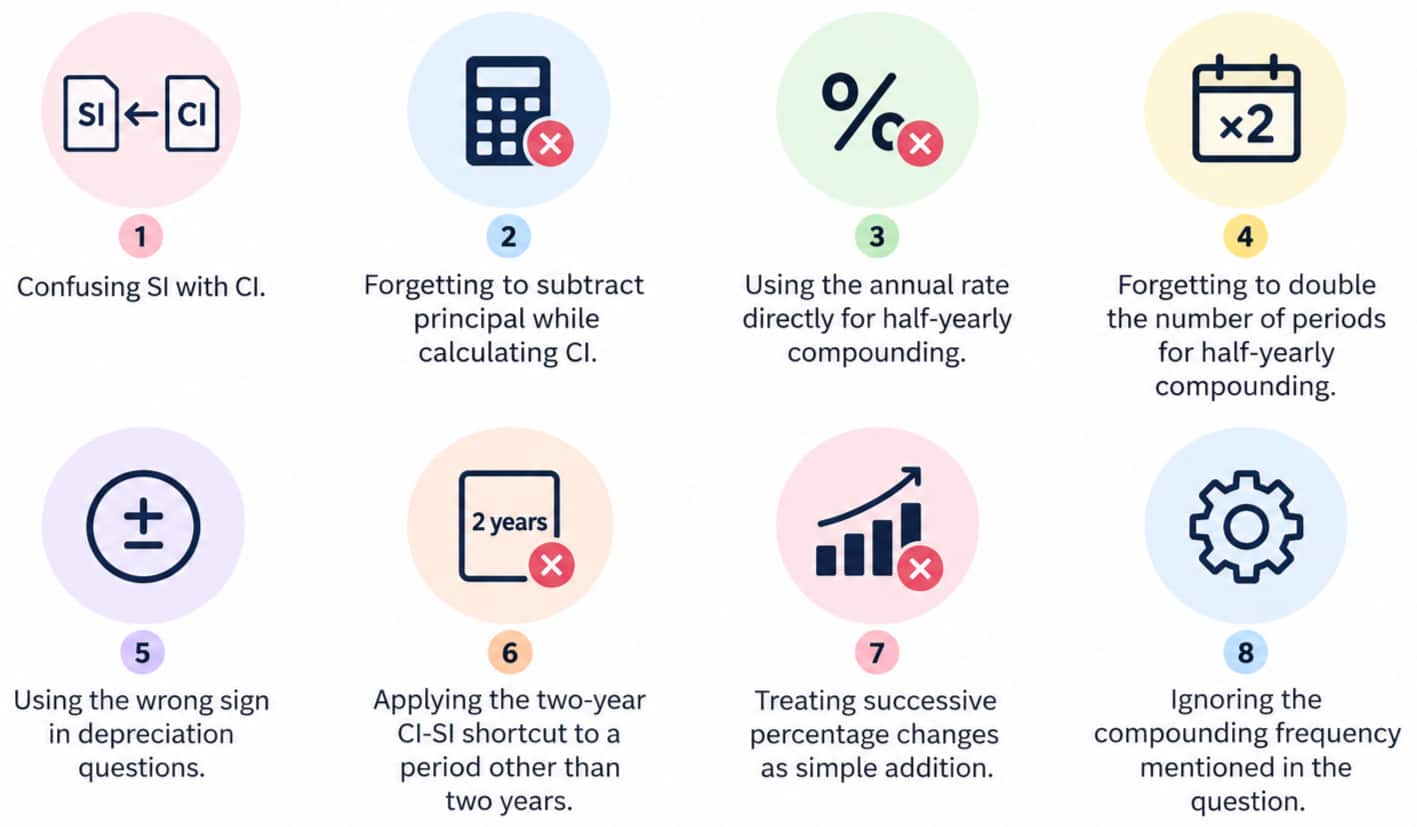
Small interpretation errors can lead to incorrect answers even when the calculation is straightforward.
Using the SI formula when interest is compounded.
Forgetting to halve the rate for half-yearly compounding.
Forgetting to double the number of periods for half-yearly compounding.
Treating successive percentage changes as simple addition.
Confusing the final amount with the interest earned.
Applying the 2-year SI-CI shortcut to a question involving three or more years.
Build a stronger foundation in CAT Arithmetic with formulas, concepts, shortcuts and practice questions designed for candidates starting from the basics.
Download now: The CAT Arithmetic Hackbook: Zero Math Background? No Problem.
This quick revision sheet brings together the key SI and CI formulas needed for fast CAT 2026 revision.
Concept | Formula |
Simple Interest | SI=PRT100 |
Amount under SI | A=P+SI |
SI Amount | A=P(1+RT100) |
Compound Amount | A=P(1+R100)T |
Compound Interest | CI=A−P |
CI directly | CI=P[(1+R100)T−1] |
2-year CI-SI difference | CI−SI=PR210000 |
Depreciation | A=P(1−R100)T |
Half-yearly CI | A=P(1+R200)2T |
Quarterly CI | A=P(1+R400)4T |
Successive increases | a+b+ab100% |
Increase followed by decrease | a−b−ab100% |
Candidates can use these formulas to revise core concepts and solve SI and CI questions more efficiently.
Access a concise collection of important CAT Quant formulas for quick revision and efficient problem-solving.
Download now: CAT Important Formulas PDF
A focused revision plan can make this topic easier to manage alongside the rest of Arithmetic.
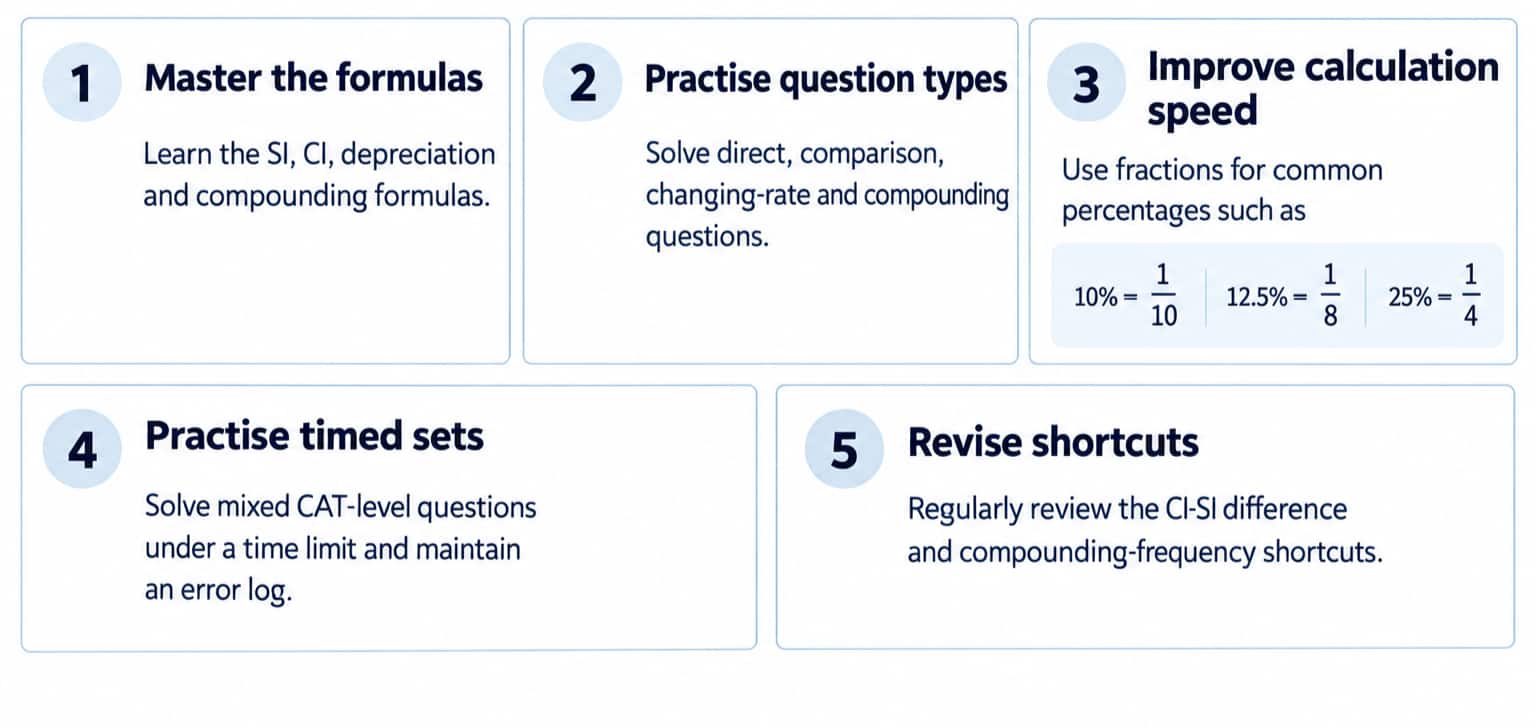
Candidates should maintain an error log while practising. Recording the formula or calculation step responsible for each mistake can make revision more targeted.
The CAT 2026 Free Mock Test gives candidates an opportunity to practise questions based on the actual exam format. Regular mock practice can help assess CAT preparation levels and improve time management.
Attempt Now: CAT 2026 Free Mock Test
If the question asks... | Use... |
Interest on original principal | SI formula |
Interest on accumulated amount | CI formula |
Difference between SI and CI for 2 years | SI-CI shortcut |
Compounding twice a year | Half-yearly formula |
Compounding four times a year | Quarterly formula |
Value after depreciation | Depreciation formula |
Different rates in different periods | Multiply growth factors |
Unknown principal/rate/time | Rearrange SI formula |
Frequently Asked Questions (FAQs)
Yes. SI and CI are part of Arithmetic, an important area within CAT Quantitative Aptitude.
The formula is $SI=\frac{P\times R\times T}{100}$.
The compound amount is $A=P\left(1+\frac{R}{100}\right)^T$, and compound interest is $CI=A-P$.
For two years, the difference is $CI-SI=\frac{PR^2}{10000}$.
For half-yearly compounding, the rate becomes $\frac{R}{2}$ and the number of periods becomes $2T$. Hence, $A=P\left(1+\frac{R}{200}\right)^{2T}$.

On Question asked by student community
Hello, CAT aur B-school entrance exams ke baare mein aap exam dates, eligibility, registration, exam pattern, syllabus, colleges ya admission process ki information dekh sakte hain. Aapki requirement ke according relevant details yahan mil sakti hain: https://bschool.careers360.com/exams
You can download the latest CAT syllabus from here:
Hey there,
For a B.Sc. with Chemistry, Botany and Zoology (CBZ), if the CAT application asks separately for:
If the Discipline dropdown has a more specific option such as “Biological Sciences,” “Life Sciences,” or “Zoology/Botany,”
Hey there,
Yes. With 2 years of work experience, you are eligible to target the regular 2-year MBA at IIM Calcutta as long as you have a bachelor's degree with at least 50% marks (45% for SC/ST/PwD). Work experience is not required for eligibility.
For
Hey there,
For NIT Hamirpur MBA, the General-category CAT cutoff is not a fixed official percentile. NIT Hamirpur's 2026–27 admission process gives CAT a 10/10 weightage in the test component, followed by an interview; it accepts CAT, CMAT and MAT.
As a practical target, 80+ percentile is worth considering, while
Directions for question:
The bar-graph given below shows the foreign exchange reserves of Nepal (in million Rupees) from 2014 to 2021. Answer the following questions based on the graph :

Question:
What was the percentage increase (rounded to the nearest integer, if deemed necessary) in the foreign exchange reserves in

Globally Recognized by AACSB (US) & AMBA (UK) | 18 LPA Avg. CTC for PGPM 2026
Gateway to IBS Hyderabad & 8 other IBS campuses | Scholarships worth 10 CR
Among top 6% B-Schools globally to be accredited by AACSB | Highest Package-35 LPA
Test centres are available in 70+ cities across India | 75,000+ aspirants apply for the NMAT exam | Accepted by 58+ institutions like NMIMS, KJSIM, ISB, SPJIMR and Great Lakes.
400+ Recruiters | Highest CTC 17.2 LPA | Average CTC 8 LPA | 92% Avg. Placements | Ranked as Platinum Institute | Awarded Best Business School of the Year
Application Open | Scholars’ Round Deadline: 14th Nov’26 | Earn upto 50% merit Scholarship + 10% for top performers | EFMD Accredited | AACSB & Business Graduates Association Member | Highest CTC 28 LPA