Birla Institute of Management Technology, Greater Noida
AACSB Accredited | Highest CTC: 22 LPA


What if the biggest mistake in MBA entrance preparation is not what you study, but how you decide what to study? An analysis of CAT, XAT, SNAP and CMAT papers from the last five years shows that while the syllabus has remained similar, the skills and question patterns have evolved. From recurring high-weightage topics to changing question types, these trends can help aspirants prepare smarter. SNAP 2026 also includes a new 10-mark Ethics, Morality and Values section. This article analyses past year papers of major MBA exams and highlights key trends to help build a focused preparation strategy.
This Story also Contains
Here are the key exam dates for the major MBA entrance exams in the current 2026- 27 admission cycle.
MBA Entrance Exam | Exam Date(s) |
CAT 2026 | November 29, 2026 |
XAT 2027 | January 3, 2027 |
SNAP 2026 | December 13, 19 & 26, 2026 |
CMAT 2027 | Official dates not announced yet |
Use these dates to plan your application timeline, preparation schedule, mock tests and revision strategy accordingly.
The common belief: Finish the syllabus.
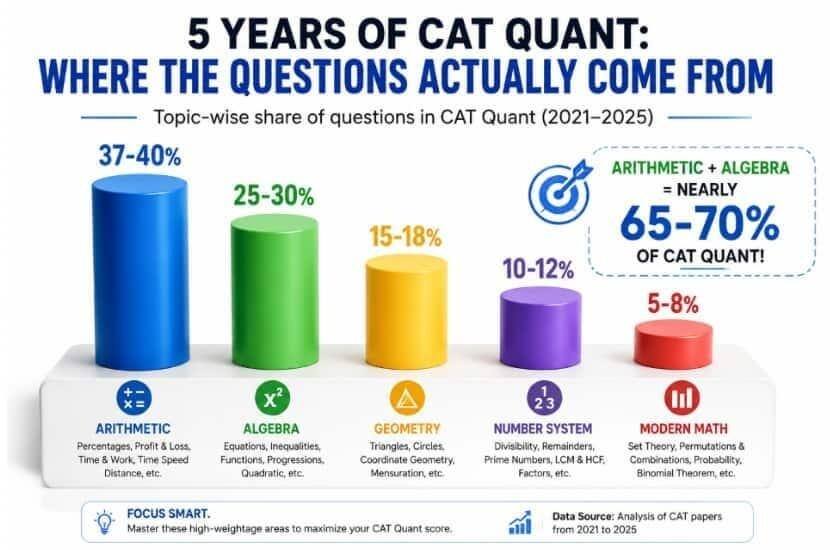
What the data shows: Across recent CAT papers, Arithmetic (35-40%) and Algebra (20-25%) together account for roughly 60-65% of the Quant section, making them the highest-return preparation areas. Reading Comprehension remains a major part of VARC preparation, while XAT continues to test Decision Making as a core section. SNAP has also introduced Ethics, Morality and Values in its 2026 exam pattern.
Instead of covering every topic equally, past year papers suggest focusing on high-weightage topics and recurring question patterns that offer better scoring opportunities.
Exam | Five-Year Observation | What It Means |
Arithmetic + Algebra consistently contribute nearly two-thirds of QA | High preparation ROI lies in mastering these first. | |
Reading Comprehension contributes nearly 65-70% of VARC | Daily reading and inference skills remain non-negotiable. | |
XAT | Decision-making has remained a standalone, high-weightage section | DM preparation cannot be postponed until after CAT. |
SNAP | It usually favours the candidates who have high speed. For 2026, a new Ethics, Morality and Values section (10 marks) has been added, breaking a five-year pattern of a stable three-section structure. | Faster execution often matters more than advanced difficulty, but candidates must now also budget time and preparation for a section with no historical data. |
CMAT | Balanced section-wise distribution has remained largely stable | Ignoring one section directly impacts the overall score. |
Insight: The CAT syllabus and exam pattern have remained broadly consistent, but the return on preparing different topics is not equal.
For the latest reference, see CAT syllabus and CAT exam pattern.
Ready for CAT 2026? Attempt the latest CAT mock tests and see how your preparation compares: CAT Free 2026 Mock Test
Many aspirants prepare for these four exams with one common strategy.
The last five years suggest that these exams reward different strengths.
Exam | What the Paper Consistently Rewards | Evidence from Recent Papers |
CAT | Question selection under pressure | Variable QA and DILR difficulty means that choosing the right questions increasingly determines the percentile. |
Judgement and structured thinking | Decision Making remains unique to XAT and carries significant weight every year. | |
Processing speed (and, from 2026, values-based judgement too) | Paper design continues to favour quick decision-making over lengthy calculations. The newly added Ethics, Morality and Values section now also tests how candidates reason through ethical scenarios, a dimension the paper hasn't rewarded in previous years. | |
Consistency | Stable section distribution rewards balanced preparation rather than specialisation. |
The papers suggest that these exams are measuring different cognitive strengths, not merely testing the same syllabus differently.
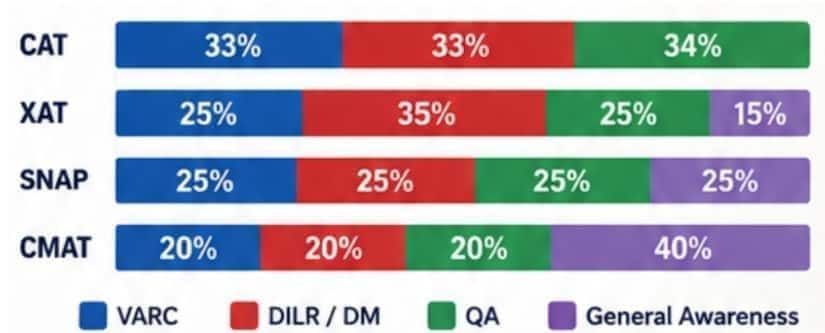
Here is a concise look at what recent CAT, XAT, SNAP and CMAT papers reveal about section-wise trends and preparation priorities.
CMAT has remained relatively balanced across sections, so consistent preparation across the syllabus is more useful than over-specialising in one area.
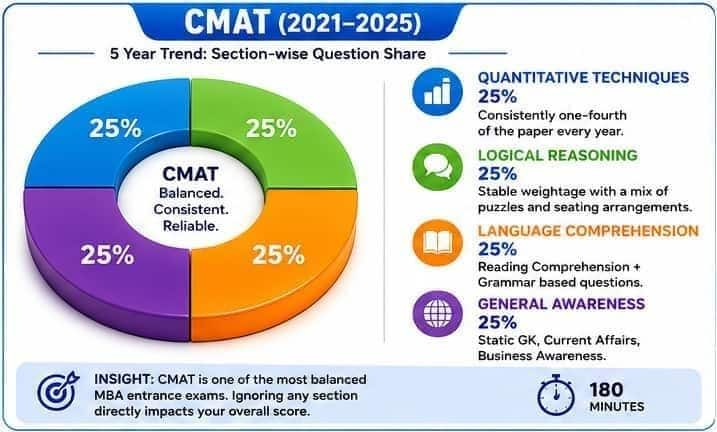
Aiming for CMAT 2027? Test your preparation with a balanced CMAT mock covering every section: CMAT Free Mock Test
SNAP rewards speed and accuracy, making time management and quick question selection important for a strong score.
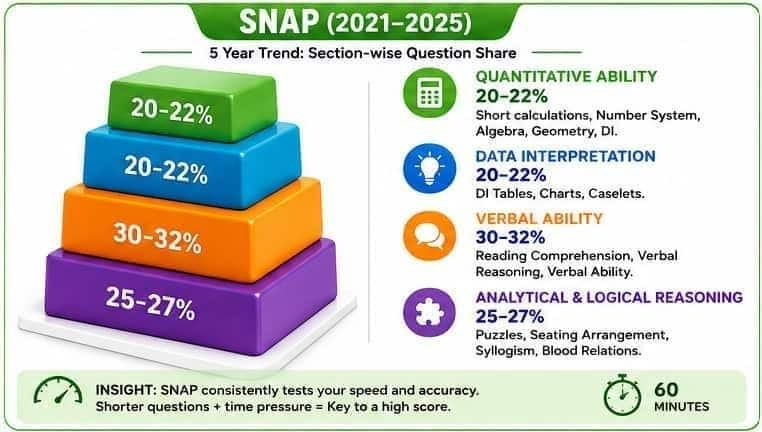
Targeting SNAP 2026? Take a speed-focused mock and improve your time management: SNAP Free Mock Test
XAT tests more than aptitude. Decision Making and analytical reasoning are central, while Verbal Ability can help differentiate stronger performers.
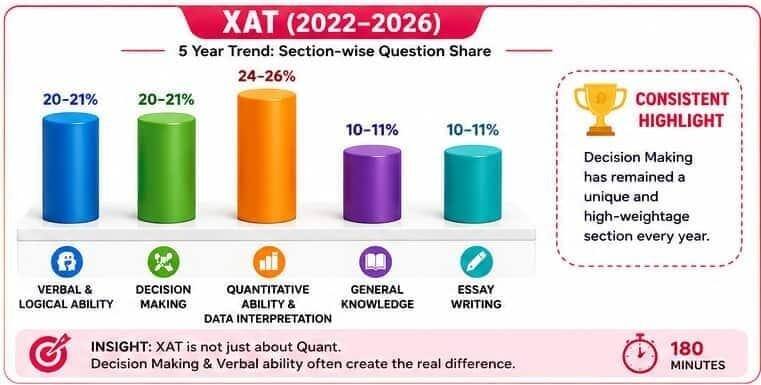
Planning for XAT 2027? Practice with XAT-level questions and strengthen your Decision Making skills by attempting FREE Online XAT 2027 Mock Test
More Attempts Are No Longer the Biggest Predictor of a Good Score
One of the strongest patterns emerging from recent papers is the growing importance of attempt efficiency.
Consider CAT:
Arithmetic contributes 35-40% of Quantitative Aptitude.
Reading Comprehension contributes nearly two-thirds of VARC.
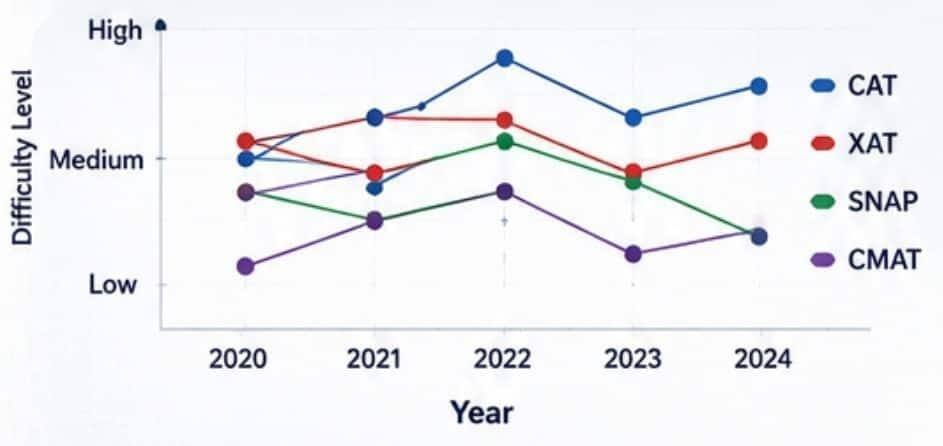
Data Interpretation and Logical Reasoning difficulty fluctuates significantly across years.
Negative marking continues to penalise poor question selection.
This changes the preparation equation.
You can practice with Past 10 years CAT Question Papers with Solution
Instead of maximising attempts, top performers increasingly maximise:
Want to learn about conversions and comparisons? Learn in detail about Baby IIM Salary 2026: Is the IIM Tag Still Enough? 6 of 9 IIMs Report
The five-year trend points to a more nuanced picture: difficulty and question mix can shift even when the core sections remain familiar.
Examples observed across recent years:
Insight: Candidates who prepare for patterns often struggle. Candidates who prepare for uncertainty adapt faster. SNAP aspirants should treat the 2026 Ethics, Morality and Values addition as a live example of this principle. Read more about SNAP preparation and exam updates.
Also preparing for NMAT 2026? Build speed and accuracy with an NMAT-style mock, attempt now FREE Online NMAT Mock Test
Looking across CAT, XAT, SNAP and CMAT, three preparation shifts consistently align with exam trends.
Data-Backed Shift | Why It Matters |
Prioritise preparation ROI | A limited number of topics repeatedly contribute the largest share of questions. |
Build exam-specific strategies | Each exam consistently rewards a different skill set. |
Analyse decisions, not just scores | Modern MBA entrance exams increasingly differentiate candidates through question selection and execution rather than conceptual knowledge alone. |
Stay alert to structural changes | SNAP's 2026 addition of Ethics, Morality and Values shows that even "stable" exams can shift with little warning, aspirants should build in some buffer for adapting to new sections. |
Five years of papers show that MBA entrance exams increasingly reward strategic preparation rather than syllabus coverage alone. Understanding recurring patterns, high-scoring areas and changing exam trends can help aspirants prepare more efficiently. SNAP’s new Ethics, Morality and Values section also highlights why adaptability matters.
Frequently Asked Questions (FAQs)
Arithmetic, Algebra, Reading Comprehension and DILR remain important areas in CAT preparation. Focus on high-weightage topics, question selection and accuracy rather than attempting every question.
Not completely. Yes, there is syllabus overlap, but XAT asks for Decision Making, SNAP is more about swift execution, and CMAT expects a balanced game plan across every section.
Arithmetic and Algebra consistently carry significant weightage in CAT Quant, while Reading Comprehension forms a major part of CAT VARC. Previous year CAT papers can help identify recurring topics and question patterns.
Not necessarily. Recent MBA entrance exam trends show that changing question patterns and unpredictability are becoming more important. Adaptability, accuracy and time management are therefore essential.
Aspirants should ideally analyse at least five years of CAT previous year papers. This helps identify recurring topics, question types, section-wise trends and changes in the CAT exam pattern.

On Question asked by student community
Hello, for AP NEET PG Category C seats, NRI documents are generally required if you are applying under the NRI quota, and eligibility depends on the applicable counselling rules. The fee payment currency and procedure should be confirmed from the current Dr. NTRUHS notification at its official website drntr.uhsap.in.
Hello, CAT aur B-school entrance exams ke baare mein aap exam dates, eligibility, registration, exam pattern, syllabus, colleges ya admission process ki information dekh sakte hain. Aapki requirement ke according relevant details yahan mil sakti hain: https://bschool.careers360.com/exams
You can download the latest CAT syllabus from here:
Hey there,
For a B.Sc. with Chemistry, Botany and Zoology (CBZ), if the CAT application asks separately for:
If the Discipline dropdown has a more specific option such as “Biological Sciences,” “Life Sciences,” or “Zoology/Botany,”
Hey there,
Yes. With 2 years of work experience, you are eligible to target the regular 2-year MBA at IIM Calcutta as long as you have a bachelor's degree with at least 50% marks (45% for SC/ST/PwD). Work experience is not required for eligibility.
For
Directions for question:
The bar-graph given below shows the foreign exchange reserves of Nepal (in million Rupees) from 2014 to 2021. Answer the following questions based on the graph :

Question:
What was the percentage increase (rounded to the nearest integer, if deemed necessary) in the foreign exchange reserves in

Globally Recognized by AACSB (US) & AMBA (UK) | 18 LPA Avg. CTC for PGPM 2026
75+ years of legacy | #1 Entrance Exam | Score accepted by 250+ BSchools
Gateway to IBS Hyderabad & 8 other IBS campuses | Scholarships worth 10 CR
Highest Package 29.30 LPA | 12 LPA Median CTC | 230+ Recruiters | AACSB Accredited | Ranked 51 in Asia by QS International
Early Application Round Deadline: 27th Oct’26 | 400+ Recruiters | Highest CTC 17.2 LPA | Average CTC 8 LPA | 92% Avg. Placements | Awarded Best Business School of the Year
Last Date to Apply - 19th December 2026 | Highest CTC 68.66 LPA | Average CTC 18.08 LPA | Top 25% Average CTC 24.66 LPA