Birla Institute of Management Technology, Greater Noida
AACSB Accredited | Highest CTC: 22 LPA


Are your CAT mock scores stuck even after taking test after test? The problem may not be a lack of practice. CAT 2025 topper experiences show that weak performance can stem from very different issues, including conceptual gaps, comprehension, speed, question selection or accuracy. With CAT 2026 scheduled for November 29 and IIM Indore conducting the exam, identifying the exact reason behind your weak section can help you use your remaining preparation time more effectively. This guide helps you diagnose the problem and choose the right corrective strategy.
This Story also Contains

A low CAT VARC, DILR, or QA score does not automatically mean you need more practice. First, determine why you are losing marks.
Use your last three mocks or sectionals and ask:
Could I solve this question correctly if there were no time limit?
Your answer can reveal the real problem.
What happens? | Likely problem | What you need |
Cannot solve even without a timer | Concepts | Concept building |
Understand the solution only afterwards | Comprehension | Reading and interpretation |
Can solve correctly when untimed | Speed/Selection | Timed practice |
Know the method but make avoidable errors | Accuracy | Error analysis |
This distinction is important because CAT weak-section preparation should be diagnosis-driven. A Quantitative Aptitude concept gap requires a different intervention from a DILR speed problem.
Your problem is likely conceptual if you:
Do not know which formula or approach to use.
Cannot solve questions even without time pressure.
Make repeated mistakes from the same topic.
Need explanations for questions that should be within your preparation level.
For CAT QA preparation, going back to fundamentals can be more productive than immediately increasing mock frequency.
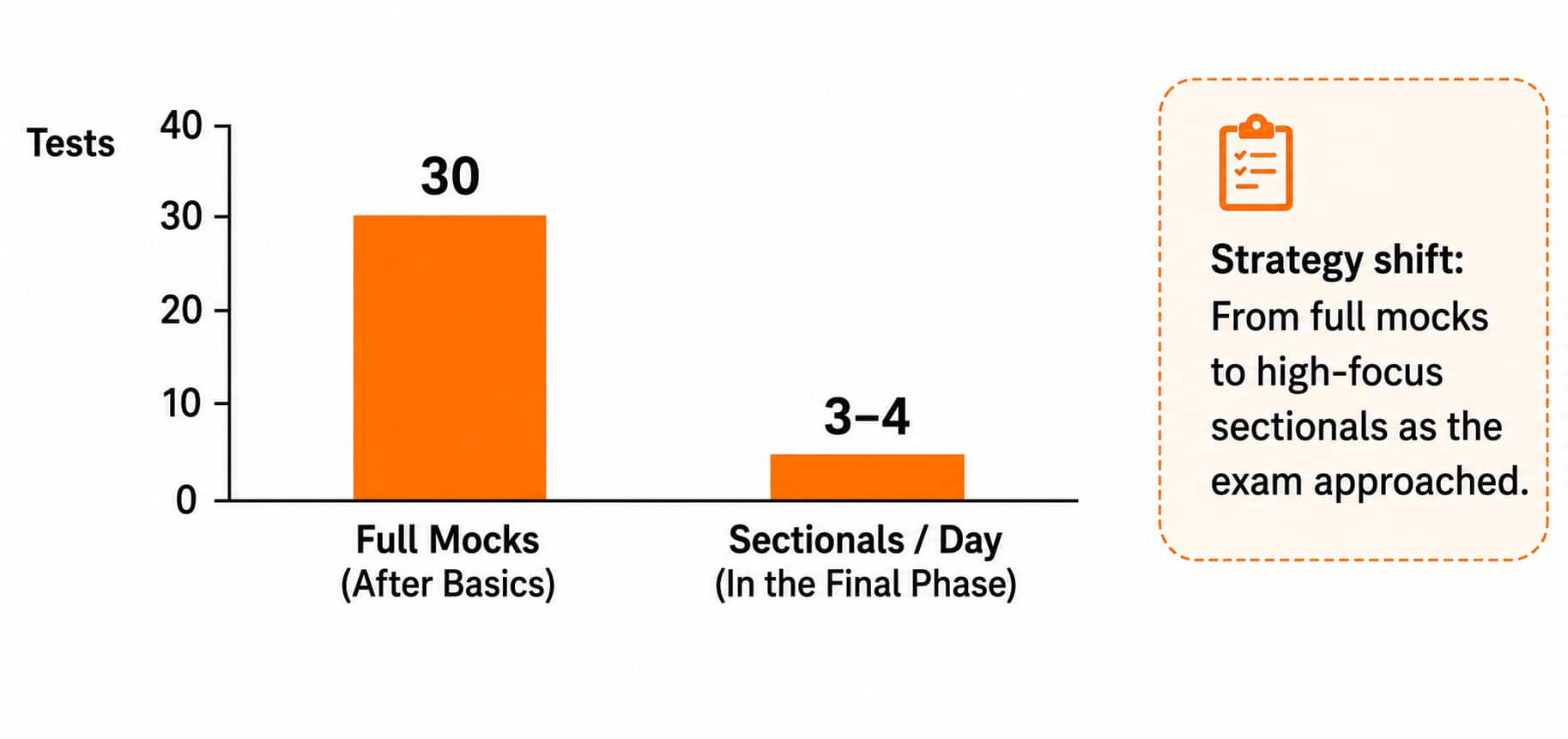
Vihaan Verma has been referring to QA as his weakest area since he had difficulty understanding the vast syllabus and diverse set of questions in the QA section. His strategy revolved around building concepts from the ground up and working on each unit in a step-wise manner; he eventually moved on to higher-level QA sectional questions and scored a 99.92 percentile.
CAT Topper Strategy: Want to know how a non-engineer achieved a 99.99 percentile in CAT 2025 with just 2.5 months of preparation? Read the CAT 2025 Topper Interview: Vihaan Verma’s Preparation Strategy to learn how he approached mocks, weak areas and section-wise preparation.
Diagnosis: If you cannot solve the question even after removing the clock, speed is not your first problem-knowledge is.
For CAT VARC preparation, solving more RCs is not always the answer.
Your problem may be comprehension if you:
Read a passage but cannot identify its central argument.
Repeatedly confuse two answer choices.
Understand the explanation but not the passage during the test.
Reread passages several times.
Have solved many RCs, but your accuracy remains inconsistent.
Sri Vallabha's CAT journey provides a strong real-world example.
CAT attempt | Overall percentile | VARC percentile | What changed |
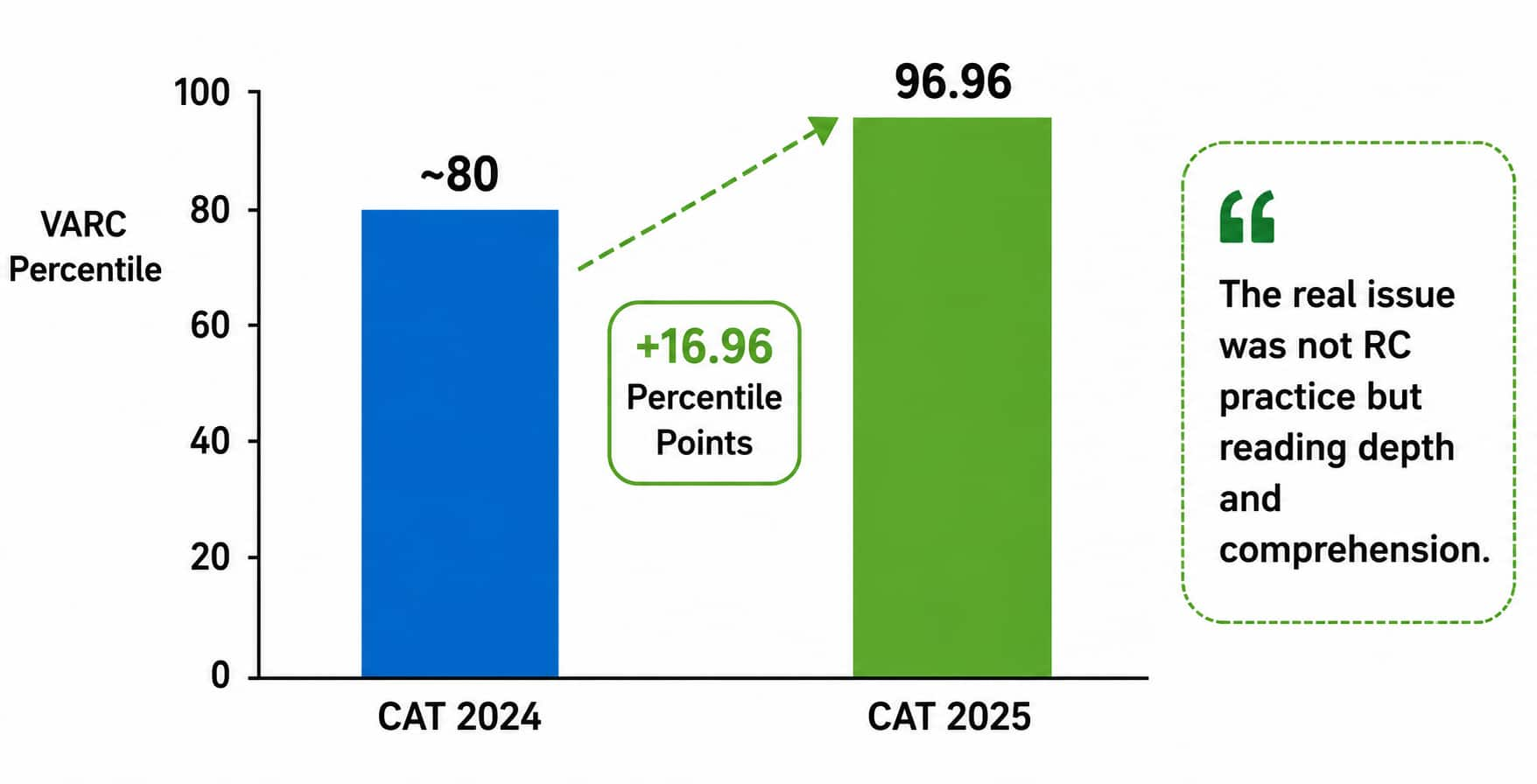
CAT 2024 | ~98.6 | ~80 | VARC remained a major weakness |
CAT 2025 | 99.94 | 96.96 | Reading depth + comprehension + later sectionals/mocks |
Sri Vallabha initially believed continuous RC practice would solve his VARC problem. After his first attempt, he realised the deeper issue was reading depth and comprehension. He then developed a stronger reading habit across diverse content before returning to sectionals and mocks.
CAT Topper Strategy: Want to know how an IIT Bombay graduate improved his CAT performance and achieved a 99.94 percentile in CAT 2025? Read the CAT 2025 Topper Interview: Sri Vallabha’s Journey to 99.94 Percentile to learn how he strengthened his weak VARC section, used mocks effectively and built consistency in his preparation.
The lesson: If comprehension is the problem, mechanically solving 100 more RCs may simply give you 100 more opportunities to repeat the same mistake.
Understand the detailed breakdown of the CAT 2025 question paper; download now: CAT 2025 Slot by Slot Master Weightage Matrix PDF.
Your problem could be speed or question selection if :
You are able to solve questions correctly when you have unlimited time.
You run out of time on the test despite knowing the concepts.
You take way too long to solve some questions.
You leave easy questions because you got stuck on the hard ones.
You find that you perform substantially worse when you are under time pressure, such as in a CAT test.
Pratham Patel used mocks to identify weaknesses, improve his attempt strategy and focus on solving questions accurately rather than attempting everything.
CAT Topper Strategy: Want to know how a 7-7-7 profile IIT Bombay graduate achieved a 100 percentile in CAT 2025? Read Pratham Patel’s CAT Topper Interview for practical preparation and mock-test strategies.
Vihaan also used measurable time targets. He practised DILR sets with a 13-minute target and QA questions with a three-minute target, allowing him to identify whether he was actually slow or whether a particular question was simply lengthy.
Don't simply tell yourself to “solve faster.”
Focus on:
Timed topic sets
Sectional tests
Question selection
Skip-and-return decisions
Post-mock time analysis
The goal is not maximum attempts. The goal is maximum marks from limited time.
Once you identify the problem, your preparation should change accordingly.
Problem | Best approach | Avoid |
Concept gap | Revise concepts → basic questions → CAT-level questions | Endless mocks |
Comprehension gap | Reading → analysis → RCs → sectionals | Mechanical RC practice |
Speed gap | Timed sets → sectionals → mock analysis | Only untimed practice |
Selection gap | Analyse skipped/incorrect questions | Forcing every question |
Accuracy gap | Error log → recurring mistake analysis | Chasing more attempts |
Aishiki Sen followed a similar weakness-first approach. She identified QA as her weak area, spent more time strengthening concepts and continued diverse reading and RC practice to maintain VARC, her stronger section.
CAT Topper Strategy: Want to know how a Psychology student scored 99.18 percentile in her first CAT attempt? Read Aishiki Sen’s CAT Topper Interview for practical preparation tips and strategies.
After your next mock, don't record only your percentile. Categorise every incorrect or unattempted question:
C - Concept
R - Reading/Comprehension
S - Speed/Selection
A - Accuracy
Then compare the pattern across three tests.
If most mistakes are... | Your next move |
C | Return to the relevant concepts |
R | Change your reading/comprehension practice |
S | Add timed sets and improve selection |
A | Maintain an error log and analyse recurring mistakes |
One bad mock does not establish a weakness. A repeated pattern across multiple tests does.
Quant Practice Resource: Strengthen your CAT Quant preparation with 5 years of PYQs (2021–2025) to understand question patterns and improve accuracy. Download Now
| Diagnosis | Immediate Focus |
|---|---|
| Concept | Revise the topic and solve basic to CAT-level questions |
| Comprehension | Reading, passage analysis and targeted RC practice |
| Speed/Selection | Timed sets and question-selection practice |
| Accuracy | Error log and repeated mistake analysis |
Repeat this diagnosis after your next few tests to check whether the same issue continues or a new bottleneck has emerged.
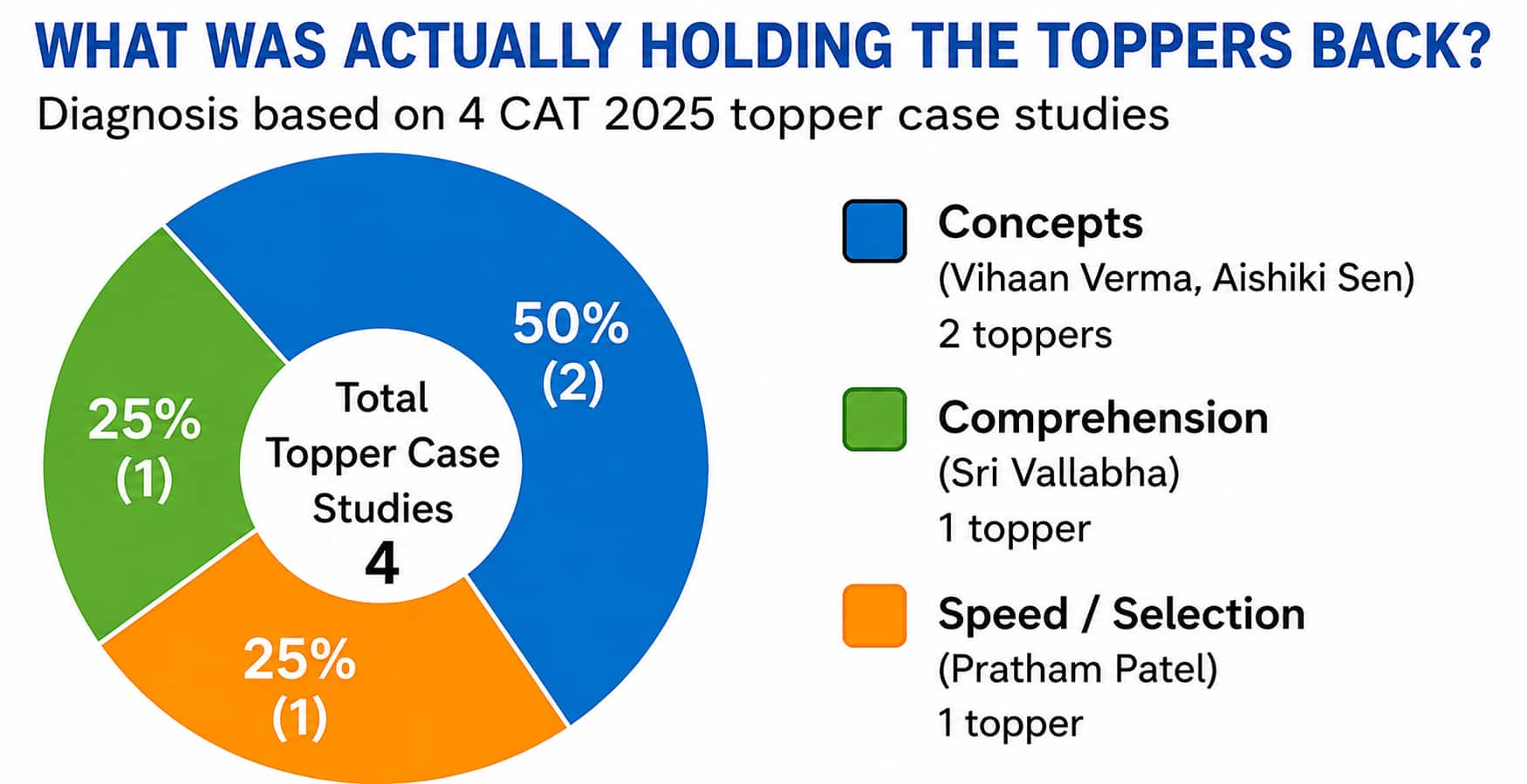
The topper interviews do not reveal one universal CAT preparation formula. Their strategies differed because their problems differed.
CAT 2025 topper | Main challenge | Response |
Vihaan Verma | QA concepts | Started from basics; increased QA sectionals |
Sri Vallabha | VARC comprehension | Reading depth + comprehension |
Pratham Patel | Speed/strategy | Mocks, accuracy and faster solving |
Aishiki Sen | QA concepts | More time on concepts while maintaining VARC |
The important pattern is not that these toppers studied in the same way. They identified the bottleneck and changed their preparation around it.
CAT Topper Strategy: Looking for CAT 2026 preparation tips from a 99.94 percentile scorer? Read Sri Vallabha’s CAT 2026 Preparation Strategy for practical insights on preparation and exam strategy.
Preparing for CAT 2026? Attempt CAT mock tests to experience the exam environment, improve time management, and assess your preparation before the November 29 exam.
Take the CAT 2026 Free Online Mock Test Now
Get access to 20 expert-designed CAT 2026 mock test sets with questions and detailed solutions for Quant, LRDI and VARC.
Download the CAT 2026 Mock Test Series – 20 Sets
Combining full-length mocks with sectional tests and PYQs can help aspirants assess their performance under exam-like conditions and refine their CAT preparation strategy.
CAT VARC preparation requires a mix of reading comprehension practice, vocabulary building, previous-year questions, and targeted study material. The following resources can help you strengthen these areas systematically.
Resource | Download |
CAT 2026 Verbal Ability and Reading Comprehension (VARC) Study Material PDF | |
CAT VARC PYQs – Complete 5-Year Question Bank (2021–2025) | |
CAT VARC: 3000+ Most Important English Words | |
500+ Idioms and Phrases List with Meanings & Examples | |
300+ Phrasal Verbs for CAT Exam | |
Avoid These Common CAT RC Mistakes | |
8 Expert-Curated Philosophy Editorials with CAT-Style Questions |
These resources cover the key components of CAT VARC, from vocabulary and RC practice to PYQs and exam-style questions. Aspirants can choose resources based on their specific preparation needs.
For CAT DILR, consistent practice is essential to improve logical reasoning, data interpretation, and the ability to identify solvable sets. These resources provide concepts, practice sets, and PYQs for structured preparation.
Resource | Download |
Ultimate DILR CAT 2026 Guide: Concepts, Practice Sets and Detailed Solutions | |
CAT DILR Questions with Solutions | |
CAT 2025 DILR Masterbook – 100 DILR Sets | |
CAT DILR PYQs – Complete 5-Year Question Bank (2021–2025) |
From concept-building to extensive set practice, these DILR resources can be used to gradually improve speed, accuracy, and set-selection skills.
CAT Quant preparation involves mastering core concepts, practising different question types, and revising formulas and shortcuts. The resources below cover important Quant topics along with practice questions and PYQs.
Resource | Download |
CAT Algebra Handbook 2026 | |
CAT 2026 Number System PDF Handbook | |
CAT 2026 Geometry & Mensuration PDF | |
CAT 2026 Modern Maths PDF Handbook | |
The CAT Arithmetic Hackbook PDF |
These materials cover major areas such as Algebra, Number System, Geometry, Mensuration, Modern Maths, and Arithmetic, making them useful for both concept learning and revision.
If you cannot solve the question without time pressure, fix your concepts.
If you cannot understand the passage or interpret the question properly, fix your comprehension.
If you can solve it accurately when untimed but fail under CAT conditions, fix your speed and question selection.
And if you know the concept, understand the question, and still make avoidable mistakes, work on accuracy.
Frequently Asked Questions (FAQs)
Analyse at least three mocks or sectionals using attempts, accuracy, time spent and question-level mistakes. Then determine whether the recurring issue is concepts, comprehension, speed, selection or accuracy.
First, diagnose what the weak point is: if knowledge gap in QA, then do concept revision; if it is in VARC, do more and more RC practice and passage analysis for better comprehension; if it is in speed and execution, then take chapter-level or section-level timed tests.
Not always. Continuous RC practice did not help my VARC, but I shifted towards deep reading and comprehension,n which improved my percentile from around 80 to 96.96, said Sri Vallabha.
Yes, if one starts preparing for CAT QA directly, it will be challenging. It is better to start with basics first and then move towards CAT-level questions. Vihaan followed this approach of strengthening his basics first and then moving towards QA sectional tests.
Not automatically. If your analysis shows a concept or comprehension problem, more full-length mocks may simply reproduce the same mistakes. Use mocks to diagnose, test and measure improvement, not just to increase your mock count. Pratham's preparation reflects this diagnostic use of mocks.

On Question asked by student community
Hello, for AP NEET PG Category C seats, NRI documents are generally required if you are applying under the NRI quota, and eligibility depends on the applicable counselling rules. The fee payment currency and procedure should be confirmed from the current Dr. NTRUHS notification at its official website drntr.uhsap.in.
Hello, CAT aur B-school entrance exams ke baare mein aap exam dates, eligibility, registration, exam pattern, syllabus, colleges ya admission process ki information dekh sakte hain. Aapki requirement ke according relevant details yahan mil sakti hain: https://bschool.careers360.com/exams
You can download the latest CAT syllabus from here:
Hey there,
For a B.Sc. with Chemistry, Botany and Zoology (CBZ), if the CAT application asks separately for:
If the Discipline dropdown has a more specific option such as “Biological Sciences,” “Life Sciences,” or “Zoology/Botany,”
Hey there,
Yes. With 2 years of work experience, you are eligible to target the regular 2-year MBA at IIM Calcutta as long as you have a bachelor's degree with at least 50% marks (45% for SC/ST/PwD). Work experience is not required for eligibility.
For
Directions for question:
The bar-graph given below shows the foreign exchange reserves of Nepal (in million Rupees) from 2014 to 2021. Answer the following questions based on the graph :

Question:
What was the percentage increase (rounded to the nearest integer, if deemed necessary) in the foreign exchange reserves in

Globally Recognized by AACSB (US) & AMBA (UK) | 18 LPA Avg. CTC for PGPM 2026
75+ years of legacy | #1 Entrance Exam | Score accepted by 250+ BSchools
Gateway to IBS Hyderabad & 8 other IBS campuses | Scholarships worth 10 CR
Highest Package 29.30 LPA | 12 LPA Median CTC | 230+ Recruiters | AACSB Accredited | Ranked 51 in Asia by QS International
Early Application Round Deadline: 27th Oct’26 | 400+ Recruiters | Highest CTC 17.2 LPA | Average CTC 8 LPA | 92% Avg. Placements | Awarded Best Business School of the Year
Last Date to Apply - 19th December 2026 | Highest CTC 68.66 LPA | Average CTC 18.08 LPA | Top 25% Average CTC 24.66 LPA