Birla Institute of Management Technology, Greater Noida
AACSB Accredited | Highest CTC: 22 LPA


The final stage of CAT preparation should focus on making your attempts more effective, not on studying every topic again. Candidates should practise choosing the right questions, avoid spending too much time on difficult ones and work on reducing mistakes in VARC, DILR and QA. Since CAT scores are normalised across sessions before percentiles are calculated, there is no fixed number of correct answers that guarantees a particular percentile. Mock tests can help candidates check their performance, find weak areas and improve their strategy. Regular revision and analysis of each mock should be a key part of the final preparation.
This Story also Contains

Yes, but scoring 99 percentile needs more than just the number of attempts. The important things are accuracy, the questions you pick, time management and section wise performance.
Do not get stuck on topics with low importance like modern math, and try to do well in topics like Arithmetic, Algebra, Geometry and Number System. Practice previous year quantitative ability questions and pick questions you are sure about.
As we know, DILR needs you to pick sets on which you will work; try to pick the sets which give you a clear starting point, do not waste time on sets which give no head start. Also, check the CAT DILR 5 year trends to sort important topics.
Work on being able to read the passages well while also maintaining accuracy. It is important to be selective while attempting the reading comprehension passages. You can also do a deep analysis of CAT VARC 5 year trends to grasp important topics.
Do not make guesses on questions you are not sure about. Try to get more right answers than wrong ones. It is important to get a positive score.
There is no exact number of attempts that one must make in order to receive a 99 percentile. Due to differing slot difficulties, and the normalisation process, it is advised to aim for a higher accuracy, rather than attempting a certain number of questions
A high number of attempts with a low accuracy can actually reduce one’s percentile, whereas a low number of accurate attempts can raise one’s percentile. It is best to determine one’s “ideal” number of attempts through mocks,
It is crucial to keep track of one’s total number of attempts, accuracy, and score in each of their mocks. As time goes on, one should attempt to raise their number of attempts if their accuracy is on par with their previous mocks, without wasting too much time on individual questions.
With roughly a month to go, it is time to change one’s strategy from completing syllabus topics to mocks, revision, determining which questions to practice, and filling in gaps.
As there are not enough days to learn new topics or books, it is advised to focus on high-yield topics and question types that have been previously learned, in order to ensure that nothing is missed out on in a short amount of time.
At this stage, mocks are essential in determining what sections and topics are scoring, as well as what needs improvement. It is important to take mocks regularly, and to avoid repeating mistakes that have been made before, in order to be fully prepared for the actual day. This is also a time to keep track of what mistakes have been made in mocks in order to avoid last minute improvisation before the D-day.
VARC: Learn to pick and choose questions wisely
DILR: Pick sets based on which are easy
QA: Pick questions based on which are easy, quick, and less calculation intensive
It is vital to keep track of questions that have been attempted wrongly, as well as questions that have been spent too much time on. This can help one prepare for their revision.
The cutoff for the 99 percentile can vary from year to year as CAT follows the policy of scaled scores and normalisation. The previous year’s trends can be used as indicative scores but should not be used as a benchmark for CAT 2026.
Section | Total Questions | Minimum Correct Answers Required | Net Marks |
VARC | 24 | 11–12 | 33–36 |
DILR | 22 | 10–11 | 30–33 |
QA | 22 | 10–12 | 30–36 |
Total | 68 | 32–35 | 96–105 |
Section | Total Questions | Target Attempts | Minimum Correct Answers Required | Net Marks |
VARC | 24 | 14–16 | 13–14 | 39–42 |
DILR | 22 | 12–13 | 11–12 | 33–36 |
QA | 22 | 11–13 | 10–12 | 30–36 |
Total | 68 | 36–39 | 34–35 | 102–105 |
Section | Total Questions | Target Attempts | Minimum Correct Answers Required | Net Marks |
VARC | 24 | 16–18 | 13–15 | 35–42 |
DILR | 22 | 14–15 | 11–12 | 33–36 |
QA | 22 | 14–15 | 11–12 | 33–36 |
Total | 68 | 44–48 | 35–38 | 101–105 |
Section | Total Questions | Target Attempts | Minimum Correct Answers Required | Net Marks |
VARC | 24 | 19–21 | 13–15 | 36–39 |
DILR | 22 | 16–17 | 11–12 | 33–36 |
QA | 22 | 18–20 | 13–14 | 36–42 |
Total | 68 | 54–58 | 38–41 | 100–105 |
Aspirants aiming for the 99th percentile in CAT 2026 should carefully balance accuracy with the number of attempts. Instead of rushing through the paper, focus on high-confidence problems in Quantitative Aptitude, VARC, and DILR, and skip those that may cause unnecessary errors. In fact, knowing how many questions to attempt for 99 percentile in CAT depends more on smart selection and accuracy than sheer volume.
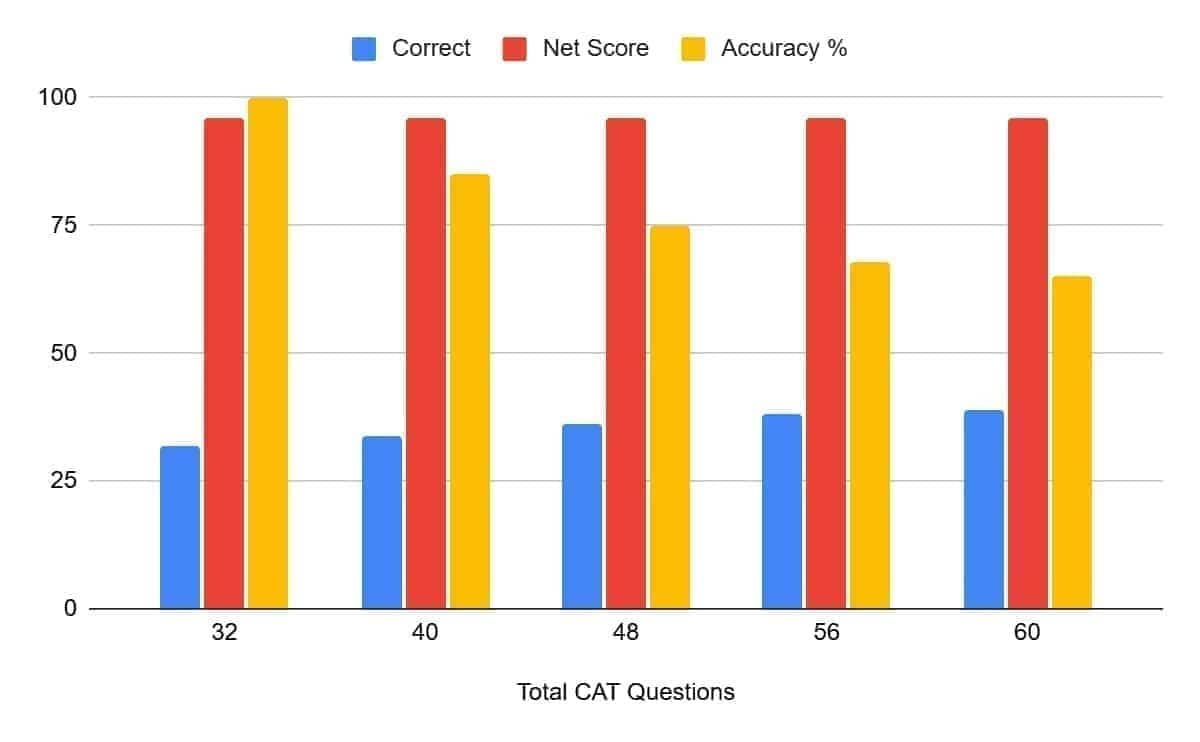
Attempt | Correct | Net Score | Accuracy % |
32 | 32 | 96 | 100 |
40 | 34 | 96 | 85 |
48 | 36 | 96 | 75 |
56 | 38 | 96 | 68 |
60 | 39 | 96 | 65 |
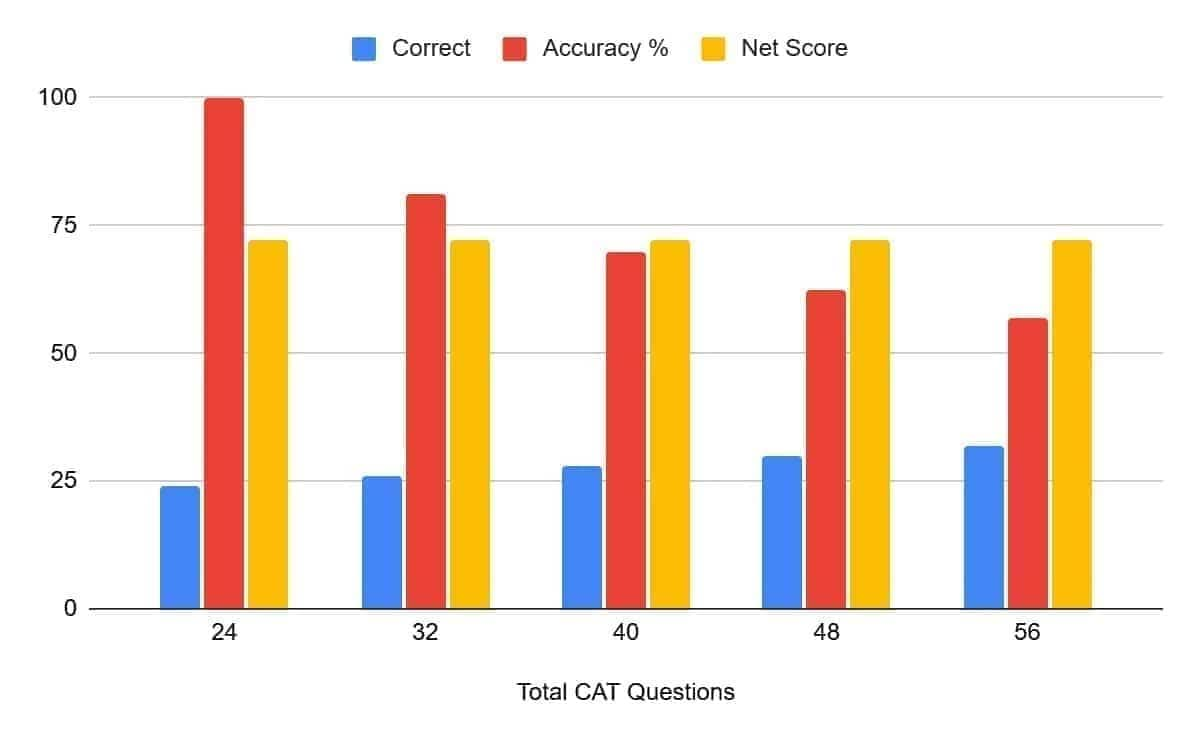
Question Attempts | Correct | Accuracy % | Net Score |
24 | 24 | 100% | 72 |
32 | 26 | 81% | 72 |
40 | 28 | 70% | 72 |
48 | 30 | 62.5% | 72 |
56 | 32 | 57% | 72 |
For a 99 percentile, the focus must be on choosing the right questions rather than trying to solve everything. Selection will enable you to maximise your scores while minimising time spent and avoiding negative marking.
Make a fast scan of the section and shortlist familiar, easy, and less time-consuming questions to solve first.
Skip questions that seem odd or extremely time consuming in comparison to others.
Set a time limit for each question and move on to the next one if you become stuck. You can go back to it later if there is any time remaining after answering the simple questions.
If nothing works, move on rather than wasting time.
Is it better to do many questions or work on my accuracy?
If you want to achieve a 99 percentile, you must understand the importance of selecting the right questions.
High attempts + Low accuracy: This means you have attempted many questions, but due to low accuracy, you get negative marks.
Moderate attempts + High accuracy: You have fewer attempts, but they are all correct, giving you a high accuracy rate. The second option is therefore far more dangerous.
CAT mock examinations can assist you in boosting your speed, ability, question selection, and time management in order to help you achieve a 99 percentile. However, you must understand how to evaluate them in order to get relevant insights for future preparation.
Start taking mocks as soon as you have grasped all of the fundamentals, and continue doing so until you are close to your CAT exam date.
Attempt the mocks under timed conditions and without any breaks during the sectional time limits.
Go through the incorrect, un-attempted, and time-consuming responses and identify where you went wrong. Determine if it was a conceptual, calculation, or time-management issue.
Based on the previous point, work on your weak areas and topics in VARC, DILR, and QA.
Keep track of your scores, attempts, accuracy, and other variables throughout these mock examinations to identify trends and patterns.
Preparing for the CAT 2026 requires more than theory; it demands adaptive practice, exposure to exam-level difficulty, and constant benchmarking. The right resources not only test accuracy but also help you develop time management, sectional prioritisation, and question filtration skills.
CAT sample papers replicate the actual exam interface and structure, giving candidates an early chance to master the three-section time-bound format (VARC, DILR, QA). These papers highlight distribution patterns, difficulty gradients, and question sequencing. By solving them, aspirants learn about real exam pressure, allocate time per section, and understand attempt strategies. They serve as technical benchmarks for evaluating reading speed, accuracy trends, and data interpretation efficiency.
Practice with CAT 2026 Sample Paper
CAT mock tests closely simulate the real exam, helping track accuracy, attempts, and sectional performance. Analysing patterns and weak areas refines strategy, while regular practice builds stamina and ensures high accuracy for a 99+ percentile. Below is the mock test to attempt and help you plan your preparation effectively.
CAT Mock test 2026 |
Previous year CAT question papers are indispensable for pattern decoding and trend analysis. By analysing them, aspirants gain clarity on weightage distribution, recurring concept clusters, and sectional volatility. These papers expose the shifts in VARC reading comprehension length, DILR puzzle complexity, and QA topic dominance. Solving PYQs under timed conditions builds familiarity with exam temperament, ensures exposure to realistic question phrasing, and prevents over-reliance on outdated test prep material.
Practice with the CAT Past 10-year question papers
Many aspirants aiming for the 99th percentile in CAT fall prey to common myths that derail preparation. One of the biggest misconceptions is that attempting the maximum number of questions automatically guarantees success. In reality, it’s more important to know how many questions to attempt to get 99 percentile in CAT with accuracy rather than chasing every question.
Trying to solve every question can backfire if accuracy drops. Serious attempts with low correctness often reduce the percentile. Focus on safe attempts with high accuracy instead of attempting everything blindly.
Every student has unique strengths in Quant, VARC, and Data Interpretation and Logical Reasoning. A single strategy doesn’t fit all. Analysing mock tests helps identify your patterns, making it easier to decide how many questions to attempt for 99 percentile in CAT confidently.
Neglecting core areas may limit your safe attempts for 99 percentile CAT. While selective preparation can save time, it’s important to practice all important topics and solve the CAT 2026 repeated questions to track your performance.
The number of attempts required for 99 percentile can vary due to normalisation and slot difficulty. Focus on accuracy and smart question selection rather than relying on fixed attempt numbers. Use mock tests to understand how many questions to attempt to get 99 percentile in CAT based on your own performance.
Learn in detail about 15 CAT Myths That Waste Months of Preparation
Candidates preparing for the CAT 2026 examination must refer to the following resources to ace their exam with high marks:
Ebook Name | Download Link |
Top 25 Reading Comprehension Passages to Practice for CAT 2026 | |
CAT 2026 VARC SAMPLE PAPER | |
CAT 2026 DILR SAMPLE PAPER | |
CAT 2026 Quant SAMPLE PAPER | |
CAT 2026 Functions Practice Questions | |
CAT 2026 Average and Mixture Practice Questions | |
CAT 2026 Co-ordinate Geometry Practice Questions | |
CAT 2026 Analytical Puzzles Practice Questions | |
CAT 2026 Linear and Circular Arrangement Practice Questions | |
CAT 2026 Blood Relations Practice Questions | |
CAT 2026 Reading Comprehension Practice Questions | |
CAT 2026 Parajumbles Practice Questions |
Frequently Asked Questions (FAQs)
A 99 percentile means you scored better than 99 % of all test-takers in CAT 2026. It reflects your relative ranking, not just the raw marks you obtained.
Usually, a total scaled score of around 85–100+ marks (out of ~198) is needed for a 99 percentile in CAT, depending on paper difficulty and normalisation.
Yes. Even with a high total score, missing section cutoffs or imbalance can hurt your percentile since CAT uses section-wise normalisation and scaling.
Candidates must aim for 85–90% accuracy. Guessing lowers your score, so attempt only those you’re confident about. Accuracy, not speed, is the real differentiator at the top percentiles.
Yes, you can! To score 99 percentile in CAT 2026 on your first attempt, focus on building strong basics, take regular mock tests, and analyze your mistakes after every test. Create a smart study plan that balances VARC, DILR, and Quant.
It depends on your starting level, but most toppers study 3–4 hours on weekdays and 6–8 hours on weekends. The key is smart study, not long hours. Break your day into small study blocks, revise regularly, and take short breaks to stay fresh
Not really! Coaching can help with guidance and structure, but many students score 99 percentile through self-study using online resources, YouTube videos, and mock tests. If you can stay disciplined, follow a proper schedule, and analyse your performance regularly, you can do well even without formal coaching.
The best time to start is 8–10 months before the exam, usually around January to March 2026. Early preparation gives you time to build strong fundamentals and attempt multiple mock tests. Even if you start later, a focused 5–6 months plan with consistent effort can still get you into the 99 percentile range.

On Question asked by student community
Hello, for AP NEET PG Category C seats, NRI documents are generally required if you are applying under the NRI quota, and eligibility depends on the applicable counselling rules. The fee payment currency and procedure should be confirmed from the current Dr. NTRUHS notification at its official website drntr.uhsap.in.
Hello, CAT aur B-school entrance exams ke baare mein aap exam dates, eligibility, registration, exam pattern, syllabus, colleges ya admission process ki information dekh sakte hain. Aapki requirement ke according relevant details yahan mil sakti hain: https://bschool.careers360.com/exams
You can download the latest CAT syllabus from here:
Hey there,
For a B.Sc. with Chemistry, Botany and Zoology (CBZ), if the CAT application asks separately for:
If the Discipline dropdown has a more specific option such as “Biological Sciences,” “Life Sciences,” or “Zoology/Botany,”
Hey there,
Yes. With 2 years of work experience, you are eligible to target the regular 2-year MBA at IIM Calcutta as long as you have a bachelor's degree with at least 50% marks (45% for SC/ST/PwD). Work experience is not required for eligibility.
For
Directions for question:
The bar-graph given below shows the foreign exchange reserves of Nepal (in million Rupees) from 2014 to 2021. Answer the following questions based on the graph :

Question:
What was the percentage increase (rounded to the nearest integer, if deemed necessary) in the foreign exchange reserves in

Globally Recognized by AACSB (US) & AMBA (UK) | 18 LPA Avg. CTC for PGPM 2026
75+ years of legacy | #1 Entrance Exam | Score accepted by 250+ BSchools
Gateway to IBS Hyderabad & 8 other IBS campuses | Scholarships worth 10 CR
Highest Package 29.30 LPA | 12 LPA Median CTC | 230+ Recruiters | AACSB Accredited | Ranked 51 in Asia by QS International
Early Application Round Deadline: 27th Oct’26 | 400+ Recruiters | Highest CTC 17.2 LPA | Average CTC 8 LPA | 92% Avg. Placements | Awarded Best Business School of the Year
Last Date to Apply - 19th December 2026 | Highest CTC 68.66 LPA | Average CTC 18.08 LPA | Top 25% Average CTC 24.66 LPA