Birla Institute of Management Technology, Greater Noida
AACSB Accredited | Highest CTC: 22 LPA


Reading one editorial every day is common CAT advice. But if you finish the article, close the page and move on, you may be missing the real benefit. CAT VARC tests whether you can follow an argument, identify the author's viewpoint, make inferences and notice assumptions - not simply whether you can read quickly. With CAT 2026 scheduled for November 29, editorials can become a powerful form of daily RC training if you know how to read them strategically. The question is: what exactly should you look for while reading?
This Story also Contains
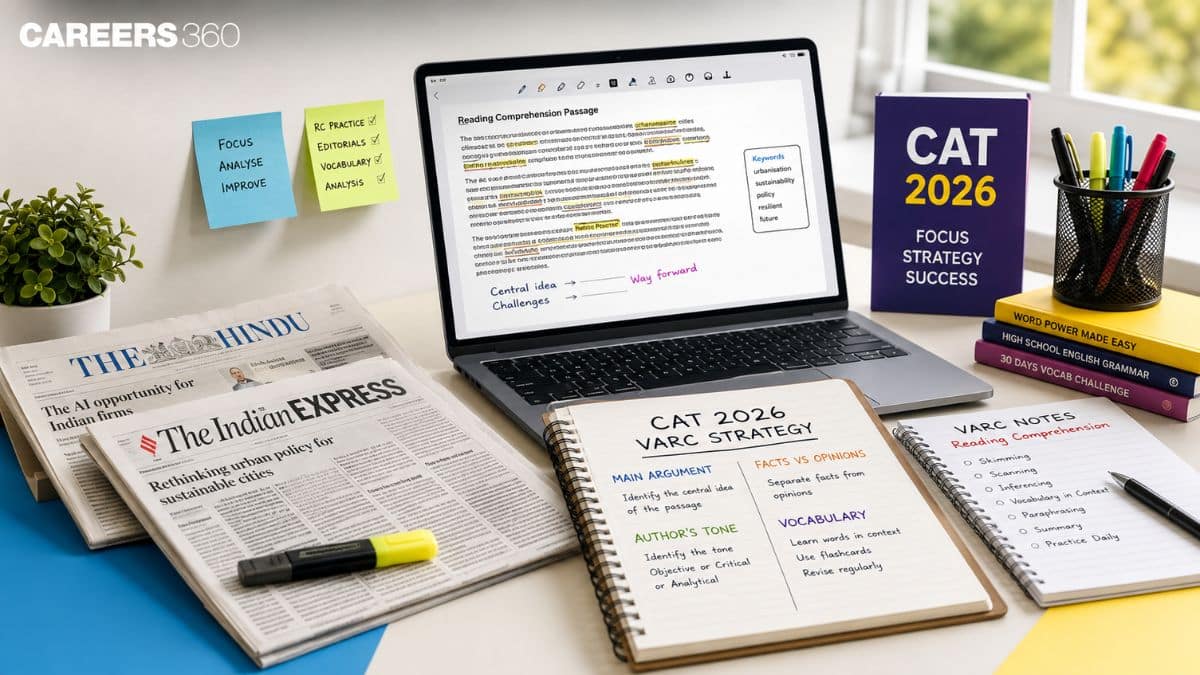
One of the biggest advantages of editorial reading is that it improves analytical reading instead of passive reading. While reading a novel, you mainly follow the story. In an editorial, you continually assess the author's assertions, evidence, assumptions, and counterarguments. This is exactly what CAT expects candidates to do while solving RC questions.
CAT Reading Comprehension passages are rarely based on simple news reports. They talk about things such as behavioral economics, climate policies, cognitive psychology, artificial intelligence, and scientific breakthroughs.
The second advantage that comes to mind is vocabulary building. Vocabulary-related questions are not asked by CAT anymore, but some tough words can be seen in RC passages. With editorial reading, you come across such words.
For example, words like nuance, paradigm, empirical, consensus, and plausible become easier to understand when you get it repeatedly in different articles.
Not every newspaper article is useful for the CAT VARC syllabus. You must choose publications that feature more analytical and opinion-based articles.
The Hindu Editorial is one of the best starting points because its editorials have a balanced language and an argument structure. Additionally, they help in developing your reading skills and vocabulary.
The Indian Express offers excellent editorials on public policy, economy, governance, education, and international affairs. Its articles are more abstract and often discuss economics, technology, science, and global politics in the style frequently seen in CAT RC passages.
Reading an editorial from beginning to end is not enough. The objective is to understand how the author builds an argument. Since IIMs frame questions in a way that it test your ability to identify the central idea, infer hidden meanings, evaluate arguments, and distinguish facts from opinions.
Complete the article once without using a dictionary. Many CAT aspirants pause their reading whenever they find an unfamiliar word. This breaks concentration, and candidates find it difficult to understand the overall flow of the argument.
Instead, try to guess the meaning of unfamiliar words from the sentences. If the word is not essential for understanding the paragraph, move ahead and check its meaning after finishing the article.
Every editorial is written to convince readers about a particular viewpoint. Answer these questions before analysing the article further:
What issue is the author discussing?
What is the author's opinion?
What conclusion does the author reach?
If you cannot summarise the editorial in one or two sentences, you probably have not understood its central idea.
Most of the editorials adhere to the following structure:
Section | Purpose |
Introduction | Introduces the issue or debate |
Background | Explains the context or problem |
Main Argument | Presents the author's viewpoint |
Evidence | Supports the argument with examples, data, or research |
Counterargument | Discusses opposing views and responds to them |
Conclusion | Summarises the position or suggests a solution |
Most of the CAT RC questions are based on assumptions, arguments, or even the author's opinion.
For example:
Fact: India's inflation rate increased during the quarter.
Opinion: The current monetary policy may not be sufficient to control inflation.
When you solve inference-based questions, you should look for the author’s tone. Your main focus should be to identify the tone of the following:
Analytical
Critical
Balanced
Optimistic
Skeptical
Persuasive
Objective
Write a summary of around 50-70 words without referring to the article once you finish reading the editorial. It should consist of the topic, central argument by the author, two ot three supporting details and a conclusion.
Well, if you are a beginner, then you should start with one CAT RC editorial every day. Once you become comfortable, you can go with 2 to 3 pieces and keep increasing the difficulty levels. Here is a breakdown of the activity and time you should take.
Activity | Time |
Read one editorial carefully | 15-20 minutes |
Note new vocabulary | 5 minutes |
Analyse the argument and tone | 10 minutes |
Write a summary and frame two RC questions | 10 minutes |
The Reading Comprehension passages in the CAT exam are chosen from magazines and academic journals. Unlike others, these are not based on breaking news or factual current affairs. Therefore, students should prioritise topics that improve their ability to understand the unfamiliar. Here are the list of topics that are asked frequently in the CAT exam.
Topic | What You Should Focus On |
Economics | Inflation, taxation, global trade, financial markets, behavioural economics |
Science | Genetics, neuroscience, climate science, space research, biotechnology |
Technology | Artificial Intelligence, automation, cybersecurity, digital privacy, social media |
Psychology | Human behaviour, memory, decision-making, cognitive biases |
Philosophy | Ethics, morality, free will, happiness, justice, consciousness |
Sociology | Gender, education, migration, urbanisation, cultural change |
Environment | Climate change, renewable energy, biodiversity, sustainable development |
Business & Management | Leadership, innovation, consumer behaviour, organisational culture |
History & Culture | Civilisations, archaeology, literature, language evolution, art |
Editorial notes in CAT VARC should help you revise your learning in a few minutes. Avoid copying paragraphs from the article, as this turns note-making into a writing exercise rather than a comprehension exercise.
Use a simple format like this:
Section | What to Write |
Date & Source | Name of the newspaper or magazine |
Topic | Economics, Psychology, Science, Technology, etc. |
Central Idea | One sentence summarising the article |
Author's View | Main opinion presented in the editorial |
Key Arguments | Three or four supporting points |
Counterargument | Opposing viewpoint, if discussed |
New Vocabulary | Five to eight useful words with meanings |
Takeaway | One important lesson from the article |
Candidates looking to qualify for CAT 2026 with a high score in VARC can refer to the following ebooks to aid their exam preparations.
| eBook | Download |
|---|---|
| The CAT Arithmetic Hackbook PDF: Zero Math Background? No Problem – Concepts, Questions | Download Now |
| CAT Algebra Handbook 2026: Everything You Need to Master Algebra – Concepts, Practice Questions | Download Now |
| CAT 2026 Number System PDF Handbook: Complete Concepts, Practice Questions & Solutions | Download Now |
| CAT 2026 Geometry & Mensuration PDF: Important Concepts, Shortcuts & Practice Questions | Download Now |
| CAT 2026 Modern Maths PDF Handbook: Key Concepts, Tricks & PYQ-Based Practice | Download Now |
| CAT 2025 Slot-by-Slot Master Weightage Matrix PDF | Download Now |
| 15 CAT Myths That Waste Months of Preparation | Download Now |
| 8 Expert-Curated Philosophy Editorials with CAT-Style Questions | Download Now |
| CAT Quant PYQs – Complete 5-Year Question Bank (2021–2025) PDF | Download Now |
| CAT 2026: AI vs Coaching – Which is Better | Download Now |
| CAT DILR PYQs Complete 5-Year Question Bank (2021–2025) | Download Now |
| CAT VARC PYQs – Complete 5-Year Question Bank (2021–2025) PDF | Download Now |
| CAT RC 2026: 12 Tones That Can Change Your Answer | Download Now |
| CAT 2026: 10 Most Repeated Concepts in Quant | Download Now |
| CAT Time & Work: Top 30 Practice Questions with Answer Key & Detailed Solutions | Download Now |
| CAT Quadratic Equations: Top 30 Practice Questions with Answer Key & Detailed Solutions | Download Now |
Frequently Asked Questions (FAQs)
Start with The Hindu and The Indian Express. Once you are comfortable, read a few articles from international newspapers as well. Reading from different sources helps you get used to the variety of topics asked in CAT.
Spend about 30–45 minutes a day. Read one or two editorials carefully instead of rushing through many articles. Understanding the ideas is more important than finishing more pages.
Yes. It improves your reading speed, helps you understand difficult passages, and makes it easier to follow the author's point of view. Over time, this can make Reading Comprehension questions easier to solve.
Read the article from start to finish without skipping parts. After reading, think about the main idea, the author's opinion, and the key arguments. Write a summary in your own words and note any new words you learn.
No. Editorials help you become a better reader, but they should be part of your preparation. Along with daily reading, practise CAT RCs, solve Verbal Ability questions, and take mock tests to improve your score.

On Question asked by student community
Hello, for AP NEET PG Category C seats, NRI documents are generally required if you are applying under the NRI quota, and eligibility depends on the applicable counselling rules. The fee payment currency and procedure should be confirmed from the current Dr. NTRUHS notification at its official website drntr.uhsap.in.
Hello, CAT aur B-school entrance exams ke baare mein aap exam dates, eligibility, registration, exam pattern, syllabus, colleges ya admission process ki information dekh sakte hain. Aapki requirement ke according relevant details yahan mil sakti hain: https://bschool.careers360.com/exams
You can download the latest CAT syllabus from here:
Hey there,
For a B.Sc. with Chemistry, Botany and Zoology (CBZ), if the CAT application asks separately for:
If the Discipline dropdown has a more specific option such as “Biological Sciences,” “Life Sciences,” or “Zoology/Botany,”
Hey there,
Yes. With 2 years of work experience, you are eligible to target the regular 2-year MBA at IIM Calcutta as long as you have a bachelor's degree with at least 50% marks (45% for SC/ST/PwD). Work experience is not required for eligibility.
For
Directions for question:
The bar-graph given below shows the foreign exchange reserves of Nepal (in million Rupees) from 2014 to 2021. Answer the following questions based on the graph :

Question:
What was the percentage increase (rounded to the nearest integer, if deemed necessary) in the foreign exchange reserves in

Globally Recognized by AACSB (US) & AMBA (UK) | 18 LPA Avg. CTC for PGPM 2026
75+ years of legacy | #1 Entrance Exam | Score accepted by 250+ BSchools
Gateway to IBS Hyderabad & 8 other IBS campuses | Scholarships worth 10 CR
Highest Package 29.30 LPA | 12 LPA Median CTC | 230+ Recruiters | AACSB Accredited | Ranked 51 in Asia by QS International
Early Application Round Deadline: 27th Oct’26 | 400+ Recruiters | Highest CTC 17.2 LPA | Average CTC 8 LPA | 92% Avg. Placements | Awarded Best Business School of the Year
Last Date to Apply - 19th December 2026 | Highest CTC 68.66 LPA | Average CTC 18.08 LPA | Top 25% Average CTC 24.66 LPA