Birla Institute of Management Technology, Greater Noida
AACSB Accredited | Highest CTC: 22 LPA


India’s internet revolution has connected millions, but reliable connectivity remains a challenge in remote villages, mountainous regions and areas with limited broadband infrastructure. Now, Starlink’s proposed entry into India is raising an important question: can satellite internet challenge established telecom giants such as Reliance Jio and Bharti Airtel? With the CAT 2026 exam scheduled for November 29, 2026, this topic is also relevant to Reading Comprehension preparation. Technology, economics, market competition and government regulation frequently provide useful contexts for analytical reading passages.
This Story also Contains
Find the Scholarships - Top 100 B-Schools in India to financially aid the MBA Journey.
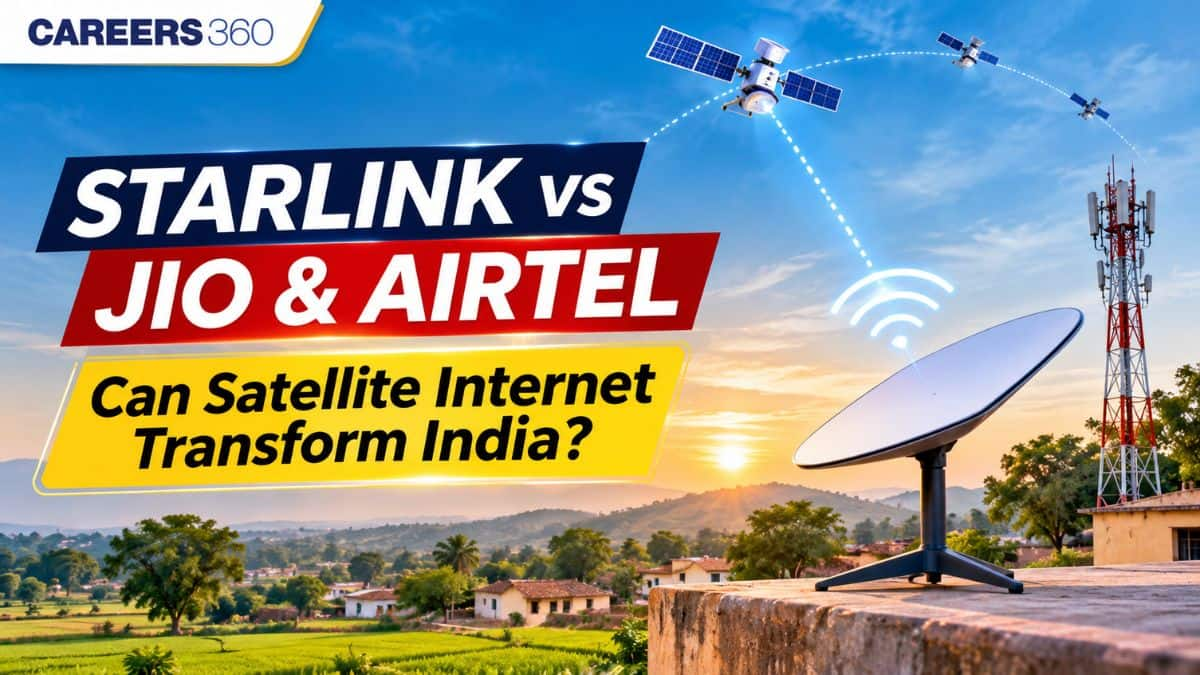
Starlink, operated by SpaceX, uses a network of low-Earth-orbit (LEO) satellites to provide internet connectivity. Unlike conventional broadband, which often depends on fibre-optic cables or mobile towers, satellite internet can reach locations where terrestrial infrastructure is difficult or expensive to establish.
LEO satellites operate much closer to Earth than traditional geostationary satellites. This generally reduces communication delays, making satellite internet more suitable for activities such as video calls, online learning and cloud-based applications.
India could benefit from this technology in remote villages, border regions, islands, schools, healthcare facilities and businesses operating beyond reliable broadband coverage. However, satellite connectivity is not automatically the best option everywhere. Network performance can depend on equipment placement, weather, service capacity and local conditions.
Established telecom companies also have important advantages. Jio and Airtel already serve large customer bases and operate extensive mobile and broadband networks. Their infrastructure, distribution channels and familiarity with the Indian market could help them compete with or collaborate with satellite providers.
According to Business Standard's October 2026 report, Starlink had obtained important licences and authorisations but was still awaiting clearances required for commercial operations. Therefore, its potential impact should not be confused with an already completed nationwide launch.
Question 1. What is the central argument of the passage?
A. Satellite internet will make mobile networks unnecessary.
B. Satellite internet can address connectivity gaps, but its impact depends on several practical factors.
C. Rural areas cannot benefit from conventional broadband.
D. Established telecom companies lack the infrastructure to compete.
Answer: B. The passage presents satellite internet as a potential solution while acknowledging technical, regulatory and competitive limitations.
Question 2. Which assumption most strongly supports the argument that Starlink could improve rural connectivity?
A. All rural consumers prefer satellite internet.
B. Existing terrestrial networks cannot be expanded anywhere in India.
C. Some underserved locations can benefit from connectivity without extensive local cable or tower infrastructure.
D. Satellite internet will always be cheaper than fibre broadband.
Answer: C. The argument depends on satellite technology offering a practical alternative in locations where terrestrial infrastructure is difficult to establish.
Question 3. The comparison between LEO and geostationary satellites primarily serves to:
A. establish that all satellite networks have identical performance.
B. explain one technical reason LEO connectivity may be suitable for interactive applications.
C. prove that Starlink has no infrastructure costs.
D. demonstrate that terrestrial broadband is obsolete.
Answer: B. The comparison explains how lower communication delays can improve the suitability of satellite internet for interactive uses.
Question 4. Which conclusion is best supported by the passage?
A. Starlink's success is guaranteed by its technology.
B. Telecom companies will necessarily lose their customers.
C. Satellite internet could complement existing networks rather than replace them entirely.
D. Government approval has no bearing on market entry.
Answer: C. The passage identifies distinct strengths for satellite and terrestrial networks, supporting the possibility of coexistence.
Understand what the CAT RC 2026 are: 12 Tones That Can Change Your Answer: Download Now
Get the actual CAT previous year question papers here
The competition between India's telecom industry and Starlink is not simply a contest between satellites and mobile towers. It also involves affordability, distribution, spectrum policy and regulatory compliance.
Jio and Airtel have established businesses spanning mobile services, broadband, enterprise connectivity and digital platforms. Their existing relationships with customers could make it easier to package connectivity services and provide customer support. Their terrestrial networks are also well suited to serving densely populated urban areas.
Starlink's potential advantage lies in reaching locations where conventional infrastructure is less practical. However, satellite services require specialised user equipment and access to satellite capacity. Their commercial appeal will depend partly on the total cost to customers, not just the advertised internet speed.
Affordability is particularly important in India, where customers have access to relatively low-cost mobile data plans. A satellite service may be valuable to a remote business or institution even if it is too expensive for an average household. Consequently, Starlink may initially serve specific market segments rather than directly compete with every mobile connection.
Partnerships could also reshape the competition. In March 2025, Airtel announced an agreement with SpaceX to explore bringing Starlink services to its customers, subject to the necessary authorisations. Jio Platforms announced a similar agreement the following day. Both arrangements explored opportunities involving distribution and expanded connectivity; they should not be interpreted as proof that Starlink services are already commercially available nationwide.
Sources: Airtel's official announcement and Business Standard's report on Jio's agreement.
Regulation remains another decisive factor. Satellite operators need the relevant authorisations and must satisfy India's security requirements and spectrum-related conditions before beginning commercial services. In October 2026, the government stated that licensed satellite operators were subject to security assessments and that commercial services could not begin before the required steps were completed.
Source:The Indian Express reported on the government's position.
Question 1. Which factor most directly limits Starlink's ability to compete with low-cost mobile data plans?
A. The absence of any potential rural customers.
B. The need to make the total cost of satellite connectivity attractive to its target users.
C. The inability of satellites to provide internet access.
D. The assumption that all urban users require satellite equipment.
Answer: B. The passage emphasises that equipment and service costs affect whether satellite internet is commercially attractive.
Question 2. What can reasonably be inferred from the Airtel and Jio agreements with SpaceX?
A. Both companies have abandoned their terrestrial networks.
B. Partnerships may allow established telecom operators to explore satellite connectivity without treating it solely as a direct rivalry.
C. Starlink has already secured every approval required for commercial operations.
D. All Indian consumers will receive free satellite internet.
Answer: B. The agreements indicate that collaboration and competition can coexist, subject to regulatory conditions.
Question 3. Which of the following, if true, would most weaken the argument that satellite internet could be commercially useful in remote regions?
A. Some remote businesses have limited access to reliable broadband.
B. Satellite services can operate without a local fibre connection to every customer.
C. The total cost of satellite equipment and subscriptions is unaffordable for most intended customers, with no viable alternative funding.
D. Telecom operators have existing distribution networks.
Answer: C. If intended customers cannot afford the service and no alternative funding exists, its commercial usefulness in those markets would be substantially reduced.
Question 4. Why is regulatory approval central to the discussion?
A. It determines whether operators can legally proceed with commercial services after satisfying applicable requirements.
B. It guarantees that a company will dominate the market.
C. It eliminates the need for spectrum.
D. It determines the technical quality of every customer's connection.
Answer: A. The passage identifies authorisation, security compliance and spectrum-related conditions as necessary steps before commercial operations.
Practice with CAT VARC PYQs- Complete 5-Year Question Bank (2021 - 2025) PDF
Starlink's arrival could expand the range of internet services available in India, but declaring a winner before commercial operations begin would be premature.
For densely populated cities and areas with established broadband infrastructure, fibre and mobile networks may remain practical because they can serve many customers through existing systems. Satellite internet could be particularly useful in locations where building or maintaining terrestrial infrastructure is difficult.
The two models may therefore serve different needs. Starlink could provide connectivity to remote households, institutions, enterprises and communities that are poorly served by existing networks. Meanwhile, telecom operators could continue strengthening their terrestrial services while exploring satellite partnerships.
Competition could also encourage companies to improve coverage, reliability and customer experience. However, whether consumers benefit will depend on pricing, service quality, actual availability and the regulatory framework. Satellite internet's technical reach alone does not guarantee mass adoption.
The likely outcome is not necessarily a complete victory for one side. India's internet market could develop into a combination of terrestrial and satellite connectivity, with different technologies serving different locations and customer requirements. Starlink's long-term position will become clearer once it receives the necessary approvals, launches commercial services and demonstrates how its offering performs in the Indian market.
Question 1. Which statement best captures the author's position?
A. Starlink will inevitably replace Jio and Airtel.
B. Traditional telecom networks have no future.
C. The outcome will depend on market conditions, regulation and the needs of different customer groups.
D. Satellite internet is useful only for international communication.
Answer: C. The author avoids a definitive prediction and identifies several factors that will shape the market.
Question 2. Which of the following best describes the relationship between satellite and terrestrial connectivity in the passage?
A. They are necessarily mutually exclusive.
B. They may be complementary technologies with different strengths.
C. They are identical in cost and infrastructure.
D. One can function only if the other is discontinued.
Answer: B. The passage argues that the technologies can serve different environments and customer needs.
Question 3. Which finding would best support the author's prediction that both types of connectivity could coexist?
A. Satellite internet receives attention in the media.
B. Fibre broadband becomes unavailable in every city.
C. Satellite services gain customers in remote areas while terrestrial networks retain strong demand in urban markets.
D. One operator announces a new product without releasing performance data.
Answer: C. This evidence would directly demonstrate that the two technologies can remain useful in different market segments.
Question 4. Which statement would the author most likely disagree with?
A. Pricing will influence satellite internet adoption.
B. Regulatory clearance is important for commercial launch.
C. Satellite internet could improve access in underserved locations.
D. A technically advanced service is guaranteed to dominate regardless of cost or consumer needs.
Answer: D. The article repeatedly stresses that technical capability alone does not guarantee commercial success.
Practise with Free CAT 2026 Mock Tests to assess your preparation, improve time management, and boost exam-day confidence.
Explore the following CAT 2026 VARC preparation resources to build vocabulary, sharpen reading comprehension skills, and practise questions aligned with the exam pattern.
500+ Idioms And Phrases List With Meanings & Examples For MBA Entrance Exams | |
CAT VARC: 3000+ Most Important English Words | |
300+ Phrasal Verbs List for CAT Exam, Types With Examples & Practice Questions. Download PDF | |
CAT 2026 Verbal Ability and Reading Comprehension (VARC) Study Material PDF | |
Avoid These Common CAT RC Mistakes to Boost your VARC Score | |
8 Expert-Curated Philosophy Editorials with CAT-Style Questions | |
CAT RC 2026: 12 Tones That Can Change Your Answer | |
Top 25 Reading Comprehension Passages to Practice for CAT 2026 | |
CAT 2026 VARC SAMPLE PAPER | |
CAT 2026 Reading Comprehension Practice Questions | |
CAT 2026 Parajumbles Practice Questions |
Incorporate these study materials into your daily preparation routine to enhance comprehension, improve accuracy, and perform better in the CAT 2026 VARC section.
MBA Specialisation | What the eBook Covers | Download eBook |
|---|---|---|
Entrepreneurship & Innovation | Colleges, rankings, fees, placements and careers | |
Rural Management | Colleges, rankings, fees, placements and career options | |
Disaster Management | Colleges, rankings, fees, placements and career paths |
Download Free Practice Tests & Solutions and Ace the CAT Exam 2026
Frequently Asked Questions (FAQs)
Starlink uses low-Earth-orbit satellites to deliver internet connectivity, while traditional mobile and broadband services commonly rely on towers, fibre-optic cables and other terrestrial infrastructure.
No nationwide commercial availability should be assumed. As reported in October 2026, Starlink was still awaiting required clearances for commercial operations. Check official announcements for subsequent updates.
It could compete for some broadband customers, especially in underserved regions. However, the partnerships announced in March 2025 also indicate that established telecom operators may explore distributing or integrating Starlink services.
Satellite connectivity could help connect remote communities, schools, healthcare facilities and businesses where terrestrial infrastructure is difficult or expensive to establish.
Not necessarily. Terrestrial networks can be well suited to densely populated areas, while satellite connectivity may be more practical in certain remote locations. Both could coexist.
It combines technology, economics, public policy and market competition. Reading passages on these themes can test a candidate's ability to identify central arguments, draw inferences, evaluate assumptions and assess evidence.

On Question asked by student community
Hi Khushdeep
Several apps and online platforms are available for CAT (Common Admission Test) preparation. Students can choose a platform based on their preparation needs, such as video lectures, practice questions, mock tests, and performance analysis.
Hello, for AP NEET PG Category C seats, NRI documents are generally required if you are applying under the NRI quota, and eligibility depends on the applicable counselling rules. The fee payment currency and procedure should be confirmed from the current Dr. NTRUHS notification at its official website drntr.uhsap.in.
Hello, CAT aur B-school entrance exams ke baare mein aap exam dates, eligibility, registration, exam pattern, syllabus, colleges ya admission process ki information dekh sakte hain. Aapki requirement ke according relevant details yahan mil sakti hain: https://bschool.careers360.com/exams
You can download the latest CAT syllabus from here:
Hey there,
For a B.Sc. with Chemistry, Botany and Zoology (CBZ), if the CAT application asks separately for:
If the Discipline dropdown has a more specific option such as “Biological Sciences,” “Life Sciences,” or “Zoology/Botany,”
Directions for question:
The bar-graph given below shows the foreign exchange reserves of Nepal (in million Rupees) from 2014 to 2021. Answer the following questions based on the graph :

Question:
What was the percentage increase (rounded to the nearest integer, if deemed necessary) in the foreign exchange reserves in

Globally Recognized by AACSB (US) & AMBA (UK) | 18 LPA Avg. CTC for PGPM 2026
Register for XAT 2027 by 28th Oct to become eligible to take the Mock Test | 75+ years of legacy | #1 Entrance Test | 100+ Test Cities | 250+ B-Schools accept XAT Score
Gateway to IBS Hyderabad & 8 other IBS campuses | Scholarships worth 10 CR
Highest Package 29.30 LPA | 230+ Recruiters | AACSB Accredited | Ranked 51 in Asia by QS International
Among top 6% B-Schools globally to be accredited by AACSB | Highest Package-35 LPA
Application Deadline: 1st Dec'26 | 400+ Recruiters | Highest CTC 17.2 LPA | Average CTC 8 LPA | 92% Avg. Placements | Awarded Best Business School of the Year