ICFAI Business School, Hyderabad
Gateway to IBS Hyderabad & 8 other IBS campuses | Scholarships worth 10 CR


A small change in speed can completely change the answer to a Time, Speed and Distance question. With CAT 2026 scheduled for November 29, 2026, this topic deserves more than formula memorisation. This article covers CAT time, speed, and distance concepts, important formulas, common question types, previous-year trends, shortcuts and a practical preparation strategy. It also explains how to approach TSD questions for CAT and use previous-year questions to improve both accuracy and calculation speed.

Time, Speed and Distance is built around one simple relationship. Once this relationship is clear, several different-looking questions can be reduced to the same calculation.
Quantity | Formula |
Speed | |
Distance | |
Time |
When distance remains constant:
Therefore, speed and time are inversely proportional. If speed increases, the time required to cover the same distance decreases.
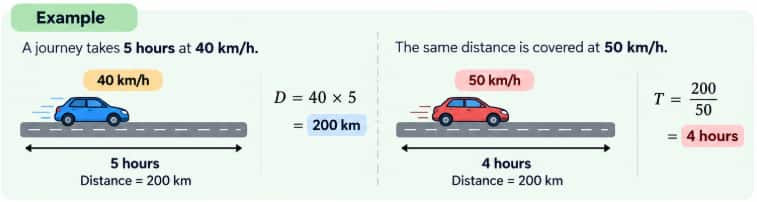
This relationship forms the base for many CAT-level questions.
The CAT syllabus for Quantitative Aptitude covers major areas such as Arithmetic, Algebra, Geometry, Number System, Modern Math and other quantitative concepts. In the CAT exam pattern, QA is one of three sections, along with VARC, Data Interpretation and Logical Reasoning, and tests candidates on speed, accuracy and problem-solving ability. Time, Speed and Distance is an important Arithmetic topic, making shortcuts for trains, relative speed, meeting points and time-based problems particularly useful for CAT preparation.
The following CAT TSD formulas cover the major concepts that candidates should know before attempting mixed questions.
Conversion | Formula |
km/h to m/s | 1km/h=518m/s |
m/s to km/h | 1m/s=185km/h |
Unit conversion should be completed before applying the distance-time formula.
Relative speed depends on the direction of movement.
Situation | Relative Speed |
Opposite directions | |
Same direction |
For example, if two cars travel towards each other at 40 km/h and 60 km/h:
If they move in the same direction:
The general formula is:
AverageSpeed=TotalDistanceTotalTime
For two equal distances covered at speeds
AverageSpeed=2S1S2S1+S2
The arithmetic mean of two speeds should not be used automatically because average speed depends on both total distance and total time.
Recognising the structure of a question before calculating can save time during the CAT Quantitative Aptitude section.
These questions directly provide two quantities and ask for the third.
For example, a car covers 300 km in 5 hours:
CAT can make a basic question more demanding by adding ratios, percentage changes or multiple stages.
These questions involve two objects moving in the same or opposite directions.
For opposite directions:
For the same direction:
The concept is commonly useful in meeting, overtaking and crossing situations.
Train questions require candidates to consider the total distance covered while crossing another object.
For a train of length
For a train crossing a platform of length
For two trains crossing each other:
The main challenge is often identifying the correct relative distance rather than performing the final calculation.
Let
Situation | Speed |
Downstream | |
Upstream |
If downstream speed is
Circular-track questions generally use relative speed.
For two people moving in the same direction around a track of length
For opposite directions:
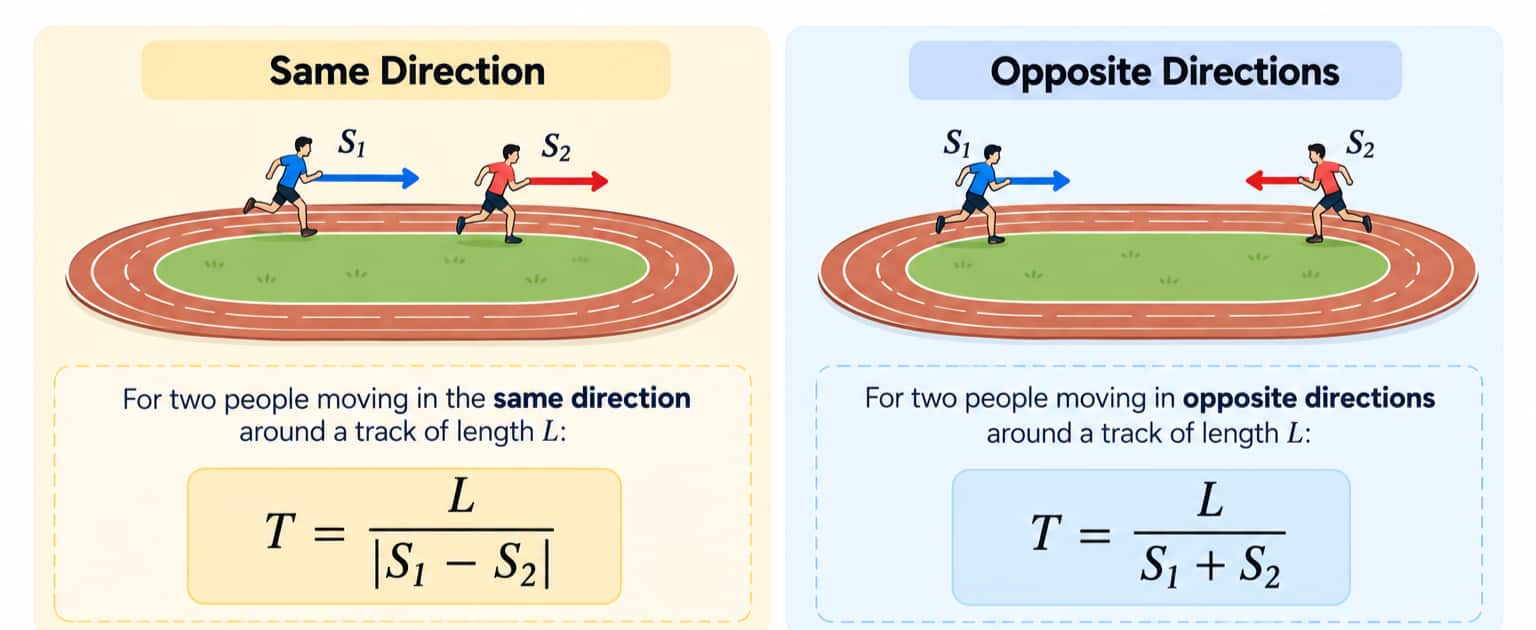
The question may then ask when they meet again or how many meetings take place during a given period.
Race questions often become easier through speed ratios.
For two participants covering the same distance:
S1S2=T2T1
This can avoid unnecessary calculation when only the relationship between the participants is required.
CAT Quant Previous-year data shows that Time, Speed and Distance had 1 question in each CAT 2025 slot, making it a recurring Arithmetic topic.
Use CAT PYQs to analyse:
1 per slot in CAT 2025
Recurring TSD concepts
Question patterns
Difficulty level
Common traps
Test your Quantitative Aptitude preparation with exam-style CAT 2026 practice questions.
Strengthen your CAT Quant preparation with previous-year Time, Speed & Distance questions. Practice real CAT-level questions, understand the patterns, and improve your speed and accuracy.
Time, Speed and Distance connects naturally with several other Arithmetic concepts.
TSD Area | Related Concept |
Speed ratios | Ratios and Proportion |
Change in speed | Percentages |
Average speed | Averages |
Multiple journeys | Algebra |
Relative movement | Ratios |
Train problems | Relative Speed |
This makes TSD useful beyond a single chapter. A candidate who understands ratios and proportional relationships can often solve certain TSD problems without relying on lengthy calculations.
Build your CAT Arithmetic fundamentals from scratch with simple concepts, shortcuts, and exam-focused practice.
A practical preparation sequence is:
Basic Speed, Distance and Time
Speed-Time relationships
Relative Speed
Average Speed
Trains
Boats and Streams
Races
Circular Tracks
Mixed TSD questions
Start with the fundamental relationships and then move towards questions that combine two or more concepts.
Time, Speed and Distance questions in CAT test your ability to connect these three quantities and apply relative speed, average speed, trains, boats and circular-track concepts efficiently. The following formula table covers the key relationships you should remember.
Concept | Formula |
Speed | |
Distance | |
Time | |
km/h to m/s | Speed518 |
m/s to km/h | Speed185 |
Average Speed | TotalDistanceTotalTime |
Average Speed for Equal Distances | 2S1S2S1+S2 |
Relative Speed - Same Direction | |
Relative Speed - Opposite Directions | |
Meeting Time - Opposite Directions | DS1+S2 |
Meeting Time - Same Direction | |
Time Saved by Increasing Speed | DS1-DS2 |
Distance Covered in Given Time | |
Train Crossing a Pole | LengthofTrainSpeedofTrain |
Train Crossing a Platform | TrainLength+PlatformLengthSpeed |
Two Trains - Opposite Directions | L1+L2S1+S2 |
Two Trains - Same Direction | $\frac{L_1+L_2}{ |
Boat Downstream Speed | |
Boat Upstream Speed | |
Boat in Still Water | DownstreamSpeed+UpstreamSpeed2 |
Speed of Stream | DownstreamSpeed-UpstreamSpeed2 |
Circular Track - Same Direction | |
Circular Track - Opposite Directions | LS1+S2 |
Time for One Round | LS |
Number of Rounds | STL |
Same Distance | |
Same Time | |
Same Distance Relation |
These formulas cover the core CAT Time, Speed and Distance toolkit. In actual questions, focus on identifying whether the problem involves relative speed, equal distances, trains, boats, or circular tracks before selecting the formula.
CAT Time, Speed and Distance questions often become lengthy only because of unnecessary calculations. These shortcuts help you reduce the problem to ratios, relative speed, or simple algebra wherever possible.
Shortcut / Trick | Quick Approach |
Speed ↑/↓ → Time ↓/↑ | Use the percentage-change relation directly; avoid recalculating distance. |
Late–Early Problems | Use the sum of late + early time as the time difference. |
Meeting Point | Distances covered are in the ratio of speeds. |
Equal Time Journeys | Average the speeds directly. |
Train vs Pole/Person | Use train length only. |
Train vs Platform | Add train + platform length. |
Two Trains | Add lengths and use relative speed. |
Opposite Directions | Use sum of speeds. |
Same Direction | Use difference of speeds. |
Round Trips | Work with total distance ÷ total time. |
Whenever you see a Time, Speed and Distance question, do not immediately calculate the distance or time. First check whether the information can be solved using a ratio or relative speed. In CAT, this often turns a multi-step calculation into a 1-2 step solution.
Compare topic-wise question distribution across all CAT 2025 slots and identify high-weightage areas. Download CAT 2025 Slot-Wise Weightage Matrix
Knowing the formula is not enough if the situation is interpreted incorrectly. Keep these errors in mind while practising:
Before calculating, identify the direction, distance, units and quantities that remain constant.
Solving CAT 2026 Quant PYQs should go beyond checking whether an answer is correct. Use each previous-year question to understand how the concept has been applied.
Follow this sequence:
Concept → PYQ → Timed Attempt → Error Analysis → Reattempt
For every question, record:
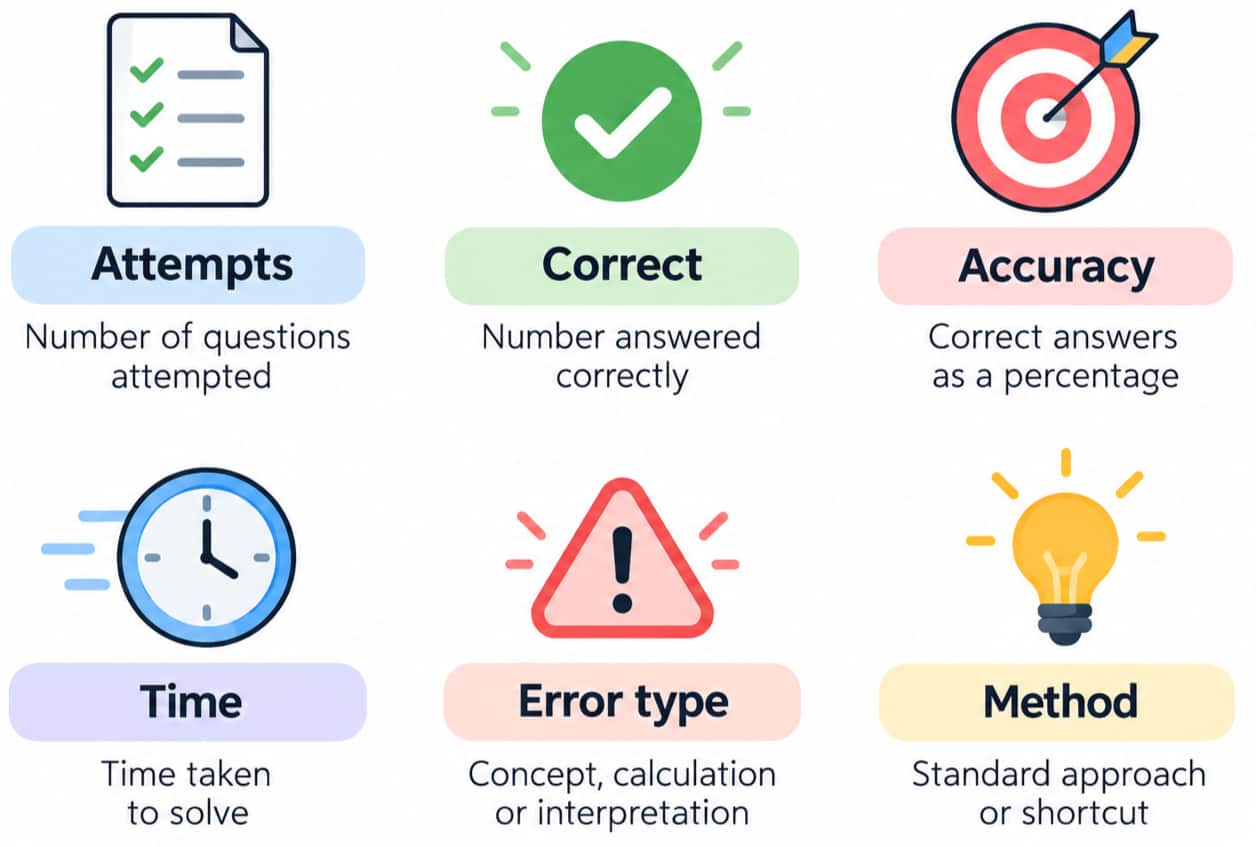
A question that is solved correctly but takes too long should also be reviewed. In CAT, efficiency matters because time has to be distributed across the entire section.
Practice 5 years of CAT Quant previous-year questions with this complete question bank. Download CAT Quant PYQs 2021-2025 Question Bank
A three-stage approach can make preparation more measurable.
Revise the core formulas and solve basic questions involving direct relationships between speed, distance and time.
Move to relative speed, average speed, trains, boats and streams, races and circular tracks.
Solve mixed TSD questions without knowing the topic beforehand. This checks whether you can identify the correct approach under time pressure.
After every practice session, review both incorrect questions and questions that took significantly longer than expected.
Accuracy should be tracked along with solving time.
For example, an illustrative practice record could look like this:
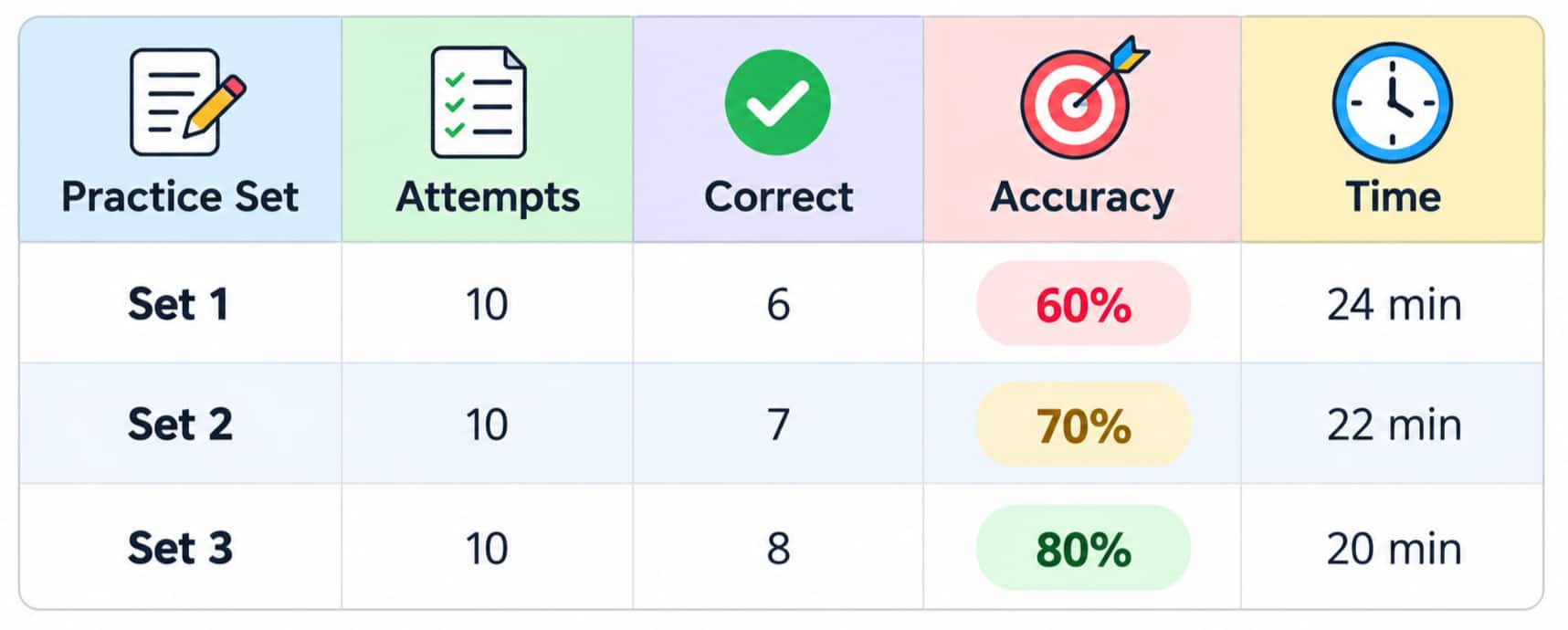
These figures are only an example and should not be treated as a CAT benchmark.
If accuracy improves while solving time decreases, the approach is becoming more efficient. If accuracy improves but solving time keeps increasing, more timed practice may be needed.
Get exam-like practice with a free CAT mock test and assess your preparation across the key sections. Identify your weak areas, improve time management, and get closer to your target percentile.
Attempt the Free CAT Mock Test
Practice with CAT 2026 Mock Test Series - 20 Sets, Questions with Solutions By Experts
Frequently Asked Questions (FAQs)
For CAT 2026, learn $S=\frac{D}{T}$, $D=S\times T$ and $T=\frac{D}{S}$ along with relative-speed and average-speed formulas.
Focus on trains, boats and streams, races, circular tracks, relative speed, average speed and speed-time relationships.
Yes, TSD has appeared in CAT Arithmetic, with 1 question reported in each CAT 2025 slot, although future weightage can vary.
Identify the relationship between distance, speed and time first, then use relative-speed or ratio-based methods where applicable instead of lengthy calculations.
Solve CAT TSD questions and PYQs under timed conditions, then review calculation errors, incorrect approaches and questions that consumed excessive time.

On Question asked by student community
Hello, for AP NEET PG Category C seats, NRI documents are generally required if you are applying under the NRI quota, and eligibility depends on the applicable counselling rules. The fee payment currency and procedure should be confirmed from the current Dr. NTRUHS notification at its official website drntr.uhsap.in.
Hello, CAT aur B-school entrance exams ke baare mein aap exam dates, eligibility, registration, exam pattern, syllabus, colleges ya admission process ki information dekh sakte hain. Aapki requirement ke according relevant details yahan mil sakti hain: https://bschool.careers360.com/exams
You can download the latest CAT syllabus from here:
Hey there,
For a B.Sc. with Chemistry, Botany and Zoology (CBZ), if the CAT application asks separately for:
If the Discipline dropdown has a more specific option such as “Biological Sciences,” “Life Sciences,” or “Zoology/Botany,”
Hey there,
Yes. With 2 years of work experience, you are eligible to target the regular 2-year MBA at IIM Calcutta as long as you have a bachelor's degree with at least 50% marks (45% for SC/ST/PwD). Work experience is not required for eligibility.
For
Directions for question:
The bar-graph given below shows the foreign exchange reserves of Nepal (in million Rupees) from 2014 to 2021. Answer the following questions based on the graph :

Question:
What was the percentage increase (rounded to the nearest integer, if deemed necessary) in the foreign exchange reserves in

Gateway to IBS Hyderabad & 8 other IBS campuses | Scholarships worth 10 CR
Highest Package 29.30 LPA | 12 LPA Median CTC | 230+ Recruiters | AACSB Accredited | Ranked 51 in Asia by QS International
75+ years of legacy | #1 Entrance Exam | Score accepted by 250+ BSchools
AACSB Accredited | Highest CTC: 22 LPA
Early Application Round Deadline: 27th Oct’26 | 400+ Recruiters | Highest CTC 17.2 LPA | Average CTC 8 LPA | 92% Avg. Placements | Ranked as Platinum Institute | Awarded Best Business School of the Year
Ranked #36 amongst institutions in Management by NIRF | 100% Placement