Birla Institute of Management Technology, Greater Noida
AACSB Accredited | Highest CTC: 22 LPA


Arithmetic can be the difference between a manageable CAT Quant section and a time-consuming one. In CAT 2025, Arithmetic contributed to a large breakup in QA questions across three slots. With CAT 2026 scheduled for November 29, 2026, aspirants should prioritise high-frequency areas such as percentages, ratio and proportion, profit and loss, averages, time and work, and time-speed-distance. This guide covers CAT 2026 Arithmetic preparation, topic-wise weightage, PYQs, formulas, shortcuts, and proven strategies for improving speed and accuracy.
This Story also Contains

Checkout the CAT Quant Topic-Wise Weightage 2021-2025: 5-Year Trend to analyze the subtopic weightage. It will strengthen your preparation and save time.
Since you are preparing for the Arithmetic section of CAT, check this out: The CAT Arithmetic Hackbook PDF: Zero Math Background? No Problem- Concepts, Questions
Arithmetic has consistently accounted for a substantial share of CAT Quant questions, based on analysis of previous-year papers. It focuses on real-life mathematical applications involving percentages, ratios, profit and loss, averages, time and work, and other business-oriented calculations. Since Arithmetic questions are generally concept-based and calculation-driven, they are often considered among the most scoring questions in CAT Quant.
Arithmetic consistently contributes the highest number of questions in the CAT Quant section. A strong understanding of Arithmetic concepts can help candidates solve a significant portion of the paper while also improving their overall problem-solving skills.
Key Reasons to Focus on Arithmetic:
Highest weightage in CAT Quantitative Aptitude
Questions are mostly application-based
Easier to master compared to advanced Algebra and Geometry topics
Builds the foundation for several MBA entrance exams
Helps improve speed and accuracy in the exam
Based on recent CAT trends, Arithmetic typically accounts for a substantial share of Quant questions. Topics such as Percentages, Ratio and Proportion, Time and Work, and Profit and Loss appear frequently across different CAT slots.
Parameter | Details |
Expected Weightage | 35%-45% of Quant Section |
Expected Questions | 8-12 Questions |
Difficulty Level | Easy to Moderate |
Importance | Very High |
Arithmetic alone may not be sufficient to maximize your CAT Quant score, but it can provide a strong foundation. Candidates who are comfortable with Arithmetic can potentially solve a large portion of the Quant section and improve their overall percentile.
What Arithmetic Can Do:
Help secure a strong sectional score
Improve confidence in Quant
Cover a large share of easy-to-moderate questions
What Arithmetic Cannot Do:
Completely replace Algebra, Geometry, or Modern Math preparation
Guarantee a top percentile without balanced Quant preparation
The CAT Arithmetic syllabus includes several important topics that are frequently tested in the Quantitative Aptitude section. Candidates should focus on understanding concepts, formulas, and practical applications rather than memorizing shortcuts alone.
Topic | Key Areas Covered |
Percentage Change, Successive Percentages | |
Direct and Inverse Proportion | |
Discounts, Marked Price, Profit Percentage | |
Interest, Growth, Depreciation | |
Mean, Weighted Average | |
Mixing Ratios, Concentration Problems | |
Efficiency, Combined Work | |
Filling and Emptying Problems | |
Relative Speed, Trains, Races | |
Boats & Streams | Upstream and Downstream |
Partnership | Profit Sharing and Investment Ratios |
Topic | Importance | Expected Difficulty |
Percentages | Very High | Easy |
Ratio and Proportion | Very High | Easy to Moderate |
Profit and Loss | High | Easy to Moderate |
SI and CI | Medium | Moderate |
Averages | High | Easy |
Mixtures and Alligation | High | Moderate |
Time and Work | Very High | Moderate |
Pipes and Cisterns | Medium | Moderate |
Time, Speed and Distance | Very High | Moderate |
Boats and Streams | Medium | Moderate |
Partnership | Medium | Easy to Moderate |
Prioritising these Arithmetic topics can help you build a strong foundation for CAT 2026 Quantitative Aptitude and prepare more effectively for Arithmetic-based questions.
Arithmetic has consistently been the highest-weightage topic in CAT Quantitative Aptitude over the past few years. In most CAT slots, Arithmetic alone has contributed a significant share of the Quant questions, making it one of the most important areas for CAT 2026 preparation. Analyzing previous year papers can help aspirants identify recurring topics, understand question trends, and prioritize high-scoring chapters.
Slot | No. of Questions |
1 | 10 |
2 | 8 |
3 | 9 |
Year | Slot | Percentage | Profit & Loss | Interest | Average, Ratio, Mixture & Alligation | TSD | Time & Work | Total |
2024 | 3 | 2 | 1 | 1 | 3 | 1 | 1 | 9 |
2024 | 2 | 2 | 1 | 1 | 2 | 1 | 1 | 8 |
2024 | 1 | 1 | 1 | 1 | 3 | 1 | 1 | 8 |
2023 | 3 | 2 | 1 | 0 | 2 | 1 | 2 | 8 |
2023 | 2 | 0 | 2 | 1 | 4 | 1 | 1 | 9 |
2023 | 1 | 1 | 1 | 1 | 2 | 3 | 1 | 9 |
2022 | 3 | 0 | 0 | 1 | 4 | 3 | 2 | 10 |
2022 | 2 | 1 | 0 | 1 | 5 | 1 | 1 | 9 |
2022 | 1 | 2 | 2 | 0 | 2 | 1 | 2 | 9 |
2021 | 3 | 1 | 1 | 1 | 3 | 1 | 3 | 10 |
2021 | 2 | 2 | 2 | 0 | 2 | 1 | 2 | 9 |
2021 | 1 | 1 | 1 | 1 | 3 | 1 | 3 | 10 |
2020 | 3 | 1 | 1 | 1 | 3 | 3 | 1 | 10 |
2020 | 2 | 1 | 1 | 1 | 2 | 4 | 1 | 10 |
2020 | 1 | 1 | 1 | 1 | 4 | 4 | 0 | 11 |
Key Trends (2020-2025)
| Topic | Trend |
|---|---|
| Average, Ratio, Mixture & Alligation | Highest contributor across most slots |
| Time, Speed & Distance (TSD) | Consistently high weightage every year |
| Percentages | Appears regularly in almost every slot |
| Profit & Loss | Usually contributes 1–2 questions per slot |
| Time & Work | Stable presence across CAT papers |
| Interest (SI & CI) | Lower but recurring weightage |
Observation: Arithmetic contributed 8–11 questions per slot across the CAT 2020–2024 analysis shown above, highlighting its substantial representation in the Quantitative Aptitude section.
Percentage and Profit & Loss are among the most important Arithmetic topics for CAT 2026. Percentage forms the foundation for several Quant topics, while Profit & Loss questions frequently test real-world business calculations involving profit, discount, and marked price concepts.
Important Concepts
| Topic | Repeated Concepts in CAT |
|---|---|
| Percentage | Venn Diagram Questions |
| Percentage | Successive Changes |
| Percentage | Income and Expenditure |
| Percentage | Averages and Mixtures |
| Percentage | Election-Based Problems |
| Profit & Loss | Markup and Discount |
| Profit & Loss | Successive Discounts |
| Profit & Loss | Profit and Loss Calculations |
CAT 2026 Tip: A strong grasp of Percentage and Profit & Loss can help you tackle a significant portion of Arithmetic questions, as these concepts frequently appear both directly and indirectly in CAT Quant.
Q.1) In an election, there were four candidates, and 80% of the registered voters cast their votes. One of the candidates received 30% of the cast votes while the other three candidates received the remaining cast votes in the proportion $1:2:3$. If the winner of the election received 2512 votes more than the candidate with the second highest votes, then the number of registered voters was:
A) 50240
B) 40192
C) 60288
D) 60200
Solution:
Let the number of registered voters be $300x$.
Then, votes cast $=80%\times300x=240x$.
Number of votes received by the candidate who received 30% of the cast votes:
$30%\times240x=72x$
Remaining votes:
$240x-72x=168x$
These votes are distributed in the ratio $1:2:3$, giving:
$28x,\ 56x,\ 84x$
The winner received $84x$ votes, while the second-highest candidate received $72x$ votes.
Therefore,
$84x-72x=2512$
$12x=2512$
$x=\frac{628}{3}$
Hence, the number of registered voters is:
$300x=300\times\frac{628}{3}=62800$
Answer: 62800
Q.2) In a village, the ratio of the number of males to females is $5:4$. The ratio of the number of literate males to literate females is $2:3$. The ratio of the number of illiterate males to illiterate females is $4:3$. If 3600 males in the village are literate, then the total number of females in the village is:
A) 43200
B) 42300
C) 43000
D) 45000
Solution:
Let the number of males and females be $5x$ and $4x$, respectively.
Let the number of literate males and females be $2y$ and $3y$, respectively.
Let the number of illiterate males and females be $4z$ and $3z$, respectively.
Therefore,
$\frac{2y+4z}{3y+3z}=\frac{5}{4}$
$8y+16z=15y+15z$
$z=7y$
According to the question,
$2y=3600$
$\therefore y=1800$
Total number of females:
$3y+3z=3y+21y=24y$
$=24\times1800=43200$
Answer: 43200 (Option A)
Q.3) A fruit seller has a stock of mangoes, bananas and apples with at least one fruit of each type. At the beginning of a day, the number of mangoes makes up $40%$ of his stock. That day, he sells half of the mangoes, 96 bananas and $40%$ of the apples. At the end of the day, he ends up selling $50%$ of the fruits. The smallest possible total number of fruits in the stock at the beginning of the day is:
Solution:
Let the initial number of fruits be $x$ and the number of apples be $y$.
Mangoes:
$40%\text{ of }x=\frac{2x}{5}$
Mangoes sold:
$\frac{1}{2}\times\frac{2x}{5}=\frac{x}{5}$
Apples sold:
$\frac{40y}{100}=\frac{2y}{5}$
Total fruits sold:
$\frac{x}{5}+\frac{2y}{5}+96$
Since 50% of the fruits are sold:
$\frac{x}{5}+\frac{2y}{5}+96=\frac{x}{2}$
Multiplying by 10:
$2x+4y+960=5x$
Therefore,
$x=\frac{4y+960}{3}$
For $x$ to be an integer, $4y+960$ must be divisible by 3. Also, $\frac{2y}{5}$ must be an integer, so $y$ must be a multiple of 5.
The smallest positive value satisfying both conditions is $y=15$.
Therefore,
$x=\frac{4(15)+960}{3}$
$=\frac{1020}{3}=340$
Hence, the smallest possible number of fruits is 340.
Q.4) In a group of 250 students, the percentage of girls was at least $44%$ and at most $60%$. The rest of the students were boys. Each student opted for either swimming or running, or both. If $50%$ of the boys and $80%$ of the girls opted for swimming while $70%$ of the boys and $60%$ of the girls opted for running, then the minimum and maximum possible number of students who opted for both swimming and running are:
A) 75 and 96, respectively
B) 72 and 88, respectively
C) 75 and 80, respectively
D) 75 and 90, respectively
Solution:
Total students $=250$
Minimum number of girls:
$44%\times250=110$
Maximum number of girls:
$60%\times250=150$
Let the number of girls be $g$ and the number of boys be:
$b=250-g$
Among boys:
Among girls:
Total swimming:
$0.5b+0.8g$
Total running:
$0.7b+0.6g$
Let the number of students who opted for both be $x$.
Using:
$\text{Swimming}+\text{Running}-\text{Both}=250$
Therefore,
$(0.5b+0.8g)+(0.7b+0.6g)-x=250$
$x=1.2b+1.4g-250$
Substituting $b=250-g$:
$x=1.2(250-g)+1.4g-250$
$=300-1.2g+1.4g-250$
$=50+0.2g$
For $g=110$:
$x=50+0.2(110)=72$
For $g=150$:
$x=50+0.2(150)=80$
Hence, the minimum and maximum possible values are 72 and 80, respectively.
Answer: 72 and 80 (Option C)
| Topic | Repeated Concepts in CAT |
|---|---|
| Profit & Loss | Questions based on CP, SP, and MP |
| Profit & Loss | Profit Percentage using Alligation |
| Profit & Loss | Successive Discount Problems |
| Profit & Loss | Percentages in Averages and Mixtures |
CAT 2026 Tip: Most Profit & Loss questions combine concepts from Percentages, Ratios, and Alligation. Focus on understanding the relationships between CP, SP, MP, profit percentage, and discount percentage rather than memorizing formulas.
Q.1) Ankita buys 4 kg cashews, 14 kg peanuts and 6 kg almonds when the cost of 7 kg cashews is the same as that of 30 kg peanuts or 9 kg almonds. She mixes all the three nuts and marks a price for the mixture in order to make a profit of ₹1752. She sells 4 kg of the mixture at this marked price and the remaining at a 20% discount on the marked price, thus making a total profit of ₹744. Then the amount, in rupees, that she had spent in buying almonds is:
A) 1680
B) 1176
C) 2520
D) 2524
Solution:
It is given:
$7C=30P=9A$
Let:
$7C=30P=9A=630k$
Therefore,
$C=90k,\quad P=21k,\quad A=70k$
Cost price of the mixture:
$4(90k)+14(21k)+6(70k)$
$=360k+294k+420k$
$=1074k$
Marked price of the mixture:
$1074k+1752$
Total quantity of mixture:
$4+14+6=24$ kg
SP of 4 kg at marked price:
$\frac{4}{24}(1074k+1752)$
SP of remaining 20 kg at 20% discount:
$\frac{20}{24}\times\frac{80}{100}(1074k+1752)$
Therefore,
$\text{SP}=\frac{5}{6}(1074k+1752)$
Given profit $=\text{₹}744$:
$\frac{5}{6}(1074k+1752)-1074k=744$
$895k+1460-1074k=744$
$179k=716$
$k=4$
Amount spent on almonds:
$6\times70k=420k$
$=420\times4$
$=\text{₹}1680$
Answer: ₹1680 (Option A)
Q.2) The selling price of a product is fixed to ensure $40%$ profit. If the product had cost $40%$ less and had been sold for 5 rupees less, then the resulting profit would have been $50%$. The original selling price, in rupees, of the product is:
A) 15
B) 20
C) 12
D) 10
Solution:
Let the original cost price be $x$.
Original selling price:
$SP=1.4x$
New cost price:
$0.6x$
New selling price:
$1.4x-5$
Given that the new profit is $50%$:
$\text{New SP}=0.6x(1.5)=0.9x$
Therefore,
$1.4x-5=0.9x$
$0.5x=5$
$x=10$
Original selling price:
$1.4(10)=\text{₹}14$
Answer: ₹14
Note: ₹14 is not among the given options, so the options in the question are incorrect.
Q.3) Gopi marks a price on a product in order to make $20%$ profit. Ravi gets $10%$ discount on this marked price, and thus saves ₹15. Then, the profit, in rupees, made by Gopi by selling the product to Ravi, is:
A) 15
B) 25
C) 10
D) 13
Solution:
Let the cost price of the product be $100x$.
Gopi wants to make a $20%$ profit.
Therefore,
$\text{MP}=100x\left(1+\frac{20}{100}\right)=120x$
Ravi gets a $10%$ discount.
Therefore,
$\text{SP}=120x\left(1-\frac{10}{100}\right)=108x$
Discount:
$120x-108x=12x$
Given that Ravi saves ₹15:
$12x=15$
$x=\frac{15}{12}=\frac54$
Profit made by Gopi:
$108x-100x=8x$
$=8\times\frac54$
$=\text{₹}10$
Answer: ₹10 (Option C)
| Concept | Formula / Shortcut |
|---|---|
| Percentage to Fraction | $50%=\frac12,\ 25%=\frac14,\ 20%=\frac15,\ 12.5%=\frac18$ |
| Percentage Change | $\frac{\text{Change}}{\text{Original Value}}\times100$ |
| Successive Percentage Change | $a+b+\frac{ab}{100}$ |
| Population Growth/Depreciation | $\text{Final Value}=\text{Initial Value}\left(1\pm\frac{r}{100}\right)^n$ |
| Profit Percentage | $\frac{\text{Profit}}{\text{CP}}\times100$ |
| Loss Percentage | $\frac{\text{Loss}}{\text{CP}}\times100$ |
| Selling Price (Profit) | $\text{SP}=\text{CP}\left(1+\frac{P}{100}\right)$ |
| Selling Price (Loss) | $\text{SP}=\text{CP}\left(1-\frac{L}{100}\right)$ |
| Cost Price | $\text{CP}=\frac{\text{SP}\times100}{100\pm P/L}$ |
| Marked Price & Discount | $\text{SP}=\text{MP}\left(1-\frac{D}{100}\right)$ |
| Successive Discounts | $\text{Equivalent Discount}=a+b-\frac{ab}{100}$ |
| Profit % on SP | $\frac{\text{Profit}}{\text{SP}}\times100$ |
| Discount Percentage | $\frac{\text{Discount}}{\text{MP}}\times100$ |
| Shortcut | Result |
|---|---|
| Increase by 20%, then decrease by 20% | Net Change = $-4%$ |
| Increase by 50%, then decrease by 50% | Net Change = $-25%$ |
| Profit = Loss % | Profit and loss percentages are calculated on different bases; they do not represent equal monetary amounts |
| Loss % > Profit % impact | For equal monetary profit and loss, the loss percentage is greater than the profit percentage |
| Discount + Profit Questions | Convert everything into CP and SP first |
| Successive Discounts 20% and 10% | Net Discount = $28%$ |
| Profit 25% | Sp: Cp=$5:4$ |
| Profit 20% | Sp: Cp=$6:5$ |
| Profit 50% | Sp: Cp=$3:2$ |
| Loss 20% | Sp: Cp=$4:5$ |
| Loss 25% | Sp: Cp=$3:4$ |
Most Important Percentage-Fraction Conversions
| Percentage | Fraction |
|---|---|
| 50% | $\frac12$ |
| 33.33% | $\frac13$ |
| 25% | $\frac14$ |
| 20% | $\frac15$ |
| 16.67% | $\frac16$ |
| 14.29% | $\frac17$ |
| 12.5% | $\frac18$ |
| 11.11% | $\frac19$ |
| 10% | $\frac1{10}$ |
CAT 2026 Exam Tip: Questions based on successive percentage changes, CP-SP-MP relationships, discounts, and percentage-fraction conversions appear regularly in CAT Arithmetic. Memorizing these shortcuts can save valuable time during the exam.
Simple Interest (SI) and Compound Interest (CI) are important Arithmetic topics for CAT 2026 and are frequently tested through questions involving investments, loans, installments, depreciation, and population growth. While Simple Interest is calculated only on the principal amount, Compound Interest is calculated on both the principal and accumulated interest.
Important Concepts
| Concept | Formula |
|---|---|
| Simple Interest | $SI=\frac{PRT}{100}$ |
| Amount (Simple Interest) | $A=P+SI$ |
| Compound Interest (Annual) | $A=P\left(1+\frac{R}{100}\right)^T$ |
| Compound Interest (Half-Yearly/Quarterly) | $A=P\left(1+\frac{R}{100n}\right)^{nT}$, where $n=2$ for half-yearly and $n=4$ for quarterly compounding |
| Depreciation | $V=P\left(1-\frac{R}{100}\right)^T$ |
| Population Growth | $A=P\left(1+\frac{R}{100}\right)^T$ |
| Difference between SI and CI (2 Years) | $P\left(\frac{R}{100}\right)^2$ |
| Difference between SI and CI (3 Years) | $P\left(\frac{R}{100}\right)^2\left(3+\frac{R}{100}\right)$ |
| Topic | Repeated Concepts in CAT |
|---|---|
| Simple Interest | Interest Calculation Problems |
| Compound Interest | Annual and Half-Yearly Compounding |
| SI vs CI | Difference Between SI and CI |
| Growth Models | Population Growth Questions |
| Depreciation | Value Reduction Problems |
| Loans & Installments | EMI and Repayment-Based Questions |
CAT 2026 Tip: Most CAT questions from this topic are application-based rather than formula-based. Focus on understanding the relationship between SI, CI, growth, and depreciation instead of memorizing formulas in isolation.
Q.1) Anil invests ₹22000 for 6 years in a scheme with $4%$ interest per annum, compounded half-yearly. Separately, Sunil invests a certain amount in the same scheme for 5 years, and then reinvests the entire amount he receives at the end of 5 years, for one year at $10%$ simple interest. If the amounts received by both at the end of 6 years are equal, then the initial investment, in rupees, made by Sunil is:
A) 20808
B) 20860
C) 20484
D) 20480
Solution:
Anil's investment:
Principal $=\text{₹}22000$
Rate per half-year $=2%$
Number of half-years $=6\times2=12$
Amount:
$22000\left(1+\frac{2}{100}\right)^{12}$
$=22000(1.02)^{12}$
Sunil invests ₹$x$ for 5 years under the same scheme.
Number of half-years $=5\times2=10$
Amount after 5 years:
$x(1.02)^{10}$
This is reinvested at $10%$ simple interest for 1 year.
Final amount:
$x(1.02)^{10}\left(1+\frac{10}{100}\right)$
$=1.1x(1.02)^{10}$
Equating both amounts:
$22000(1.02)^{12}=1.1x(1.02)^{10}$
Therefore,
$x=\frac{22000(1.02)^2}{1.1}$
$=\frac{22000\times1.0404}{1.1}$
$=20808$
Answer: ₹20808 (Option A)
Q.2) Alex invested his savings in two parts. The simple interest earned on the first part at $15%$ per annum for 4 years is the same as the simple interest earned on the second part at $12%$ per annum for 3 years. Then, the percentage of his savings invested in the first part is:
A) 37.5%
B) 62.5%
C) 60%
D) 65%
Solution:
Let the investments of Alex be $a$ and $b$ in the two schemes.
Interest earned on the first investment:
$0.15\times a\times4$
Interest earned on the second investment:
$0.12\times b\times3$
According to the question:
$0.15\times a\times4=0.12\times b\times3$
$0.6a=0.36b$
$A: B=3:5$
Therefore, the percentage of savings invested in the first scheme is:
$\frac{3}{3+5}\times100=37.5%$
Answer: 37.5% (Option A)
Q.3) Mr. Pinto invests one-fifth of his capital at $6%$, one-third at $10%$ and the remaining at $1%$, each rate being simple interest per annum. Then, the minimum number of years required for the cumulative interest income from these investments to equal or exceed his initial capital is:
A) 20
B) 18
C) 16
D) 12
Solution:
Let the total investment be $15x$ and the number of years required be $T$.
Investment at $6%$:
$\frac15(15x)=3x$
Investment at $10%$:
$\frac13(15x)=5x$
Remaining investment:
$15x-3x-5x=7x$
Total interest:
$\frac{3x\times6\times T}{100}+\frac{5x\times10\times T}{100}+\frac{7x\times1\times T}{100}$
$\geq15x$
Therefore,
$\frac{75xT}{100}\geq15x$
$75T\geq1500$
$T\geq20$
Hence, the minimum value of $T$ is 20 years.
Answer: 20 years (Option A)
Time, Speed and Distance (TSD) is one of the most frequently tested Arithmetic topics in CAT 2026, with 2-3 questions commonly appearing every year. Questions are generally based on relative speed, average speed, trains, boats and streams, and circular motion. A clear understanding of the relationship between time, speed, and distance is essential for solving these questions quickly.
Speed = Distance ÷ Time
Distance = Speed × Time
Time = Distance ÷ Speed
Relative Speed
Average Speed
Boats and Streams
Circular Motion
Train Problems
| Concept | Formula |
|---|---|
| Speed, Distance, Time Relationship | $S=\frac{D}{T}$ |
| Distance | $D=S\times T$ |
| Time | $T=\frac{D}{S}$ |
| km/hr to m/s | Multiply by $\frac{5}{18}$ |
| m/s to km/hr | Multiply by $\frac{18}{5}$ |
| Relative Speed (Same Direction) | $S_B-S_A$ |
| Relative Speed (Opposite Direction) | $S_B+S_A$ |
| Average Speed | $\frac{\text{Total Distance}}{\text{Total Time}}$ |
| Average Speed for Equal Distances | $\frac{2S_1S_2}{S_1+S_2}$ |
| Upstream Speed | $S_B-S_R$ |
| Downstream Speed | $S_B+S_R$ |
| Circular Motion: First Meeting | $\frac{\text{Circumference}}{\text{Relative Speed}}$ |
| Circular Motion: First Meeting at Start Point | $\operatorname{LCM}(\text{Individual Lap Times})$ |
Topic | Repeated Concepts in CAT |
Time, Speed and Distance | Average Speed Problems |
Relative Speed | Same and Opposite Direction Movement |
Trains | Crossing Poles, Platforms, and Trains |
Boats and Streams | Upstream and Downstream Speed |
Circular Motion | Meeting Point Questions |
Circular Motion | Number of Distinct Meeting Points |
Race Problems | Lead and Catch-Up Scenarios |
CAT 2026 Tip: Most TSD questions can be solved quickly by identifying the correct concept—relative speed, average speed, or circular motion. Focus on understanding applications rather than memorizing lengthy formulas.
Q.1) Trains A and B start travelling at the same time towards each other with constant speeds from stations X and Y, respectively.
Train A reaches station Y in 10 minutes while train B takes 9 minutes to reach station X after meeting train A. Then the total time taken, in minutes, by train B to travel from station Y to station X is:
A) 6
B) 15
C) 12
D) 10
Solution:-
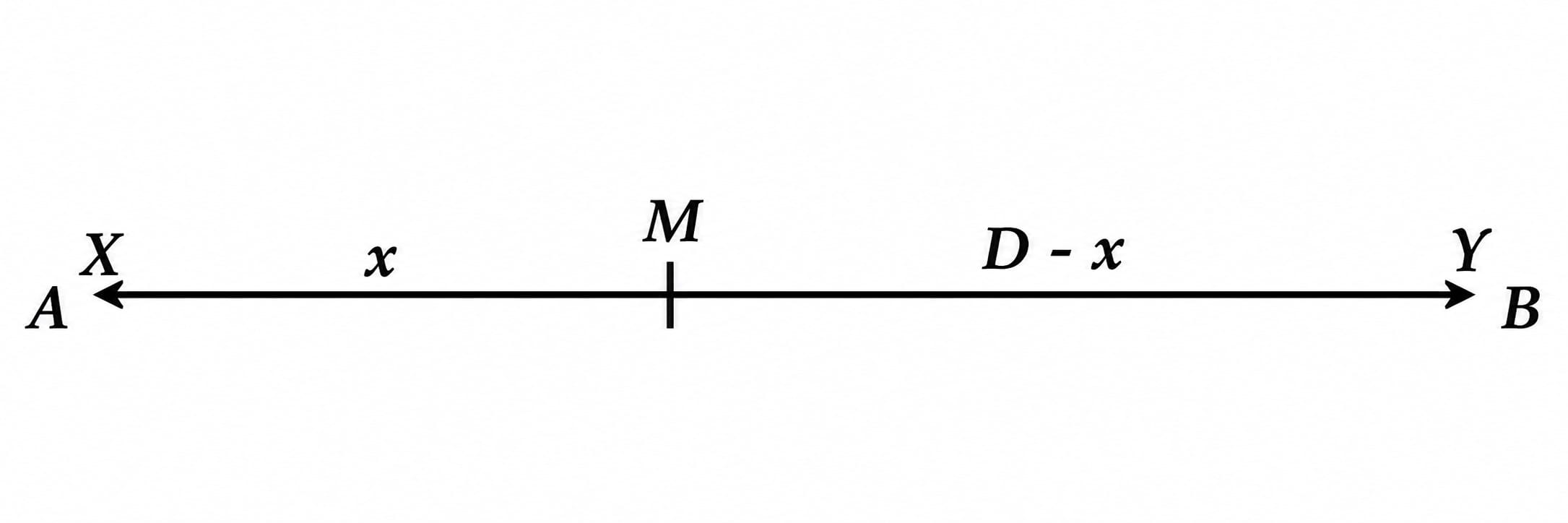
M - First meeting pointLet the speeds of trains A and B be ‘a’ and ‘b’, respectively.
$
\frac{x}{a}=\frac{D-x}{b}
$
It is given,
$
\begin{aligned}
& \frac{D}{a}=10 \text { and } \frac{x}{b}=9\\\
& \frac{x}{\frac{D}{10}}=\frac{D-x}{\frac{x}{9}}\ [\text{After putting the values}] \\
& ⇒\frac{10 x}{D}=\frac{9 D-9 x}{x} \\
&⇒ 10 x^2=9 D^2-9 D x \\
& ⇒10 \mathrm{x}^2+9 \mathrm{Dx}-9 \mathrm{D}^2=0
\end{aligned}
$
Solving, we get, $ x=\frac{3 D}{5}$
Solving, we get,
$
\frac{x}{b}=9
$
$\begin{aligned} &⇒ \frac{3 D}{b \times 5}=9 \\ & ⇒\frac{D}{b}=15\end{aligned}$
The total time taken by train B to travel from station Y to station X is 15 minutes.
Hence, the correct answer is option (2).
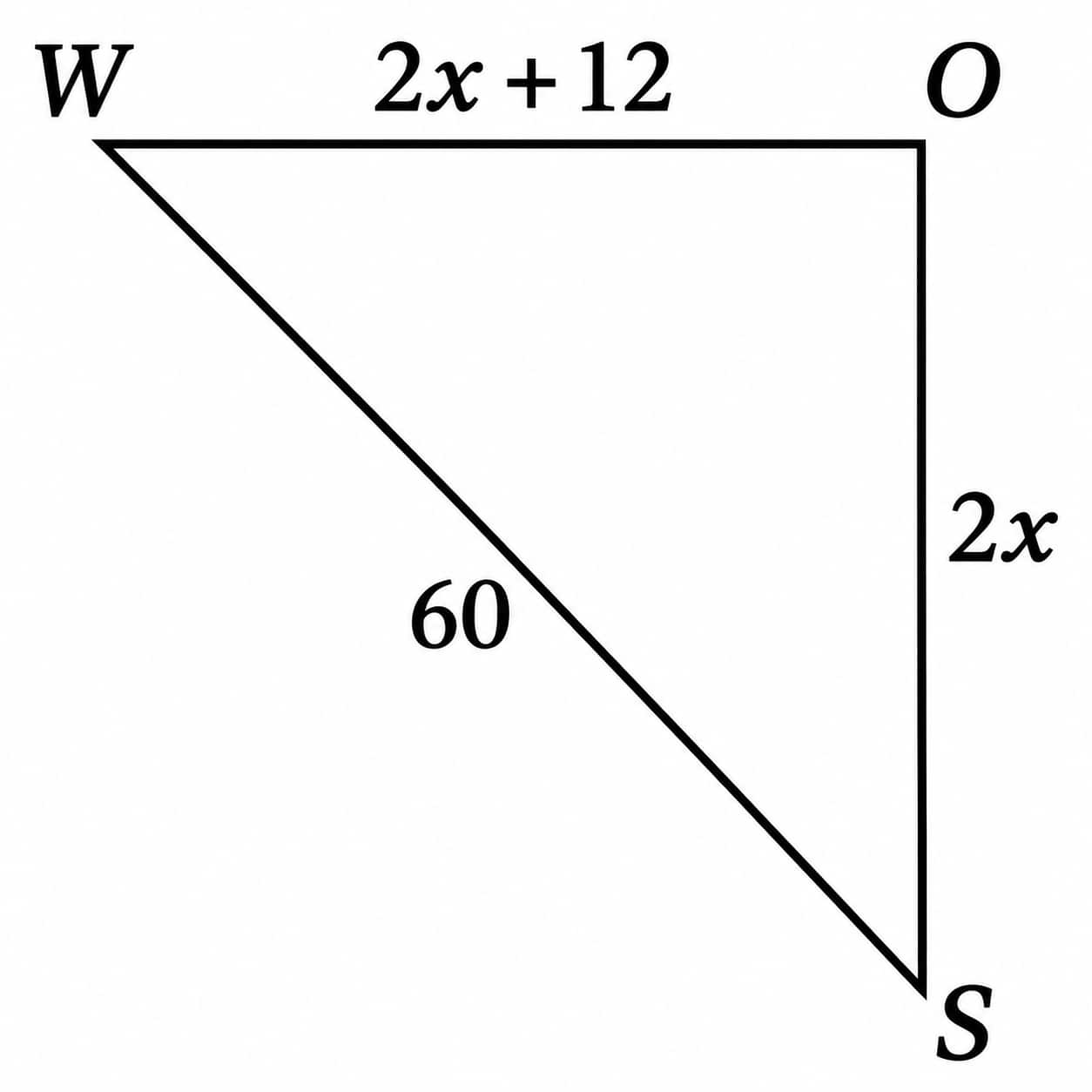
Q.2) Two ships meet mid-ocean, and then, one ship goes south and the other ship goes west, both traveling at constant speeds. Two hours later, they are 60 km apart. If the speed of one of the ships is 6 km per hour more than the other one, then the speed, in km per hour, of the slower ship is:
A) 20
B) 12
C) 18
D) 16
Solution:-
Let the speeds of two ships be x and (x + 6) km per hour.
Distance covered in 2 hours will be 2x and (2x + 12).
$
\begin{aligned}
& (2 x)^2+(2 x+12)^2=60^2 \\
& ⇒(x)^2+(x+6)^2=30^2 \\
& ⇒ 2 x^2+12 x+36=900 \\
& ⇒x^2+6 x+18=450 \\
& ⇒ x^2+6 x-432=0\\
& ⇒ (x+24)(x-18)=0
\end{aligned}
$
Solving, we get x=18 or x=-24
As speed can't be negative, the speed of the slower ship is 18 km/hr.
Hence, the correct answer is option (3).
Q.3) A straight road connects points A and B. Car 1 travels from A to B and Car 2 travels from B to A, both leaving at the same time. After meeting each other, they take 45 minutes and 20 minutes, respectively, to complete their journeys. If Car 1 travels at the speed of 60 km/hr, then the speed of Car 2, in km/hr, is
A) 100
B) 90
C) 80
D) 84
Solution:-
Let the speed of Car 2 be ' x ' kmph and the time taken by the two cars to meet be ' t ' hours. In 't' hours, Car 1 travels (60t) km while Car 2 travels (xt)km
It is given that the time taken by Car 1 to travel (xt) km is 45 minutes or (34) hours.
$\therefore \frac{(x \times t)}{60}=\frac{3}{4} ⇒ t=\frac{180}{4 x}$......(i)
Similarly, the time taken by Car 2 to travel (60t) is 20 minutes or (13) hours.
$\therefore \frac{(60 \times t)}{x}=\frac{1}{3}$ or
$\therefore t=\frac{x}{180}$ ....(ii)
Equating the values in (i) and (ii), and solving for x:
$\therefore \frac{180}{4 x}=\frac{x}{180} \Rightarrow x=90$ kmph
Hence, the correct answer is 90.
Time and Work is one of the most important CAT Arithmetic topics and regularly appears in CAT previous year papers. Questions are based on work efficiency, combined work, work distribution, and pipes & cisterns. The key to solving these questions is understanding the relationship between work, efficiency, and time.
Total Work
One Day's Work
Work Efficiency
Combined Work
Pipes and Cisterns
Positive and Negative Work
Work Distribution
| Concept | Formula |
|---|---|
| Work Relationship | $\text{Work} = \text{Efficiency} \times \text{Time}$ |
| Efficiency | $\text{Efficiency} = \frac{\text{Work}}{\text{Time}}$ |
| Total Work | $\text{Total Work} = \text{Efficiency} \times \text{Time}$ |
| One Day's Work | $\frac{1}{\text{Number of Days Required}}$ |
| Days Required | $\frac{\text{Total Work}}{\text{Work per Day}}$ |
| Combined Work | $\frac{1}{T} = \frac{1}{A} + \frac{1}{B} + \frac{1}{C} + \cdots$ |
| Man-Day Formula | $M_1D_1R_1W_1 = M_2D_2R_2W_2$ |
| Pipes & Cisterns | Filling work = Positive; Emptying work = Negative |
Topic | Repeated Concepts in CAT |
Time and Work | Individual and Combined Efficiency |
Time and Work | Men-Women-Children Efficiency Problems |
Time and Work | Work Distribution Questions |
Time and Work | Alternate Working Patterns |
Pipes and Cisterns | Filling and Emptying Tanks |
Pipes and Cisterns | Leak and Drainage Problems |
Time and Work | Work and Wages Questions |
CAT 2026 Tip: Most Time and Work questions become easy once you convert everything into one day's work or efficiency units. Focus on understanding efficiency concepts rather than relying solely on formulas.
Q.1) Renu would take 15 days working 4 hours per day to complete a certain task, whereas Seema would take 8 days working 5 hours per day to complete the same task. They decide to work together to complete this task. Seema agrees to work for double the number of hours per day as Renu, while Renu agrees to work for double the number of days as Seema. If Renu works 2 hours per day, then the number of days Seema will work is:
Solution:
Renu's total work time $=15\times4=60$ hours.
Seema's total work time $=8\times5=40$ hours.
Let Seema work for $x$ days. Then Renu works for $2x$ days.
Seema works $4$ hours per day.
Therefore,
$\frac{2x}{60}+\frac{4x}{40}=1$
$\Rightarrow \frac{x}{30}+\frac{x}{10}=1$
$\Rightarrow \frac{4x}{30}=1$
$\Rightarrow x=7.5$
Hence, the correct answer is 7.5 days.
Q.2) Working alone, the times taken by Anu, Tanu, and Manu to complete any job are in the ratio $5:8:10$. They accept a job that they can finish in 4 days if they all work together for 8 hours per day. However, Anu and Tanu work together for the first 6 days, working 6 hours 40 minutes per day. Then, the number of hours that Manu will take to complete the remaining job working alone is:
A) 6
B) 8
C) 4
D) 3
Solution:
Let the time taken by Anu, Tanu, and Manu be $5x$, $8x$, and $10x$ hours.
Taking total work as $40x$ units, their efficiencies are:
Anu $=8$, Tanu $=5$, Manu $=4$ units/hour.
All three complete the work in:
$4\times8=32$ hours.
Thus,
$32(8+5+4)=40x$
$\Rightarrow x=\frac{68}{5}$
Anu and Tanu work for:
$6\times6\frac{2}{3}=40$ hours.
Work completed:
$40(8+5)=520$
Total work:
$40x=544$
Remaining work $=544-520=24$.
Manu takes:
$\frac{24}{4}=6$ hours.
Hence, the correct answer is 6 hours (Option A).
Q.3) John takes twice as much time as Jack to finish a job. Jack and Jim together take one-third of the time to finish the job than John takes working alone. Moreover, in order to finish the job, John takes three days more than the three of them working together. In how many days will Jim finish the job working alone?
A) 4
B) 5
C) 6
D) 7
Solution:
Let Jack take $x$ days. Then John takes $2x$ days.
Take total work as $2x$ units.
Jack's efficiency $=2$ units/day.
John's efficiency $=1$ unit/day.
Jack and Jim together take $\frac{2x}{3}$ days, so their combined efficiency is $3$ units/day.
Therefore, Jim's efficiency:
$=3-2=1$ unit/day.
All three together have efficiency:
$2+1+1=4$ units/day.
According to the question:
$2x=\frac{2x}{4}+3$
$\Rightarrow 8x=2x+12$
$\Rightarrow x=2$
Therefore, Jim takes:
$\frac{2x}{1}=4$ days.
Hence, the correct answer is 4 days (Option A).
Q.4) Pipes A and C are fill pipes while Pipe B is a drain pipe of a tank. Pipe B empties the full tank in one hour less than the time taken by Pipe A to fill the empty tank. When pipes A, B, and C are turned on together, the empty tank is filled in two hours. If pipes B and C are turned on together when the tank is empty and Pipe B is turned off after one hour, then Pipe C takes another one hour and 15 minutes to fill the remaining tank. If Pipe A can fill the empty tank in less than five hours, then the time taken, in minutes, by Pipe C to fill the empty tank is:
A) 90
B) 60
C) 120
D) 123
Solution:
Let Pipe A fill the tank in $x$ hours, Pipe B empty it in $(x-1)$ hours, and Pipe C fill it in $y$ hours.
Since A, B, and C together fill the tank in 2 hours:
$\frac{1}{x}-\frac{1}{x-1}+\frac{1}{y}=\frac{1}{2}$ …… (1)
B and C work together for 1 hour, followed by C alone for $1.25$ hours:
$-\frac{1}{x-1}+\frac{2.25}{y}=1$ …… (2)
Solving (1) and (2):
$(x,y)=(3,\frac{3}{2})$ or $(6,\frac{15}{8})$
Since Pipe A takes less than 5 hours:
$x=3$
Therefore,
$y=\frac{3}{2}$ hours
$=\frac{3}{2}\times60$
$=90$ minutes.
Hence, the correct answer is 90 minutes (Option A).
Ratio and Proportion is a fundamental Arithmetic topic for CAT 2026 and serves as the foundation for several other topics, including Mixtures, Alligation, Partnership, and Percentages. Questions are usually straightforward and test a candidate's ability to compare quantities and establish relationships between them.
Ratio Comparison
Proportion
Direct Variation
Inverse Variation
Partnership
Age-Based Problems
| Concept | Formula / Shortcut |
|---|---|
| Ratio | $a:b=\frac{a}{b}$ |
| Proportion | $\frac{a}{b}=\frac{c}{d}$ |
| Share of $a$ in Ratio $a:b$ | $\frac{a}{a+b}$ |
| Share of $b$ in Ratio $a:b$ | $\frac{b}{a+b}$ |
| Partnership Ratio | $I_1T_1:I_2T_2:I_3T_3$ |
| Direct Variation | $\frac{y_1}{y_2}=\frac{x_1}{x_2}$ |
| Inverse Variation | $\frac{y_1}{y_2}=\frac{x_2}{x_1}$ |
| Compound Ratio | Multiply corresponding terms of the ratios |
| Fourth Proportional | If $a:b=c:d$, then $d=\frac{bc}{a}$ |
Shortcut | Use |
Equalize common terms before combining ratios | Ratio Conversion Questions |
Use LCM of common terms | Multiple Ratio Problems |
Partnership = Investment × Time | Profit Sharing Questions |
Convert ratios into fractions | Faster calculations |
Topic | Repeated Concepts in CAT |
Ratio & Proportion | Age-Based Problems |
Ratio & Proportion | Partnership Questions |
Ratio & Proportion | Direct Variation |
Ratio & Proportion | Inverse Variation |
Ratio & Proportion | Distribution and Comparison Problems |
CAT 2026 Tip: Most Ratio and Proportion questions can be solved using simple comparisons and proportional reasoning. Focus on understanding relationships between quantities rather than relying on lengthy calculations.
Question 1: In a company, the ratio of men to women is $5:3$. If 40 men leave and 80 women join, the ratio becomes $7:5$. Find the original number of employees.
Solution:
Let the original numbers be $5x$ and $3x$.
According to the question,
$\frac{5x-40}{3x+80}=\frac{7}{5}$
$25x-200=21x+560$
$4x=760$
$x=190$
Total employees:
$=5x+3x$
$=8x$
$=1520$
Answer: 1520
Question 2: The incomes of A and B are in the ratio $4:5$ and their expenditures are in the ratio $3:4$. If each saves ₹20,000 and B's income exceeds A's income by ₹25,000, find A's income.
Solution:
Let the incomes be $4x$ and $5x$.
$5x-4x=25,000$
$x=25,000$
Therefore,
A's income:
$=4x$
$=\text{₹}1,00,000$
Verification:
A's expenditure $= \text{₹}1,00,000 - \text{₹}20,000 = \text{₹}80,000$
B's expenditure $= \text{₹}1,25,000 - \text{₹}20,000 = \text{₹}1,05,000$
Thus, the expenditures are in the ratio:
$80,000:1,05,000=16:21$
This does not satisfy the stated expenditure ratio of $3:4$.
Therefore, the given question is internally inconsistent. Although the income condition gives A's income as ₹1,00,000, it does not satisfy all the conditions.
Question 3: Two numbers are in the ratio $3:5$. If 9 is added to each number, the ratio becomes $4:6$. Find the larger number.
Solution:
Let the numbers be $3x$ and $5x$.
According to the question,
$\frac{3x+9}{5x+9}=\frac{4}{6}$
$6(3x+9)=4(5x+9)$
$18x+54=20x+36$
$2x=18$
$x=9$
Larger number:
$=5x$
$=45$
Answer: 45
Mixtures and Alligation is one of the most scoring Arithmetic topics in CAT 2026. Questions are generally based on mixing two quantities with different values, concentrations, or costs to achieve a desired result. The Rule of Alligation provides a quick shortcut for solving most mixture problems.
Rule of Alligation
Mean Value of Mixture
Replacement of Liquid
Concentration Problems
Cost-Based Mixtures
| Concept | Formula / Shortcut |
|---|---|
| Alligation Rule | $\frac{\text{Quantity of cheaper}}{\text{Quantity of dearer}}=\frac{d-m}{m-c}$ |
| Mean Value | $\frac{\text{Total Value}}{\text{Total Quantity}}$ |
| Weighted Average | $\frac{n_1x_1+n_2x_2}{n_1+n_2}$ |
| Replacement Formula | $\left(1-\frac{x}{V}\right)^n$ |
| Mixture Cost Price | $\frac{\text{Total Cost}}{\text{Total Quantity}}$ |
| Concentration | $\frac{\text{Solute}}{\text{Solution}}\times100$ |
Shortcut | Use |
Cross-Difference Method | Alligation Questions |
Dearer : Cheaper = Difference from Mean | Mixture Ratio Problems |
Replacement Questions | Use direct replacement formula |
Avoid lengthy weighted average calculations | Use Alligation directly |
Convert percentages into fractions | Faster concentration calculations |
Topic | Repeated Concepts in CAT |
Mixtures | Cost-Based Mixture Problems |
Mixtures | Concentration Questions |
Alligation | Finding Mixing Ratios |
Replacement | Successive Replacement Problems |
Mixtures | Milk-Water and Solution Problems |
CAT 2026 Tip: The Rule of Alligation can significantly reduce calculation time. Practice cost-price and concentration-based questions, as they are among the most frequently tested CAT concepts.
Question 1: A merchant mixes two varieties of rice costing ₹60/kg and ₹90/kg. He sells the mixture at ₹84/kg and gains 20%. Find the ratio in which the two varieties were mixed.
Solution:
Cost price of mixture:
$=\frac{84}{1.2}$
$=70$
Using alligation:
| Rice Type | Price |
|---|---|
| Cheap | ₹60 |
| Mean | ₹70 |
| Dear | ₹90 |
Ratio:
$=(90-70):(70-60)$
$=20:10$
$=2:1$
Answer: $2:1$
Question 2: A container contains 80 litres of milk. 20 litres are removed and replaced with water. The process is repeated three times. Find the quantity of milk left.
Solution:
Milk left:
$=80\left(1-\frac{20}{80}\right)^3$
$=80\left(\frac{3}{4}\right)^3$
$=80\times\frac{27}{64}$
$=33.75$
Answer: 33.75 litres
Question 3: A solution contains milk and water in the ratio $7:3$. How much water must be added to 40 litres of solution so that the ratio becomes $7:5$?
Solution:
Milk:
$=\frac{7}{10}\times40$
$=28$ litres
Water:
$=\frac{3}{10}\times40$
$=12$ litres
Let $x$ litres of water be added.
$\frac{28}{12+x}=\frac{7}{5}$
$140=84+7x$
$56=7x$
$x=8$
Answer: 8 litres
Averages is a high-frequency CAT Arithmetic topic that is often combined with Percentages, Ratios, and Mixtures. Most questions are easy to moderate in difficulty and can be solved quickly if the underlying concepts are clear.
Arithmetic Mean
Weighted Average
Average of Groups
Age-Based Averages
Combined Average
Concept | Formula / Shortcut |
Average | SumofObservationsNumberofObservations |
Sum of Observations | Average × Number of Observations |
Weighted Average | $\frac{n_1x_1+n_2x_2}{n_1+n_2}$ |
Combined Average | TotalSumTotalNumber |
New Average after Addition | Adjust total sum first, then divide |
Shortcut | Use |
Average = Balance Point | Age and Marks Questions |
Change in Average × Number of Items | Total Change in Sum |
If one value increases by x | Total sum increases by x |
Weighted Average | Preferred over individual calculations |
Group Average Questions | Work with totals, not individual values |
Topic | Repeated Concepts in CAT |
Averages | Age-Based Questions |
Averages | Weighted Average Problems |
Averages | Combined Average Questions |
Averages | Average and Percentage Applications |
Averages | Arithmetic Mean and Geometric Mean |
CAT 2026 Tip: Weighted Average is one of the most important concepts in this chapter and frequently appears in CAT previous year papers. Mastering weighted averages can also help in solving Mixtures and Alligation questions more efficiently.
Q.1) Let $A$, $B$, and $C$ be three positive integers such that the sum of $A$ and the mean of $B$ and $C$ is 5. In addition, the sum of $B$ and the mean of $A$ and $C$ is 7. Then the sum of $A$ and $B$ is:
A) 5
B) 4
C) 6
D) 7
Solution:
Given,
$A+\frac{B+C}{2}=5$
$\Rightarrow 2A+B+C=10$ …… (i)
$\frac{A+C}{2}+B=7$
$\Rightarrow A+2B+C=14$ …… (ii)
Subtracting (ii) from (i):
$B-A=4$
$\Rightarrow B=A+4$
Given that $A$, $B$, and $C$ are positive integers.
If $A=1$, then $B=5$ and $C=3$.
If $A=2$, then $B=6$ and $C=0$, which is invalid as $C$ is positive.
Similarly, if $A>2$, $C$ will be negative, so these cases are not valid.
Hence,
$A+B=1+5=6$
Hence, the correct answer is 6 (Option C).
Q.2) The mean of all 4-digit even natural numbers of the form "aabb", where $a>0$, is:
A) 4466
B) 5544
C) 4864
D) 4860
Solution:
The four-digit even numbers will be of the form:
$1100,1122,1144,\ldots,1188,2200,2222,2244,\ldots,9900,9922,9944,9966,9988$
For each value of $a$, there are 5 possible values of $b$: $0,2,4,6,8$.
Therefore, the sum of all the numbers is:
$S=5(1100+2200+\cdots+9900)+9(22+44+66+88)$
$=5(1100)(1+2+3+\cdots+9)+9(22+44+66+88)$
$=5(1100)\left(\frac{9\times10}{2}\right)+9(11)(20)$
$=247500+1980$
$=249480$
The total number of numbers is:
$9\times5=45$
Therefore, the mean is:
$=\frac{S}{45}$
$=\frac{249480}{45}$
$=5544$
Hence, the correct answer is 5544.
Q.3) Onion is sold for 5 consecutive months at the rate of Rs. 10, 20, 25, 25, and 50 per kg, respectively. A family spends a fixed amount of money on onion for each of the first three months, and then spends half that amount on onion for each of the next two months. The average expense for onion, in rupees per kg, for the family over these 5 months is closest to:
A) 26
B) 20
C) 18
D) 19
Solution:
Let the fixed monthly expenditure be $M$ rupees.
For the first three months, the expenditure is $M$ each month.
Quantity bought:
$\frac{M}{10},\quad \frac{M}{20},\quad \frac{M}{25}$ kg
For the next two months, the expenditure is $\frac{M}{2}$ each month.
Quantity bought:
$\frac{M/2}{25}=\frac{M}{50}$ kg and
$\frac{M/2}{50}=\frac{M}{100}$ kg
Total expenditure:
$=3M+\frac{M}{2}+\frac{M}{2}$
$=4M$
Total quantity:
$=\frac{M}{10}+\frac{M}{20}+\frac{M}{25}+\frac{M}{50}+\frac{M}{100}$
$=\frac{10M+5M+4M+2M+M}{100}$
$=\frac{22M}{100}$
$=\frac{11M}{50}$
Average price per kg:
$=\frac{\text{Total expenditure}}{\text{Total quantity}}$
$=\frac{4M}{11M/50}$
$=\frac{200}{11}$
$\approx18.18$
The closest option is 18.
Hence, the correct answer is 18 (Option C).
Average is an important concept which is used to solve the problems of weighted average, problems including ages, mixture and alligations, etc.
Averages are used in day-to-day life calculations.
Used in making an estimate
1. When a person replaces another person, the average age of the group will be increased or decreased.
Difference between the persons added and who left = change in average x number of persons.
2. When a person joins the group of n persons, if average increases then
Age of new person = Old average + (n+1) difference between averages
If average decreases then
Age of new person = Old average - (n+1) difference between averages
3. Average of an AP of odd terms is always its middle term.
4. In general case, Average of an AP is the average of its first and last term.
5. Average of an AP of even terms is average of its two middle terms.
6. Arithmetic mean is always greater than or equal to geometric mean.
Questions that combine Ratio, Percentage, and Profit & Loss are frequently asked in CAT Quantitative Aptitude. These questions typically require candidates to apply multiple concepts together rather than solve them independently. Such problems are common in population growth, business transactions, investments, and profit-sharing scenarios.
Ratio and Percentage Conversion
Population Growth and Decline
Profit & Loss Based on Ratios
Markup and Discount
Successive Percentage Changes
Ratio-Based Business Transactions
Use this table to revise the key Percentage, Profit & Loss, Population, and Ratio formulas and shortcuts required for CAT Arithmetic questions.
| Concept | Formula / Shortcut |
|---|---|
| Percentage Change | $\frac{\text{Change}}{\text{Original}}\times100$ |
| Successive Percentage Change | $a+b+\frac{ab}{100}$ |
| Profit Percentage | $\frac{\text{Profit}}{\text{CP}}\times100$ |
| Loss Percentage | $\frac{\text{Loss}}{\text{CP}}\times100$ |
| Population Growth | Final Population $=$ Initial Population $\times\left(1+\frac{R}{100}\right)$ |
| Population Decline | Final Population $=$ Initial Population $\times\left(1-\frac{R}{100}\right)$ |
| Share in Ratio $A: B$ | $\frac{a}{a+b}$ and $\frac{b}{a+b}$ |
| Net Profit | Selling Price $-$ Cost Price |
These formulas provide a quick reference for solving percentage-based problems and connecting ratios, profit and loss, population changes, and distributions efficiently.
The table below highlights the common concept combinations and question types that appear in CAT questions involving Ratios, Percentages, and Profit & Loss.
Topic | Repeated Concepts in CAT |
Ratio + Percentage | Male-Female Population Growth |
Ratio + Percentage | Successive Increase and Decrease |
Ratio + Profit & Loss | CP-SP Ratio Problems |
Ratio + Profit & Loss | Profit Sharing Questions |
Ratio + Percentage | Income and Expenditure Problems |
Multiple Concepts | Markup, Discount, and Profit Calculations |
Recognising these combinations can help you identify the required approach faster when solving CAT Arithmetic PYQs involving multiple concepts.
These shortcuts can help simplify Ratio, Percentage, Profit & Loss, and distribution-based questions while reducing unnecessary calculations.
Shortcut | Use |
Convert Ratios into Actual Fractions | Population and Distribution Questions |
Assume Convenient Values | Ratio-Based CAT Questions |
Use the Successive Change Formula | Multiple Percentage Changes |
Convert Profit/Loss into CP-SP Ratios | Faster Calculations |
Work with Parts Instead of Actual Numbers | Saves Time in CAT |
CAT 2026 Tip: Most CAT questions from this area are multi-concept problems where Ratio, Percentage, and Profit & Loss are tested together. Focus on understanding how ratios change after percentage increases or decreases and how profit calculations can be represented using ratios. These questions often appear as moderate-to-difficult CAT Arithmetic problems and can be highly scoring with sufficient practice.
Q.1) A person buys tea of three different qualities at INR 800, INR 500, and INR 300 per kg, respectively, and the amounts bought are in the proportion $2:3:5$. She mixes all the tea and sells one-sixth of the mixture at INR 700 per kg. The price, in INR per kg, at which she should sell the remaining tea, to make an overall profit of 50%, is:
A) 653
B) 688
C) 692
D) 690
Solution:
Let the person buy $2x$, $3x$, and $5x$ kg of the three different qualities at INR 800, INR 500, and INR 300 per kg, respectively. Let the selling price of the remaining tea be $P$.
Total cost price:
$=2x\times800+3x\times500+5x\times300$
$=4600x$
For an overall profit of 50%, the total selling price should be:
$=4600x\left(1+50\%\right)$
$=4600x\left(\frac{3}{2}\right)$
The selling price of $\frac{1}{6}$ of the mixture is:
$=\frac{1}{6}\times10x\times700$
$=\frac{7000x}{6}$
The selling price of the remaining $\frac{5}{6}$ of the mixture is:
$=\frac{5}{6}\times10x\times P$
$=\frac{50Px}{6}$
Therefore,
$4600x\left(\frac{3}{2}\right)=\frac{7000x}{6}+\frac{50Px}{6}$
$6900=\frac{7000}{6}+\frac{50P}{6}$
$41400=7000+50P$
$50P=34400$
$\therefore P=688$
Hence, the correct answer is 688 (Option B).
Q.2) The salaries of three friends Sita, Gita, and Mita are initially in the ratio $5:6:7$, respectively. In the first year, they get salary hikes of 20%, 25%, and 20%, respectively. In the second year, Sita and Mita get salary hikes of 40% and 25%, respectively, and the salary of Gita becomes equal to the mean salary of the three friends. The salary hike of Gita in the second year is:
A) 26%
B) 28%
C) 25%
D) 27%
Solution:
Let the initial salaries of Sita, Gita, and Mita be 500, 600, and 700, respectively.
After getting 20%, 25%, and 20% salary hikes, respectively, their salaries become:
Sita $=500\times1.20=600$
Gita $=600\times1.25=750$
Mita $=700\times1.20=840$
In the second year, Sita and Mita get 40% and 25% hikes, respectively.
So, after two years, the salaries of Sita and Mita are:
Sita $=600\times1.40=840$
Mita $=840\times1.25=1050$
We also know that Gita's salary is equal to the mean salary of the three friends. Therefore, it is equal to the average of Sita's and Mita's salaries:
$=\frac{840+1050}{2}$
$=\frac{1890}{2}$
$=945$
So, the hike in Gita's salary during the second year is:
$=\frac{945-750}{750}\times100$
$=\frac{195}{750}\times100$
$=26%$
Hence, the correct answer is 26% (Option A).
Many CAT Arithmetic questions can be solved efficiently by forming simple linear equations. Topics such as Ages, Profit & Loss, Mixtures, Time & Work, and Time-Speed-Distance often require candidates to translate verbal information into mathematical equations and solve them systematically.
Linear Equations in One Variable
Linear Equations in Two Variables
Age-Based Problems
Profit & Loss Equations
Mixture Equations
Time and Work Equations
Time-Speed-Distance Equations
Use this table to understand how to translate common CAT Arithmetic problems into equations and identify the appropriate approach for each topic.
Topic | Equation Formation Approach |
Ages | Convert age relationships into equations |
Profit & Loss | Equate CP, SP, and Profit Percentage |
Mixtures | Form equations using quantity and concentration |
Time & Work | Equate work done and efficiency |
TSD | Use Distance=SpeedTime |
Ratios | Convert ratios into variables and form equations |
Forming the right equation can simplify multi-step Arithmetic questions and help you solve problems involving ages, ratios, mixtures, profit and loss, TSD, and time and work more systematically.
The table below highlights the equation-based question types and concepts that are commonly tested across CAT Arithmetic topics.
Topic | Repeated Concepts in CAT |
Ages | Present, Past, and Future Age Questions |
Profit & Loss | Finding CP, SP, or Profit Percentage |
Mixtures | Concentration and Replacement Problems |
Time & Work | Combined Work Questions |
TSD | Relative Speed and Distance Problems |
Ratios | Ratio-Based Equation Formation |
Recognising these recurring patterns can help you identify the required equation quickly when solving CAT Arithmetic PYQs.
These shortcuts provide practical ways to set up equations faster and reduce unnecessary calculations in CAT Arithmetic questions.
Shortcut | Use |
Assign Variables Early | Simplifies lengthy calculations |
Convert Ratios into x, 2x, 3x | Ratio-Based Problems |
Form Equations Before Calculating | Reduces errors |
Use Total Work = Rate × Time | Time & Work Questions |
Use CP = 100 Assumption | Profit & Loss Problems |
Assume Total Population = 100 | Percentage and Ratio Questions |
CAT 2026 Tip: Many moderate and difficult CAT Arithmetic questions appear complex at first glance but become straightforward once translated into equations. Developing the habit of converting word problems into simple algebraic expressions can significantly improve both speed and accuracy in CAT Quant.
Q.1) A gentleman decided to treat a few children in the following manner: He gives half of his total stock of toffees and one extra to the first child, then half of the remaining stock along with one extra to the second, and continues giving away in this fashion. His total stock exhausts after he takes care of 5 children. How many toffees were in his stock initially?
A) 62
B) 60
C) 50
D) 55
Solution:
Let the initial number of toffees be $x$.
The first child gets $\frac{x}{2}+1$, leaving:
$\frac{x}{2}-1$
The second child gets $\frac{x}{4}$ of the original stock plus one extra, leaving:
$\frac{x}{4}-\frac{3}{2}$
Continuing in this manner, after 5 children the remaining stock is:
$\frac{x}{32}-\frac{31}{16}$
Since the total stock is exhausted:
$\frac{x}{32}-\frac{31}{16}=0$
$\Rightarrow \frac{x}{32}=\frac{31}{16}$
$\Rightarrow x=62$
Hence, the gentleman initially had 62 toffees.
Hence, the correct answer is option (1).
Q.2) Amal purchases some pens at INR 8 each. To sell these, he hires an employee at a fixed wage. He sells 100 of these pens at INR 12 each. If the remaining pens are sold at INR 11 each, then he makes a net profit of INR 300, while he makes a net loss of INR 300 if the remaining pens are sold at INR 9 each. The wage of the employee, in INR, is:
A) 1000
B) 800
C) 1500
D) 1530
Solution:
Let the number of pens purchased be $n$.
Then, the cost price is:
$8n$
The total expenses incurred would be:
$8n+W$
where $W$ refers to the wage of the employee.
Then, the selling price in the first case is:
$12\times100+11\times(n-100)$
Given that the profit is 300:
$1200+11n-1100-8n-W=300$
$\Rightarrow 3n-W=200$ ……… (1)
In the second case:
$1200+9n-900-8n-W=-300$
$\Rightarrow W-n=600$ ……… (2)
Adding equations (1) and (2):
$2n=800$
$\therefore n=400$
So,
$W=600+400=1000$
Hence, the correct answer is 1000.
Q.3) The price of a precious stone is directly proportional to the square of its weight. Sita has a precious stone weighing 18 units. If she breaks it into four pieces with each piece having a distinct integer weight, then the difference between the highest and lowest possible values of the total price of the four pieces will be 288000. Then, the price of the original precious stone is:
A) 1296000
B) 1944000
C) 972000
D) 972400
Solution:
If $W$ is the weight of the stone and $P$ is the price of that stone, then:
$P=kW^2$
Price of the unbroken stone:
$=18^2k$
$=324k$
The total cost is minimum if the weights of the broken stones are as close to each other as possible, that is, the weights are $3$, $4$, $5$, and $6$ units.
Total cost in this case:
$=k(3^2+4^2+5^2+6^2)$
$=k(9+16+25+36)$
$=86k$
The total cost is maximum when the weights of the broken stones are as far apart as possible, that is, the weights are $1$, $2$, $3$, and $12$ units.
Total cost in this case:
$=k(1^2+2^2+3^2+12^2)$
$=k(1+4+9+144)$
$=158k$
According to the question:
$158k-86k=2,88,000$
$\Rightarrow 72k=2,88,000$
$\Rightarrow k=4,000$
Therefore, the price of the unbroken stone:
$=324k$
$=324\times4,000$
$=12,96,000$
Hence, the correct answer is option (1).
CAT frequently asks multi-concept Arithmetic questions that combine Ratios, Averages, Time & Work, and Time-Speed-Distance (TSD). These questions test a candidate's ability to identify relationships between quantities and apply multiple concepts simultaneously. Such questions are often moderate to difficult in difficulty and appear regularly in CAT previous year papers.
Ratio and Speed Relationship
Ratio and Time Relationship
Average Speed
Efficiency and Work
Combined Work
Relative Speed
Weighted Average
Use this table to revise the essential CAT 2026 Arithmetic formulas and shortcuts needed to solve questions quickly and accurately.
| Concept | Formula / Shortcut |
|---|---|
| Speed ∝ Distance (Time Constant) | $\frac{S_1}{S_2}=\frac{D_1}{D_2}$ |
| Speed ∝ $\frac{1}{\text{Time}}$ (Distance Constant) | $\frac{S_1}{S_2}=\frac{T_2}{T_1}$ |
| Average Speed | $\frac{\text{Total Distance}}{\text{Total Time}}$ |
| Average Speed for Equal Distances | $\frac{2S_1S_2}{S_1+S_2}$ |
| Efficiency and Time | $\text{Efficiency} \propto \frac{1}{\text{Time}}$ |
| Efficiency Ratio | $\frac{E_1}{E_2}=\frac{T_2}{T_1}$ |
| Combined Work | $\frac{1}{T}=\frac{1}{A}+\frac{1}{B}$ |
| Weighted Average | $\frac{n_1x_1+n_2x_2}{n_1+n_2}$ |
A quick-reference table of essential Speed, Distance, Time, Efficiency, Work, and Average formulas and shortcuts for solving CAT Arithmetic questions efficiently.
The table below highlights the concept combinations and question types that repeatedly appear in CAT questions involving TSD, Ratios, Averages, and Time & Work.
Topic | Repeated Concepts in CAT |
Ratio + TSD | Speed, Distance, and Time Comparisons |
Ratio + TSD | Relative Speed Problems |
Average + TSD | Average Speed Questions |
Ratio + Time & Work | Efficiency-Based Questions |
Average + Time & Work | Combined Work and Productivity |
Mixed Concepts | Ratio, Average, and Work Distribution |
Understanding these recurring combinations can help you recognise the underlying concept faster when solving CAT Arithmetic PYQs.
These shortcuts can help reduce calculation time and simplify questions involving Speed, Time, Work, Efficiency, Ratios, and Averages.
Shortcut | Use |
Higher Efficiency → Less Time | Time & Work Questions |
Higher Speed → Less Time | TSD Questions |
Use LCM Method for Work | Combined Work Problems |
Assume Total Work = LCM of Days | Faster Calculations |
Convert Ratios into Actual Values Only When Needed | Saves Time |
Use Weighted Average Instead of Lengthy Calculations | Average-Based Problems |
CAT 2026 Tip: Most CAT questions from this area are not direct formula-based questions. Instead, they test how well candidates can connect Ratios, Averages, Efficiency, Speed, and Time in a single problem. Focus on understanding proportional relationships rather than memorizing formulas, as this approach can significantly reduce calculation time in the exam.
CAT Time & Work: Top 30 Practice Questions with Answer Key & Detailed Solutions |
Q.1) A person spent Rs. 50,000 to purchase a desktop computer and a laptop computer. He sold the desktop at a 20% profit and the laptop at a 10% loss. If overall he made a 2% profit, then the purchase price, in rupees, of the desktop is:
A) 20,000
B) 18,000
C) 16,000
D) 17,000
Solution:
Using the Alligation Rule, the ratio of cost prices of desktop and laptop will be:
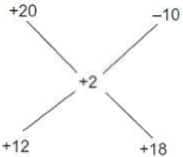
i.e., 12:18 = 2:3
∴ The cost of desktop $= 25 \times 50,000 = \text{Rs. }12,50,000$
Hence, the correct answer is option (1).
Q.2) A and B are two points on a straight line. Ram runs from A to B while Rahim runs from B to A. After crossing each other, Ram and Rahim reach their destinations in one minute and four minutes, respectively. If they start at the same time, then the ratio of Ram's speed to Rahim's speed is:
A) $1:2$
B) $2:1$
C) $1:4$
D) $2:3$
Solution:
The required ratio of speeds is the square root of the inverse ratio of the times taken after crossing each other.
$= \sqrt{\frac{4}{1}}$
$= 2:1$
Hence, the correct answer is $2:1$.
Q.3) The amount Neeta and Geeta together earn in a day equals what Sita alone earns in 6 days. The amount Sita and Neeta together earn in a day equals what Geeta alone earns in 2 days. The ratio of the daily earnings of the one who earns the most to that of the one who earns the least is:
A) $3:2$
B) $11:7$
C) $11:3$
D) $11:5$
Solution:
Let Neeta, Geeta, and Sita earn $N$, $G$, and $S$ amounts per day, respectively.
Given that,
$N + G = 6S$ …… (1)
$S + N = 2G$ …… (2)
Substituting (2) in (1) for $N$:
$2G - S + G = 6S$
$\Rightarrow 3G = 7S$
$\Rightarrow \frac{G}{S} = \frac{7}{3}$
Substituting (2) in (1) for $S$:
$N + G = 6(2G - N)$
$\Rightarrow N + G = 12G - 6N$
$\Rightarrow 7N = 11G$
$\Rightarrow \frac{N}{G} = \frac{11}{7}$
Therefore,
$N: G:S = 11:7:3$
The highest daily earning is $N = 11$ and the lowest daily earning is $S = 3$.
Hence, the required ratio is:
$\boxed{11:3}$
Hence, the correct answer is $11:3$.
Q.4) Amar, Akbar, and Anthony are working on a project. Working together, Amar and Akbar can complete the project in 1 year, Akbar and Anthony can complete it in 16 months, and Anthony and Amar can complete it in 2 years. If the person who is neither the fastest nor the slowest works alone, the time in months he will take to complete the project is:
Solution:
Let Amar's, Akbar's, and Anthony's 1-month work be $a$, $b$, and $c$, respectively.
Then,
$a+b=\frac{1}{12}$
$b+c=\frac{1}{16}$
$c+a=\frac{1}{24}$
Adding all three equations:
$2(a+b+c)=\frac{1}{12}+\frac{1}{16}+\frac{1}{24}$
$2(a+b+c)=\frac{4+3+2}{48}$
$2(a+b+c)=\frac{9}{48}=\frac{3}{16}$
Therefore,
$a+b+c=\frac{3}{32}$
Now,
$a=(a+b+c)-(b+c)$
$=\frac{3}{32}-\frac{1}{16}$
$=\frac{3}{32}-\frac{2}{32}$
$=\frac{1}{32}$
Similarly,
$b=(a+b+c)-(c+a)$
$=\frac{3}{32}-\frac{1}{24}$
$=\frac{9-4}{96}$
$=\frac{5}{96}$
And,
$c=(a+b+c)-(a+b)$
$=\frac{3}{32}-\frac{1}{12}$
$=\frac{9-8}{96}$
$=\frac{1}{96}$
Thus, the speeds are:
$a=\frac{1}{32},\quad b=\frac{5}{96},\quad c=\frac{1}{96}$
Therefore, the order of speed is:
Fastest: Akbar ($b$)
Middle: Amar ($a$)
Slowest: Anthony ($c$)
Hence, Amar is neither the fastest nor the slowest.
Time taken by Amar alone:
$=\frac{1}{a}$
$=\frac{1}{1/32}$
$=\boxed{32\text{ months}}$
Hence, the correct answer is 32 months.
To prepare CAT arithmetic section, here is a structured approach that will help you boost your CAT percentile.
There are many common mistakes made by a student during preparation and appearing for the CAT exam.
Common mistakes | How to improve |
While calculating the percentage, students often chose the wrong base | You must be very careful while taking the base. For example: Percentage change is always calculated on the initial value. Profit percent/ Loss percent is always calculated on CP. The discount percentage is always calculated on MP. |
Misinterpreting the question | Read the question carefully and practice all the variations of questions on any concept. It will help you to understand the questions correctly. |
Silly mistakes while calculating percentages, multiplication, division, etc | Hurry, but not hurry. You have to do the calculations quickly but with accuracy. |
In the questions of time and work, students often misinterpret the negative work as positive work | Practice such types of questions more. |
In mixtures and alligations, students make mistakes in taking the ratios | Learn the formula correctly. |
This table highlights the common mistakes students make in CAT Arithmetic and practical ways to improve accuracy, interpretation, and calculation skills.
To improve accuracy and speed,
Learn Vedic maths for the CAT exam for multiplication and finding the square of larger numbers.
Learn percentage to fraction conversion and vice versa.
Learn squares, cubes, and tables up to 30.
Practice questions daily on each topic according to the plan made by you. Also, practice PYQs.
Do mental maths.
During the exam, you should do:
Allocate time to each question separately.
Do not waste much time on one question.
Avoid lengthy calculations.
Avoid the use of pen when the calculations can be done mentally.
Always check on time shown on your screen.
Practice sets on arithmetic play an important role in boosting your CAT percentile.
What you should do:
Attempt at least one small practice set in a day.
Identify the areas where you are making mistakes most and work on them to rectify.
Make a record of the time taken by you in every test and the score of each test.
Identify the question patterns you are taking more time on and try to reduce the time in the next test.
Check if your score improves after the test. In these ways, you can track your performance.
These practices will certainly help you to improve.
Candidates can download the various CAT preparation resources designed by Careers360 using the links given below.
eBook Title | Download Now |
CAT 2026 Quantitative Aptitude Questions with Answers PDF | |
CAT 2026 Quantitative Aptitude 20 Free Sectional Tests | |
100 Quant Facts Every CAT Aspirant Must Know | |
CAT Algebra Handbook 2026: Everything You Need to Master Algebra-Concepts, Practice Questions | |
CAT 2026 Number System PDF Handbook: Complete Concepts, Practice Questions & Solutions | |
CAT 2026 Geometry & Mensuration PDF: Important Concepts, Shortcuts & Practice Questions | |
CAT 2026 Modern Maths PDF Handbook: Key Concepts, Tricks & PYQ-Based Practice | |
CAT 2026: 10 Most Repeated Concepts in Quant | |
CAT Quadratic Equations: Top 30 Practice Questions with Answer Key & Detailed Solutions | |
CAT 2026 Quant SAMPLE PAPER | |
CAT 2026 Functions Practice Questions | |
CAT 2026 Average and Mixture Practice Questions | |
CAT 2026 Co-ordinate Geometry Practice Questions |
Frequently Asked Questions (FAQs)
Important topics in Arithmetic for CAT are:
Percentages, Profit & Loss, Simple & Compound Interest, Averages, Ratios & Proportion, Mixtures & Alligations, Time & Work, Time-Speed-Distance.
In the QA section, you will find around 8 - 10 questions from arithmetic.
Well, it varies person to person. Arithmetic as a unit is very vast. You should not focus on the time that you want to give. First, find out the important topics which are frequently asked in the CAT quant section and give time according to your capability to understand the topic well.

On Question asked by student community
Hello, for AP NEET PG Category C seats, NRI documents are generally required if you are applying under the NRI quota, and eligibility depends on the applicable counselling rules. The fee payment currency and procedure should be confirmed from the current Dr. NTRUHS notification at its official website drntr.uhsap.in.
Hello, CAT aur B-school entrance exams ke baare mein aap exam dates, eligibility, registration, exam pattern, syllabus, colleges ya admission process ki information dekh sakte hain. Aapki requirement ke according relevant details yahan mil sakti hain: https://bschool.careers360.com/exams
You can download the latest CAT syllabus from here:
Hey there,
For a B.Sc. with Chemistry, Botany and Zoology (CBZ), if the CAT application asks separately for:
If the Discipline dropdown has a more specific option such as “Biological Sciences,” “Life Sciences,” or “Zoology/Botany,”
Hey there,
Yes. With 2 years of work experience, you are eligible to target the regular 2-year MBA at IIM Calcutta as long as you have a bachelor's degree with at least 50% marks (45% for SC/ST/PwD). Work experience is not required for eligibility.
For
Directions for question:
The bar-graph given below shows the foreign exchange reserves of Nepal (in million Rupees) from 2014 to 2021. Answer the following questions based on the graph :

Question:
What was the percentage increase (rounded to the nearest integer, if deemed necessary) in the foreign exchange reserves in

Globally Recognized by AACSB (US) & AMBA (UK) | 18 LPA Avg. CTC for PGPM 2026
75+ years of legacy | #1 Entrance Exam | Score accepted by 250+ BSchools
Gateway to IBS Hyderabad & 8 other IBS campuses | Scholarships worth 10 CR
Highest Package 29.30 LPA | 12 LPA Median CTC | 230+ Recruiters | AACSB Accredited | Ranked 51 in Asia by QS International
Early Application Round Deadline: 27th Oct’26 | 400+ Recruiters | Highest CTC 17.2 LPA | Average CTC 8 LPA | 92% Avg. Placements | Awarded Best Business School of the Year
Last Date to Apply - 19th December 2026 | Highest CTC 68.66 LPA | Average CTC 18.08 LPA | Top 25% Average CTC 24.66 LPA