Birla Institute of Management Technology, Greater Noida
AACSB Accredited | Highest CTC: 22 LPA


With IIM Indore returning as the organising institute for CAT 2026, many students are asking a simple question: Is this just an administrative change, or could it signal something more? The CAT 2026 official notification has been released, and the exam is scheduled for November 29, 2026. CAT 2026 will be IIM Indore's fourth edition as the organising institute, following CAT 2013, CAT 2014 and CAT 2020. This article analyses these previous editions to understand CAT exam pattern and difficulty trends, and highlights what CAT 2026 aspirants should realistically expect and how they can prepare.
This Story also Contains

Worried about your CAT Preparation so far? Attempt now the CAT 2026 Free Mock Test
Whenever the CAT conducting institute changes, aspirants start searching for patterns. And when the name is IIM Indore, the discussion becomes even louder. The reason is simple: two of the most significant structural changes in CAT exam pattern occurred during editions conducted by IIM Indore.
Of course, this does not mean that IIM Indore deliberately redesigns the CAT exam pattern every time it takes charge. However, history shows that some of the most memorable CAT pattern changes have happened under its watch, making CAT 2026 under IIM Indore a topic of intense curiosity among aspirants.
Most aspirants would probably choose a tough CAT.
However, unexpected changes often create a greater challenge. Difficult questions affect a few minutes of your exam. Structural changes can influence your entire strategy, time management, and decision-making process.”
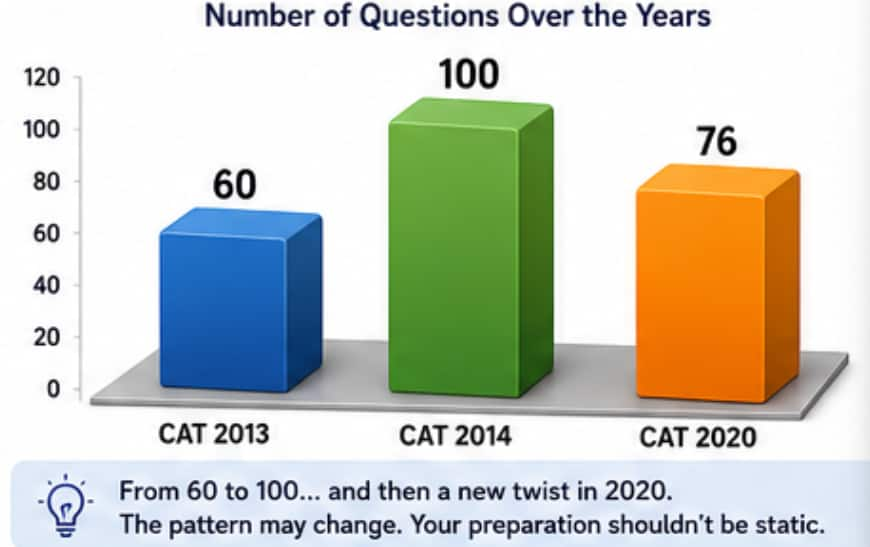
| Feature | CAT 2013 | CAT 2014 | CAT 2020 |
|---|---|---|---|
Total Questions | 60 | 100 | 76 |
Duration | 140 Minutes | 170 Minutes | 120 Minutes |
Major Focus | Conceptual Strength | Speed + Selection | Adaptability |
QA Style | Calculation & Logic Heavy | Broad Topic Coverage | Efficient Problem Solving |
VARC Style | Traditional RC & VA | Expanded Coverage | Reading Intensive |
LRDI Style | Conventional Sets | Larger Variety | Complex Modern Sets |
CAT 2013 felt like a classic aptitude examination. The paper rewarded aspirants with strong fundamentals who were comfortable handling lengthy mathematical and logical reasoning problems. Several questions demanded multi-step thinking, making conceptual clarity and accuracy important.
Strong emphasis on Arithmetic, Algebra and Geometry
Traditional Logical Reasoning sets
Calculation-intensive problem solving
High importance of conceptual clarity
Accuracy over speed
Strong fundamentals
Logical thinking
Patience under pressure
Mathematical rigor
If CAT 2013 represented continuity, CAT 2014 represented disruption. The exam increased to 100 questions and 170 minutes, exposing aspirants to a wider range of topics and making question selection and time management more important.
Significant increase in question count
Wider topic representation
Greater emphasis on question selection
Increased importance of time management
Strategic decision-making
Smart question selection
Time management
Section balancing
Strategic decision-making
Perhaps. Three CAT editions are not enough to establish a guaranteed pattern. However, since CAT 2013, CAT 2014 and CAT 2020 witnessed notable structural changes, it is understandable why aspirants are paying attention. The challenge is to stay informed without becoming overly speculative.
CAT 2020 arrived under exceptional circumstances and looked very different from previous editions. With 76 questions, a two-hour duration and fixed 40-minute sectional limits, every minute became more valuable.
Shorter exam duration
Reduced question count
Reading-heavy VARC
Inference-based questioning
Faster decision-making
Adaptability
Reading ability
Quick decision-making
Efficient execution
Candidates can download CAT 2020 Slot 1 Question Paper with answers andCAT 2020 Slot 2 Question Paper with answers
The pattern is not that IIM Indore makes CAT harder.
The pattern is that IIM Indore has been associated with CAT editions that looked different from the immediately preceding years.
2013 → Strong emphasis on mathematical reasoning and analytical thinking
2014 → One of the biggest structural changes in CAT at the time
2020 → A major time and format change during the COVID-19 period
To learn more about the insights of the previous years where IIM Indore conducted the CAT exam, you can check out IIM Indore is Back for CAT 2026! Big Pattern Changes Incoming?
Looking only at difficulty levels misses the bigger picture.
The real story is how dramatically the focus of the exam shifted across these three editions.
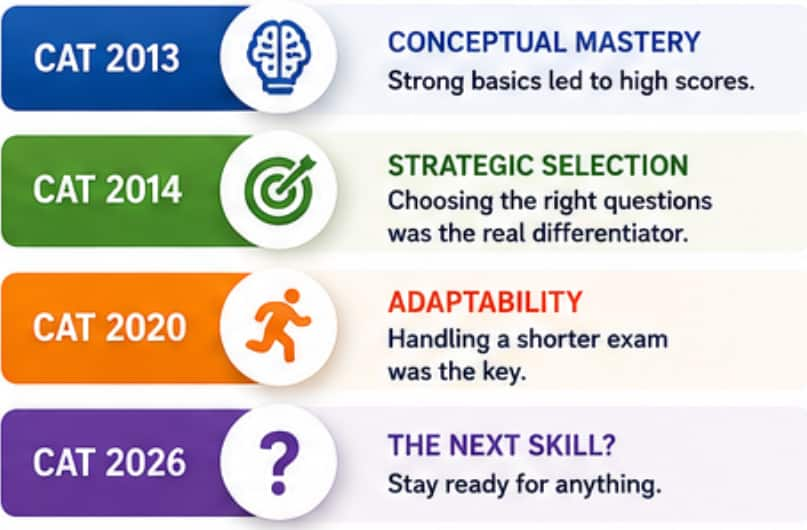
Notice the trend:
CAT 2013 asked, “Can you solve difficult problems?”
CAT 2014 asked, “Can you manage a larger exam efficiently?”
CAT 2020 asked, “Can you adapt to a completely different environment?”
The challenge changed, the skill being tested changed, and the winning strategy changed.
The history of CAT under IIM Indore does not prove that the CAT 2026 exam pattern will become harder, easier, longer, or shorter. However, it highlights one recurring theme: some of CAT’s most memorable pattern changes have occurred during editions conducted by IIM Indore.
For aspirants, the takeaway is not to predict the exact CAT 2026 exam pattern or difficulty level, but to stay flexible. If CAT 2013 rewarded thinkers, CAT 2014 rewarded strategists, and CAT 2020 rewarded adapters, the biggest question for IIM Indore CAT 2026 is: what skill will the next exam choose to reward?
If there is one lesson from previous IIM Indore-led CAT editions, it is that aspirants should be prepared for more than just difficult questions. CAT 2014 changed the structure of the exam, while CAT 2020 changed the testing experience itself. As a result, CAT 2026 aspirants may need to focus on flexibility just as much as preparation.
Most aspirants take mocks primarily to improve scores. However, CAT history suggests that mocks should also prepare candidates for uncertainty.
Instead of limiting yourself to one type of mock, it may be useful to expose yourself to different situations.
| Mock Type | Purpose |
|---|---|
Standard CAT-pattern mocks | Build familiarity |
High-difficulty mocks | Improve resilience |
Speed-based mocks | Enhance decision-making |
LRDI-intensive mocks | Strengthen problem-solving |
Reading-heavy mocks | Prepare for VARC surprises |
A wider range of mock experiences often translates into greater confidence on exam day.
You can check out the CAT 2013 Question Paper With Solution
Adaptability is one of the most underrated CAT skills. While concepts remain important, the ability to adjust quickly can make a significant difference when the paper does not match expectations.
Aspirants can develop adaptability by:
Solving questions from different CAT years
Attempting unfamiliar LRDI sets
Experimenting with multiple test-taking strategies
Learning to move on from difficult questions
Practicing under varying levels of time pressure
The objective is not to predict every change but to remain effective regardless of the change.
One of the biggest mistakes aspirants make is preparing for only one version of CAT.
A better approach is to consider multiple possibilities.
Possible Scenario | What It Could Mean? |
|---|---|
No major changes | Traditional preparation remains effective |
Minor modifications | Strategy adjustments become important |
Significant changes | Adaptability becomes a competitive advantage |
Candidates who prepare for several possibilities are generally less affected by surprises.
You can also check the CAT 2026 Syllabus and High-Weightage Topics Guide and Download Now
Even when CAT evolves, some skills continue to deliver results.
These include:
Strong conceptual understanding
Reading comprehension ability
Logical reasoning skills
Time management
Question selection
Decision-making under pressure
These qualities were valuable in CAT 2013, CAT 2014, and CAT 2020, and they are likely to remain valuable in CAT 2026.
A comparison of CAT 2013, CAT 2014, and CAT 2020 highlights several lessons that remain relevant for current aspirants.
Many aspirants assume that the next CAT will closely resemble the previous one. However, history tells a different story.
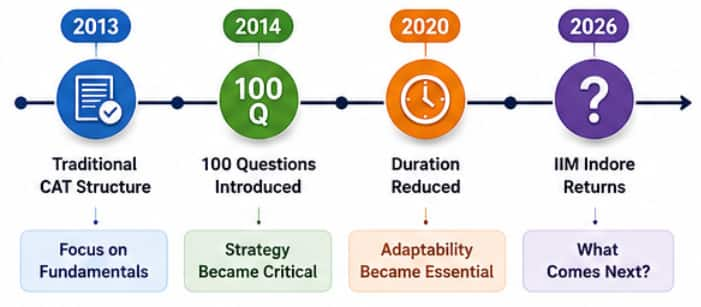
The broader lesson is simple: preparation should not depend entirely on continuity.
A strong conceptual foundation is essential, but it is only one part of the equation.
CAT 2014 demonstrated that:
Question selection matters
Time allocation matters
Prioritization matters
Decision-making matters
The ability to execute a strategy effectively can be just as important as knowing how to solve a problem.
Whenever CAT changes, some aspirants struggle while others thrive.
The difference often comes down to adaptability.
Top performers tend to:
Stay calm under pressure
Adjust quickly to unexpected situations
Avoid emotional decision-making
Focus on execution rather than speculation
This pattern has been visible across multiple CAT editions.
Practice with CAT 2014 Question Paper With Solution
Historically, certain categories of aspirants tend to perform better when the exam introduces change.
Candidates with strong concepts are usually less dependent on a specific exam pattern.
Whether CAT becomes longer, shorter, or more difficult, a solid foundation provides stability.
Some candidates become distracted when faced with unexpected situations. Others remain composed and continue executing their strategy.
The second group generally adapts more effectively.
Exposure to different testing conditions often reduces exam-day shock.
These aspirants have already experienced:
Unusual VARC passages
Time-intensive sections
Unexpected difficulty distributions
As a result, they are less likely to be unsettled by surprises.
Preparing for CAT, XAT or NMAT? Discover 4 powerful AI tools that can help you practise questions, improve concepts, personalise your preparation and revise smarter.
Watch the Video: 4 AI Tools Every CAT/XAT/NMAT Aspirant MUST Use in 2026
Every year, countless discussions revolve around predicting CAT.
However, successful aspirants typically focus more on preparation than prediction.
Preparing for possibilities is often more productive than trying to forecast the future.
The significance of IIM Indore's return lies not in difficulty levels but in the possibility of change.
Most discussions quickly turn toward a familiar question:
"Will CAT 2026 be harder?"
However, previous CAT editions suggest that structural changes can influence performance more than difficulty alone.
A difficult question can be skipped.
A structural change affects the entire paper.
Consider the difference:
| Situation | Potential Impact |
|---|---|
Difficult questions in a familiar format | Manageable |
Moderate questions in an unfamiliar format | Potentially disruptive |
This is why aspirants often remember major pattern changes long after they forget individual questions.
Rather than attempting to predict the exact CAT 2026 pattern, aspirants may benefit more from focusing on:
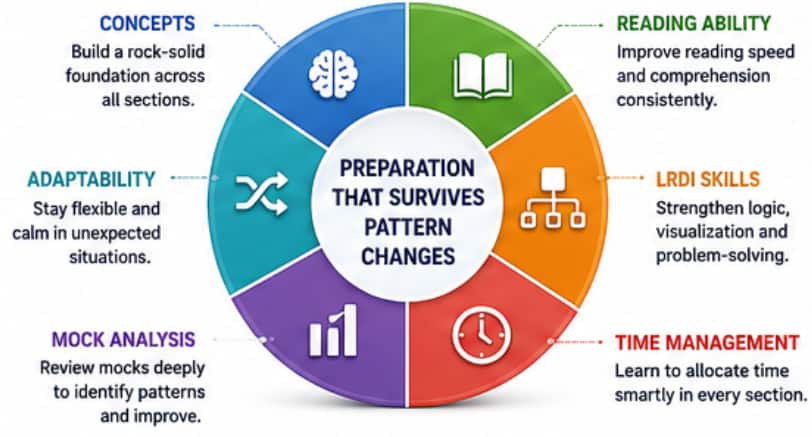
These areas remain valuable regardless of future changes.
The answer is not simple.
Previous CAT editions conducted by IIM Indore saw some major changes in the CAT exam pattern. This makes CAT 2026 under IIM Indore worth watching closely.
At the same time, history does not prove that:
CAT 2026 will definitely be harder
The number of questions will increase
A new CAT 2026 exam pattern is certain
The difficulty level will rise significantly
Such predictions are not supported by the available evidence.
A review of CAT 2013, CAT 2014 and CAT 2020 shows one clear lesson: the highest percentilers are rarely the candidates who correctly predict the exam.
They are the ones who prepare well enough to handle different situations. If IIM Indore's previous CAT editions teach us anything, it is that flexibility remains one of the most useful skills for CAT 2026 preparation.
Preparing for CAT 2026 requires more than just hard work-it requires the right resources. Explore these carefully curated CAT 2026 eBooks, preparation guides, and study materials designed to strengthen your concepts and boost your exam readiness.
| Ebook | Download |
|---|---|
| CAT 2025 Slot-by-Slot Master Weightage Matrix PDF | Download Now |
| 15 CAT Myths That Waste Months of Preparation | Download Now |
| 8 Expert-Curated Philosophy Editorials with CAT-Style Questions | Download Now |
| CAT Quant PYQs - Complete 5-Year Question Bank (2021 - 2025) PDF | Download Now |
| CAT 2026: AI VS Coaching - Which is Better | Download Now |
| CAT DILR PYQs Complete 5-Year Question Bank (2021 - 2025) | Download Now |
| CAT VARC PYQs - Complete 5-Year Question Bank (2021 - 2025) PDF | Download Now |
| CAT RC 2026: 12 Tones That Can Change Your Answer | Download Now |
| CAT 2026: 10 Most Repeated Concepts in Quant | Download Now |
| CAT Time & Work: Top 30 Practice Questions with Answer Key & Detailed Solutions | Download Now |
| CAT Quadratic Equations: Top 30 Practice Questions with Answer Key & Detailed Solutions | Download Now |
Frequently Asked Questions (FAQs)
CAT 2026 is scheduled to be conducted on November 29, 2026. IIM Indore is the conducting institute for CAT 2026.
The best approach is to strengthen core aptitude skills, practice diverse mock tests, and improve decision-making under pressure. Candidates with strong fundamentals are generally better equipped to handle unexpected changes.
These three editions highlight an important lesson: CAT rewards different skills in different years. While CAT 2013 emphasized conceptual strength, CAT 2014 rewarded strategic question selection, and CAT 2020 tested adaptability. Successful aspirants are usually those who can adjust to changing exam conditions.
There is no official indication that CAT 2026 will have a major pattern change simply because IIM Indore is conducting the exam. CAT 2013, CAT 2014 and CAT 2020 had different exam structures, but past changes do not guarantee a similar pattern for CAT 2026.
The most important takeaway is not that CAT becomes harder under IIM Indore, but that previous IIM Indore-led editions have coincided with significant structural shifts. As a result, adaptability may be one of the most important skills for CAT 2026 aspirants.
The last date to register for CAT 2026 is September 15, 2026, at 5 PM. Candidates should complete the registration process before the deadline to avoid missing the opportunity to appear for the exam.
The CAT 2026 admit card is scheduled to be released on November 4, 2026. Candidates should download the admit card and check the exam centre, date and other details before the test.

On Question asked by student community
Hello, for AP NEET PG Category C seats, NRI documents are generally required if you are applying under the NRI quota, and eligibility depends on the applicable counselling rules. The fee payment currency and procedure should be confirmed from the current Dr. NTRUHS notification at its official website drntr.uhsap.in.
Hello, CAT aur B-school entrance exams ke baare mein aap exam dates, eligibility, registration, exam pattern, syllabus, colleges ya admission process ki information dekh sakte hain. Aapki requirement ke according relevant details yahan mil sakti hain: https://bschool.careers360.com/exams
You can download the latest CAT syllabus from here:
Hey there,
For a B.Sc. with Chemistry, Botany and Zoology (CBZ), if the CAT application asks separately for:
If the Discipline dropdown has a more specific option such as “Biological Sciences,” “Life Sciences,” or “Zoology/Botany,”
Hey there,
Yes. With 2 years of work experience, you are eligible to target the regular 2-year MBA at IIM Calcutta as long as you have a bachelor's degree with at least 50% marks (45% for SC/ST/PwD). Work experience is not required for eligibility.
For
Directions for question:
The bar-graph given below shows the foreign exchange reserves of Nepal (in million Rupees) from 2014 to 2021. Answer the following questions based on the graph :

Question:
What was the percentage increase (rounded to the nearest integer, if deemed necessary) in the foreign exchange reserves in

Globally Recognized by AACSB (US) & AMBA (UK) | 18 LPA Avg. CTC for PGPM 2026
75+ years of legacy | #1 Entrance Exam | Score accepted by 250+ BSchools
Gateway to IBS Hyderabad & 8 other IBS campuses | Scholarships worth 10 CR
Highest Package 29.30 LPA | 12 LPA Median CTC | 230+ Recruiters | AACSB Accredited | Ranked 51 in Asia by QS International
Early Application Round Deadline: 27th Oct’26 | 400+ Recruiters | Highest CTC 17.2 LPA | Average CTC 8 LPA | 92% Avg. Placements | Awarded Best Business School of the Year
Last Date to Apply - 19th December 2026 | Highest CTC 68.66 LPA | Average CTC 18.08 LPA | Top 25% Average CTC 24.66 LPA