Birla Institute of Management Technology, Greater Noida
AACSB Accredited | Highest CTC: 22 LPA


Quant has often carried the reputation of being CAT’s toughest section, but does the recent data actually support that perception? With CAT 2026 scheduled for November 29, 2026, and IIM Indore conducting the exam, previous-year trends can offer a useful perspective. This article examines five years of CAT papers to understand how the difficulty of VARC, DILR and Quant has changed and whether Quant has consistently remained the most challenging section.
This Story also Contains
Candidates can check out the CAT 2026 exam overview from the section below.
Particulars | Details |
Full Exam Name | Common Admission Test |
Short Exam Name | CAT |
Conducting Body | Indian Institute of Management Calcutta |
Frequency of Conduct | Once a year |
Subjects | Data Interpretation and Logical Reasoning Quantitative Aptitude Verbal Ability and Reading Comprehension |
Exam Level | National Level Exam |
Language | English |
Mode of Application | Online |
Application Fee | ₹2,500 |
Mode of Exam | Online |
Mode of Counselling | Online |
Participating Colleges | 1,294 |
Exam Duration | 2 Hours |
Candidates can get a quick overview of the major changes introduced in the CAT exam pattern over the years below:
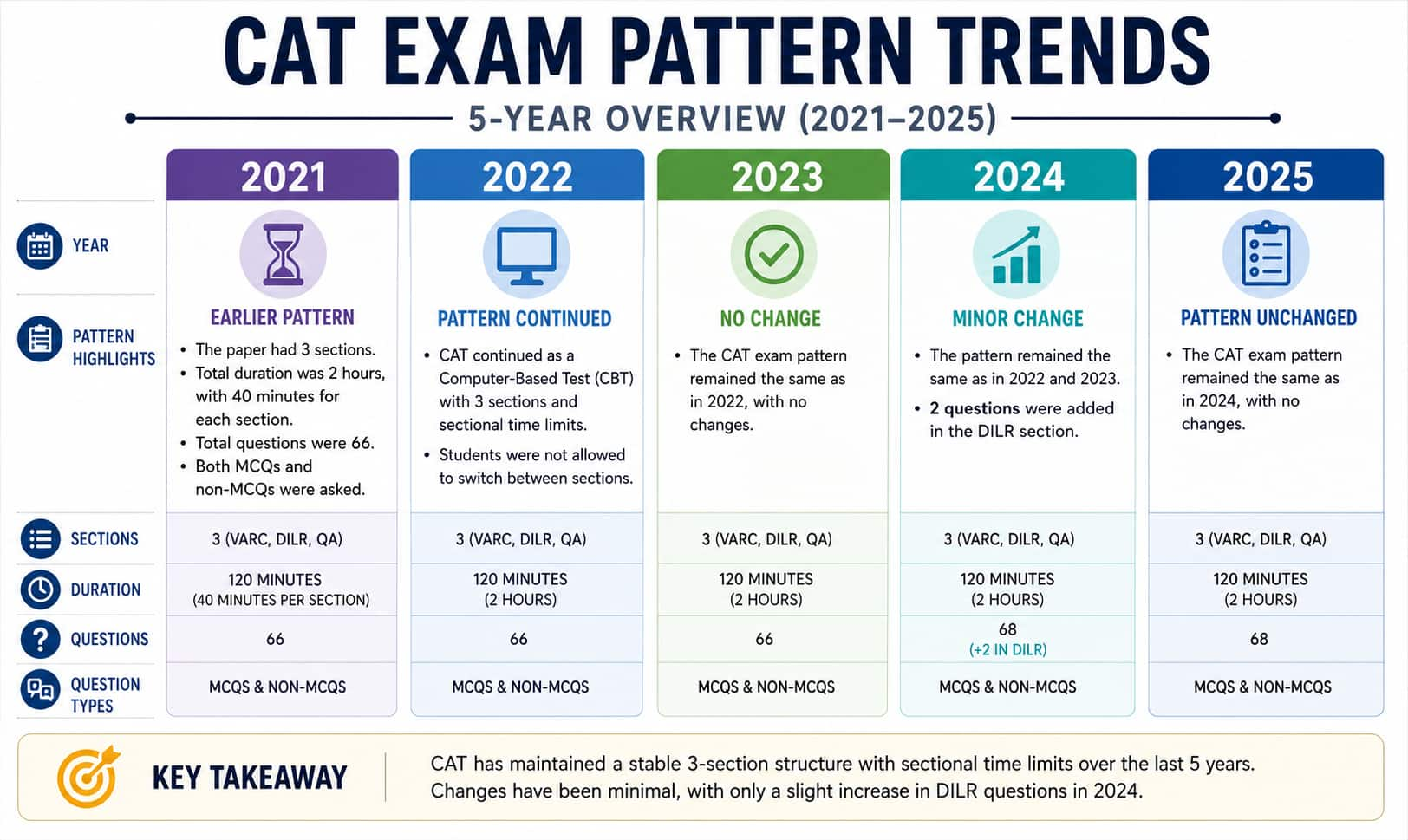
Having a detailed understanding of the CAT section wise difficulty level helps candidates to understand and predict the sections that may be tough. We have done a detailed analysis of the last 5 years and decoded the expected CAT toughest section 2026.
Over the years, DILR has seen a huge change in the kind of questions and logic asked in the exam. These days, now questions are more based on set selection, recognising patterns, and puzzle solving. Thus, according to the CAT exam difficulty trend, DILR has now become one of the most unpredictable and difficult sections in recent CAT exams.
The balance has shifted from calculation-driven Data Interpretation to logic-intensive set construction, with recent papers featuring a higher proportion of arrangements, networks, tournaments, scheduling, and distribution-based LR sets.
Set structures have become increasingly unconventional, often combining multiple variables, constraints, and conditional relationships within a single question set, making interpretation more challenging than calculation.
The number of directly solvable DI sets has declined, with tables, charts, and graphs now frequently embedded within logics that require extensive deduction before calculations can begin.
DILR has become the most unpredictable section in CAT, with significant fluctuations in set complexity, data presentation, and solvability across different years and slots.
Multi-layered LR sets have become more common, where candidates must establish several interconnected relationships before arriving at a valid framework for solving the questions.
Check Here, How to Improve Reading Speed and Accuracy for CAT 2026 VARC
VARC has remained relatively stable in terms of structure, but the nature of RC passages has changed.
Reading Comprehension now accounts for nearly 70–75% of the VARC score, making passage interpretation significantly more important than standalone Verbal Ability questions.
Passages have shifted toward abstract and academic themes, with topics frequently drawn from Philosophy, Sociology, Psychology, Anthropology, Political Theory, Economics, and Cultural Studies rather than business or current affairs.
Inference-based questions have increased substantially, requiring candidates to identify implied meanings, author assumptions, hidden arguments, and logical conclusions rather than locate direct textual evidence.
Now, there are more questions based on the author's tone, intent, and central argument that have become more prominent.
The difficulty of RCs increasingly stems from unfamiliar subject matter rather than complex language. This requires candidates to comprehend dense ideas even when the vocabulary itself is manageable.
Para Jumbles have become more logic-intensive, with fewer obvious opening or closing sentences and a greater emphasis on identifying conceptual continuity, pronoun references, and argument progression.
Also Check, CAT 2026 VARC Strategy: Sectional Plan to Score 40+ Marks & Get 95+ Percentile
The questions in the Quantitative Aptitude section of CAT have become more challenging, but it is not the toughest section among the three. According to the recent trends, here are the changes that we found:
Arithmetic now contributes nearly 40–50% of the QA section, with topics such as Time & Work, Time-Speed-Distance, Percentages, Profit & Loss, Ratio-Proportion, Averages, and Mixtures appearing consistently across slots.
Algebra has emerged as the second-most dominant area, with a strong focus on Linear Equations, Quadratic Equations, Inequalities, Logarithms, Functions, and Progressions.
Geometry and Modern Mathematics have witnessed reduced representation, with topics such as Coordinate Geometry, Permutation & Combination, Probability, and Set Theory appearing in fewer questions compared to earlier CAT papers.
Question design has shifted from formula-based solving to concept integration, where a single problem often combines multiple concepts, such as percentages with algebra, or arithmetic with number systems, increasing analytical complexity.
The proportion of lengthy calculations has decreased, while questions now emphasise mathematical modelling, logical interpretation of data, and efficient equation formation, rewarding conceptual clarity over computational speed.
Read Here, CAT Quant Preparation 2026: Topic-wise Strategy for 99+ Percentile
CAT has three sections that candidates have to cover to secure high marks in the examination. Using these Careers360 ebooks helps candidates to clear their basic concepts and get a clear understanding of the difficult topics.
CAT Ebooks | Download Link |
Ultimate DILR CAT 2025 Guide: Concepts, Practice Sets and Detailed Solutions | |
500+ Idioms And Phrases List With Meanings & Examples For MBA Entrance Exams | |
CAT VARC: 3000+ Most Important English Words | |
CAT 2025 Exam's High Scoring Chapters and Topics (Just Study 27% Syllabus and Score upto 100%) | |
CAT 2025 Quantitative Aptitude Study Material PDF - Geometry and Mensuration | |
CAT 2025 Mastery: Chapter-wise MCQs for Success for VARC, DILR, Quant | |
CAT 2025 Syllabus and High-Weightage Topics Guide | |
CAT 2025 Mock Test Series - 20 Sets, Questions with Solutions By Experts | |
Boost your CAT preparation with a comprehensive 60-day study material by Experts | |
300+ Phrasal Verbs List for CAT Exam, Types With Examples & Practice Questions. Download Pdf | |
CAT DILR Questions with Solution, Download LRDI Questions for CAT Pdf | |
CAT 2025 preparation tips with 30-day study material by Experts | |
CAT 2025 Verbal Ability and Reading Comprehension (VARC) Study Material PDF | |
Mastering CAT Exam: VARC, DILR, and Quant MCQs & Weightages | |
CAT 2025 Important Formulas | |
CAT 2025 Exam: Mistakes to Avoid for 99+ Percentile | |
CAT 2025 Exam: Success Strategy for Working Professionals & College Students | |
Avoid These Common CAT RC Mistakes to Boost your VARC Score | |
100 Quant Facts Every CAT Aspirant Must Know |
Frequently Asked Questions (FAQs)
DILR (Data Interpretation and Logical Reasoning) is widely considered the section that is getting harder. Recent CAT papers have included more complex puzzle-based and logic-driven sets.
DILR has become tougher because the sets are less predictable and require more logical thinking. Many candidates struggle to identify which sets are worth attempting first.
Yes, VARC is gradually becoming more challenging. Reading passages now cover more abstract topics, and many questions test inference and critical thinking rather than direct information.
Quantitative Aptitude is still challenging, but the topic distribution has become more predictable, with Arithmetic and Algebra contributing the highest number of questions.
Most experts recommend giving extra attention to DILR. A strong score in this section can make a major difference because it is often the toughest and most scoring differentiator in CAT.

On Question asked by student community
Hello, for AP NEET PG Category C seats, NRI documents are generally required if you are applying under the NRI quota, and eligibility depends on the applicable counselling rules. The fee payment currency and procedure should be confirmed from the current Dr. NTRUHS notification at its official website drntr.uhsap.in.
Hello, CAT aur B-school entrance exams ke baare mein aap exam dates, eligibility, registration, exam pattern, syllabus, colleges ya admission process ki information dekh sakte hain. Aapki requirement ke according relevant details yahan mil sakti hain: https://bschool.careers360.com/exams
You can download the latest CAT syllabus from here:
Hey there,
For a B.Sc. with Chemistry, Botany and Zoology (CBZ), if the CAT application asks separately for:
If the Discipline dropdown has a more specific option such as “Biological Sciences,” “Life Sciences,” or “Zoology/Botany,”
Hey there,
Yes. With 2 years of work experience, you are eligible to target the regular 2-year MBA at IIM Calcutta as long as you have a bachelor's degree with at least 50% marks (45% for SC/ST/PwD). Work experience is not required for eligibility.
For
Directions for question:
The bar-graph given below shows the foreign exchange reserves of Nepal (in million Rupees) from 2014 to 2021. Answer the following questions based on the graph :

Question:
What was the percentage increase (rounded to the nearest integer, if deemed necessary) in the foreign exchange reserves in

Globally Recognized by AACSB (US) & AMBA (UK) | 18 LPA Avg. CTC for PGPM 2026
75+ years of legacy | #1 Entrance Exam | Score accepted by 250+ BSchools
Gateway to IBS Hyderabad & 8 other IBS campuses | Scholarships worth 10 CR
Highest Package 29.30 LPA | 12 LPA Median CTC | 230+ Recruiters | AACSB Accredited | Ranked 51 in Asia by QS International
Early Application Round Deadline: 27th Oct’26 | 400+ Recruiters | Highest CTC 17.2 LPA | Average CTC 8 LPA | 92% Avg. Placements | Awarded Best Business School of the Year
Last Date to Apply - 19th December 2026 | Highest CTC 68.66 LPA | Average CTC 18.08 LPA | Top 25% Average CTC 24.66 LPA