
Search Colleges, Exams, Schools & more


Login
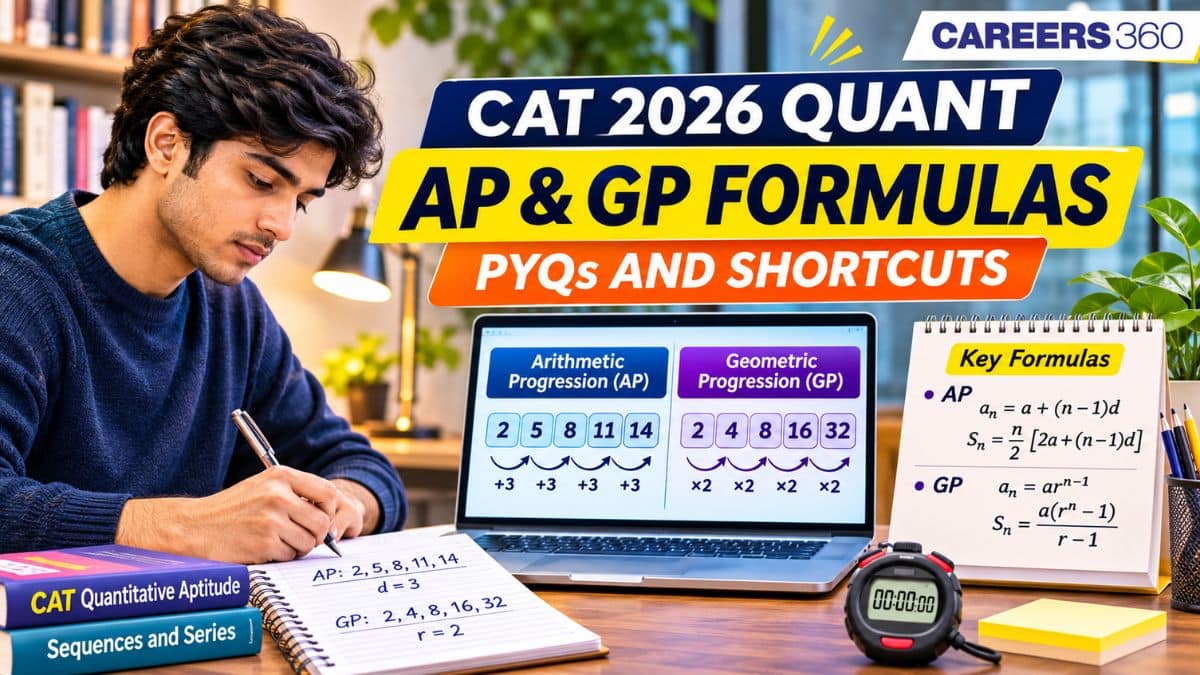
What if you could find the 100th term of a sequence without writing down the first 99 terms? That is the power of mastering Arithmetic Progressions (AP) and Geometric Progressions (GP) for CAT 2026. With the exam scheduled for November 29, 2026, learning to spot patterns, find missing terms and calculate sums quickly can save valuable time in Quantitative Aptitude. Explore important formulas, smart shortcuts and solved CAT previous-year questions to discover how a few simple steps can make lengthy series questions easier to solve.
Live | Nov 3, 2026 | 1:32 PM IST
This Story also Contains
- CAT 2026 Progressions and Series: Important Formulas
- CAT 2026 GP Questions and Sum of Infinite Series
- CAT Progressions and Series: Additional PYQ Practice
- Shortcuts to Solve AP and GP Questions Faster
- How to Prepare for CAT 2026 Progressions and Series?
- CAT 2026 Mock Test
Explore MBA scholarship opportunities across India’s top B-schools. Scholarships - Top 100 B-Schools in India
CAT 2026 Progressions and Series: Important Formulas
Before attempting CAT algebra questions on sequences and series, revise these formulas. They are useful for finding individual terms, sums and common differences.
Concept | Formula |
(n)th term of AP | an=a+(n-1)d |
Sum of first (n) AP terms | Sn=n2[2a+(n-1)d] |
Sum using first and last terms | Sn=n2(a+l) |
(n)th term of GP | an=arn-1 |
Sum of first (n) GP terms | Sn=a(rn-1)r-1, for r1 |
Sum of an infinite GP | S=a1-r, for $r<1$ |
Here, a is the first term, d is the common difference, r is the common ratio and l is the last term.
CAT 2026 AP Questions From Previous Year Papers
AP questions often provide relationships between selected terms rather than giving the first term and common difference directly. The following examples from the CAT previous year questions illustrate this approach.
Question 1: CAT 2024 Slot 1 - Finding the 100th Term of an AP
The terms x1,x2,x3,,x100 are in an arithmetic progression. If x5=-4 and 2x6+2x9=x11+x13, find x100.
Solution:
Let the first term be a and the common difference be d.
Given:
x5=a+4d=-4
Using the second condition:
2(a+5d)+2(a+8d)=(a+10d)+(a+12d)
Simplifying:
4a+26d=2a+22d
2a+4d=0
Therefore, a=-2d.
Substitute this into a+4d=-4:
-2d+4d=-4
d=-2, so a=4.
Now,
x100=a+99d
x100=4+99(-2)=-194
Answer: -194 (Option A).
CAT takeaway: Convert each term into a+(n-1)d before using the given relationship. This keeps the equation organised and reduces calculation errors.
Question 2: CAT 2022 - Finding the Smallest Value of (n)
The sum of the first n terms of an arithmetic progression is given by Sn=n+2n2. If the nth term is divisible by 9, find the smallest possible positive value of n.
Solution:
The nth term is the difference between two consecutive partial sums:
an=Sn-Sn-1
Given:
Sn=n+2n2
Sn-1=(n-1)+2(n-1)2
Therefore,
an=(n+2n2)-[(n-1)+2(n-1)2]
Simplifying:
an=4n-1
Since the term must be divisible by 9:
$4n-1\equiv0\pmod9$
$4n\equiv1\pmod9$
The smallest positive integer satisfying this condition is n=7, because 4(7)-1=27.
Answer: 7 (Option C).
CAT takeaway: When the sum of the first n terms is provided, calculate an using Sn-Sn-1 instead of trying to identify the first term and common difference separately.
Question 3: CAT 2023 Slot 2 - Finding a Term From Two APs
Two arithmetic progressions, a1,a2, and b1,b2,, have prime-number common differences. Given that a5=b9, a19=b19 and b2=0, find a11.
Solution:
Let the first terms be A and B, and the common differences be d and $e.
Since b2=0:
B+e=0B=-e
Using a5=b9:
A+4d=B+8e=7e
Using a19=b19:
A+18d=B+18e=17e
Subtract the first equation from the second:
14d=10e
7d=5e
Since both d and e are prime numbers, d=5 and e=7.
From A+4d=7e:
A+20=49A=29
Therefore,
a11=A+10d=29+50=79
Answer: 79 (Option A).
CAT takeaway: When two APs are involved, use their term formulas together. Conditions involving prime common differences can help determine the exact values of the differences.
CAT 2026 GP Questions and Sum of Infinite Series
GP questions can require candidates to identify the common ratio, use relationships between consecutive terms or determine whether an infinite series has a finite sum.
Question 4: CAT 2025 Slot 2 - Sum of a Decreasing Infinite GP
The terms of a decreasing infinite geometric progression are a1,a2,a3,. If
a1+a2+a3=52
and
a1a2+a2a3+a3a1=624,
find the sum of the infinite progression.
Solution:
Let the first term be a and the common ratio be r.
Then:
a1+a2+a3=a(1+r+r2)=52
Also,
a1a2+a2a3+a3a1=a2r(1+r+r2)=624
Divide the second equation by the first:
ar=62452=12
Thus, a=12r.
Substitute into a(1+r+r2)=52:
12r(1+r+r2)=52
Simplifying:
3r2-10r+3=0
Factoring:
(3r-1)(r-3)=0
Therefore, r=13 or r=3.
For a decreasing infinite GP with a finite sum, |r|<1. Hence, r=13.
Since ar=12, the first term is a=36.
The sum of the infinite GP is:
S=a1-r
S=361-13=54
Answer: 54 (Option A).
CAT takeaway: In GP questions involving both sums and products of terms, dividing the given equations can eliminate the repeated factor and reveal the common ratio. Always check the condition |r|<1 before using the infinite-sum formula.
Get exam-focused practice for CAT 2026 Quant with this five-year question bank. Solve previous-year questions to understand question patterns and improve your problem-solving skills.
CAT Progressions and Series: Additional PYQ Practice
Practise these CAT 2021-2025 PYQs to strengthen your understanding of AP, GP, recurrence relations, and sequence-based algebra. These questions test your ability to apply progression formulas to numerical, geometrical, and algebraic problems.
CAT year and slot | Question type | Skill tested |
CAT 2021 Slot 2 | Three positive integers in AP, with a condition involving their product and sum | Applying AP properties alongside algebra |
CAT 2023 Slot 1 | Areas of three figures are in AP, with a relationship between two areas | Translating a real-world condition into an AP |
CAT 2023 Slot 3 | A sequence defined by a recurrence relation | Working with successive terms and growth |
CAT 2024 Slot 1 | A 100-term AP with relationships between selected terms | Finding the common difference and a distant term |
CAT 2025 Slot 2 | Decreasing infinite GP with sums and products of terms | Finding the common ratio and infinite sum |
These questions show why preparation should go beyond memorising formulas. CAT can test progressions through number relationships, geometry, algebraic conditions and recurrence-based sequences.
Shortcuts to Solve AP and GP Questions Faster
These shortcuts help you identify common patterns in AP and GP questions and solve them without calculating every term.
Shortcut | How to use it |
Skip finding the first term | If an AP question gives two terms, subtract their equations to find the common difference directly. Example: a8-a3=25, so 5d=25, giving d=5. |
Use the middle-term trick | In an AP, terms equally far from the middle add up to twice the middle term. For example, a4+a10=2a7. |
Find the AP sum without listing terms | If the first and last terms are known, take their average and multiply by the number of terms. For terms from 3 to 99 in steps of 3, S=33(3+99)/2=1683. |
Spot a GP using division | Divide consecutive terms instead of subtracting them. For 3,6,12,24, the ratio is 2, so the sequence is a GP. |
Reverse a GP when useful | In a three-term GP, write the terms as ar,a,ar. This often makes questions involving products and sums easier. |
Find a term from two known terms | In a GP, divide the terms to find the power of the common ratio. For example, a6/a2=r4. |
Recover a term from a sum | If the sum of the first n terms is given, use an=Sn-Sn-1 rather than finding every term separately. |
These methods are especially useful when a CAT question gives only a few terms or sums and asks you to find a distant term or the value of the series.
How to Prepare for CAT 2026 Progressions and Series?
Revise AP first: Practise finding the common difference and using relationships between non-consecutive terms.
Move to GP: Focus on the common ratio, finite sums and conditions for an infinite sum.
Practise mixed conditions: Work on questions involving two progressions, sums of terms and algebraic constraints.
Review mistakes: Reattempt difficult PYQs after a few days and note whether you can solve them faster.
Use timed practice: Focus on choosing an efficient approach instead of spending too long on one question.
CAT 2026 Mock Test
Check your CAT preparation before exam day. Take a free mock test to practise time management, evaluate your accuracy, and build confidence.
Industry and Sector-Focused MBA Specialisations - Free eBooks
MBA Specialisation | What the eBook Covers | Download eBook |
|---|---|---|
Healthcare & Hospital Management | Colleges, rankings, fees, salary and careers | |
Pharmaceutical Management | Pharma MBA colleges, rankings, fees, placements and career options | |
Supply Chain & Logistics | Colleges, rankings, fees, salary and careers | |
Retail Management | Colleges, rankings, fees, placements and career options | |
Insurance & Banking | Colleges, rankings, fees, placements and career opportunities | |
Aviation Management | Colleges, rankings, fees, placements and career paths | |
Travel & Tourism | Colleges, rankings, fees, placements and career opportunities |
Frequently Asked Questions (FAQs)
Q: Which topics are covered under Progressions and Series for CAT 2026?
A:
The main topics include Arithmetic Progression (AP), Geometric Progression (GP), sums of series, arithmetic and geometric means, and recurrence relations.
Q: Are Progressions and Series important for CAT 2026 Quantitative Aptitude?
A:
Yes, they are worth preparing as part of Algebra. Practising previous-year questions helps you understand how CAT tests sequences, number relationships, and series.
Q: What are the most important formulas for CAT Progressions and Series?
A:
Focus on the nth term and sum formulas of AP and GP, the common difference, the common ratio, and the sum of an infinite GP where applicable.
Q: How should I prepare Progressions and Series for CAT 2026?
A:
Start with basic AP and GP concepts, learn the formulas, solve topic-wise questions, and then practise CAT previous-year questions involving algebraic conditions and recurrence relations.
Q: Can I prepare Progressions and Series using CAT previous-year questions?
A:
Yes. CAT PYQs help you practise different question patterns, identify weak areas, and improve your problem-solving speed. Attempt questions from multiple years and review your mistakes regularly.
Articles
Related Stories
|
Upcoming Mba Exams

Certifications By Top Providers
Explore Top Universities Across Globe
Popular Courses and Specializations
List of colleges accepting CAT
Browse Mba Colleges by State
Questions related to CAT
On Question asked by student community
Have a question related to CAT ?
Hi Khushdeep
Several apps and online platforms are available for CAT (Common Admission Test) preparation. Students can choose a platform based on their preparation needs, such as video lectures, practice questions, mock tests, and performance analysis.
Hello, for AP NEET PG Category C seats, NRI documents are generally required if you are applying under the NRI quota, and eligibility depends on the applicable counselling rules. The fee payment currency and procedure should be confirmed from the current Dr. NTRUHS notification at its official website drntr.uhsap.in.
Hello, CAT aur B-school entrance exams ke baare mein aap exam dates, eligibility, registration, exam pattern, syllabus, colleges ya admission process ki information dekh sakte hain. Aapki requirement ke according relevant details yahan mil sakti hain: https://bschool.careers360.com/exams
You can download the latest CAT syllabus from here:
Hey there,
For a B.Sc. with Chemistry, Botany and Zoology (CBZ), if the CAT application asks separately for:
- Degree Name: B.Sc.
- Graduation Stream: Science
- Discipline: enter/select Science if that is an available option.
If the Discipline dropdown has a more specific option such as “Biological Sciences,” “Life Sciences,” or “Zoology/Botany,”
Popular CAT Questions
Directions for question:
The bar-graph given below shows the foreign exchange reserves of Nepal (in million Rupees) from 2014 to 2021. Answer the following questions based on the graph :

Question:
What was the percentage increase (rounded to the nearest integer, if deemed necessary) in the foreign exchange reserves in

Applications for Admissions are open.
Globally Recognized by AACSB (US) & AMBA (UK) | 18 LPA Avg. CTC for PGPM 2026
XAT
ApplyRegister for XAT 2027 by 28th Oct to become eligible to take the Mock Test | 75+ years of legacy | #1 Entrance Test | 100+ Test Cities | 250+ B-Schools accept XAT Score
IBSAT
ApplyGateway to IBS Hyderabad & 8 other IBS campuses | Scholarships worth 10 CR
K J Somaiya Institute of Management, Mumbai
ApplyHighest Package 29.30 LPA | 12 LPA Median CTC | 230+ Recruiters | AACSB Accredited | Ranked 51 in Asia by QS International
Goa Institute of Management, Goa
ApplyAmong top 6% B-Schools globally to be accredited by AACSB | Highest Package-35 LPA
ISBR Business School, Bangalore
ApplyApplication Deadline: 1st Dec'26 | 400+ Recruiters | Highest CTC 17.2 LPA | Average CTC 8 LPA | 92% Avg. Placements | Awarded Best Business School of the Year
CAT Notifications
Never miss CAT update
Get timely CAT updates directly to your inbox. Stay informed!