Birla Institute of Management Technology, Greater Noida
AACSB Accredited | Highest CTC: 22 LPA


CAT 2026 will be conducted on November 29, 2026, and non-engineering aspirants have limited time to strengthen their Quantitative Aptitude (QA) preparation. The key is not to master every mathematical concept but to prioritise important topics, improve accuracy and avoid losing marks on manageable questions. This 30-day CAT 2026 Quant preparation plan covers topic priorities, a week-wise study schedule, mock-test strategy and sectional cutoff guidance to help non-engineers prepare strategically.

Explore Scholarships - Top 100 B-Schools in India to learn about financial assistance options for your MBA.
Candidates from non-engineering backgrounds may need additional time to rebuild mathematical fundamentals, especially if they have not studied mathematics recently. However, an engineering degree is not a prerequisite for performing well in CAT Quant.
The section tests conceptual understanding, logical thinking, calculation skills and question selection. According to previous-year paper analysis, Arithmetic and Algebra deserve the highest preparation priority, although their actual weightage can vary across slots.
Before starting, review the CAT 2026 Quantitative Aptitude syllabus and important topics to identify your strengths and weaknesses.
Instead of distributing your time equally across every chapter, follow this priority order for CAT Preparation 2026.
Priority | Topics to Cover | Preparation Focus |
High | Percentages, Ratio and Proportion, Averages, Profit and Loss | Build calculation speed and conceptual clarity |
High | Time and Work, Time-Speed-Distance, Mixtures and Alligation | practice standard question types and applications |
High | Linear Equations and Quadratic Equations, Inequalities, Logarithms | Strengthen algebraic fundamentals |
Medium | Functions, Sequences and Series, Exponents and Surds | Learn core concepts and practice selected problems |
Medium | Triangles, Circles, Quadrilaterals and Mensuration | Revise CAT formulas and solve application-based questions |
Selective | Number Systems, Permutation and Combination, Probability, Set Theory | Cover fundamentals and practice representative questions |
This order is a preparation recommendation, not a guarantee of the questions that will appear. Refer to the CAT Quant topic-wise weightage trends for historical analysis.
Divide the final month into four phases, focusing on revising familiar concepts, improving accuracy, practising CAT-level questions and analysing mock tests. This plan assumes that candidates have already studied the fundamentals and need to strengthen their preparation before CAT 2026.
Priority: Percentages, Ratio and Proportion, Averages, Profit and Loss, Mixtures, Time and Work, and Time-Speed-Distance.
Revise formulas, calculation techniques and shortcuts for all major Arithmetic topics.
Solve 20-30 CAT-level questions daily, focusing on accuracy and question selection.
Revisit previously solved questions and identify recurring calculation errors.
Use important CAT formulas for quick revision.
Attempt a timed QA sectional test at the end of the week and analyse your performance.
Avoid spending too much time relearning familiar concepts. Focus on questions you previously found difficult and topics where your accuracy remains inconsistent.
Priority: Linear Equations, Quadratic Equations, Inequalities, Logarithms, Functions, Sequences and Series.
Revise the concepts and formulas you have already studied.
Practise mixed Algebra questions instead of solving only basic, topic-wise exercises.
Revisit selected Geometry, Mensuration and Number System questions.
Solve previous-year CAT Quantitative Aptitude questions to understand common question patterns.
Attempt another timed QA sectional test and compare your accuracy with the previous week.
Give more time to topics that offer a reasonable chance of improvement. If a topic is already strong, revise it briefly rather than spending hours repeating familiar questions.
Priority: Previous-year questions, mixed-topic practice, weak areas and time management.
Solve mixed Arithmetic, Algebra, Geometry and Number System sets under timed conditions.
Revise selected Permutation and Combination and Probability questions if you have already covered their fundamentals.
Attempt full-length CAT mock tests according to your preparation level.
Analyse every mock, identifying incorrect answers, calculation mistakes and easy questions you missed.
Use CAT Quantitative Aptitude sectional tests for targeted practice.
Mock-test analysis is as important as attempting the test. Understand why a question went wrong and whether the problem was conceptual knowledge, calculation, time pressure or poor question selection.
Priority: Formula revision, weak topics, mock analysis and accuracy.
Revise your formula notebook and previously marked difficult questions.
Revisit your five weakest topics and solve selected CAT-level questions.
Attempt full-length mocks at suitable intervals, leaving enough time to analyse each one.
Practise selecting questions that match your strengths instead of attempting every question.
Revise calculation techniques and avoid repeatedly making the same mistakes.
In the final two or three days, prioritise light revision, familiar questions and a stable exam strategy over learning difficult new concepts.
The goal is to maximise marks from topics you already know. For non-engineers, a focused revision strategy, careful question selection and consistent accuracy can be more useful than trying to cover every Quant topic in the final month.
If you are preparing for CAT alongside college or work, aim for approximately 2-3 focused hours of Quant practice daily, subject to your current proficiency and other CAT preparation commitments.
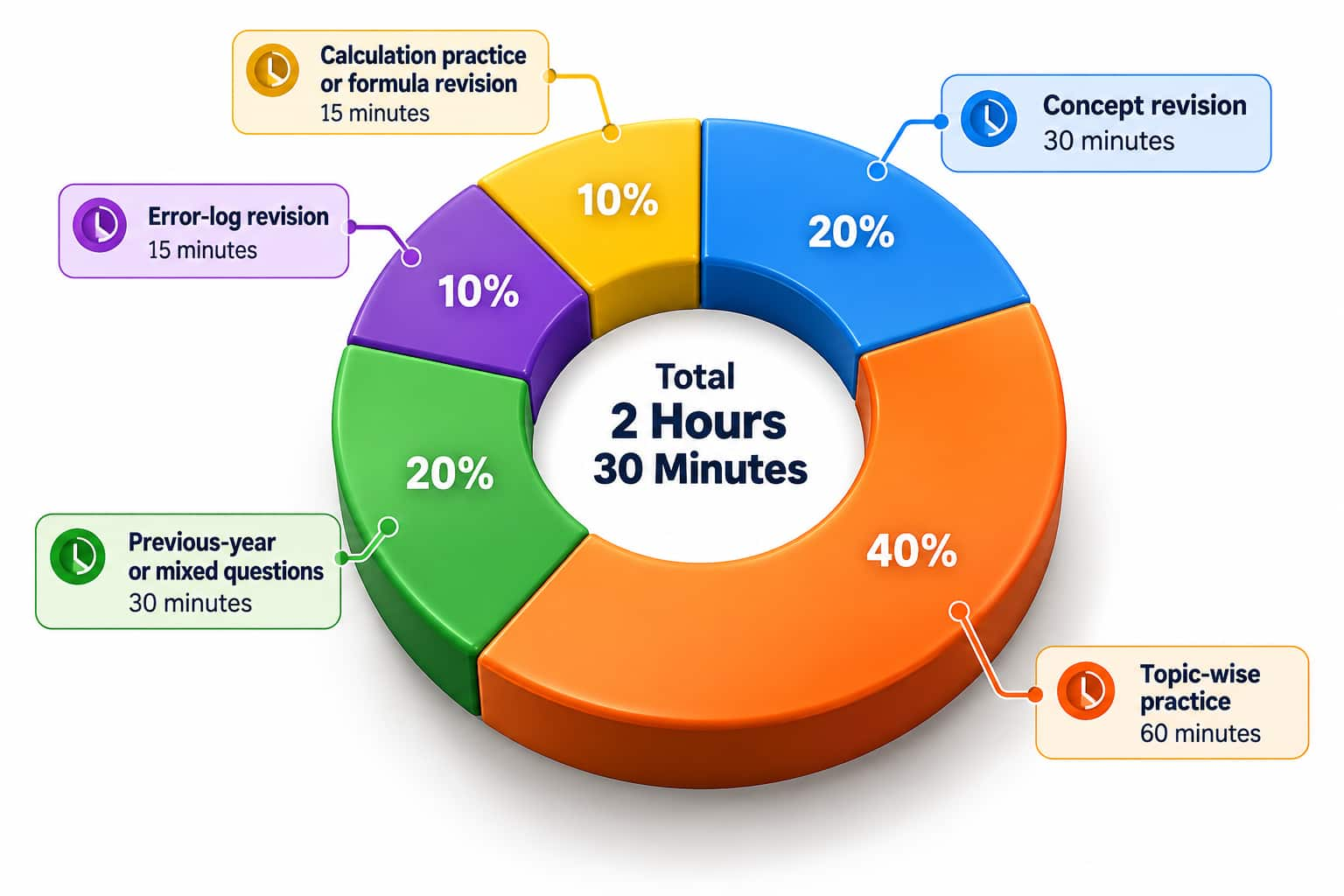
On mock-test days, replace part of the routine with a timed test and detailed analysis. Remember that this is a suggested Quant schedule, not the entire CAT study timetable; VARC and DILR also require regular practice.
Clearing the Quantitative Aptitude sectional cutoff requires a different strategy from targeting a very high overall percentile. Candidates should first identify their target institutes' eligibility requirements.
The CAT 2026 sectional cutoff marks and IIM CAT cutoff 2026 requirements can help you understand the expected section-wise percentile requirements. These figures are not interchangeable with raw marks, and the final cutoffs vary by institute, category and admission criteria.
Follow these strategies:
Set a realistic target: Use mock-test performance to establish a baseline and track improvement.
Choose questions carefully: Attempt familiar, manageable questions before spending time on lengthy problems.
Protect accuracy: Under the standard CAT marking scheme, a correct answer earns three marks and an incorrect MCQ attracts a one-mark penalty. Unanswered questions do not attract negative marking.
practice under timed conditions: Develop the ability to recognise when to solve, skip or return to a question.
Analyse every mock: Record conceptual errors, calculation mistakes, time-consuming questions and missed easy questions.
For a broader understanding of institute-wise eligibility, consult the CAT cutoff 2026 guide.
A CAT mock test can help you determine whether your 30-day preparation plan is working. Take a diagnostic test before beginning the schedule, then compare your accuracy, attempts and sectional performance as you progress.
Attempt the CAT 2026 Free Mock Test
After every test, review:
Questions answered incorrectly.
Easy questions left unattempted.
Topics consuming too much time.
Concepts requiring revision before the next test.
Do not judge your preparation only by your overall score. Your QA performance and recurring error patterns are more useful for deciding what to study next.
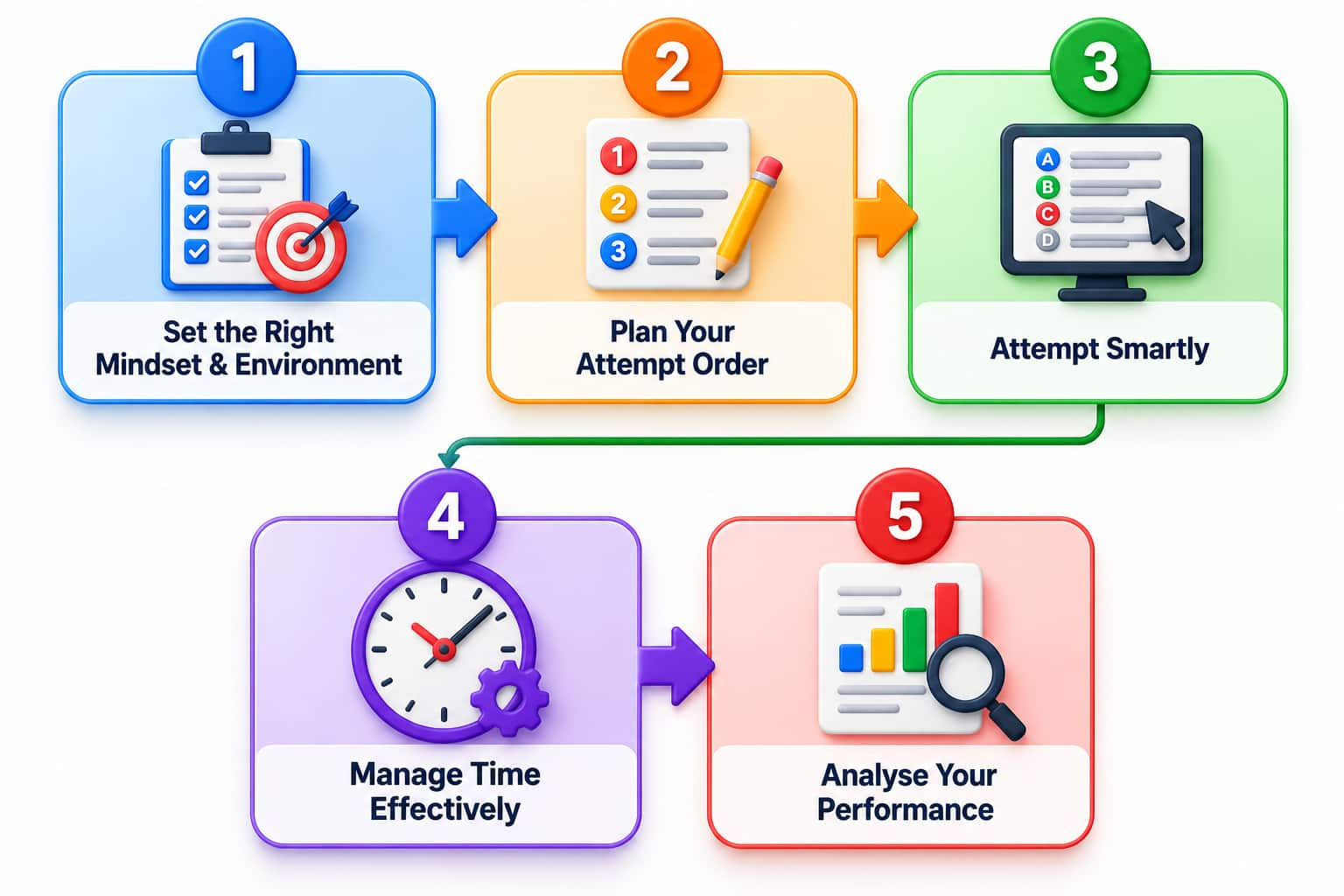
Use these resources as a separate part of your preparation to organise revision and practice more systematically.
Get structured study material to support preparation across Quantitative Aptitude, VARC and DILR during the final two months.
Download CAT 2026 Comprehensive 60-Day Study Material
Use this resource to organise final-stage revision, prioritise pending topics and manage your preparation time.
For CAT 2026, non-engineers should focus on strong fundamentals, selective topic coverage, timed practice and consistent mock-test analysis. Use the 30-day plan as a flexible framework, revise recurring mistakes and measure progress through sectional performance. A focused approach can improve your chances of clearing the QA cutoff without attempting to master every topic in the syllabus.
Access these free eBooks covering popular MBA specialisations to compare colleges, fees, placements and career opportunities before choosing your preferred field.
MBA Specialisation | What the eBook Covers | Download eBook |
Marketing Management | Top colleges, rankings, fees, placements and career options | |
Human Resource Management | Top HR colleges, rankings, fees, placements and careers | |
Financial Management & Services | Finance colleges, rankings, fees, placements and careers | |
Operations Management | Private colleges for operations, rankings, fees, placements and careers | |
Project Management | Colleges, rankings, fees, placements and careers | |
International Business | Top IB colleges, rankings, fees, placements and career opportunities |
Download the relevant eBook to shortlist MBA colleges and make a more informed decision about your specialisation.
Frequently Asked Questions (FAQs)
Yes, it is possible, depending on your starting level, conceptual clarity, practice consistency and mock-test performance. However, clearing the cutoff is not guaranteed.
Start with Percentages, Ratio and Proportion, Averages, Profit and Loss, Time and Work, and Time-Speed-Distance. Progress to Algebra before expanding your preparation to Geometry and other topics.
Start with 15-25 focused questions daily and increase the number as your accuracy improves. Quality of practice and error analysis matter more than completing an arbitrary number of questions.
There is no single cutoff applicable to every candidate or IIM. Sectional percentile requirements vary by institute, category and admission policy. Check the latest institute-specific criteria before setting your target.
No. Prioritise Arithmetic and Algebra first, but reserve time for Geometry, Number Systems and Modern Mathematics. Their question distribution varies, so skipping entire topics can eliminate potential scoring opportunities.

On Question asked by student community
Hello, for AP NEET PG Category C seats, NRI documents are generally required if you are applying under the NRI quota, and eligibility depends on the applicable counselling rules. The fee payment currency and procedure should be confirmed from the current Dr. NTRUHS notification at its official website drntr.uhsap.in.
Hello, CAT aur B-school entrance exams ke baare mein aap exam dates, eligibility, registration, exam pattern, syllabus, colleges ya admission process ki information dekh sakte hain. Aapki requirement ke according relevant details yahan mil sakti hain: https://bschool.careers360.com/exams
You can download the latest CAT syllabus from here:
Hey there,
For a B.Sc. with Chemistry, Botany and Zoology (CBZ), if the CAT application asks separately for:
If the Discipline dropdown has a more specific option such as “Biological Sciences,” “Life Sciences,” or “Zoology/Botany,”
Hey there,
Yes. With 2 years of work experience, you are eligible to target the regular 2-year MBA at IIM Calcutta as long as you have a bachelor's degree with at least 50% marks (45% for SC/ST/PwD). Work experience is not required for eligibility.
For
Directions for question:
The bar-graph given below shows the foreign exchange reserves of Nepal (in million Rupees) from 2014 to 2021. Answer the following questions based on the graph :

Question:
What was the percentage increase (rounded to the nearest integer, if deemed necessary) in the foreign exchange reserves in

Globally Recognized by AACSB (US) & AMBA (UK) | 18 LPA Avg. CTC for PGPM 2026
75+ years of legacy | #1 Entrance Exam | Score accepted by 250+ BSchools
Gateway to IBS Hyderabad & 8 other IBS campuses | Scholarships worth 10 CR
Highest Package 29.30 LPA | 12 LPA Median CTC | 230+ Recruiters | AACSB Accredited | Ranked 51 in Asia by QS International
Early Application Round Deadline: 27th Oct’26 | 400+ Recruiters | Highest CTC 17.2 LPA | Average CTC 8 LPA | 92% Avg. Placements | Ranked as Platinum Institute | Awarded Best Business School of the Year
Last Date to Apply - 19th December 2026 | Highest CTC 68.66 LPA | Average CTC 18.08 LPA | Top 25% Average CTC 24.66 LPA