Great Lakes - PGDM & PGPM Admissions 2027
Globally Recognized by AACSB (US) & AMBA (UK) | 18 LPA Avg. CTC for PGPM 2026


The final 60 days of CAT 2026 preparation should not become a race to finish every chapter. This is the stage where topic priority, mock performance and question selection start deciding how much of your preparation actually converts into marks. With CAT 2026 scheduled for November 29, 2026, candidates should now move from broad learning to targeted revision and timed practice. Recent CAT 2025 question paper analysis also offers useful direction, particularly for QA and VARC. Read on for a section-wise CAT 2026 preparation plan for the last 60 days with weekly targets and mock-analysis strategies.
This Story also Contains

Analyse the slot-wise topic weightage from CAT 2025 to identify important trends and use them to plan your CAT 2026 preparation more effectively.
The CAT 2026 exam pattern covers the three sections, their question structure and sectional time limits that candidates need to account for in their exam strategy.
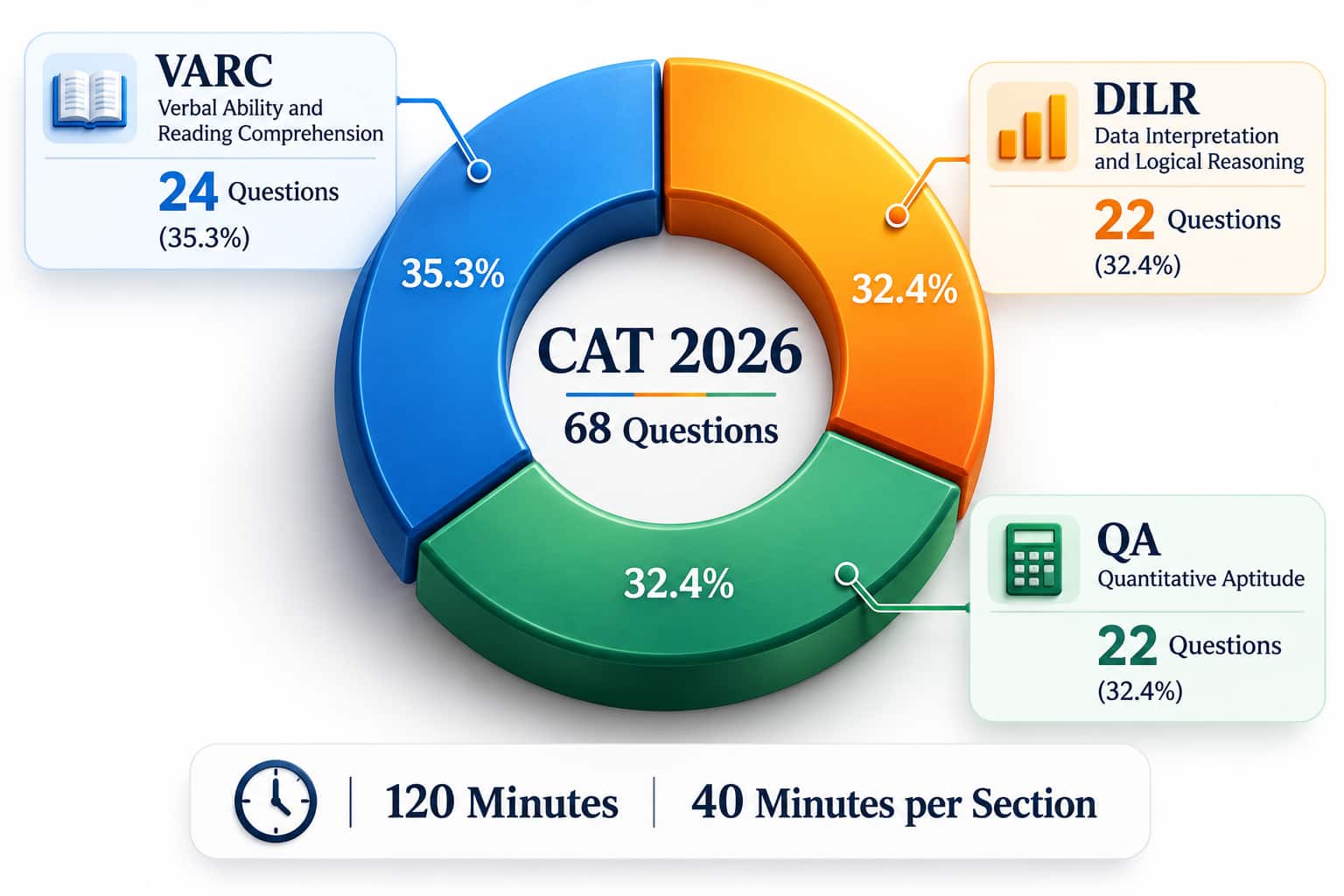
The 60-day plan can be divided into four stages so that CAT preparation becomes progressively more exam-focused.
Phase | Weeks | Main Focus |
Diagnosis | Week 1 | Find weaknesses through a mock |
Concept Repair | Weeks 2-3 | Fix high-priority topics |
Timed Practice | Weeks 4-6 | PYQs, sectionals and mixed sets |
Final Simulation | Weeks 7-8 | Mocks, analysis and revision |
CAT 2026 is scheduled for November 29, 2026, and the examination has three sections: VARC, DILR, and QA.
Activity | Daily Time |
QA practice/revision | 1.5–2 hours |
DILR sets | 1–1.5 hours |
VARC/RC | 1–1.5 hours |
PYQs/error log | 30–45 mins |
Analysis/revision | 30 mins |
Recent CAT trends make Arithmetic and Algebra key areas to prioritise while keeping the remaining QA topics in the revision plan.
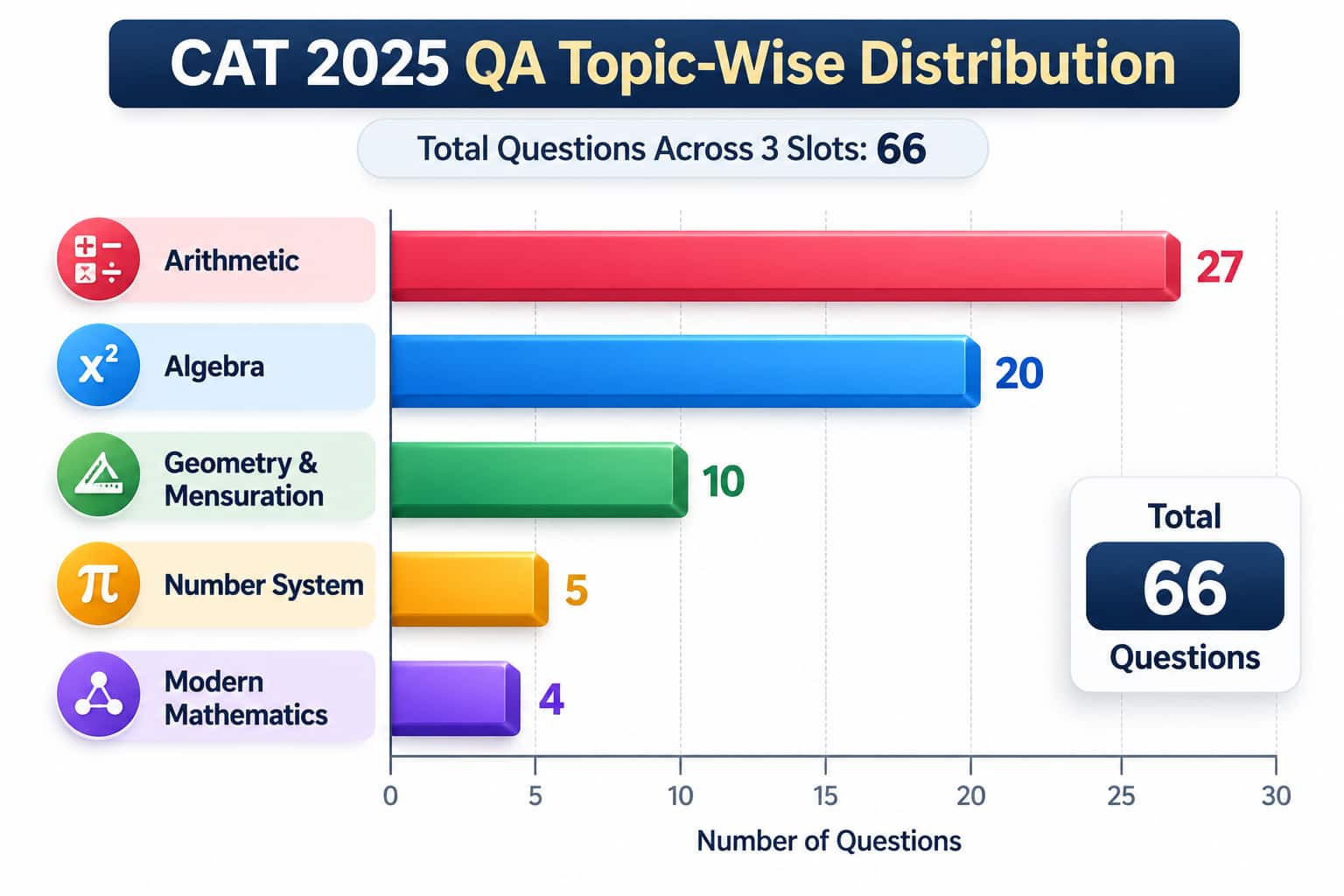
This does not mean other topics should be skipped. It means the final revision schedule should give more time to high-frequency areas while using mock performance to identify individual gaps.
Prioritise:
Functions
Logarithms
After revising each topic, immediately solve mixed questions instead of spending several days only reading theory.
Use Week 3 for:
Geometry
Mensuration
Number System
Permutation and Combination
Globally Recognized by AACSB (US) & AMBA (UK) | 18 LPA Avg. CTC for PGPM 2026
Test centres are available in 70+ cities across India | 75,000+ aspirants apply for the NMAT exam | Accepted by 58+ institutions like NMIMS, KJSIM, ISB, SPJIMR and Great Lakes.
Start mixed QA sets by the end of the week. Do not look at the chapter name before solving; CAT requires you to identify the approach yourself.
Use the Quant resources to practise previous-year questions and test your preparation with a dedicated CAT 2026 Quant sample paper.
These resources cover CAT Quant PYQs and CAT 2026 Quant sample paper practice for topic revision and timed question solving.
Data Interpretation and Logical Reasoning (DILR) should be prepared as sets rather than isolated questions.
CAT 2025 had 22 DILR questions across five sets. The paper included arrangements, charts, games and tournaments, data-based sets and other logical structures.
Practise:
Distribution
Tables
Bar graphs
Caselets
Networks
Take four or five sets together and first scan them without solving.
Classify them as:
Category | Approach |
Clear and familiar | Attempt first |
Manageable but lengthy | Consider second |
Complex structure | Reassess |
No clear starting point | Leave for later |
This is important because spending 15 minutes on an unsuitable set can affect the entire section.
Start taking complete Data Interpretation and Logical Reasoning sectionals. After every test, record:
Which set you selected first
Whether that selection was correct
Time spent per set
Questions solved from each set
Calculation or interpretation errors
Your goal should be to improve selection quality, not simply the number of sets attempted.
Use these resources to practise CAT DILR questions and understand the type of sets expected in the examination.
These resources can be used for both previous-year question practice and CAT 2026 DILR sample-paper practice.
VARC should not become a grammar-only preparation exercise.
CAT 2025 had 24 VARC questions, including 16 Reading Comprehension questions from four passages and eight Verbal Ability questions.
The VA questions included:
Para Jumbles
Para Summary
Para Completion
Odd Sentence
Practise 2-3 RC passages regularly.
For every incorrect question, identify the reason:
Misread the passage
Missed the central argument
Chose an extreme option
Used outside knowledge
Failed to eliminate an option
Misunderstood the question
This makes RC practice more useful than simply counting how many passages you completed.
Start combining RC and VA under the 40-minute section limit.
Track:
Metric | What to Monitor |
Attempts | Too low or too high? |
Accuracy | Stable across mocks? |
RC Selection | Which passages work for you? |
Time | Where are minutes being lost? |
VA Accuracy | Which question type causes errors? |
Do not force yourself to attempt the same number of questions in every mock. Your own accuracy data should guide your final strategy.
Practise previous-year VARC questions alongside a dedicated sample paper to improve Reading Comprehension and Verbal Ability preparation.
Together, these resources provide CAT VARC PYQs and sample-paper practice for both familiarisation and timed preparation.
The following schedule converts the section-wise CAT 2026 preparation plan into practical weekly targets.
Week | Quant | DILR | VARC | Testing |
1 | Diagnostic + Arithmetic | Basic sets | RC baseline | 1 mock |
2 | Arithmetic + Algebra | Set practice | RC accuracy | Sectionals |
3 | Geometry + Number System | Selection drills | RC + VA | Sectionals |
4 | Mixed Quantitative Aptitude | Timed sets | Timed VARC | 1-2 mocks |
5 | QA PYQs | DILR PYQs | RC + VA PYQs | 2 mocks |
6 | Weak-topic repair | Weak-set repair | Accuracy repair | 2 mocks |
7 | Mock-driven revision | Mock-driven revision | Mock-driven revision | 2-3 mocks |
8 | Formula + error log | Selection revision | RC + VA revision | Final mocks |
The number of mocks should be adjusted according to how much time you can spend analysing each one.
Practise with the CAT 2026 Free Mock Test to assess your preparation, improve time management and identify areas that need more practice. Use the mock to understand your section-wise performance and get familiar with the pressure of solving CAT-level questions within a fixed time.
Attempt Now: CAT 2026 Free Mock Test
Practice with CAT 2026 Mock Test Series - 20 Sets, Questions with Solutions By Experts
A mock score tells you what happened. Your analysis should tell you why it happened.
After every mock, record:
Section-wise attempts
Section-wise accuracy
Time spent
Easy questions missed
Questions taking excessive time
Conceptual errors
Calculation errors
Selection errors
For DILR, add the most important question: Did I choose the right sets?
For VARC, check whether incorrect answers are concentrated in particular RC types or VA formats.
For QA, distinguish between a concept you do not know and a concept you know but cannot apply quickly.
CAT PYQs should become increasingly important during the final 60 days.
Use them in three ways:
Solve PYQs after revising a topic to test whether you can apply the concept.
Solve questions without knowing their topic beforehand.
Return to questions that you previously got wrong or skipped.
This is particularly useful in Quant because recent papers have continued to test multiple areas despite the stronger representation of Arithmetic and Algebra.
During the first half of the 60 days, concept revision can occupy a larger share of your time.
During the final month, the balance should shift towards testing.
A practical structure is:
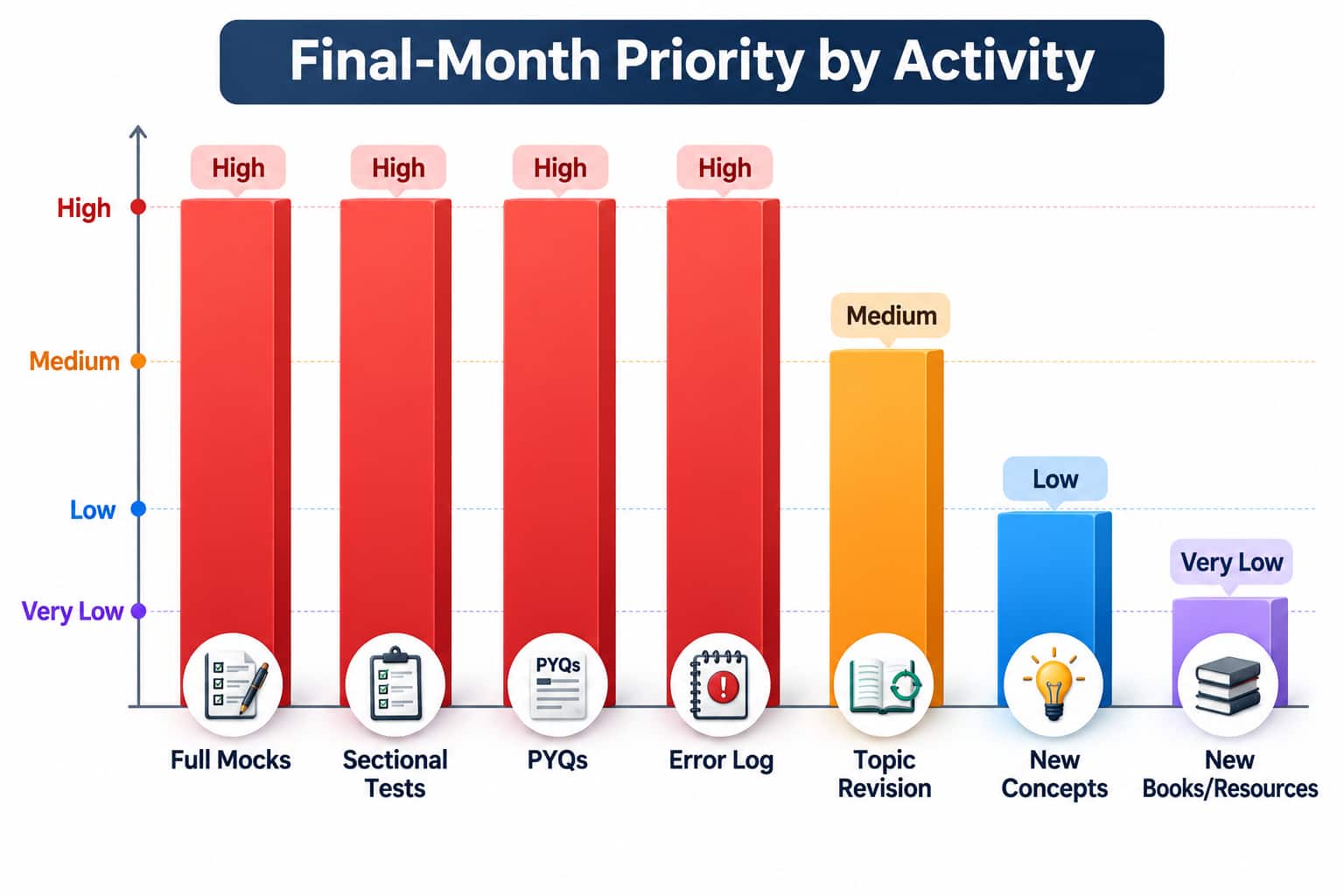
The aim is to improve execution rather than continually expand your preparation material.
The final 15 days should be highly targeted.
Revise formulas, shortcuts and questions from your error log.
Review previously solved sets and mistakes in set selection.
Continue daily RC practice and revise recurring VA errors.
Take mocks selectively and analyse them completely.
Do not introduce multiple new resources at this stage.
The final week should focus on confidence through familiarity rather than last-minute syllabus expansion.
Revise your:
QA formula sheet
DILR approaches
VARC error log
Important PYQs
Mock-analysis notes
Avoid drastically changing your attempt strategy because of one unusually high or low mock score.
A balanced daily routine can look like this:
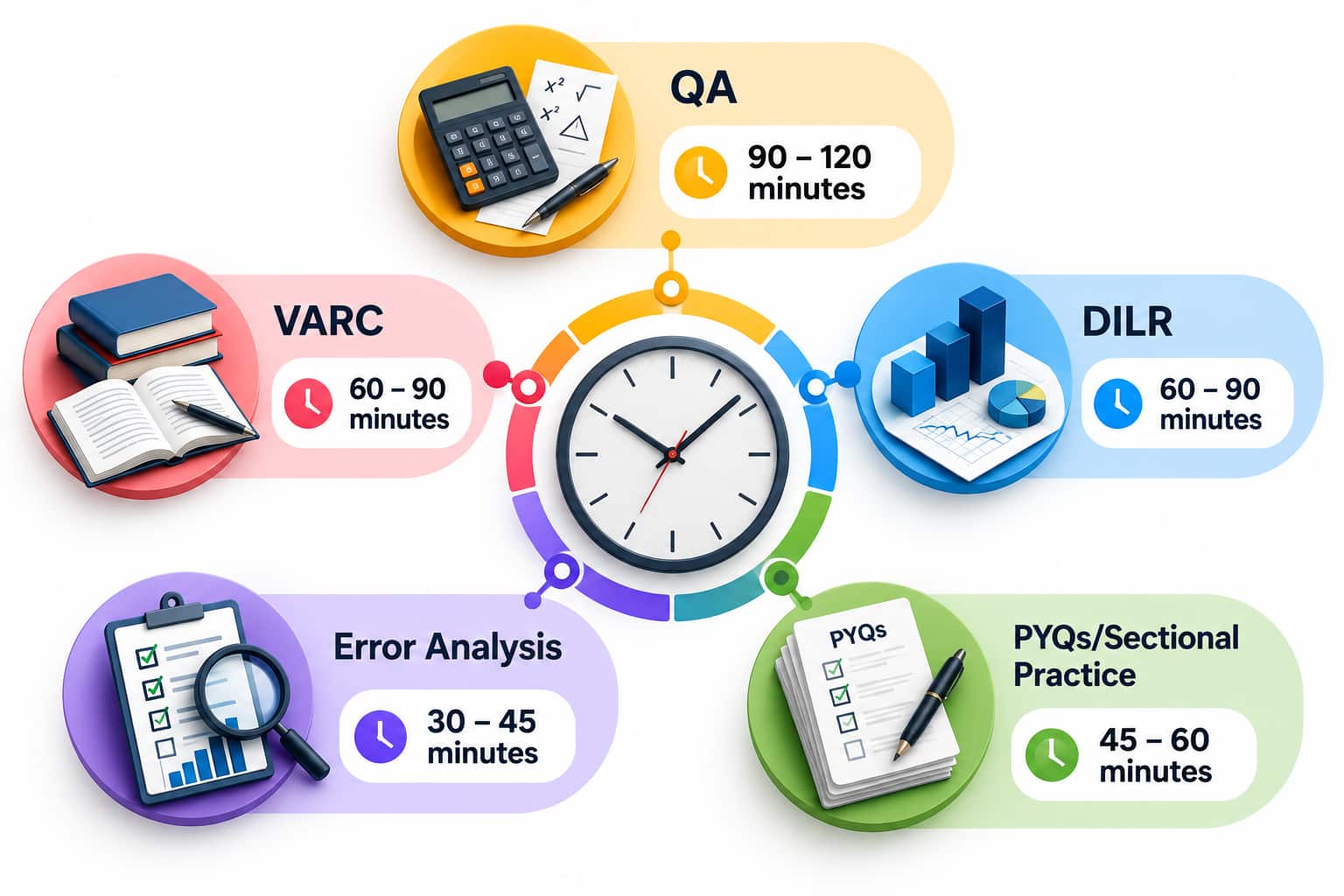
On mock days, replace regular practice with the mock and its analysis.
The most commonly wasted time at this stage is not solving questions incorrectly; it is taking tests without analysing them afterwards.
The final 60 days should be less about finishing the CAT 2026 syllabus and more about improving the decisions you make under the clock. Use recent CAT data to set priorities, use CAT PYQs to sharpen application, and use mocks to measure whether those changes are actually working. With CAT 2026 scheduled for November 29, 2026, the final phase should ultimately move through one cycle: identify → practise → test → analyse → improve.
Frequently Asked Questions (FAQs)
Based on CAT 2025's distribution, Arithmetic and Algebra deserve substantial attention, followed by Geometry, Number System and Modern Mathematics according to your individual weaknesses.
Practise complete sets and focus on set selection, interpretation and time management, rather than solving individual questions without a time limit.
RC should remain a daily part of VARC preparation because CAT 2025 had 16 RC questions out of 24 VARC questions.
Use PYQs to understand question styles and practise concepts, while mocks should be used for time management, question selection and exam simulation.
Track attempts, accuracy, time, easy questions missed, time-consuming questions and recurring conceptual errors. Use these findings to decide what to practise next.

On Question asked by student community
Hello, CAT aur B-school entrance exams ke baare mein aap exam dates, eligibility, registration, exam pattern, syllabus, colleges ya admission process ki information dekh sakte hain. Aapki requirement ke according relevant details yahan mil sakti hain: https://bschool.careers360.com/exams
You can download the latest CAT syllabus from here:
Hey there,
For a B.Sc. with Chemistry, Botany and Zoology (CBZ), if the CAT application asks separately for:
If the Discipline dropdown has a more specific option such as “Biological Sciences,” “Life Sciences,” or “Zoology/Botany,”
Hey there,
Yes. With 2 years of work experience, you are eligible to target the regular 2-year MBA at IIM Calcutta as long as you have a bachelor's degree with at least 50% marks (45% for SC/ST/PwD). Work experience is not required for eligibility.
For
Hey there,
For NIT Hamirpur MBA, the General-category CAT cutoff is not a fixed official percentile. NIT Hamirpur's 2026–27 admission process gives CAT a 10/10 weightage in the test component, followed by an interview; it accepts CAT, CMAT and MAT.
As a practical target, 80+ percentile is worth considering, while
Directions for question:
The bar-graph given below shows the foreign exchange reserves of Nepal (in million Rupees) from 2014 to 2021. Answer the following questions based on the graph :

Question:
What was the percentage increase (rounded to the nearest integer, if deemed necessary) in the foreign exchange reserves in

Globally Recognized by AACSB (US) & AMBA (UK) | 18 LPA Avg. CTC for PGPM 2026
Gateway to IBS Hyderabad & 8 other IBS campuses | Scholarships worth 10 CR
Among top 6% B-Schools globally to be accredited by AACSB | Highest Package-35 LPA
Test centres are available in 70+ cities across India | 75,000+ aspirants apply for the NMAT exam | Accepted by 58+ institutions like NMIMS, KJSIM, ISB, SPJIMR and Great Lakes.
400+ Recruiters | Highest CTC 17.2 LPA | Average CTC 8 LPA | 92% Avg. Placements | Ranked as Platinum Institute | Awarded Best Business School of the Year
Application Open | Scholars’ Round Deadline: 14th Nov’26 | Earn upto 50% merit Scholarship + 10% for top performers | EFMD Accredited | AACSB & Business Graduates Association Member | Highest CTC 28 LPA