


"A Scientist never grows up!"
When he was a kid, he was fascinated by the army, but soon realised that he disliked being bossed around. Then, young Amitabh decided to follow in his dad’s footsteps and become a teacher, and the idea stuck.
“Teaching is more rewarding than doing research, sometimes I think I have a romantic vision of it,” says Amitabh Joshi, an Associate Professor of Evolutionary and Organismal Biology at the Jawaharlal Nehru Centre for Advanced Science and Research, Bangalore, and winner of this year’s prestigious Shanti Swarup Bhatnagar Award (see box) for evolutionary biology.
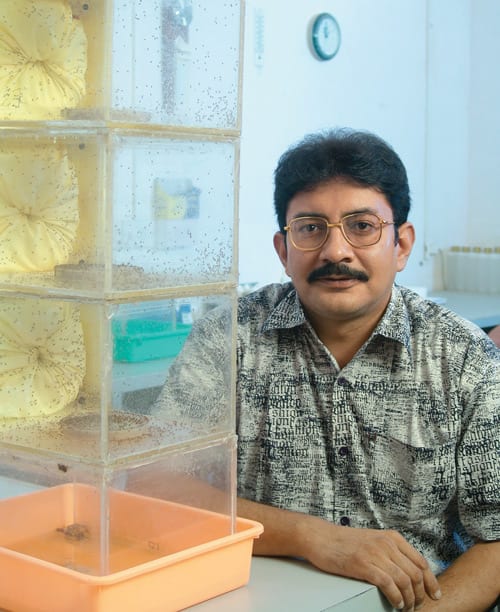
He has been studying the evolution of life-history, biological clocks, and population ecology in organisms through his work on the common fruit fly (drosophila melanogaster). His labs do interesting work in these domains.
He believes that a succinct definition of evolution in biology would be “that it is an interaction between genetics and ecology mediated through the process of development”. In an interview with Shalini Gupta he talks about life beyond science, what inspires him and makes him tick.
Who is your inspiration?
I grew up in a gurukul kind of atmosphere at home with my father being a professor of statistics. He was a dedicated and sincere academician who influenced me a lot. Then while doing my graduation at Delhi University in the 80s, it was the legendary Professor CR Babu - a teacher par excellence, a dedicated scientist and a wonderful human being, who encouraged me to go abroad for my PhD.
Ronald Fisher is my intellectual hero. He is considered the father of modern statistics, who almost single handedly created quantitative genetics (traits governed by a large no. of genes), and was instrumental in setting up of the Indian Statistical Institute.
|
What is your view on India’s scientific talent?
There is no dearth of scientific talent in India. If the saying ‘Genius is one in a million’ was statistically true, we, a nation of over one billion people would be having more than one million geniuses.
But here is where our education system comes into play. It authoritatively emphasises on consuming knowledge and regurgitating it during exams for the first 17 years and then suddenly one is expected to be a producer from a consumer. Having said that, India produces some of the best scientists in the world, not “because” of the system but “despite” it.
How would you define scientific temper?
Every kid is a scientist, because they ask a lot of questions, they are inquisitive about anything and everything under the sun. But over a period of time as we go through our educational system we somehow lose that spark, our inquisitivity dies and we start accepting things the way they are. I think, someone who is a scientist to the core never grows up, he still keeps on asking questions.
What would be your advice to budding scientists?
If you enjoy the thrill of puzzle solving and discovery, then there’s nothing like science. Get into a field that you find interesting, not because people say it’s the next big thing. Students today tend to get practical and plan their career to the last detail. When I decided to pursue my PhD in evolutionary biology, many warned me that it is not a “hot” subject, but I persisted just because I believed in it.
Better to be paid for doing something that you enjoy rather than getting paid and then thinking how you can enjoy yourself. This is the value I believe in and I have been enjoying it for the past 22 years. So if you enjoy doing something, don’t worry if you will get paid or what its scope is, just focus on doing good work.
Scope is not a function of the field you are in, it’s a function of you. Also remember that science is a collective endeavour. Like Newton said, “If I have been able to see further than other men, it is because I was standing on their shoulders.”
More toppers speak up!
How Shubhra aced the civil services
This IIM graduate shares his CAT mantras
