Birla Institute of Management Technology, Greater Noida
AACSB Accredited | Highest CTC: 22 LPA


CAT does not release an official topic-wise weightage, so the distribution is estimated from previous-year papers and recent CAT trends. Reading Comprehension has consistently accounted for about two-thirds of VARC, while Arithmetic and Algebra together form a major share of QA. In DILR, the distribution changes considerably across slots because questions are presented as sets rather than fixed chapters. Recent analyses show Arithmetic contributing roughly 35–40% of QA, while RC contributed about 66–68% of VARC in recent papers. Candidates can use these trends to allocate preparation time without treating the percentages as a fixed CAT 2026 blueprint.
This Story also Contains
Attempt our CAT 2026 Free Mock Test
Each CAT paper varies, but some themes tend to show up with higher frequency and weightage than others. When aspirants study the earlier years' papers, they can spot these recurring trends, manage study time with more precision, and focus on areas that are more likely to affect the final percentile.
Understanding the CAT topic-wise weightage can help you:
While CAT does not follow a fixed blueprint, the latest paper provides the strongest indication of the topics that deserve greater attention for CAT 2026.
As the most recent CAT examination, CAT 2025 offers the most relevant insights for CAT 2026 aspirants. The paper largely continued the trends observed in recent years, with Arithmetic and Algebra dominating Quantitative Aptitude, Reading Comprehension remaining the backbone of VARC, and Logical Reasoning accounting for a larger share of DILR than traditional Data Interpretation. The following analysis is based on the combined question distribution across all three CAT 2025 slots.
The Quantitative Aptitude (QA) section consisted of 22 questions in each slot, resulting in 66 questions across all three CAT 2025 slots. Arithmetic continued to be the most important area, followed by Algebra. Together, these two topics contributed 47 out of 66 questions, accounting for over 71% of the entire QA section.
| Topic | Slot 1 | Slot 2 | Slot 3 | Total | Weightage |
|---|---|---|---|---|---|
| Arithmetic | 10 | 8 | 9 | 27 | 40.9% |
| Algebra | 7 | 7 | 6 | 20 | 30.3% |
| Geometry & Mensuration | 3 | 3 | 4 | 10 | 15.2% |
| Number System | 1 | 2 | 2 | 5 | 7.6% |
| Modern Mathematics | 1 | 2 | 1 | 4 | 6.1% |
The Arithmetic section covered a wide range of concepts, including Ratio & Proportion, Percentages, Profit & Loss, Simple & Compound Interest, Time & Work, Time, Speed & Distance, Mixtures & Alligation, Partnership, Averages, and Arithmetic Progression. Similarly, Algebra included questions from Linear Equations, Quadratic Equations, Linear Inequalities, Functions, Logarithms, Exponents, Integer Equations, and Algebraic Expressions. This balanced distribution indicates that aspirants should focus on building conceptual clarity across all major chapters instead of relying on selective preparation.
The Data Interpretation and Logical Reasoning (DILR) section also consisted of 22 questions in each slot (66 questions across all three slots). CAT 2025 continued the recent trend of favouring Logical Reasoning-based sets over traditional Data Interpretation, with most sets requiring analytical thinking, deduction, and multi-step reasoning.
| Category | Total Questions | Weightage |
|---|---|---|
| Logical Reasoning | 39 | 59.1% |
| Mixed DI-LR Caselets | 15 | 22.7% |
| Pure Data Interpretation | 12 | 18.2% |
| Topic | Questions |
|---|---|
| Ranking & Promotions | 10 |
| Scheduling & Timeline | 10 |
| Trade / Business DI | 9 |
| Arrangement & Seating | 8 |
| Table-based DI | 8 |
| Comparison & Ordering | 4 |
| Logical Matrix | 4 |
| Distribution / Assignment | 4 |
| Sequencing / Movement Puzzle | 4 |
The overall distribution clearly shows that CAT 2025 emphasised reasoning-intensive sets over straightforward calculation-based Data Interpretation, making logical problem-solving an essential skill for CAT 2026 aspirants.
Practice DILR questions by downloading: CAT DILR PYQs- Complete 5-Year Question Bank (2021 - 2025) PDF
The Verbal Ability and Reading Comprehension (VARC) section contained 24 questions in each slot, resulting in 72 questions across all three CAT 2025 slots. Reading Comprehension continued to dominate the section, accounting for 48 out of 72 questions, while the remaining 24 questions came from Verbal Ability.
| Topic | Total Questions (Across All Three Slots) | Weightage |
|---|---|---|
| Reading Comprehension | 48 | 66.67% |
| Verbal Ability | 24 | 33.33% |
Practice Quant questions by downloading: CAT Quant PYQs- Complete 5-Year Question Bank (2021 - 2025) PDF
A notable feature of CAT 2025 was the consistency of the Verbal Ability section. All three slots followed an identical pattern, with equal representation for every question type.
| Verbal Ability Topic | Total Questions (Across All Three Slots) |
|---|---|
| Para Summary | 6 |
| Para Completion | 6 |
| Para Jumbles | 6 |
| Odd One Out | 6 |
Since each topic appeared with equal frequency, aspirants should prepare all four Verbal Ability question types with equal emphasis rather than prioritising one over another.
Across all three CAT 2025 slots, candidates attempted a total of 12 Reading Comprehension passages (4 passages in each slot), comprising 48 questions. The passages covered a broad mix of disciplines, reflecting CAT's continued emphasis on reading adaptability and analytical comprehension rather than domain-specific knowledge.
The overall domain-wise distribution was as follows:
| RC Domain | Total Questions (Across All Three Slots) |
|---|---|
| Humanities (Arts, Culture, Literature, Philosophy & Language) | 16 |
| Science & Research | 12 |
| Economics & Business | 8 |
| Technology & Artificial Intelligence | 4 |
| Society & Public Policy | 4 |
The analysis shows that Humanities-related passages accounted for the largest share of Reading Comprehension, followed by Science and Economics. Technology, Philosophy, Society, Urban Development, and Public Policy also featured across different slots, highlighting the diverse nature of CAT RC passages. To prepare effectively for CAT 2026, aspirants should regularly read editorials, long-form articles, and opinion pieces covering economics, science, technology, philosophy, culture, and current social issues from reputed publications.
Get the detailed breakdown by downloading CAT 2025 Slot by Slot Master Weightage Matrix PDF
Quantitative Aptitude is a scoring section for candidates who practise consistently. Based on past trends in CAT, the topics that are most weighted are Arithmetic and Algebra.
Topic | Approx. Weightage | Key Areas |
Arithmetic | 35–50% | Ratios Averages Time & Work Compound Interest |
Algebra | 25–35% | Functions Inequalities Logarithms |
Geometry & Mensuration | 10–15% | Circles, 2D/3D Mensuration, Coordinate Geometry |
Number Systems | 5–10% | HCF and LCM, Divisibility, Remainders, Floor Functions |
Modern Maths | 5–10% | Probability, Sets, Functions |
High-frequency QA topics: Arithmetic and Algebra consistently appear in CAT 2020–2024, making them must-practice areas. Geometry and Modern Maths appear less frequently but often involve high-difficulty questions, making them valuable scoring topics.
VARC accounts for 24 questions per CAT slot and is dominated by Reading Comprehension passages. Understanding CAT verbal topic-wise weightage ensures focused preparation.
Topic | Approx. Weightage | Key Areas |
Reading Comprehension (RC) | 60–70% | Business, Economics, Social Sciences, Technology passages |
Para Jumbles | 10–15% | Logical ordering of sentences |
Para Summary | 10–15% | Thematic inference and summarisation |
Odd Sentence Out / Para Completion | 5–10% | Identifying irrelevant sentences, completing logical sequences |
Vocabulary & Critical Reasoning | 5–10% | Contextual meaning, assumptions, conclusions |
Tip: RC passages dominate each slot, so practising comprehension, speed reading, and inference is key.
DILR includes puzzles, seating arrangements, and charts. It requires a mix of speed, logic, and analytical skills.
Topic | Approx. Weightage | Key Areas |
Puzzles and | 50–60% | Linear, Circular, Grid-based, Complex arrangements |
Tables & Charts | 40–50% | Tabular data, Bar/Line/Pie charts, Mixed sets |
10–20% | Round-robin, knockout, scoring systems | |
Venn Diagrams & Hybrid Sets | 5–10% | Set theory, logical deduction |
Scheduling & Blood Relations | 5–10% | Task allocation, family trees, directional reasoning |
High-yield DILR topics like Tables, Puzzles, and Seating Arrangements appear every year, making them essential for focused CAT preparation.
The CAT 2024 slot-wise analysis reveals slight variations in question distribution, with DILR maintaining an equal focus on the Data Interpretation and Logical Reasoning components, making historical trend analysis crucial for strategic CAT 2026 preparation.
Section | Dominant Category | Weightage |
QA | Arithmetic | 40.91% |
DILR | Games & Tournaments, QUANT-based LR | 22.73% |
VARC | Reading Comprehension | 66.67% |
Verbal Ability & Reading Comprehension (VARC)
Category | Topics Covered | No. of Qs | % Weightage |
Reading Comprehension | 4 RC Passages × 4 Qs each (Bandicoots, Economics, Craftsmanship, Media) | 16 | 66.67% |
Para Summary | Thematic inference-based summaries | 3 | 12.5% |
Para Completion | Logical sentence continuation | 3 | 12.5% |
Odd One Out | Sentence exclusion from thematic group | 2 | 8.33% |
Total | 24 | 100% |
Data Interpretation & Logical Reasoning (DILR)
Category | Topics Covered | No. of Qs | % Weightage |
Games & Tournaments | Linear Arrangement with Score/Match Logic | 5 | 22.73% |
Distribution | Distribution-based Logical Reasoning | 4 | 18.18% |
Venn Diagrams | Set-based logic involving country visits | 4 | 18.18% |
Line & Bar Graphs | DI set on Candlestick Chart (Bar + Line hybrid) | 4 | 18.18% |
QUANT Based LR | Voter logic and campaign-based quantitative reasoning | 5 | 22.73% |
Total | 22 | 100% |
Quantitative Aptitude (QA)
Category | Topics Covered | No. of Qs | % Weightage |
Arithmetic | Averages, Ratios & Proportions, Percentages, Mixtures & Alligations, Profit & Loss, Time, Speed & Distance, Time & Work, SI | 9 | 40.91% |
Algebra | Linear & Quadratic Equations, Sequence & Series, Logarithms, Surds & Indices | 5 | 22.73% |
Geometry | Triangles, 3D Mensuration, Coordinate Geometry + Inequalities | 3 | 13.64% |
Number System | Remainders, Floor Function | 2 | 9.09% |
Modern Maths | Permutations & Combinations, Set Theory & Functions | 2 | 9.09% |
Total | 22 | 100% |
The distribution is largely similar with minor variations:
VARC: 34.29% weightage per slot
DILR: 31.43% weightage per slot
QA: 31.43% weightage per slot
Students are advised to go through the following articles for a detailed analysis of the CAT 2024 Slot 2 and Slot 3 question papers.
Key Takeaway: Reading Comprehension (VARC), Arithmetic & Algebra (QA), and Puzzles/Seating (DILR) are consistently high-yield areas.
A comparison of the last three CAT examinations shows that while the distribution of questions varies slightly each year, the overall emphasis has remained largely consistent. Arithmetic and Algebra continue to dominate Quantitative Aptitude, Reading Comprehension remains the backbone of VARC, and Logical Reasoning has become increasingly prominent in DILR.
| Section | CAT 2023 | CAT 2024 | CAT 2025 |
|---|---|---|---|
| Quantitative Aptitude | Arithmetic and Algebra carried the highest weightage. | Arithmetic remained the largest contributor, followed by Algebra. | Arithmetic (27 questions) and Algebra (20 questions) together contributed over 71% of the QA section across all three slots. |
| VARC | Reading Comprehension dominated the section with nearly two-thirds of the questions. | Reading Comprehension continued to account for approximately two-thirds of the section. | Reading Comprehension contributed 48 out of 72 questions (66.67%), while all four Verbal Ability topics received equal representation. |
| DILR | LR-based sets formed the core of the section, supported by DI caselets. | Logical reasoning and mixed DI-LR sets continued to dominate. | Logical Reasoning accounted for 39 of 66 questions, with only one traditional DI set appearing in each slot. |
The table below highlights how the weightage of major topics has evolved over the last six CAT examinations. While the exact distribution changes every year, the comparison clearly shows recurring patterns across VARC, DILR, and Quantitative Aptitude. The CAT 2025 row is based on the combined analysis of all three exam slots, making it the latest and most relevant reference for CAT 2026 aspirants.
| Year | VARC | DILR | QA |
|---|---|---|---|
| 2025 | Reading Comprehension 66.67%, Verbal Ability 33.33% (Para Summary, Para Completion, Para Jumbles & Odd One Out contributed equally) | Logical Reasoning 59.1%, Mixed DI-LR Caselets 22.7%, Pure Data Interpretation 18.2% | Arithmetic 40.9%, Algebra 30.3%, Geometry & Mensuration 15.2%, Number System 7.6%, Modern Mathematics 6.1% |
| 2024 | RC 66.67%, Para Summary 12.5%, Para Completion 12.5%, Odd One Out 8.33%* | Games & Tournaments, Quant-based LR, Distribution, Venn Diagrams, Line & Bar Graphs | Arithmetic 40.91%, Algebra 22.73%, Geometry 13.64%, Number System 9.09%, Modern Maths 9.09%* |
| 2023 | RC 68%, Para Jumbles 12%, Para Summary 12%, Para Completion 4% | Tables/Graphs/Arrangements 100% | Arithmetic 41%, Algebra 32%, Geometry 18%, Number System 5%, Modern Maths 5% |
| 2022 | RC 67%, Para Jumbles 14%, Para Summary 13%, Para Completion 8% | Reasoning-based DI 47%, Tables/Graphs 53% | Arithmetic/Algebra 35–40%, Geometry 11%, Number System 18%, Modern Maths 8% |
| 2021 | RC 65%, Para Jumbles 15%, Para Summary 13%, Odd One Out 7% | DI 32%, Tables 35%, Games & Tournaments 7%, Ordering & Ranking 10%, Bar Graphs 13% | Arithmetic/Algebra 35–40%, Geometry 6–8%, Number System 14%, Modern Maths 5% |
| 2020 | RC 79%, Para Jumbles 11%, Para Summary 11%, Odd One Out 10% | Tables 47%, Reasoning DI 22%, Games & Tournaments 10%, Bar Graphs 8%, Venn Diagrams 7% | Arithmetic 15%, Number System 26%, Geometry & Mensuration 9%, Modern Maths 8%, Algebra 12%, Time & Work 15% |
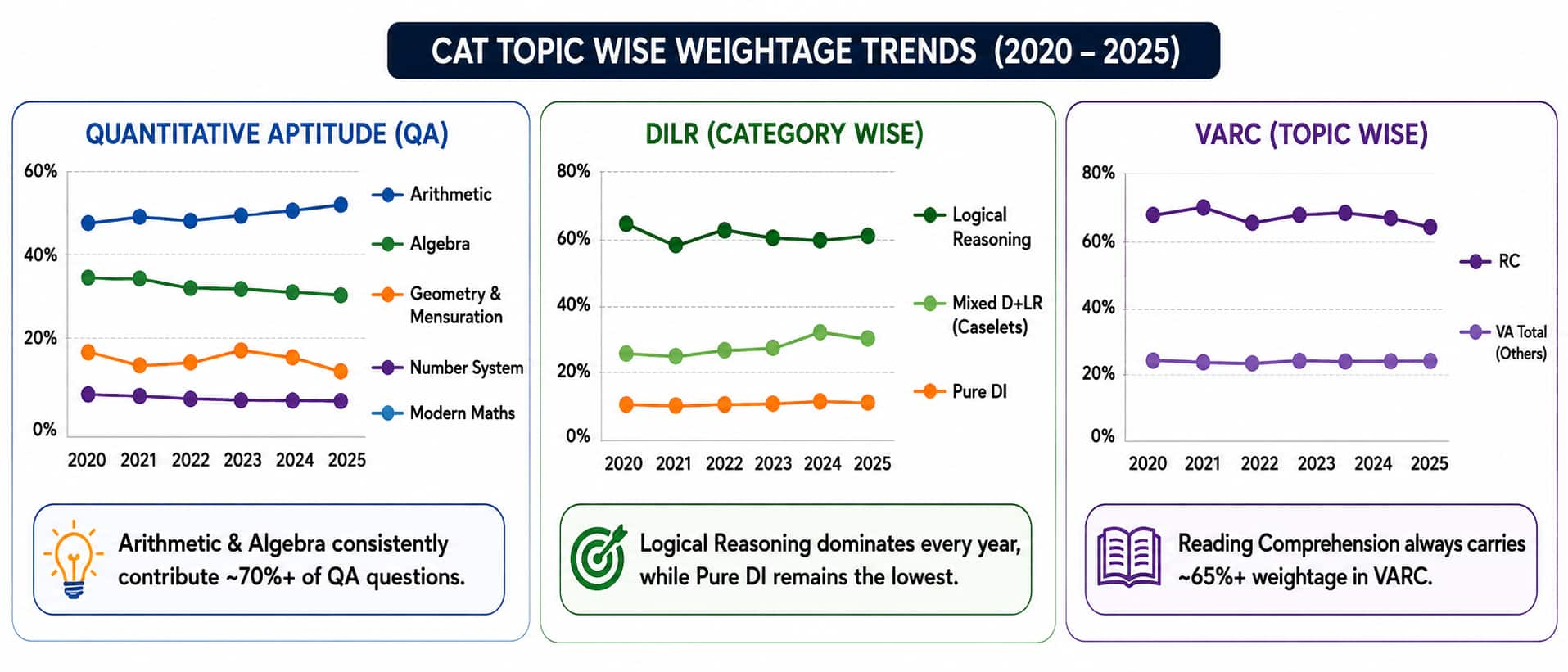
The historical comparison highlights several consistent patterns that can help aspirants prepare more strategically for CAT 2026:
Previous years' CAT topic-wise weightage helps you identify high-frequency topics and allocate your preparation time more effectively. While the exact distribution changes every year, recurring trends make it easier to prioritise important chapters and improve your overall strategy.
Focus first on topics that consistently carry maximum weightage, such as Arithmetic and Algebra in QA, Reading Comprehension in VARC, and Logical Reasoning-based sets in DILR. Building a strong foundation in these areas can significantly improve your overall score.
Divide your preparation time according to topic importance. Spend more time on high-weightage topics while ensuring moderate and low-weightage chapters are also covered to avoid missing easy marks.
Compare your mock test performance with historical topic trends to identify weak areas. Focus your revisions on topics that appear frequently and where your accuracy is low.
Based on CAT 2025 and previous years' trends, these topics should be prioritised for CAT 2026 preparation:
No. Topic-wise weightage helps you prepare more strategically, but a 99 percentile also requires strong conceptual clarity, consistent mock practice, effective time management, and high accuracy across all three sections. Aspirants should use topic-wise trends to prioritise preparation, not to predict the exact CAT paper.
The CAT ebooks are a helpful resource that helps candidates prepare for the examination. These ebooks cover different sections of the subjects relevant to the examination. Candidates must use these ebooks and prepare for the examination accordingly. Refer to the table below to get the download links for the CAT 2026.
Ultimate DILR CAT 2026 Guide: Concepts, Practice Sets and Detailed Solutions | |
500+ Idioms And Phrases List With Meanings & Examples For MBA Entrance Exams | |
CAT VARC: 3000+ Most Important English Words | |
The CAT Arithmetic Hackbook PDF: Zero Math Background? No Problem- Concepts, Questions | |
CAT Algebra Handbook 2026: Everything You Need to Master Algebra-Concepts, Practice Questions | |
CAT 2026 Number System PDF Handbook: Complete Concepts, Practice Questions & Solutions | |
CAT 2026 Geometry & Mensuration PDF: Important Concepts, Shortcuts & Practice Questions | |
CAT 2026 Modern Maths PDF Handbook: Key Concepts, Tricks & PYQ-Based Practice | |
CAT 2025 Slot-by-Slot Master Weightage Matrix PDF | |
15 CAT Myths That Waste Months of Preparation | |
8 Expert-Curated Philosophy Editorials with CAT-Style Questions | |
CAT Quant PYQs- Complete 5-Year Question Bank (2021 - 2025) PDF |
Frequently Asked Questions (FAQs)
It identifies high-frequency topics where mistakes occur, allowing aspirants to focus on critical scoring areas for maximum impact.
While the final pattern is released by IIMs each year, the general trend shows around 68 questions divided into three sections, VARC (24), DILR (22), and Quant (22). The exact topic distribution varies, but knowing past weightage helps you predict where to focus for the best results.
In VARC, Reading Comprehension carries around 70% weightage, while Para Jumbles, Para Summary, and Odd Sentence Out make up the remaining share.
Data Interpretation and Logical Reasoning (DILR) is often considered the most difficult section. Within it, complex puzzle-based and arrangement sets trouble most aspirants.
Focusing on high-weightage topics during mocks increases correct attempts and reduces time spent on unfamiliar areas. It also highlights weak topics needing more practice, boosting both confidence and percentile in CAT 2026.
No, low-weightage topics may appear in tricky questions that can make a difference in top percentiles. A balanced approach, prioritising high-weightage while revising moderate topics, ensures better overall performance and reduces risk.

On Question asked by student community
Hello, for AP NEET PG Category C seats, NRI documents are generally required if you are applying under the NRI quota, and eligibility depends on the applicable counselling rules. The fee payment currency and procedure should be confirmed from the current Dr. NTRUHS notification at its official website drntr.uhsap.in.
Hello, CAT aur B-school entrance exams ke baare mein aap exam dates, eligibility, registration, exam pattern, syllabus, colleges ya admission process ki information dekh sakte hain. Aapki requirement ke according relevant details yahan mil sakti hain: https://bschool.careers360.com/exams
You can download the latest CAT syllabus from here:
Hey there,
For a B.Sc. with Chemistry, Botany and Zoology (CBZ), if the CAT application asks separately for:
If the Discipline dropdown has a more specific option such as “Biological Sciences,” “Life Sciences,” or “Zoology/Botany,”
Hey there,
Yes. With 2 years of work experience, you are eligible to target the regular 2-year MBA at IIM Calcutta as long as you have a bachelor's degree with at least 50% marks (45% for SC/ST/PwD). Work experience is not required for eligibility.
For
Directions for question:
The bar-graph given below shows the foreign exchange reserves of Nepal (in million Rupees) from 2014 to 2021. Answer the following questions based on the graph :

Question:
What was the percentage increase (rounded to the nearest integer, if deemed necessary) in the foreign exchange reserves in

Globally Recognized by AACSB (US) & AMBA (UK) | 18 LPA Avg. CTC for PGPM 2026
75+ years of legacy | #1 Entrance Exam | Score accepted by 250+ BSchools
Gateway to IBS Hyderabad & 8 other IBS campuses | Scholarships worth 10 CR
Highest Package 29.30 LPA | 12 LPA Median CTC | 230+ Recruiters | AACSB Accredited | Ranked 51 in Asia by QS International
Early Application Round Deadline: 27th Oct’26 | 400+ Recruiters | Highest CTC 17.2 LPA | Average CTC 8 LPA | 92% Avg. Placements | Awarded Best Business School of the Year
Last Date to Apply - 19th December 2026 | Highest CTC 68.66 LPA | Average CTC 18.08 LPA | Top 25% Average CTC 24.66 LPA