Birla Institute of Management Technology, Greater Noida
AACSB Accredited | Highest CTC: 22 LPA


CAT Quantitative Aptitude tests a candidate’s conceptual understanding, calculation speed and ability to solve questions efficiently within a limited time. With CAT 2026 scheduled for November 29, 2026, knowing the right calculation techniques can help reduce unnecessary steps while solving Quant questions. This article covers useful shortcut methods, formulas and calculation techniques for Arithmetic, Algebra, Number System, Geometry, Mensuration, Trigonometry, Probability and Permutation & Combination.
This Story also Contains

CAT 2026 will have three sections: VARC, DILR and QA. The QA section carries 22 questions and has a 40-minute sectional time limit. Check the CAT 2026 Exam Pattern for Quant below:
| Particular | CAT 2026 |
|---|---|
| QA Questions | 22 |
| QA Marks | 66 |
| QA Duration | 40 minutes |
| Correct Answer | +3 |
| Incorrect MCQ | -1 |
| TITA | No negative marking |
CAT does not prescribe a fixed topic-wise QA syllabus. However, previous-year question trends show that the section broadly covers the following areas:
| Area | Important Topics |
|---|---|
| Arithmetic | Percentages, Ratio, Proportion, Averages, Mixtures, Profit & Loss, Simple Interest & Compound Interest, TSD, Time & Work |
| Algebra | Linear & Quadratic Equations, Inequalities, Functions, Algebraic Identities |
| Number System | Divisibility, Factors, LCM & HCF, Remainders, Number Properties |
| Geometry & Mensuration | Triangles, Circles, Quadrilaterals, Coordinate Geometry, Areas & Volumes |
| Modern Maths | P&C, Probability, Set Theory |
| Other Topics | Trigonometry, Logarithms, Surds |
An analysis of 330 CAT Quant questions from 2021 to 2025 shows that Arithmetic and Algebra together contributed 233 questions, or 70.6% of the five-year sample. Arithmetic was the largest individual category with 135 questions, followed by Algebra with 98.
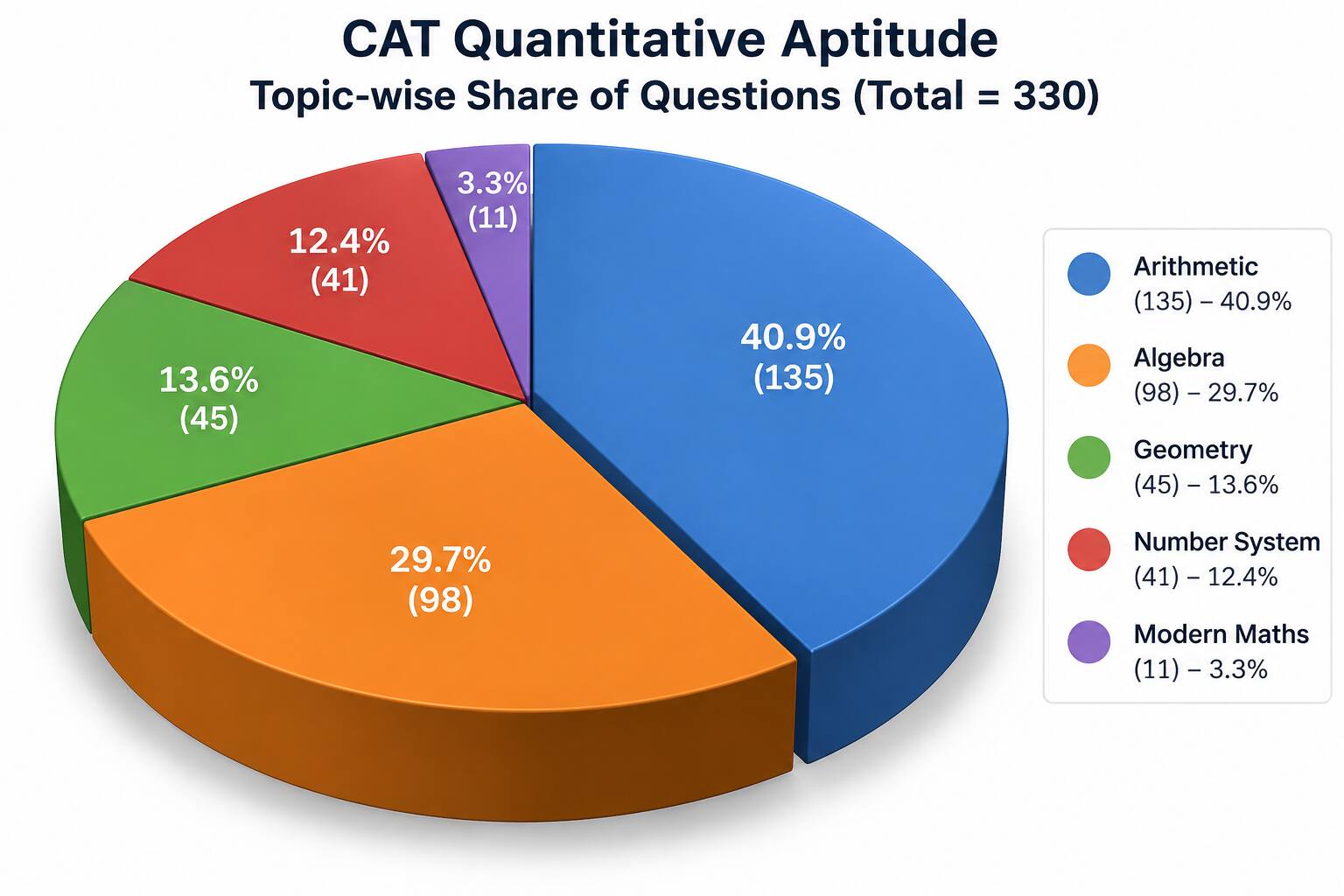
The trend indicates that Arithmetic and Algebra deserve strong conceptual preparation, while Geometry, Number System and Modern Maths should also be covered rather than skipped.
Practise CAT Quant previous year questions from 2021 to 2025 to understand recurring concepts, question patterns and exam-level difficulty. Download Now
The QA section has 22 questions to be solved in 40 minutes, making efficient calculation important. Shortcuts can help reduce unnecessary steps in familiar question types, but they should be used only after understanding the underlying concept.
Number System concepts are useful for direct questions as well as problems involving Arithmetic and Algebra. The following shortcuts can help reduce calculation time.
For divisibility by $9$, add the digits of the number.
Example: For $N=37895$:
$3+7+8+9+5=32$
Since $32$ is not divisible by $9$, $37895$ is not divisible by $9$.
A number of the form $abcabc$ can be expressed as a multiple of $1001$.
$abcabc=abc\times1001$
Since $1001=7\times11\times13$, this pattern is useful in divisibility and factorisation questions.
Example:
$325325\div1001=325$
Writing a number using convenient factors can simplify LCM, HCF and factor-related questions.
Example:
$240=16\times15=2^4\times3\times5$
Cancelling common factors before multiplication can reduce the number of calculation steps.
Example:
$\frac{50\times35+28\times25}{75\times30+60\times15}=\frac79$
Arithmetic covers Percentage, Ratio, Average, TSD and Time & Work, making calculation efficiency important in the QA section.
Using nearby round numbers can make mental calculations faster.
$28+8=28+10-2=36$
$36+9=36+10-1=45$
$57-8=57-10+2=49$
$87+65=87+60+5=152$
The following conversions can simplify divisions by common numbers.
| Division | Shortcut |
|---|---|
| $\div5$ | $\times2\div10$ |
| $\div25$ | $\times4\div100$ |
| $\div125$ | $\times8\div1000$ |
These shortcuts replace division with simpler multiplication and scaling.
Examples: $523\div5=104.6$, $728\div25=29.12$, and $523\div125=4.184$.
These common percentage-fraction conversions are useful for quick calculations.
| Percentage | Fraction |
|---|---|
| $25\%$ | $\frac14$ |
| $33.33\%$ | $\frac13$ |
| $50\%$ | $\frac12$ |
| $20\%$ | $\frac15$ |
| $10\%$ | $\frac1{10}$ |
For example, if B is $30%$ more than A and $A=₹200$, then $B=200\times1.30=₹260$.
For a standard late/early problem, the distance can be obtained directly using the following relation.
$D=\frac{S_1S_2\times\text{time difference}}{S_2-S_1}$
For $S_1=7$ km/h, $S_2=8$ km/h and a time difference of $15$ minutes:
$D=\frac{7\times8\times\frac14}{8-7}=14\text{ km}$
The LCM method provides a quick way to calculate combined work rates.
If A takes $8$ days and B takes $14$ days:
$\text{Total work}=\operatorname{LCM}(8,14)=56$
$A=\frac{56}{8}=7$ units/day
$B=\frac{56}{14}=4$ units/day
Together, they complete $11$ units/day.
Therefore, $\text{Time}=\frac{56}{11}$ days.
Algebraic identities can reduce lengthy calculations and help with factorisation.
The following identities are particularly useful for CAT Quant.
| Identity | Formula |
|---|---|
| Square of sum | $(a+b)^2=a^2+2ab+b^2$ |
| Square of difference | $(a-b)^2=a^2-2ab+b^2$ |
| Difference of squares | $(a+b)(a-b)=a^2-b^2$ |
| Cube of sum | $(a+b)^3=a^3+3a^2b+3ab^2+b^3$ |
These identities are useful for both simplification and faster numerical calculations.
Example:
$42\times38=(40+2)(40-2)=40^2-2^2=1596$
A perfect-square quadratic can often be recognised immediately.
$x^2+6x+9=0$
Therefore:
$(x+3)^2=0$
Pythagorean relationships and standard geometric results can help reduce calculation steps in familiar question types.
These commonly used triplets can be recalled directly.
| Triplet | Hypotenuse |
|---|---|
| $(3,4,5)$ | $5$ |
| $(5,12,13)$ | $13$ |
| $(6,8,10)$ | $10$ |
| $(8,15,17)$ | $17$ |
For example, when the perpendicular sides are $8$ and $15$, the hypotenuse is $17$.
The circumradius of an equilateral triangle of side $a$ is given by:
$R=\frac{a}{\sqrt3}$
For $a=6$:
$R=\frac6{\sqrt3}=2\sqrt3$
Knowing standard formulas helps reduce the time spent deriving basic area and volume relationships.
The following formulas cover several frequently used shapes.
| Shape | Formula |
|---|---|
| Parallelogram | $A=bh$ |
| Circle | $A=\pi r^2$ |
| Cylinder Volume | $V=\pi r^2h$ |
| Cylinder CSA | $2\pi rh$ |
| Cone Volume | $V=\frac13\pi r^2h$ |
These formulas can be used directly when the required dimensions are given.
For a regular hexagon of side $a$, the standard formulas are:
$A=\frac{3\sqrt3}{2}a^2$
$R=a$
For $a=8$:
$A=96\sqrt3\text{ sq. units}$
$R=8\text{ units}$
Explore the CAT 2025 Slot-Wise Master Weightage Matrix to analyse section-wise and topic-wise question distribution across all three slots. Download Now
Basic trigonometric ratios and identities are useful when geometry questions involve angles.
For a right triangle:
$\sin\theta=\frac{P}{H}$
$\cos\theta=\frac{B}{H}$
$\tan\theta=\frac{P}{B}$
These identities are useful for simplifying trigonometric expressions.
$\sin^2\theta+\cos^2\theta=1$
$\sec^2\theta-\tan^2\theta=1$
For the area of a triangle:
$A=\frac12ab\sin C$
For $a=10$, $b=7$ and $C=30^\circ$:
$A=\frac12(10)(7)\sin30^\circ=17.5\text{ cm}^2$
Basic outcome-counting formulas can simplify straightforward Probability and P&C questions.
The basic probability formula is:
$P(E)=\frac{\text{Favourable outcomes}}{\text{Total outcomes}}$
For $n$ coin tosses:
$\text{Total outcomes}=2^n$
For $n$ dice:
$\text{Total outcomes}=6^n$
When each of $n$ distinct objects can independently be placed in any of $r$ boxes, the number of ways is:
$\text{Number of ways}=r^n$
For 5 letters and 3 boxes:
$3^5=243$
The following table summarises the main shortcut areas covered in the article.
| Area | Key Shortcuts |
|---|---|
| Number System | Divisibility, factorisation, cancellation |
| Arithmetic | Percentage, ratio, TSD, LCM method |
| Algebra | Identities, factorisation |
| Geometry | Pythagorean triplets |
| Mensuration | Standard area and volume formulas |
| Trigonometry | Ratios and identities |
| Probability | $2^n$ and $6^n$ |
| P&C | $r^n$ |
Use these shortcuts as a revision checklist after completing the underlying concepts and practising CAT-level questions.
Shortcuts are most effective when applied to familiar concepts under timed conditions.
Learn the underlying concept first.
Practise each shortcut with different question types.
Apply shortcuts to CAT previous-year questions.
Use timed sectional tests to improve speed.
Maintain an error log for calculation mistakes.
Avoid a shortcut if it increases the possibility of an incorrect answer.
To find the number of factors of a factorial, like n!, follow these steps:
Prime Factorization: First, find the prime factorization of n!. For this, you need to determine the highest power of each prime number that divides n!. For a prime p, this power can be calculated using the formula:
Highest power of p in n! = (n/p) + (n/p²) + (n/p³) + …, where you stop when p^k > n.
Number of Factors: Once you have the prime factorization of n!, express it in the form p₁a₁ × p₂a₂ × … × pₖaₖ. To find the total number of factors, use the formula:
Number of factors = (a₁ + 1) × (a₂ + 1) × … × (aₖ + 1).
Here, a₁, a₂, …, aₖ are the powers of the prime factors.
The assumption technique is a method used in quantitative aptitude problems, especially in algebra and statistics, to simplify complex problems by making reasonable assumptions. Here’s how to use it:
Identify the Variables: Understand the variables involved in the problem and what you need to find.
Make an Assumption: Choose a reasonable value for one of the variables to simplify calculations. For example, assume a specific value for an unknown or a common value to test the feasibility of different options.
Solve the Simplified Problem: Use the assumed value to solve the problem and derive a solution or pattern. This helps in making the problem more manageable and often leads to insights about the real values.
Validate the Assumption: Check if the solution obtained with the assumption fits all conditions of the problem. Adjust the assumption if necessary and repeat the process.
For numbers between 30 and 70, you can use the following shortcuts to quickly find their squares:
Use the Formula: For numbers near 50, use the formula: (50 ± d)² = 2500 ± 2 × 50 × d + d². Here, d is the difference from 50. For example, to find 53², use:
53² = (50 + 3)² = 50² + 2 × 50 × 3 + 3² = 2500 + 300 + 9 = 2809.
Break Down Larger Numbers: For numbers further from 50, break them into simpler parts. For instance, to find 68², use:
68² = (70 - 2)² = 70² - 2 × 70 × 2 + 2² = 4900 - 280 + 4 = 4624.
Direct Multiplication: For exact squares, use direct multiplication if you’re comfortable. For example, 34² = 34 × 34 = 1156.
Estimate and Adjust: For quicker estimates, find the nearest base (like 50 or 100), calculate the square, and adjust for the difference.
Using these tricks and techniques will help you tackle problems related to factorials, assumptions, and squares more efficiently.
Percentages: To quickly find 15% of a number, calculate 10% and 5% separately and add them together. For example, 15% of 240 is 24 (10% of 240) + 12 (5% of 240) = 36.
Squaring Numbers Close to 50: For numbers close to 50, use (a+b)² = a² + 2ab + b². For example, to find 48², use (50 - 2)² = 50² - 2 × 50 × 2 + 2² = 2500 - 200 + 4 = 2304.
Multiplying Numbers Close to 100: For numbers like 97 and 98, use (100 - a) × (100 - b) = 10000 - 100(a + b) + ab. So, 97 × 98 = 10000 - 100(97 + 98) + (97 × 98) = 9506.
Percentage Increase/Decrease: To find a percentage increase, use (New Value - Old Value) / Old Value × 100%. For a decrease, the formula is (Old Value - New Value) / Old Value × 100%.
Finding the Average: To quickly find the average of a set of numbers, sum them up and divide by the number of items. For example, the average of 8, 12, and 15 is (8 + 12 + 15) / 3 = 35 / 3 = 11.67.
Simple Interest Calculation: Use the formula SI = (P × R × T) / 100, where P is the principal, R is the rate of interest, and T is the time in years.
Compound Interest Approximation: For compound interest, use the formula A = P × (1 + R/100)ⁿ, where P is the principal, R is the rate, and n is the number of periods. For quick approximation, use 1 + (R/100)ⁿ.
Ratios: To simplify ratios, divide all terms by their greatest common divisor. For example, 30:45 simplifies to 2:3 (since both 30 and 45 can be divided by 15).
Time and Work: If A can complete a job in x days and B in y days, their combined work rate is 1/x + 1/y. For example, if A can finish in 6 days and B in 12 days, their combined rate is 1/6 + 1/12 = 1/4, so they finish in 4 days.
Finding Percentages of Large Numbers: To find 8% of 1250, calculate 10% of 1250 (which is 125), and then subtract 2% (which is 25). Thus, 8% of 1250 = 125 - 25 = 100.
Shortcuts become useful through repeated application. After learning a technique, practise it with CAT-level questions and previous-year questions to check whether it actually saves time.
CAT 2026 Quant ebooks and recommended resources
The following CAT 2026 Quant ebooks and resources cover key concepts, formulas, shortcuts, practice questions, PYQs and sectional tests to support focused Quantitative Aptitude preparation.
| eBook Title | Download Link |
|---|---|
| CAT 2026 Arithmetic Important Concepts and Practice Questions | Download Now |
| CAT 2026 Algebra Important Concepts and Practice Questions | Download Now |
| CAT 2026 Quantitative Aptitude Study Material PDF - Geometry and Mensuration | Download Now |
| CAT 2026 Number System Important Concepts & Practice Questions | Download Now |
| CAT 2026 Quantitative Aptitude Cheat Sheet | Download Now |
| Permutation & Combination - Important Concepts, Videos, Questions for CAT & Other MBA Entrance Exams | Download Now |
| CAT 2026 Quantitative Aptitude Questions with Answers PDF | Download Now |
| CAT 2026 Important Formulas | Download Now |
| CAT 2026 Quantitative Aptitude 20 Free Sectional Tests | Download Now |
| 100 Quant Facts Every CAT Aspirant Must Know | Download Now |
| The CAT Arithmetic Hackbook PDF: Zero Math Background? No Problem - Concepts, Questions | Download Now |
| CAT Algebra Handbook 2026: Everything You Need to Master Algebra - Concepts, Practice Questions | Download Now |
| CAT 2026 Number System PDF Handbook: Complete Concepts, Practice Questions & Solutions | Download Now |
| CAT 2026 Geometry & Mensuration PDF: Important Concepts, Shortcuts & Practice Questions | Download Now |
| CAT 2026 Modern Maths PDF Handbook: Key Concepts, Tricks & PYQ-Based Practice | Download Now |
| CAT 2026: 10 Most Repeated Concepts in Quant | Download Now |
| CAT Time & Work: Top 30 Practice Questions with Answer Key & Detailed Solutions | Download Now |
| CAT Quadratic Equations: Top 30 Practice Questions with Answer Key & Detailed Solutions | Download Now |
These resources cover concept building, formulas, topic-wise practice, PYQs, sectional tests and high-frequency Quant topics for CAT 2026.
Access free CAT practice questions in MCQ format with detailed solutions to strengthen concepts, improve accuracy and practise exam-level Quant questions.
TITLE | STUDY LINKS |
NUMBER SYSTEMS SET 1 | |
NUMBER SYSTEMS SET 2 | |
RATIO, PROPORTION & VARIATION SET 1 | |
RATIO, PROPORTION & VARIATION SET 2 | |
PERCENTAGES SET 1 | |
PERCENTAGES SET 2 | |
PROFIT, LOSS & DISCOUNT SET 1 | |
PROFIT, LOSS & DISCOUNT SET 2 | |
INTEREST SET 1 | |
INTEREST SET 2 | |
AVERAGES AND MIXTURES SET 1 | |
AVERAGES AND MIXTURES SET 2 | |
TIME, SPEED & DISTANCE SET 1 | |
TIME, SPEED & DISTANCE SET 2 | |
TIME & WORK SET 1 | |
TIME & WORK SET 2 | |
POLYNOMIALS SET 1 | |
POLYNOMIALS SET 2 | |
EQUATIONS SET 1 | |
EQUATIONS SET 2 | |
FUNCTIONS SET 1 | |
FUNCTIONS SET 2 | |
SEQUENCE & SERIES SET 1 | |
SEQUENCE & SERIES SET 2 | |
GEOMETRY SET 1 | |
GEOMETRY SET 2 | |
MENSURATION SET 1 | |
MENSURATION SET 2 | |
PERMUTATIONS AND COMBINATIONS SET 1 | |
PERMUTATIONS AND COMBINATIONS SET 2 | |
PROBABILITY SET 1 | |
PROBABILITY SET 2 | |
SET THEORY SET 1 | |
SET THEORY SET 2 | |
COORDINATE GEOMETRY SET 1 | |
COORDINATE GEOMETRY SET 2 | |
TRIGONOMETRY SET 1 | |
TRIGONOMETRY SET 2 | |
LOGARITHM AND SURDS SET 1 | |
LOGARITHM AND SURDS SET 2 | |
STATISTICS SET 1 | |
STATISTICS SET 2 |
Frequently Asked Questions (FAQs)
You can start practicing with LOD 1 (Level of Difficulty 1) questions. Once you get comfortable with the methods, move to sample papers and CAT PYQs. Solve a lot of questions from each topic.
The CAT QA section covers the following topics:
Percentage
Ratios
Averages
Profit & Loss
Simple and Compound Interest
Time, Speed and Distance
Time & Work
Numbers and their classification
LCM & HCF
Lines and angles
Triangles
Circles
Quadrilaterals
Mensuration
Trigonometry
Co-ordinate Geometry
Advance Linear Equations
Quadratic Equations
Inequalities & Modulus
Permutation & Combination
Probability
The Quant section has a total of 22 questions with a sectional time limit of 40 minutes.
Go through the CAT QA syllabus and understand the exam pattern. Start by revising basic concepts.
Take the help of online or offline tutors if you’re weak in maths. A thorough understanding of basic concepts is necessary.
Practice questions from CAT QA books, sample papers and PYQs regularly.
Don’t forget to revise the concepts that you have studied.
Take mock tests regularly to gauge your performance and analyze the mocks to identify your strengths and weaknesses. Work on weak areas accordingly.
Yes, if you use shortcut methods correctly then they are reliable. For this, you should practice a lot using shortcut methods to improve your accuracy and speed.

On Question asked by student community
Hello, for AP NEET PG Category C seats, NRI documents are generally required if you are applying under the NRI quota, and eligibility depends on the applicable counselling rules. The fee payment currency and procedure should be confirmed from the current Dr. NTRUHS notification at its official website drntr.uhsap.in.
Hello, CAT aur B-school entrance exams ke baare mein aap exam dates, eligibility, registration, exam pattern, syllabus, colleges ya admission process ki information dekh sakte hain. Aapki requirement ke according relevant details yahan mil sakti hain: https://bschool.careers360.com/exams
You can download the latest CAT syllabus from here:
Hey there,
For a B.Sc. with Chemistry, Botany and Zoology (CBZ), if the CAT application asks separately for:
If the Discipline dropdown has a more specific option such as “Biological Sciences,” “Life Sciences,” or “Zoology/Botany,”
Hey there,
Yes. With 2 years of work experience, you are eligible to target the regular 2-year MBA at IIM Calcutta as long as you have a bachelor's degree with at least 50% marks (45% for SC/ST/PwD). Work experience is not required for eligibility.
For
Directions for question:
The bar-graph given below shows the foreign exchange reserves of Nepal (in million Rupees) from 2014 to 2021. Answer the following questions based on the graph :

Question:
What was the percentage increase (rounded to the nearest integer, if deemed necessary) in the foreign exchange reserves in

Globally Recognized by AACSB (US) & AMBA (UK) | 18 LPA Avg. CTC for PGPM 2026
75+ years of legacy | #1 Entrance Exam | Score accepted by 250+ BSchools
Gateway to IBS Hyderabad & 8 other IBS campuses | Scholarships worth 10 CR
Highest Package 29.30 LPA | 12 LPA Median CTC | 230+ Recruiters | AACSB Accredited | Ranked 51 in Asia by QS International
Early Application Round Deadline: 27th Oct’26 | 400+ Recruiters | Highest CTC 17.2 LPA | Average CTC 8 LPA | 92% Avg. Placements | Awarded Best Business School of the Year
Last Date to Apply - 19th December 2026 | Highest CTC 68.66 LPA | Average CTC 18.08 LPA | Top 25% Average CTC 24.66 LPA