


Aestivation: The Floral Arrangement
Aestivation in plants is the arrangement of sepals and petals inside a flower bud before blooming. This floral arrangement is an important concept in plant morphology. Botanists use aestivation in plants for classification, identification, and tracing evolutionary relationships. Plant families like Fabaceae, Solanaceae, and Brassicaceae are identified by their types of aestivation. It also shows the biological importance of aestivation in plants across different families.
This Story also Contains
- Definition of Aestivation in Plants
- Types of Aestivation in Plants with Examples
- Biological Importance of Aestivation
- Difference Between Types of Aestivation: Floral Arrangement Patterns with Examples
- Aestivation in Plant Families
- Factors Affecting Aestivation
- Aestivation NEET MCQs
- Recommended Video on "Aestivation"
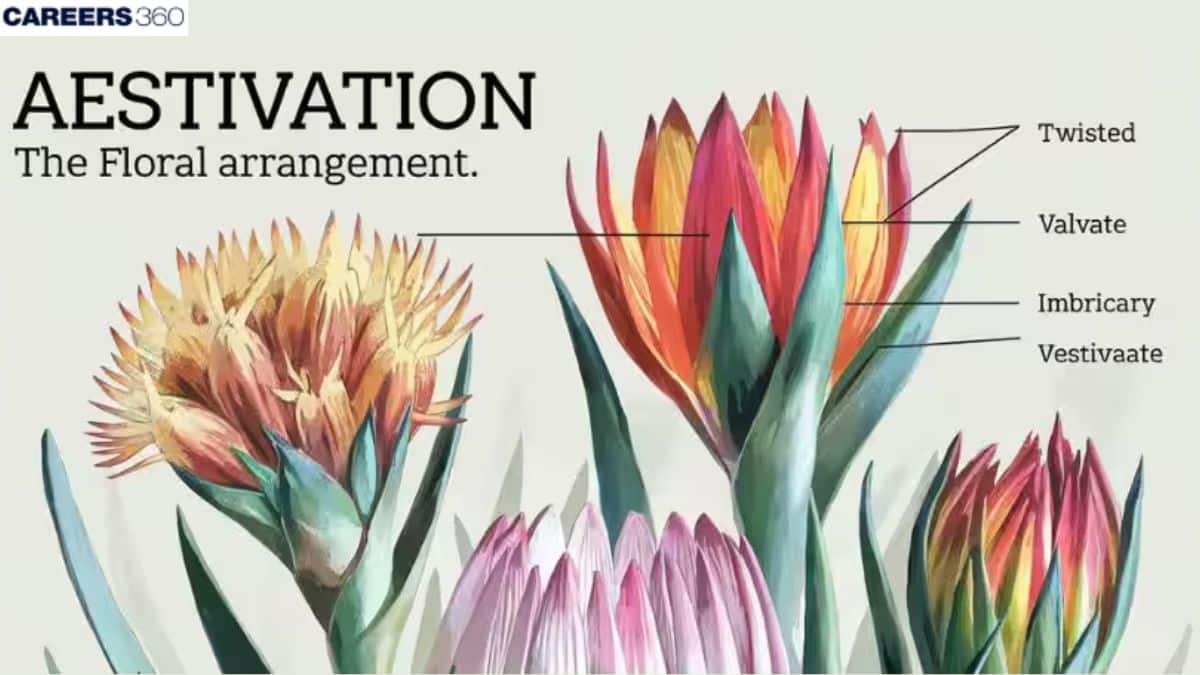
The definition of aestivation in plants explains how sepals and petals are placed in the bud. It is often confused with vernation, which is the arrangement of leaves in a bud. The sepals and petals are collectively known as a perianth. The Morphology of flowering plants shows different floral arrangement patterns like Valvate Aestivation, Twisted Aestivation, Imbricate Aestivation, Vexillary Aestivation, and Quincuncial Aestivation. Studying aestivation in plants with examples improves knowledge of morphology and helps solve MCQs on aestivation in NEET Biology notes.
Definition of Aestivation in Plants
Aestivation in plants is the arrangement of petals and sepals inside the flower bud before blooming. This floral arrangement is of huge importance for the development of the flower and of its function in plant morphology. Botanists study asevation in plants to identify and classify plant families like Solanaceae, Fabaceae, and Liliaceae in the ecosystem
The definition of aestivation explains how the sepal and petal are placed in the flower bud. Botanists will know floral arrangement patterns to understand the evolutionary interrelationships between different plant species. The biological importance of aestivation in plants lies in how the floral arrangement of sepals and petals in the flower bud protects reproductive organs, supporting pollination too. Aestivation affects the reproduction in plants through its effects on how flowers interact with pollinators and in protecting their reproductive organs.
Types of Aestivation in Plants with Examples
Aestivation in plants has been classified into several types based on the floral arrangement of a flower bud. The commonly known types of aestivation are Valvate Aestivation, Twisted Aestivation, Imbricate Aestivation, Vexillary Aestivation, and Quincuncial Aestivation
Valvate Aestivation
The sepals and petals barely touch each other, showing no overlapping. It is the least differentiated and simplest type of floral arrangement in plant morphology.
Examples:
Hibiscus and Family Malvaceae are some common examples belonging to the valvate aestivation category.
This is a common pattern in members of the Malvaceae family.
Twisted Aestivation
Each sepal or petals are overlapping each other, but in a methodical spiral manner. The petal or sepal folds over the next one in a regular sequence, so that it overlaps in a one-way twist.
Examples:
The Malvaceae, such as cotton and hibiscus, usually have twisted aestivation.
China rose (Hibiscus rosa-sinensis) is one of the common examples.
Imbricate Aestivation
There is irregular overlapping without fixed patterns of sepals and petals. There is no definite pattern of overlap, and the arrangement seems haphazard.
Examples:
Cassia and Gulmohar (foliage: Delonix regia) belong to the Fabaceae family.
This kind is common in many plants belonging to the leguminous species.
Vexillary Aestivation
It is a mixture of imbricate and valvate. There are both overlapping and touching margins. Generally, any two petals or sepals overlap, two are overlapped, and one portion is external.
Examples:
Solanaceae family, such as Solanum and Datura.
Aestivation also occurs in the family Brassicaceae.
Quincuncial Aestivation
The five-petaled or five-sepal arrangement, with two entirely inside, two entirely outside, and one overlapping partially. Overlapping is very complex in a spiral fashion, covering the inner floral parts.
Examples:
China Rose (Hibiscus rosa-sinensis) shows quincuncial overlap for the protection of reproductive parts.
Solanaceae Family, frequently seen in flowers such as Datura and Solanum.
Biological Importance of Aestivation
Aestivation in plants shows great importance in varied biological processes. The biological importance of aestivation in plants lies in its role in reproduction, pollination, protection of floral organs and evolution of plants. Different types of aestivation in plants influence how flowers interact with pollinators and ensure species-specific pollination.
Pollination factor:
An appropriate floral arrangement of sepals and petals facilitates easy penetration of the pollen or other parts of the flower by the vectors of the pollen so that healthy pollination occurs.
Specific aestivation type attracts specific kinds of pollen vectors. This results in species-specific pollination.
This highlights the importance of aestivation in plant morphology and its role in evolutionary success.
Protection of Reproductive Parts:
Overlapping sepals and petals help protect sensitive reproductive organs, stamen and pistils from environmental stress and damage.
These floral arrangement patterns may shade reproductive parts, strengthening the survival and reproduction in diverse plant families.
Difference Between Types of Aestivation: Floral Arrangement Patterns with Examples
Aestivation in plants refers to the floral arrangement of sepals and petals in a flower bud. It is an important concept in plant morphology and Class 11 Biology NEET notes. There are different types of aestivation in plants, such as Valvate Aestivation, Twisted Aestivation, Imbricate Aestivation, Vexillary Aestivation, and Quincuncial Aestivation. Here is a table clearly showing the types of aestivation found in different kinds of flowers:
| Type | Description | Examples |
|---|---|---|
Valvate | Sepals/petals touch but do not overlap | Calotropis, Mustard, Annona |
Twisted | One margin overlaps the next in a regular spiral | Hibiscus, Cotton |
Imbricate | Overlapping in an irregular manner | Cassia, Gulmohar |
Vexillary | One large standard overlaps two lateral wings and two small keel petals | Pea, Bean (Fabaceae) |
Quincuncial | Five parts: two outer, two inner, and one with one margin in and one out | Datura, Guava, China rose |
Aestivation in Plant Families
Aestivation in plants shows distinct floral arrangement patterns that vary dramatically in different plant families, and each family presents unique characteristics. This makes the types of aestivation in plants an important tool in plant morphology for the classification of angiosperms. Here are the variations of Aestivation found in different families of plants:
Fabaceae
In the Fabaceae plant family, flowers often show imbricate aestivation.
It also shows overlapping of sepals and petals without a specific pattern known as Vexillary aestivation.
Examples of aestivation: Cassia, Gulmohar (Delonix regia).
Solanaceae
In the Solanaceae plant family, it usually shows quincuncial aestivation. It is the combination of overlapping and touching edges.
This floral arrangement in flower bud ensure protection and effective pollination.
Examples- Solanum, Datura.
Brassicaceae
In the Brassicaceae plant family, most of the species show quincuncial aestivation.
These types of aestivation in plants highlight the evolution of adaptive features of the floral structure with more protection and better pollination.
Examples - Mustard, Brassica, Cabbage, Brassica oleracea.
Plant family | Type of aestivation | Example |
|---|---|---|
Fabaceae | Vexillary/Imbricate | Pea, Gulmohar, Cassia |
Solanaceae | Quincuncial | Datura, Solanum |
Brassicaceae | Quincuncial/Valvate | Mustard, Cabbage |
Factors Affecting Aestivation
The factors affecting aestivation in plants include genetics, evolution, and environment. Additional factors like developmental biology, flower symmetry, and adaptation strategies also affect aestivation. These provide that aestivation in plants supports survival, reproduction, and ecological success.
The floral arrangement of sepals and petals in a flower bud is regulated by certain genes. These genes decide the type of aestivation in plants seen in families like Fabaceae, Solanaceae, and Brassicaceae.
Evolution prefers types of aestivation patterns that are advantageous in pollination and defence.
Environmental conditions such as light and wind also determine these floral arrangement patterns.
The type of aestivation in plant families like Fabaceae, Solanaceae and Brassicaceae tends to remain constant, helping in their classification and identification in plant morphology.
Aestivation NEET MCQs
Q1. In twisted aestivation
There is a regular overlapping of petals/sepals
There is an irregular overlapping of petals/sepals
There is no overlapping of petals/sepals
None of these
Correct answer: 1) There is a regular overlapping of petals/sepals
Explanation:
Aestivation is the position of sepals or petals in a floral bud. There are:
Valvate: Margins touch without overlapping (e.g., Calotropis).
Twisted: One margin overlaps the next (e.g., China Rose).
Imbricate: Margins overlapping irregularly. For example: Cassia.
Vexillary: The largest petal overlaps the wings and keel in pea flowers.
Quincuncial: Two petals inner, two outer, and one partly inner (e.g., Ranunculus).
Hence the correct answer is Option (1) There is a regular overlapping of petals/sepals.
Q2. Irregular overlapping occurs in
Twisted aestivation
Valvate aestivation
Imbricate aestivation
All of these
Correct answer: 3) Imbricate aestivation
Explanation:
Aestivation refers to the arrangement of sepals or petals in a floral bud in relation to other members of the same whorl. There are several types of aestivation in the corolla and calyx: Valvate aestivation occurs when sepals or petals in a whorl simply touch at the margins without overlapping, as seen in Calotropis; Twisted aestivation is when one margin of a petal overlaps the next, as seen in China Rose, Lady's finger, and cotton; Imbricate aestivation involves the overlapping of sepals or petals without any specific direction, seen in Cassia and Gulmohar; Vexillary aestivation is found in pea and bean flowers, where the largest petal (standard) overlaps the two lateral petals (wings), which in turn overlap the smallest petals (keel); and Quincuncial aestivation occurs when two petals are inner, two are outer, and one is partly inner and partly outer, as seen in Ranunculus.
Hence the correct answer is option (3) Imbricate aestivation.
Q3. Petals not overlapping each other are said to show
Twisted aestivation
Valvate aestivation
Vexillary aestivation
Quincuncial aestivation
Correct answer: 2) Valvate aestivation
Explanation:
Valvate Aestivation: When sepals and petals in a whorl just touch one another at the margin, without overlapping, as seen in Calotropis, it is called valvate aestivation.
Twisted Aestivation: If one margin of the appendage overlaps that of the next one and so on as seen in China Rose, Lady’s finger and cotton, it is called twisted.
Imbricate Aestivation: If the margins of sepals or petals overlap one another but not in any particular direction as in Cassia and Gulmohar, the aestivation is called imbricate.
Vexillary Aestivation: In pea and bean flowers, there are five petals. The largest (standard) overlaps the two lateral petals (wings) which in turn overlap the smallest anterior petals (keel). This type of aestivation is called vexillary and the corolla is called papilionaceous.
Quincuncial Aestivation: When two petals are inner and two outer and one is partly inner and partly outer, it is called quincuncial. For example, Ranunculus.
When sepals and petals in a whorl just touch one another at the margin, without overlapping, as seen in Calotropis, it is called valvate aestivation.
Hence the correct answer is Option (2) Valvate aestivation.
Recommended Video on "Aestivation"
Frequently Asked Questions (FAQs)
Aestivation in plants is the arrangement of sepals and petals inside a flower bud before blooming. It is important in plant morphology and classification.
Aestivation refers to floral arrangement of sepals and petals. Vernation refers to leaf arrangement in a bud.
The main types are Valvate, Twisted, Imbricate, Vexillary, and Quincuncial aestivation. Each type shows a distinct floral arrangement pattern.
Types of aestivation in plants remain constant in families like Fabaceae, Solanaceae, and Brassicaceae, helping in classification and identification.
It protects reproductive organs, supports pollination, and ensures species-specific pollination. This makes aestivation in plants vital for survival and evolution.