ATIT
Ranked 1 st among Top Law Schools of super Excellence in India - GHRDC | NAAC A+ Accredited | #36 by NIRF


The plant kingdom covers a wide variety of groups of organisms that range from simple algae to complex flower-bearing plants. These plants are very important for life because they provide us oxygen, prepare their own food through the process of photosynthesis, and support ecosystems. This chapter is one of the highest-weightage topics in NEET Biology. Therefore, it becomes necessary to understand this chapter properly as it forms the base of Botany.
This Story also Contains
This chapter also explains important topics such as alteration of generations, plant reproduction, and physiological processes, differences among them, and life cycles of algae, bryophytes, pteridophytes, gymnosperms, and angiosperms. Since questions from the Plant Kingdom are regularly asked in NEET, understanding these concepts is important for scoring well in the exam.
The five-kingdom biological classification of all living organisms into Monera, Protista, Fungi, Plantae, and Animalia. The kingdom includes multicellular, eukaryotic organisms that photosynthesise and manufacture their own food. Here, the plants are characterised by their structure, reproduction and adaptation. They play a major role in the ecosystem as producers and are found at the base of the food chain.
The classification has ranged from simple observation to modern molecular techniques. Plants are very important because they provide oxygen, along with various other things. They also help in maintaining nature’s balance, fight climate change and prevent species extinction.
Plant Kingdom Classification at a Glance
Plant Group | Vascular Tissue | Seeds | Flowers | Fruits |
Algae | No | No | No | No |
Bryophytes | No | No | No | No |
Pteridophytes | Yes | No | No | No |
Gymnosperms | Yes | Yes | No | No (Naked seeds) |
Angiosperms | Yes | Yes | Yes | Yes (Enclosed seeds) |
Kingdom Plantae consists of multicellular, autotrophic organisms that make their own food through photosynthesis. These organisms have cell walls made of cellulose and store energy as starch. They play a key role in maintaining oxygen levels and forming the base of food chains. The following are characteristics of the plant kingdom:
Multicellularity: Plants are multicellular organisms with specialised cells organised into tissues and organs.
Photosynthetic Autotrophs: They are mostly autotrophic; they prepare their food with the help of the green pigment known as chlorophyll in photosynthesis.
Presence of Cell Walls: The plant cells are covered by a cell wall, mainly containing cellulose to provide rigidity and protection to the cell.
Chlorophyll pigments are present and help plants carry out photosynthesis.
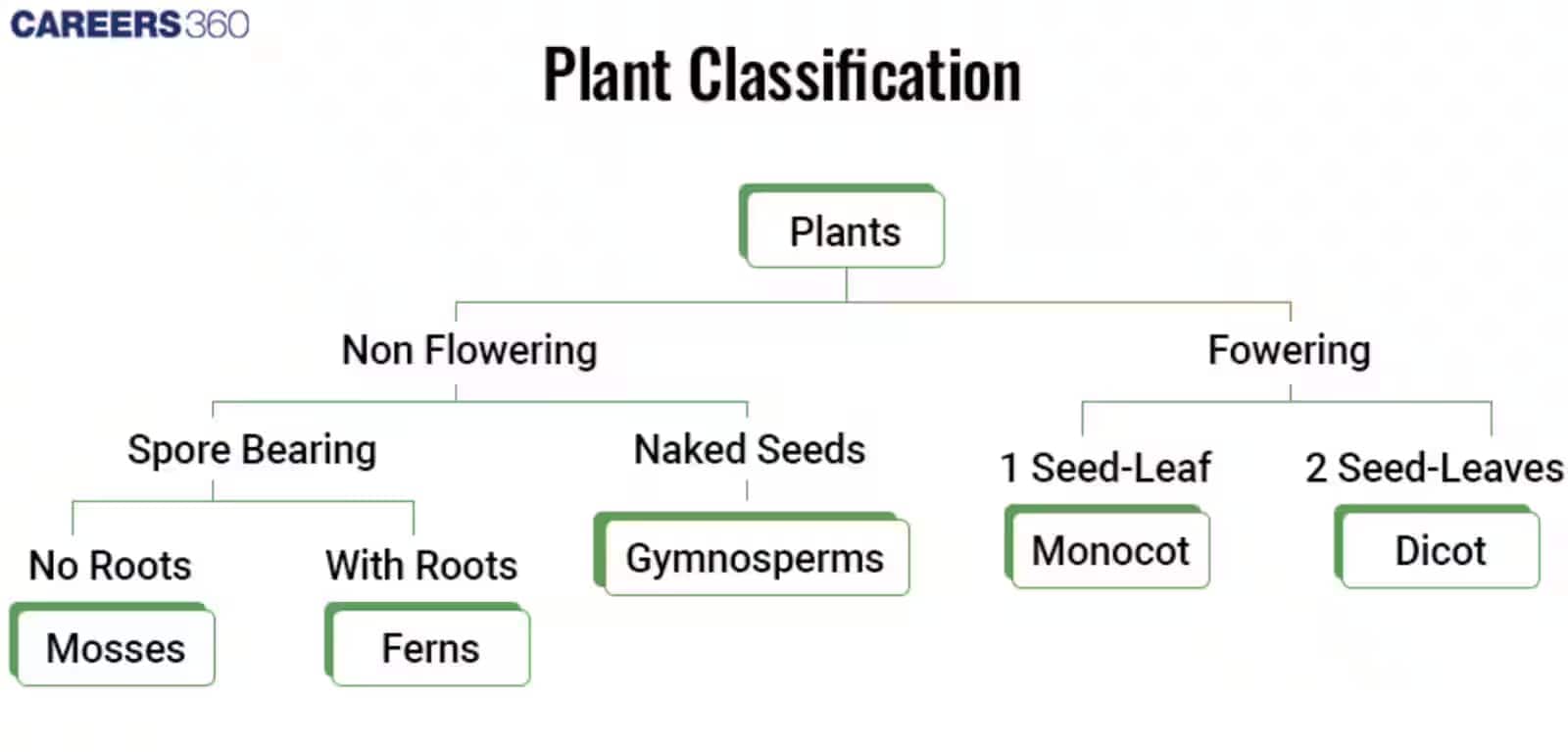
Plants are classified based on traits like the presence of vascular tissues, seeds, and flowers. The major groups include algae, bryophytes, pteridophytes, gymnosperms, and angiosperms. Each group represents a different level of evolutionary advancement. Given below is the classification of the Kingdom Plantae in detail:
Algae have a thallus-like body structure and lack a well-differentiated body structure.
Plants of the Thallophyta family have a primitive and simple body structure.
The thallus is the plant's main body, and it can be filamentous, colonial, branching, or unbranched.
Algae such as green algae, red algae, and brown algae are examples. Volvox, Fucus, Spirogyra, Chara, Polysiphonia, Ulothrix, and other species are common examples.
Classification of Algae
Algae are classified into three major classes based on their pigments, stored food material, and cell wall composition.
Class | Common Name | Major Pigments | Stored Food | Examples |
Chlorophyceae | Green algae | Chlorophyll a and b | Starch | Chlamydomonas, Volvox, Ulothrix |
Phaeophyceae | Brown algae | Chlorophyll a, c and fucoxanthin | Mannitol and laminarin | Fucus, Laminaria, Sargassum |
Rhodophyceae | Red algae | Chlorophyll a, d and phycoerythrin | Floridean starch | Polysiphonia, Porphyra, Gelidium |
Bryophyta usually have low-growing, attached to the ground in appearance.
Bryophytes reproduce by spores produced in capsules borne on the sporophyte. Water is essential for sexual reproduction.
Vascular tissues are absent in bryophytes. Root-like, stem-like, and leaf-like components make up the plant's body.
Bryophytes are terrestrial plants that are also known as "Amphibians of the Plant Kingdom" since they require water for sexual reproduction.
They survive in wet, shaded environments. Mosses, hornworts, and liverworts are all members of the Bryophyta family.
Marchantia, Funaria, Sphagnum, Anthoceros, and some examples.
Types of Bryophytes
Bryophytes are divided into three main groups based on their structure and reproductive features.
Type | Characteristics | Examples |
Liverworts | Thalloid or leafy gametophyte | Riccia, Marchantia |
Mosses | Leafy gametophyte with multicellular rhizoids | Funaria, Sphagnum |
Hornworts | Horn-like sporophyte | Anthoceros |
Ferns are among the vascular plants that have true roots, stems (rhizomes), and leaves (fronds).
They reproduce through spores, and the spore-producing structures or sporangia are found on the surface of fronds, particularly the undersides.
Most ferns usually have a highly developed sporophyte generation.
Pteridophytes have a distinct plant body that is divided into roots, stems, and leaves.
They have a transport system that allows water and other chemicals to be transported.
Selaginella, Equisetum, Pteris, and other common examples are only a few.
Homospory and Heterospory in Pteridophytes
Most pteridophytes produce only one type of spore and are called homosporous plants. Some pteridophytes, such as Selaginella and Salvinia, produce two different types of spores and are called heterosporous plants.
Feature | Homospory | Heterospory |
Types of Spores | One | Two |
Gametophyte | Usually bisexual | Usually unisexual |
Examples | Pteris, Equisetum | Selaginella, Salvinia |
Gymnosperm is derived from the Greek words gymnos (naked) and sperma (seed), which literally means seed without a covering.
It has needle-like or scaly leaves, and these plants are found in areas ranging from the boreal to the desert. Some of these conifers are pines, spruces, and cypresses as well.
The plant body and vascular tissues are well-differentiated.
They produce naked seeds, which are seeds that are not encased in a fruit.
Gymnosperms include plants such as Cycas, Pinus, Ephedra, and others.
Angiosperms have flowers for sexual reproduction, attracting insects, birds, and mammals for pollination.
Angiosperms have numerous forms of adaptations and are the largest class of plants in the world.
Angiosperms are vascular plants that produce seeds and have a well-differentiated plant body.
Angiosperm seeds are contained within the fruits.
Angiosperms are found all over the world and come in a wide range of sizes.
Eucalyptus trees grow to be around 100 meters tall, while Wolffia plants grow to be about 0.1 cm tall.
Angiosperms are divided into monocotyledons and dicotyledons based on the number of cotyledons present in their seeds.
Mango, rose, tomato, onion, wheat, maize, and other common examples.
Difference Between Monocots and Dicots
Angiosperms are classified into monocotyledons and dicotyledons based on the number of cotyledons present in their seeds.
Feature | Monocots | Dicots |
Number of Cotyledons | One | Two |
Leaf Venation | Parallel | Reticulate |
Root System | Fibrous | Tap root |
Examples | Wheat, Maize, Rice | Pea, Mango, Mustard |
Bryophytes, pteridophytes, gymnosperms, and angiosperms are the four main groups of plants that differ in their structure, method of reproduction, and level of development.
Feature | Bryophytes | Pteridophytes | Gymnosperms | Angiosperms |
Common Name | Mosses and liverworts | Ferns and their allies | Naked-seeded plants | Flowering plants |
Plant Body | Thalloid or differentiated into stem-like and leaf-like structures; true roots absent | Differentiated into true roots, stems, and leaves | Well-differentiated into roots, stems, and leaves | Well-differentiated into roots, stems, and leaves |
Vascular Tissues | Absent | Present | Present | Present |
Dominant Plant Body | Gametophyte | Sporophyte | Sporophyte | Sporophyte |
Main Reproductive Unit | Spores | Spores | Seeds | Seeds |
Seeds | Absent | Absent | Present | Present |
Nature of Seeds | Not produced | Not produced | Naked seeds | Seeds enclosed within fruits |
Flowers | Absent | Absent | Absent | Present |
Fruits | Absent | Absent | Absent | Present |
Reproductive Structures | Antheridia and archegonia | Sporangia, antheridia and archegonia | Male and female cones (strobili) | Flowers |
Requirement of Water for Fertilisation | Required | Required | Not required | Not required |
Sporophyte Dependency | Dependent on gametophyte | Independent | Independent | Independent |
Habitat | Moist and shady places | Mostly terrestrial, often in moist habitats | Mostly terrestrial; common in temperate regions | Found in a wide range of habitats |
Examples | Riccia, Marchantia, Funaria | Selaginella, Equisetum, Pteris | Cycas, Pinus, Ephedra | Mango, Rose, Wheat, Maize |
Students often get confused between different groups of plants and their characteristics. Knowing these common mistakes can help in better understanding and exam preparation.
Plants reproduce both sexually and asexually, depending on the group. Reproductive organs range from simple structures in algae to complex flowers in angiosperms. Alternation of generations is a common feature in their life cycles.
Both gymnosperms and angiosperms show alternation of generations, consisting of a haploid gametophyte and a dominant diploid sporophyte.
The gametophyte produces male and female gametes, which fuse to form a zygote. The zygote develops into a sporophyte.
The sporophyte produces haploid spores through meiosis. These spores germinate and grow into new gametophytes, completing the life cycle.
Gametophyte → Gametes → Zygote → Sporophyte → Spores → Gametophyte
Sexual Reproduction: It refers to the fusion of gametes brought by the gametophytes, and this causes variation in offspring.
Asexual Reproduction: This happens in a manner that involves fragmentation, budding or formation of reproductive structures like the bulbs and tubers, which form plants without fusion of gametes.
Plants carry out essential physiological processes like photosynthesis, respiration, transpiration, and nutrient absorption. These functions help in energy production, water regulation, and growth. Adaptations such as stomata, xylem, and phloem support these functions. Plants perform several important physiological processes that sustain their growth, development, and interaction with the environment.
Chlorophyll is a pigment in chloroplasts in plants that enables light energy to be changed into a chemical form, glucose, which the plant uses for energy, and the byproduct of this process is oxygen.
Photosynthesis is important for getting energy for the metabolic activities of plants and for the synthesis of oxygen used in aerobic respiration by living beings.
Through cellular respiration, plant cells can split glucose molecules and release free energy for use in other cellular processes. This process, called cellular respiration, takes place in the mitochondria, where oxygen is used in the process and carbon dioxide and water are formed as waste.
Regulation assists in the growth, development, and reproduction of plants throughout the process of respiration.
Stomata on the leaves of plants enable the process of releasing water vapour into the surroundings.
It helps in controlling temperature, water uptake by the plant and absorption of other minerals from the ground.
Transpiration in plants generates a pressure that drives the movement of water and nutrients from roots to the shoots, promoting plant development and nutrient distribution.
Q1. Bryophytes are different than algae in
Having multicellular sporophytic generation
Having no sporophyte
Having zygotic meiosis
Formation of embryo
Correct answer: 4) Formation of embryo
Explanation:
Embryo formation is absent in algae, given that the zygote mostly undergoes meiosis instead of developing into an embryo. On the other hand, bryophytes exhibit embryogenesis, a process in which the zygote develops into a multicellular embryo, which then progresses to form a sporophyte. This establishes a difference in the reproductive strategy of these two different groups: where bryophytes depend upon embryonic development for the continuity of their life cycle, but algae do not.
Hence the correct answer is Option (4) Formation of embryo.
Q2. Choose the incorrect match pair:
Hepaticopsida - Marchantia
Sporophyte - Columella
Bryopsida - Anthoceros
Biflagellate antherozoids - Riccia
Correct answer: 3) Bryopsida - Anthoceros
Explanation:
Anthoceros is classified within the class: Anthocerotopsida, but it is still within the phylum: Anthocerotophyta. These are hornworts with all their peculiar aspect and reproductive biology. It constitutes the largest genus from this class since it has been documented to host around 200 species spread from all over, mainly in cool and shaded or moist places. The taxonomical classification of Anthoceros is as listed below:
Domain: Plantae
Division: Anthocerotophyta
Class: Anthocerotopsida
Orde : Anthocerotales
Family: Anthocerotaceae
This classification draws out the distinguishing features and ecological functions of the Anthoceros within the larger context of the bryophyte.
Hence the correct answer is Option (3) Bryopsida - Anthoceros.
Q3. In liverworts spore dispersal occurs via
Peristome teeth
Trabeculae
Elaters
Perigynium
Correct answer: 3) Elaters
Explanation:
Liverworts disperse by using their elaters, which have the appearance of tubular cells. Elaters within the capsules of their spores facilitate the process of spore dispersal by exhibiting hygroscopic movements. In dry weather, elaters twist and spring to flick the spores into the air. It effectively promotes the dispersal of spores, assisting in the successful reproduction and colonization in appropriate environments.
Hence the correct answer is Option (3) Elaters.
Also Read:
The Plant Kingdom is one of the five kingdoms in Whittaker’s classification. It consists of multicellular, eukaryotic, and autotrophic organisms. These organisms contain chlorophyll pigments that allow them to perform photosynthesis. Plants have rigid cell walls made up of cellulose that provide structural support. They are the primary producers of food in ecosystems. They play a crucial role in maintaining oxygen balance on Earth.
Alternation of generations is a unique feature of plants where their life cycle alternates between two multicellular stages. The haploid gametophyte produces gametes through mitosis. The fusion of gametes forms a zygote, which develops into the sporophyte. The sporophyte undergoes meiosis to produce haploid spores. These spores give rise again to gametophytes, completing the cycle. This alternation ensures genetic variation and continuity of the plant life cycle.
Plants carry out several physiological processes that support survival and growth. Photosynthesis allows them to convert light energy into chemical energy, respiration provides energy for metabolic activities, transpiration regulates water movement and absorption of minerals and water by roots supports nutrition. In addition, plants exhibit processes like photoperiodism and phototropism that help in adaptation. Together, these processes help plants to survive on Earth.
Gymnosperms and angiosperms differ mainly in their seed characteristics. Gymnosperms produce naked seeds, not enclosed in fruits, and they usually form cones instead of flowers (e.g., Cycas, Pinus). Angiosperms are flowering plants with seeds enclosed within fruits (e.g., Wheat, Mango).
Gymnosperms are mostly woody and evergreen, whereas angiosperms show great diversity in habit, ranging from herbs to large trees.
Angiosperms also show double fertilization, which is absent in gymnosperms.
Frequently Asked Questions (FAQs)
The term "amphibian" in the context of the Plant Kingdom refers to Bryophytes, which include mosses and liverworts. Bryophytes are considered amphibious because they require water for reproduction but can also thrive on land. They lack vascular tissues, which distinguishes them from more advanced plant groups like ferns and flowering plants.
The Plant Kingdom is immensely beneficial to humans and the environment in several ways:
The Plant Kingdom, known scientifically as Kingdom Plantae, includes all multicellular plants that can be found in various environments, both terrestrial and aquatic. Members of this kingdom are primarily eukaryotic and photosynthetic, meaning they produce their own food through photosynthesis, utilizing sunlight, carbon dioxide, and water to create sugars and oxygen. The Plant Kingdom is one of the six kingdoms of life and plays a crucial role in ecosystems as primary producers
Algae belong to the kingdom Plantae. It is the most primitive plant on the planet.
The plant kingdom has been divided into five subgroups on the basis of plant body, vascular system, and seed formation:
Thallophyta
Bryophyta
Pteridophyta
Gymnosperms
Angiosperms
They are multicellular, eukaryotic, and autotrophic creatures. The cell wall of a plant cell is stiff. Plants have chloroplasts, which contain the pigment chlorophyll, which is necessary for photosynthesis.
Sunflowers belong to the kingdom Plantae.

Ranked 1 st among Top Law Schools of super Excellence in India - GHRDC | NAAC A+ Accredited | #36 by NIRF
Law Admissions 2026 Open | Avail Merit-Based Scholarships
Get Job Ready in Healthcare | Employability-Focused Programs
Highest CTC: 24 LPA | Average CTC: 12.32 LPA | 85 Placement Partners
Leading Design College | Highest CTC: ₹12 LPA | Average CTC: ₹7.5 LPA | Scholarships for Deserving Students
Attend 9-Hour Masterclass on 10th October 2026 to help you score 99+ percentile in CAT 2026