Great Lakes - PGDM & PGPM Admissions 2027
Globally Recognized by AACSB (US) & AMBA (UK) | 18 LPA Avg. CTC for PGPM 2026


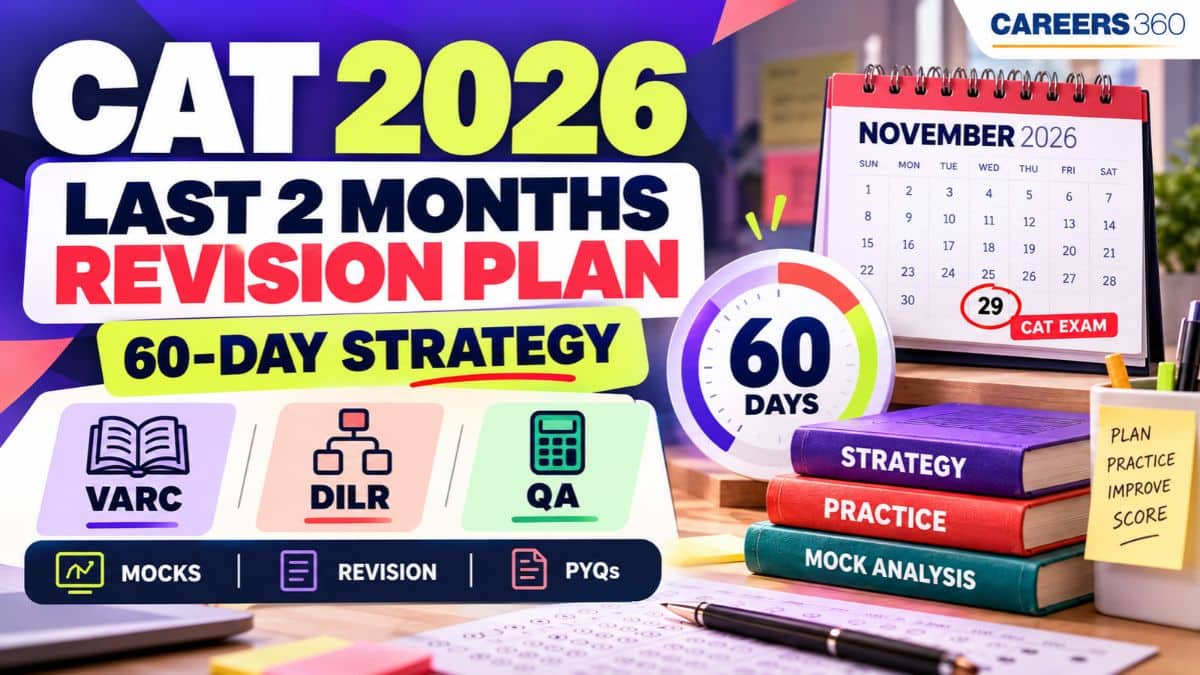
The final 60 days before CAT 2026 can do more than just refresh old concepts - they can decide how much of that preparation actually converts into marks. With the exam scheduled for November 29, this is the stage to identify weak areas, revise high-value topics, improve question selection, reduce repeated mistakes and build mock-test consistency across VARC, DILR and QA. But what should be revised first? How many mocks are enough? And is 60 days really enough for a 95 percentile? This CAT 2026 last 2 months revision strategy answers these questions with a focused 60-day plan.
The CAT last 60 days study plan should move from topic revision to mixed practice and then to full-length mocks. The topic order should also change by section because VARC, DILR and QA need different types of revision.
Days | Main Focus | VARC | DILR | Quant |
60-46 | Concept revision | RC + VA basics | Core set types | Arithmetic + Algebra |
45-31 | PYQs + timed practice | Mixed RC + VA | Mixed Data Interpretation and Logical Reasoning sets | Mixed Arithmetic + Algebra |
30-16 | Mocks + correction | Sectionals + RC selection | Set selection + timed sets | Mixed Quantitative Aptitude + weak topics |
15-1 | Final revision | PYQs + error log | Selected sets + error log | Formula revision + CAT PYQs |
The five-year CAT Quant analysis also supports giving strong priority to Arithmetic and Algebra: together, they accounted for 233 of 330 questions analysed from CAT 2021-2025.
Download the CAT 2025 Slot-Wise Master Weightage Matrix to compare topic-wise weightage across CAT slots and plan revision accordingly.
The first 15 days should be used to revise the topics that can give the highest return and identify gaps through an initial mock.
VARC
Prioritise:
Reading Comprehension: main idea, inference, tone, author's purpose and paragraph function
Para Summary
Para Jumbles
Odd One Out
Para Completion
Target: 3 RC passages + 8-10 VA questions daily.
Do not just check the correct answer. For every wrong RC question, identify whether the mistake came from misunderstanding the passage, choosing an extreme option or missing the author's central idea.
DILR
Revise the basic approach for:
Tables and caselets
Bar, line and mixed graphs
Distribution
Globally Recognized by AACSB (US) & AMBA (UK) | 18 LPA Avg. CTC for PGPM 2026
Test centres are available in 70+ cities across India | 75,000+ aspirants apply for the NMAT exam | Accepted by 58+ institutions like NMIMS, KJSIM, ISB, SPJIMR and Great Lakes.
Target: 2 sets daily, with at least one set from a different type.
The main goal at this stage is to learn how to convert information into a table, diagram or set of conditions.
QA
Start with Arithmetic:
Then move to Algebra:
Functions
Progressions
After these, revise Geometry, Number System and Modern Mathematics based on mock performance.
At this stage, stop studying chapters in isolation. Start mixing questions in the same way CAT does.
VARC: Solve CAT RC and VA PYQs under time limits. Practise 3 RCs together instead of solving each passage without a time limit. For VA, mix Para Summary, Para Jumbles, Odd One Out and Para Completion.
DILR: Move from individual set types to mixed practice. For example, solve one arrangement set, one DI set and one distribution/game-based set during a practice session. Start giving yourself a fixed time limit for each set.
QA: Mix Arithmetic and Algebra. A practice set could contain Percentages, Time and Work, Quadratics, Ratio, TSD and Inequalities rather than six questions from one chapter.
At the end of every practice session, separate questions into:
Solved correctly
Solved incorrectly
Could solve but took too long
Could not solve
Take 2-3 full mocks during these 15 days.
This is where the CAT preparation should become highly personalised. Do not revise every topic after every mock.
Check:
RC accuracy by passage
Time spent per passage
Number of questions attempted
Inference mistakes
Questions lost because of poor passage selection
VA accuracy
If RC accuracy is good but time is high, work on reading and option elimination. If accuracy is low, spend the next few days analysing passages rather than simply increasing the number of RCs.
For every mock, record the sets that were:
Correctly solved
Partially solved
Solvable but not selected
Selected but too difficult
Time-consuming
This will reveal whether the main problem is set selection or set solving.
Divide mistakes into topic buckets:
Mistake type | Corrective action |
Conceptual error | Revise the concept and solve 5–10 targeted questions |
Calculation error | Practise accurate calculations and verify intermediate steps |
Slow solution | Compare alternative methods and practise timed questions |
Wrong question selection | Review whether the question was worth attempting under exam conditions |
Could not solve | Revisit the concept if important, then attempt a graded practice set |
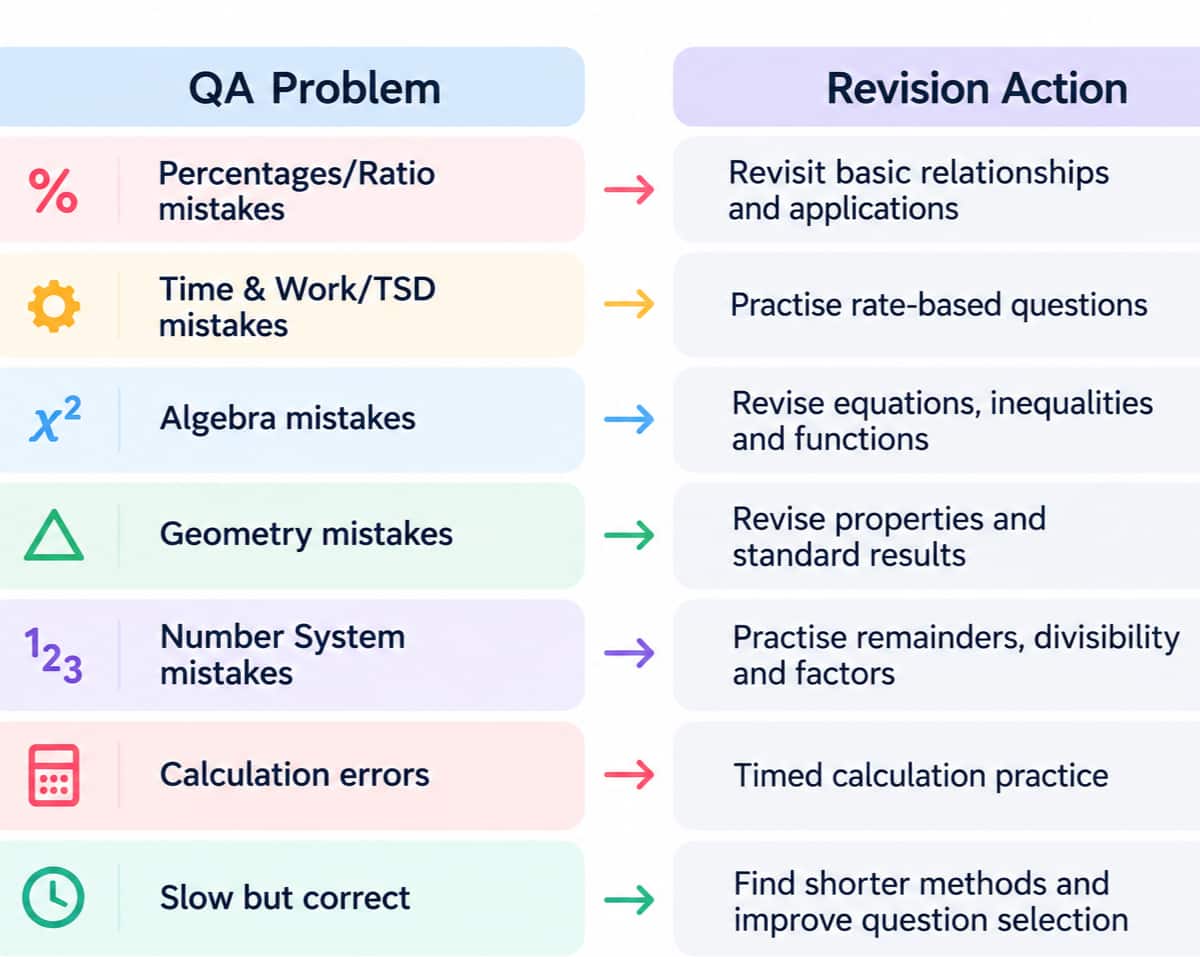
Take a full mock every 3-4 days, but spend enough time analysing it before taking the next one.
The final 15 days should focus on topics that have already been studied and questions that have already been attempted.
VARC
Re-solve selected CAT RC and VA PYQs
Review repeated RC mistakes
Practise passage selection
Maintain daily RC practice
DILR
Re-solve previously difficult sets
Revise common set structures
Practise selecting 2-3 workable sets quickly
Avoid spending the final days collecting new puzzle types
QA
Revise the most important formulas and question types from:
Arithmetic: Percentages, Ratio, Averages, Profit and Loss, Time and Work, TSD, Mixtures and Interest
Algebra: Equations, Quadratics, Inequalities, Functions and Progressions
Other QA: Geometry, Number System and Modern Mathematics according to individual mock performance.
The final 2-3 days should be light. No major new topic, new book or completely different mock strategy should be introduced.
Phase | VARC | DILR | QA | Full Mocks |
Days 60-46 | Daily RC + VA | 2 sets/day | 20-25 questions/day | 2 |
Days 45-31 | 3 RCs + VA/day | 2-3 timed sets/day | 25-30 mixed questions/day | 2-3 |
Days 30-16 | Sectionals + targeted RC | 2-3 timed sets | Mixed QA + weak topics | 4-5 |
Days 15-1 | Selected CAT PYQs + error log | Selected sets | Formula + PYQ revision | 2-3 |
This makes the 60-day strategy much more specific: VARC focuses on RC accuracy and selection, Data Interpretation and Logical Reasoning set selection and representation, and QA on high-value Arithmetic and Algebra followed by targeted revision of the remaining areas.
Yes, 60 days can be enough, especially when the basics are already clear. Focus on important topics, PYQs, mocks and repeated mistakes rather than trying to cover everything.
Yes. Follow a simple cycle:
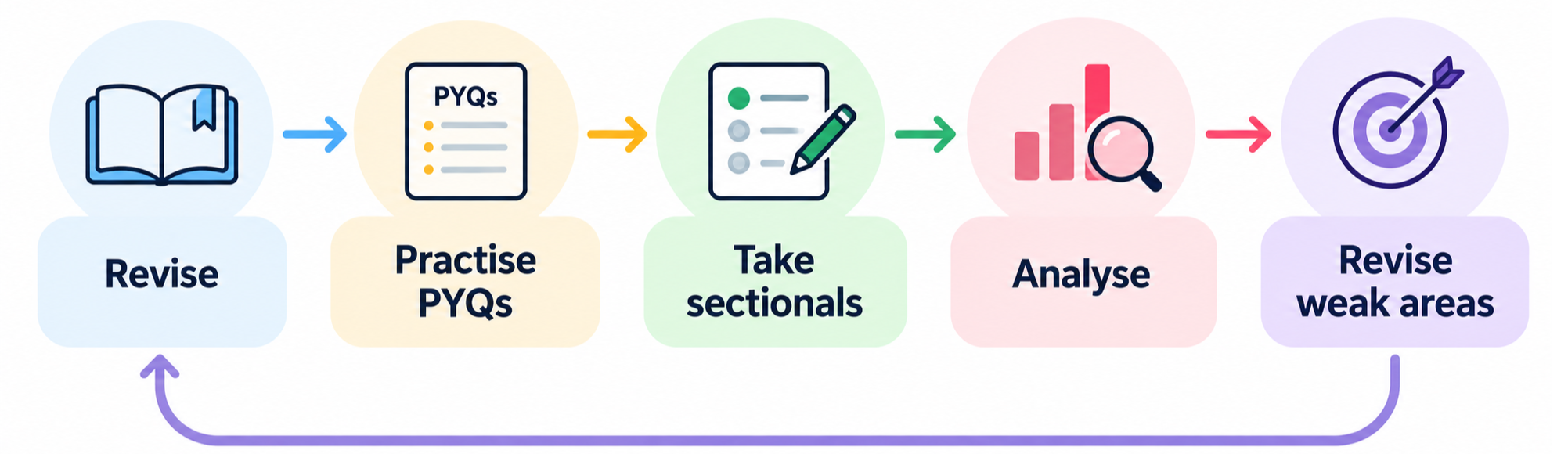
Yes, 95 percentile is possible, but it depends on the starting level and mock performance. Use mock scores to track progress and identify areas that need improvement.
The CAT 2026 Last 2 Months Revision Plan PDF provides a focused roadmap for the final phase of preparation, helping candidates organise revision across VARC, DILR and QA. It can be used to track important topics, practice, mocks and final revision in a structured manner.
Download CAT 2026 Last 2 Months Revision Plan PDF
The CAT 2026 Comprehensive 60-Day Study Material helps organise preparation with focused study resources and practice for the final phase. Use it alongside the revision plan to strengthen concepts and prepare more systematically.
Download CAT 2026 Comprehensive 60-Day Study Material PDF
The PDF should be followed as a daily checklist rather than treated as another study material.
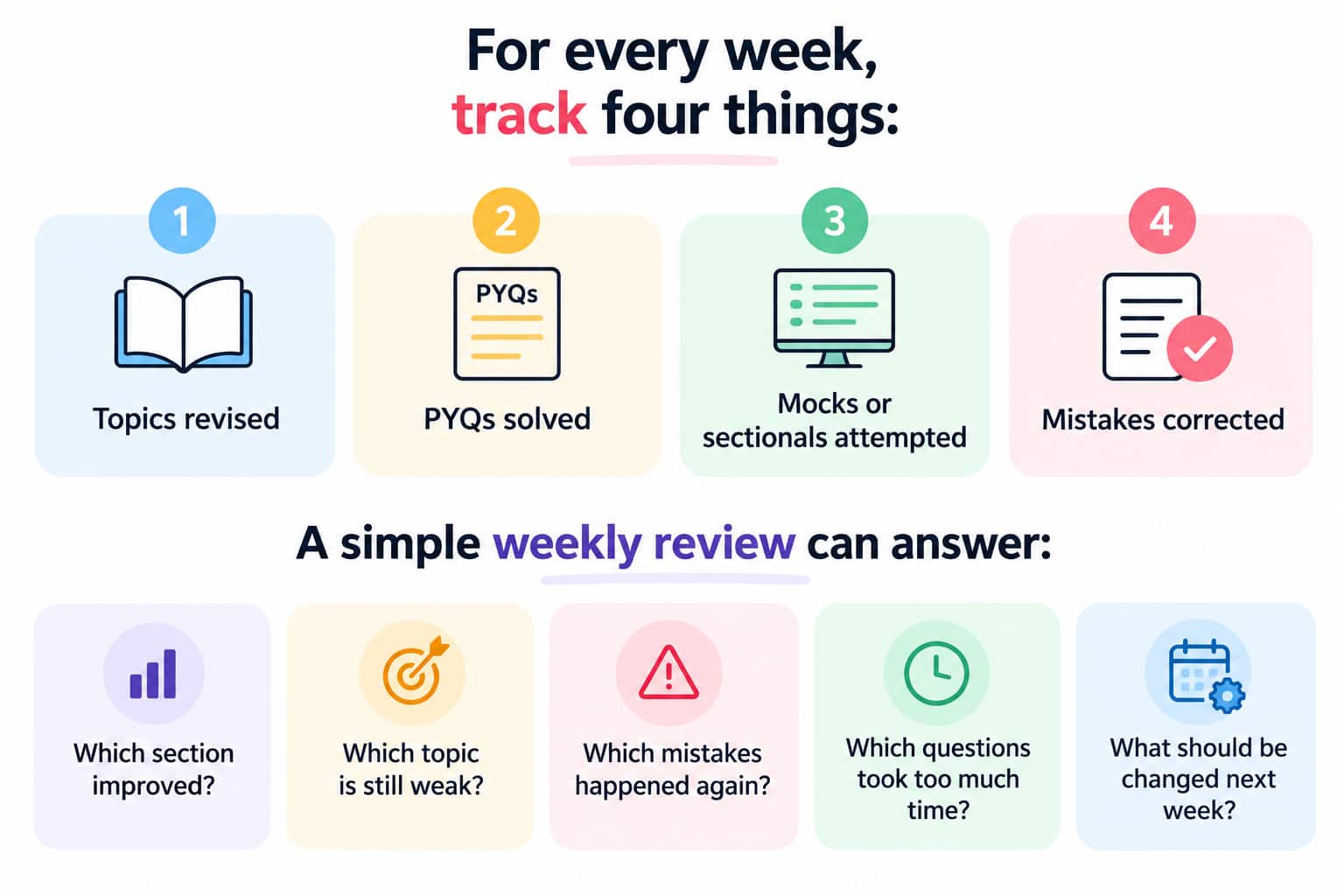
The final goal is not to complete the maximum number of questions. It is to reach CAT 2026 with a clear section strategy, strong topics, fewer repeated mistakes and better control over time.
Attempt the free CAT mock test to assess preparation, practise the exam pattern and identify areas that need improvement.
Explore these carefully selected CAT 2026 eBooks for focused revision, topic-wise practice, PYQs and exam-oriented preparation across VARC, DILR and QA.
CAT Quant PYQs- Complete 5-Year Question Bank (2021 - 2025) PDF | |
CAT DILR PYQs Complete 5-Year Question Bank (2021 - 2025) | |
CAT VARC PYQs- Complete 5-Year Question Bank (2021 - 2025) PDF | |
CAT RC 2026: 12 Tones That Can Change Your Answer | |
CAT 2026: 10 Most Repeated Concepts in Quant | |
CAT Time & Work: Top 30 Practice Questions with Answer Key & Detailed Solutions | |
CAT Quadratic Equations: Top 30 Practice Questions with Answer Key & Detailed Solutions | |
Top 25 Reading Comprehension Passages to Practice for CAT 2026 | |
CAT 2026 VARC SAMPLE PAPER | |
CAT 2026 DILR SAMPLE PAPER | |
CAT 2026 Quant SAMPLE PAPER |
Frequently Asked Questions (FAQs)
Yes, especially when the basics are already covered and the final two months are used for focused practice and mock analysis.
Arithmetic and Algebra are important in QA, while Reading Comprehension dominates VARC and set selection is a key skill in DILR.
Analyse every mock for wrong answers, slow questions, missed easy questions and poor question selection, then revise those specific areas before the next test.
A beginner should first build basic concepts in the important topics of QA, VARC and DILR, then gradually add timed practice, PYQs and mock tests.
Around 4-6 focused hours a day can provide a strong preparation, provided the time is divided between concepts, practice, mock analysis and revision.

On Question asked by student community
Hello, CAT aur B-school entrance exams ke baare mein aap exam dates, eligibility, registration, exam pattern, syllabus, colleges ya admission process ki information dekh sakte hain. Aapki requirement ke according relevant details yahan mil sakti hain: https://bschool.careers360.com/exams
You can download the latest CAT syllabus from here:
Hey there,
For a B.Sc. with Chemistry, Botany and Zoology (CBZ), if the CAT application asks separately for:
If the Discipline dropdown has a more specific option such as “Biological Sciences,” “Life Sciences,” or “Zoology/Botany,”
Hey there,
Yes. With 2 years of work experience, you are eligible to target the regular 2-year MBA at IIM Calcutta as long as you have a bachelor's degree with at least 50% marks (45% for SC/ST/PwD). Work experience is not required for eligibility.
For
Hey there,
For NIT Hamirpur MBA, the General-category CAT cutoff is not a fixed official percentile. NIT Hamirpur's 2026–27 admission process gives CAT a 10/10 weightage in the test component, followed by an interview; it accepts CAT, CMAT and MAT.
As a practical target, 80+ percentile is worth considering, while
Directions for question:
The bar-graph given below shows the foreign exchange reserves of Nepal (in million Rupees) from 2014 to 2021. Answer the following questions based on the graph :

Question:
What was the percentage increase (rounded to the nearest integer, if deemed necessary) in the foreign exchange reserves in

Globally Recognized by AACSB (US) & AMBA (UK) | 18 LPA Avg. CTC for PGPM 2026
Gateway to IBS Hyderabad & 8 other IBS campuses | Scholarships worth 10 CR
Among top 6% B-Schools globally to be accredited by AACSB | Highest Package-35 LPA
1 Exam accepted by 17 Top Symbiosis Institutes for 32 MBA programmes.
Test centres are available in 70+ cities across India | 75,000+ aspirants apply for the NMAT exam | Accepted by 58+ institutions like NMIMS, KJSIM, ISB, SPJIMR and Great Lakes.
Highest CTC- 21 LPA | Average CTC- 10.38 LPA Scholarships Available | MBA in Forestry Management MBA in Sustainability Management MBA in Sustainable Development MBA in Development and Sustainable Finance