KCC Institute of Legal and Higher Education, Greater Noida
Law Admissions 2026 Open | Avail Merit-Based Scholarships


FAST FACT
Qualification: BSc Nursing. 4-year degree programme, General Nursing & Midwifery course (3.5 years).
For further education: MSc, MPhil, PhD.
Visit: http://www.indiannursingcouncil.org/types-nursing-programs.asp
Colleges: Raj Kumari Amrit Kaur College of Nursing, Delhi, AllMS, Safdarjung Hospital, St. Stephens Hospital (Delhi), Bharati Vidyapeeth’s College of Nursing (Pune), National Institute of Mental Health and Neurosciences ( Bangalore), N.I.N.E PGIMER, (Chandigarh) CMC,(Vellore). See the list of INC recognised colleges @ www.indiannursingcouncil.org/Recognized-Nursing-Institution.asp
 Photos: Rohit Gautam |
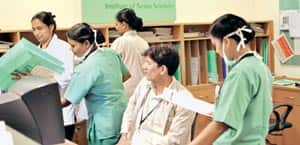
| TAKING STOCK: Nurse examining their patients' files before resuming their work schedules at Max HealthCare, Saket, New Delhi |
Nurse Linsy S Lazar has taken a break from her work for a few months. The 27-year-old, a new mother, is enjoying motherhood, but is also missing her job. What she misses most is the gratifying experience that she carried back home everyday.
 |
| “Stringent screening test of candidates, surprise audits of colleges, de-recognition of bad institutions, focus on quality rather than quantity is the need of the hour” Ms Saravjeet kaur, Director, Nursing, Max Healthcare |
Saravjeet Kaur too, just like Linsy, was a passionate nurse. “The satisfaction is more than any appreciation letter,” she says. Now Director Nursing, Max Healthcare, pan-India, Kaur was in the army for 25 years, nursing soldiers and officers back to health. In ’76 it was unusual for a Punjabi girl to choose nursing as profession, reminisces Kaur, a decision that annoyed her granny very much. But the smile of convalescing patients brought a young Saravjeet so much joy, that the thought of quitting never occurred to her. Post-army, she continues to work in the private sector.
Some youngsters gravitate towards this profession to serve the sick and needy, some for ready job prospects. Nursing is one sector where no one remains unemployed. Healthcare industry is expanding fast and is facing acute shortage of quality nurses. “In two years, Delhi has got seven new hospitals,” says Dr. B.K. Baluja, executive director, Primus Super Specialty Hospital. “But doctors and nurses have not expanded in that ratio,” he adds. Now male nurses are also successfully charting out a career in the field predominantly led by “sisters.”
Nurses play a significant role in the healthcare industry. Articulating their role, Dr. Baluja says, “They are one of the pillars of healthcare, at par with doctors.”
If you too feel nursing is a right career choice for you, go ahead but be aware of a few hiccups that might come your way.
Nursing Education: The Wellness Chart
Hailing from Kerala, Linsy is a quintessential ‘Keralite’ nurse; amiable, soft-spoken, humble and accommodating, just like several other Malayali counterparts of hers who dot Delhi -NCR hospitals.
Linsy is now employed with a government hospital, GTB in Delhi. She is an efficient worker and is praised for her quality delivery. But when she was a student with a private nursing Institute in Greater Noida, she remembers how she and her classmates had to struggle with limited infrastructure facilities and clinical exposure. Frustrated, many of her batch-mates dropped out. “We were the first batch of students in the nursing programme,” she says.
 |
| NURSE LINSY S LAZER, 27, Working at GTB Hospital, Delhi |
Some colleges give their students good exposure and training and they stand out as performers from day one. However, those who lack in the first innings learn on the job and work their way up for a bright stint. Linsy belongs to the second category of learners.
But the truth of the matter is that a majority of the colleges lack adequate lab facilities. “Most private colleges don’t give sufficient clinical exposure, even though they claim it,” says Dr. Baluja. He advises students to choose colleges that have collaboration with reputed hospitals for practical knowledge.
A lot needs to be done in nursing education. Government institutions are running courses that were adopted somewhere in the 1970s. Many sub-standard colleges are operating as well. Indian Nursing Council (INC) has been unable to prevent their operations. Even in some recognised colleges, the quality is not strictly monitored. But the INC has no full-time inspectors for evaluation and so it has to make do with just ad-hoc inspectors.
Rising fees is another big dampener for potential students. In 2005, Linsy paid a total of Rs. 6 lakhs, sans hostel accommodation, for her 4-year BSc degree. Currently, fees of a typical private provider stand close to Rs. 10 lakhs for a 4-year degree course. This is excluding hostel fee, which amounts to approximately Rs. 60,000 per year. MSc Nursing is tagged at Rs. 1.5 lakhs to Rs. 2 lakhs as tuition fee per annum. One grey area in the education is the capitation fee. The ongoing rates are anywhere between Rs. 50,000-80,000 for Delhi-NCR region, say sources.
The entry level salaries, however, are low. It hovers in the range of Rs. 12,000 -18,000 per month in a big private hospital for those with a BSc degree. But overall also, nurses’ salaries are not at par with the labour they put in. In government sector, salaries, guided by Pay Commissions, are comparatively better than that of private hospitals.
Registration is a must to practise as a nurse. It usually takes a candidate one to six months to obtain primary registration. When nurses move from one state to another, they have to get registered with the respective State Nursing Council (SNC). “However, this process is a time consuming affair,” says Hemant Kumar Saini, Lecturer, University College of Nursing Baba Farid University of Health Sciences. “But for doctors, the same process is smooth,” says Dr. Baluja. That is because Medical Council of India provides the registration facility unlike the Nursing Council.
Law Admissions 2026 Open | Avail Merit-Based Scholarships
BBA/MBA/PGDM Early Bird Applications Deadline 19th Oct '26. Apply now using coupon code CAREER250 and get ₹250 off the application fee
 |
| “There is a need for a separate Nursing Directorate with independent powers under the Ministry of Health and Family Welfare, to improve the structure and management of nursing” Ms Sheila Seda Secretary- General, Trained Nurses Association of India |
Pulse Monitoring: Daily Basis
In day-to-day operations, the challenges vary. A major grouse of nurses is that they are not allowed to take any decisions. They are only supposed to assist medical personnel in executing nursing functions. Ms. Kaur, heading a force of 2,500 nurses pan-Max Hospital, agrees and hopes that this scenario changes soon.
Many nurses also complain of doctors being rude to them. Ms. Sheila Seda, secretary general, Trained Nurses Association of India (TNAI), assess the issue objectively. She says that this situation surfaces from the knowledge and skill mismatch of a doctor-nurse. “If a cardiologist is given a non-specialised nurse in cardiology, how would she know about the patient’s post-operative care?” she asks. She sees a clear need for nurses to get trained in specific areas. But right now, whatever little domain-training exists is not only insufficient but is marred by limitations. For instance, a nurse who is domain-trained is not sure whether she/he will be employed in her specialised area by a hospital. Besides, there is also no recognition in terms of posts and incentives whereas an MBBS doctor, who has a specialised degree gets paid more. “So why not nurses too?” questions Ms. Seda.
Emergency Case: Urgent Solution Needed
While functional areas have their setbacks, at policy level too, nursing sector suffers from a host of ailments. A major issue is the nurse-to-patient ratio. INC prescribes one nurse for every five patients in a non-teaching hospital. For teaching hospital, the ratio is 1:3. “However, the need is of one nurse per patient,” emphasises Ms Seda of TNAI, a 100-year-old organisation working as a link between the nurses and policy makers. She reasons, patients in ICU, or in specialised departments like operation theatre or in labour room, require one-on-one care. Besides, there are patients to be attended to in emergencies and OPD, so 1:3 ratio is an inadequate allocation especially when nurses’ leave reserve are factored in too. Right now, nurses are overburdened. “Abroad, there are three nurses per doctor but situation here is somewhat reverse,” says Jaiwanti P Dhaulta, former secretary general, TNAI.
The industry suffers from high attrition rate. “It ranges from 25-28 percent,” says Dr. Baluja, which is a cause of worry, he adds. Migration is a double whammy. A lot of nursing practitioners pack their bags to Gulf countries, especially to Saudi Arabia and Muscat. The other two preferred destinations are Canada and Ireland. Poor pay packages and inconsiderate treatment are two prime reasons. “To combat migration, salaries must be improved and better treatment must be meted out to over-worked nurses,” says Ms Kaur.
|
The System: Needs Nursing Back to Health
The nursing sector currently needs several remedial measures to function properly. In order to revitalise the sector, government formed a High Power Committee on Nursing and Nursing Profession. But the Committee’s report with proposed recommendations is still in the back burner 23 years later. The report entails a host of reform measures ranging from nursing manpower requirements to education, higher education, training, infrastructure, organisational set up at Central, State and district levels and much more.
TNAI, also an affiliate of International Council of Nurses, feels government needs to wake up to the needs of the nursing community fast. She adds, “The post of nursing advisor at Government is vacant since last June.”A slackened approach towards reform is extremely disheartening.
A snail’s pace of change is clearly hurting the industry. It’s time to bring nursing out of the ICU.
| DONNING THE UNIFORM |
| Gaining Entry: State level tests are conducted by state universities. For example Rajiv Gandhi University of Health Sciences, Karnataka, Baba Farid University of Health Sciences, Punjab etc. A few other colleges too conduct tests. For example, AIIMS, NINE-PGIMER, AFMC ,CMC etc Number of Seats: 40 or more, provided institutions have infrastructure & clinical facilities. Specialty Areas: Medical surgical nursing (cardio-vascular, nephro-urological, orthopedic, critical care, neurological paediatrics (child health nursing), obstetrical/gynaecological nursing, psychiatric nursing , community health nursing Registration: Registration with respective State Nursing Councils (SNC) is a must to practice. The candidate has to apply for registration in respective SNC’s like Punjab, Karnataka etc. The SNC’s assign a dedicated number to its each applicant called RN/RM (Registered Nurse/ Registered Midwife), after which a candidate can start practising as a nurse. Nurses now have to get their registration renewed after five years. |
Hemant Kumar Saini Lecturer, University College of Nursing Baba Farid University of Health Sciences. “Private colleges lack basic facilities” Q: How can a potential nursing student check the authenticity of a nursing college? A: The students can visit the Indian Nursing Council website to see the institutions in the country that have permission to run a particular course. http://www.indiannursingcouncil.org/Recognized-Nursing-Institution.asp Q: How would you rate teaching standards? A: Some of the government institutions are doing an excellent job, they have extraordinary facilities like AIIMS, RAK, NIMHANS , JIPMAR, NINE-PGIMER etc. Also, some of the private institutions are up to the mark like KLE’S Belgaum and CMC Vellore. There is an acute shortage of nursing faculty across the country. Male nurses are not accepted well in the nursing fraternity as the profession is feminine in nature and dominated by women everywhere. But introduction of male nurses has brought tremendous changes in the functional ability of nursing profession as a whole because males are more easily able to bear the pressure from the much hyped lobby of doctors. Q: How can a nurse, willing to go abroad ensure she/he is not falling into fraudulent hands? A: Students should not take short-cuts and must do their due diligence. They must directly enquire from college/hospital on the necessary documents needed to practise in their country. Students can also use technology to their advantage. Facebook, Twitter etc have nurses’ communities and one can use these platforms to cross-check the overseas college’s/recruiter’s credentials. |
Riju Raju, 23 ICU Staff Nurse, Kohinoor Hospital, Mumbai “Each day is exciting and thrilling” Q: Why did you choose nursing as a career? A: At first, I wanted to make a career in the medical field, but due to my financial condition, I could not afford doing MBBS, so nursing was the next option. Moreover, I wanted a job with readily available placement opportunities with a decent salary, and nursing fulfilled this criteria. Last but not the least, I wanted to take care of the sick and lend a helping hand to my society and people around me. Q: Did the college from where you studied prepare you well for work? A: I graduated from Mahatma Gandhi Missions College of Nursing, Kamothe, Navi Mumbai. Being a charitable mission hospital, our hospital didn’t have latest medical infrastructure, but still my college was able to guide me in understanding different equipment which were not available in our hospital. During my bond period I had a good exposure to a variety of disease conditions and their treatment modalities. Q: How is your typical day like? A: When I get to work, the first thing I do is to check our ward inventory, and then take up my patient care assignment. Being in ICU, it is really stressful as each patient is critical and I need to keep my senses on guard to look out for any minute changes in the patient’s condition. One small mistake can turn fatal. While I do have my patient assignment, I am also part of the (ICU) team. So, if any new admission takes place or if a patient’s condition worsens I need to help my colleague. I need to be on my toes each and every second. After an eight hour of run, when I get home, I am literally exhausted but there is a feeling of satisfaction. With this feeling, I have a peaceful sleep. Q: Any interesting experience you would like to share? A: Actually every day is interesting as I learn something new each day. But memorable moments are those when severely ill patients get well, and while going back, they thank me and bless me. Their words wash away all my tensions, tiredness and energise me. These are moments that charge me up for another new day of caring. |
Select list of colleges offering courses in Nursing | ||
Institute | Course | Website |
AFMC College of Nursing, Pune | BSc (Nursing) | http://afmc.nic.in |
Amrita College of Nursing, Kochi | BSc, MSc (Nursing), GNM | http://aims.amrita.edu |
Bharati Vidyapeeth’s College of Nursing, Pune | BSc, MSc (Nursing) | http://conpune.bharatividyapeeth.edu/default.aspx |
BIMR Nursing College, Gwalior | BSc (Nursing) | http://bimr.in/index.php |
BM Birla Heart Research Centre, Kolkata | BSc, MSc (Nursing) | www.birlaheart.org/College_of_Nursing/academic.htm |
College of Nursing, All India Institute of Medical Sciences, New Delhi | BSc (Nursing) | www.aiims.edu |
College of Nursing, Bombay Hospital, Mumbai | BSc, MSc (Nursing), GNM | www.bombayhospital.com |
College of Nursing, CMC, Ludhiana | BSc, MSc (Nursing) | www.cmcludhiana.org/nursing.htm |
College of Nursing, Indore | BSc, MSc (Nursing) | www.choithram.org/misc/nurse.htm |
College of Nursing, Safdarjung Hospital, New Delhi | BSc, MSc (Nursing) | www.vmmc-sjh.nic.in |
Combined (PG) Institute of Medical Science & Research, Dehradun | BSc, MSc (Nursing) | www.cimsrdoon.com |
Kasturba Gandhi College of Nursing, Pondicherry | BSc, MSc (Nursing) | www.sbvuniversity.com/wwwroot/kashome.htm |
KG College of Nursing, Coimbatore | BSc, MSc (Nursing), GNM | www.kghospital.com/healthscience/course.html |
KLE Society’s Institute of Nursing Sciences, Belgaum | BSc, MSc (Nursing), P.B. BSc, PhD | www.nursing.kleuniversity.edu.in |
Maharishi Markandeshwar College of Nursing, Ambala | BSc, MSc (Nursing) | http://mmumullana.org |
Manipal College of Nursing, Manipal | BSc, MSc (Nursing), P.B. BSc | www.manipal.edu/INSTITUTIONS/NURSING |
National Institute of Mental Health and Neurosciences, Bangalore | BSc, MSc (Nursing) | www.nimhans.kar.nic.in |
National Institute of Nursing Education, Chandigarh | BSc, MSc (Nursing) | http://pgimer.nic.in |
North Eastern Indira Gandhi Regional Institute of Medical Health & Sciences, Shillong | BSc, MSc (Nursing) | www.neigrihms.nic.in |
Regional College of Nursing, Guwahati | BSc, MSc (Nursing) | http://rcnguwahati.ac.in |
Course Duration: BSc (N): 4 yrs, MSc (N): 2 yrs, GNM: 3 yrs, P.B. BSc: 2 yrs, PhD: 3 yrs | ||


Law Admissions 2026 Open | Avail Merit-Based Scholarships
BBA/MBA/PGDM Early Bird Applications Deadline 19th Oct '26. Apply now using coupon code CAREER250 and get ₹250 off the application fee
Ranked #36 amongst institutions in Management by NIRF | 100% Placement
Globally Recognized by AACSB (US) & AMBA (UK) | 18 LPA Avg. CTC for PGPM 2026
Leading Design College | 95% Placement Record | Merit-cum-Means Scholarships for Deserving Students
NEET PG All India & State College Predictor with Admission Process Guide

