
Search Colleges, Exams, Schools & more


Login
Distance Education Council: Shut or revamp?
ONE issue that kept cropping up when Careers360 spoke to different stakeholders of Distance Learning, is the status of Distance Education Council. As an independent entity but constituted under IGNOU Act, the actions of DEC more often that not has been viewed as skewed in favour of its parent body. The fact that DEC had issued show cause notices to KSOU for offering technical programmes by DL mode, while IGNOU blatantly announces tie-up with organisations like AERO, who subsequently appoint centres exactly the same way as KSOU does, shows the bias.
Read: Careers360's investigation on KSOU and other degrees for sale
What's laughable is the fact that this toothless body is headless for over a year now. Two committees empowered to search for a DEC chairman have failed and a new committee is yet to be constituted. The HRD ministry's apathy is alarming. The avowed joint committee of UGC-AICTE-DEC is comatose. The system just appears to muddle along, and while good players get penalised, the rogues have a field day.
The Madhav Menon Committee recommendations do not seem to move further. Shifting DEC out of IGNOU is the place to begin the clean up. It is time to separate DEC, make it independent and find the right person to head it.
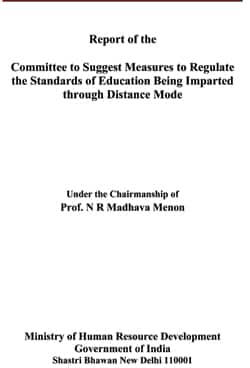
READ: Madhav Menon's committee's full report here
The Madhava Menon Committee Report has inter alia recommended:
Government of India, while accepting the MMC Report in principle has decided against the setting up of a new statutory DECI. |
Two educators share their view:
Dr S K Singh Vice Chancellor, M.P. Bhoj Open University, Bhopal On territorial jurisdiction No state Open University can go out of their state. Reason being that state legislature can only legislate for its own state and only the parliament has the right to legislate for the whole country. So there is a very well established constitutional principle of territorial jurisdiction, which says that a law passed by the parliament shall be operative throughout the country of India and a law passed by the state legislature shall be operative in that particular state only. Secondly, even within the states, universities are distributing franchisees to private shop owners. Supposing he opens a shop, and installs 10 computers, and puts up a board that this is a computer centre/school, and he comes to me and he signs an Memorandum of Understanding (MoU), I start giving my degree to his students, and he invites all students to join the BCA/MCA courses. You see, BCA, MCA and PGDCA are very well paying job-oriented courses.
He used to charge the student even more than the full fee and he was paying only Rs. 700 to the university due to which we were running losses because it was very costly for the university to print question papers, conduct examinations and evaluations, print and distribute the mark sheets and degrees with this amount. I came to know that the student was being charged a hefty fee of Rs. 40-50,000 . But I closed all this and said I will not allow anyone to sell my degrees. If there will be a check on this degree distribution system, then certainly the degree of open universities will have its own value and weight. What is the use of giving a BCA degree to a student who does not know how to operate a computer? I have gone through the acts of all open universities. There is no provision for any MoU in the act of any open university, hence all such MoUs and franchisees are totally illegal. University can sign an MoU for purchase of something, for sale of something, but for providing training and degrees there cannot be any MoU. All the defamation of the open education system is because of the private players who have opened shops for sale of degrees in the market. Their objective is just to make money, not the service of the society. They will open a shop, keep a fancy name and come here to sign an MoU. They try to influence the Vice Chancellor and the office bearers of the university to recommend their case. So the MoU happens. DEC has to take care of this, but they are not being successful. |

Dr Swati Majumdar Director, Symbiosis Centre for Distance Learning It is about teaching the unreacHable There is a big misconception which is being floated about this whole territorial jurisdiction concept. Legally, territorial jurisdiction means not operating or conducting academic activities outside your territory of jurisdiction. For example, say there is an ‘A’ university located in Mumbai, then it is expected that they will not conduct activities outside Mumbai. But it is misconceived to denote enrolment. Any university can enrol students from anywhere in the world. How do you become a global university? For example, University of Pune has a huge international student base. For hundreds of years students have been coming to Pune for education, not only from India but from so many countries. But that doesn’t mean that Pune University is violating territorial jurisdiction. But if Pune University was to open a campus in Delhi, then it would be crossing the boundaries of territorial jurisdiction because it is a state university established in Maharashtra. Similarly is the case with distance learning, there is no bar of enrolling students from anywhere, the bar is on conducting activities in other states. For example, if SCDL was to open a centre in Jalandhar and start conducting classes there then it would be improper. What many universities end up doing is using the study centre concept to franchise education. They will conduct full-time courses also from the study centre. They will conduct coaching classes also from the study centre which is what the government is against, and rightly so. A study centre should not be used to run full-time courses. For that you take permission from UGC and start a campus. What they want to do is minimize their investment by starting just a study centre and then do all kinds of activities from there. But philosophically if you see, a study centre is supposed to provide support services rather than academic services.
Distance education is supposed to cross boundaries. It is meant to reach the unreached. It was meant to reach those remote areas which could not be reached by conventional education. Why would people go for distance education? Affordability is one of the reasons; reach is another reason. We can’t build buildings and infrastructure in every street, every village because it is so expensive! The prime question to ask is how can we make good education reach the remote and rural areas? |

Both columns are presented ‘As told to Nitin Jindal’ who interviewed them.
Should DEC be shut down or revamped? Share your views here
Articles
Upcoming Exams


Study Resources, Applications and Opportunities
Law Admissions 2026 Open | Avail Merit-Based Scholarships
Global Institute of Business Studies, Bengaluru
ApplyBBA/MBA/PGDM Early Bird Applications Deadline 19th Oct '26. Apply now using coupon code CAREER250 and get ₹250 off the application fee
School of Business, UPES, Dehradun
ApplyRanked #36 amongst institutions in Management by NIRF | 100% Placement
Great Lakes Institute of Management, Chennai
ApplyGlobally Recognized by AACSB (US) & AMBA (UK) | 18 LPA Avg. CTC for PGPM 2026
Indian Institute of Art and Design, New Delhi
ApplyLeading Design College | 95% Placement Record | Merit-cum-Means Scholarships for Deserving Students
NEET PG College Predictor
ExploreNEET PG All India & State College Predictor with Admission Process Guide