
Search Colleges, Exams, Schools & more


Login
PCPA Full Form
What is the full form of PCPA?
PCPA is a mathematical term that stands for Per Cent Per Annum. It is used to find the rate of interest over a particular period of time. It consists of two terms, namely, percent and per annum, each meaning a very particular mathematical formulation. The equation for PCPA can be used for calculating simple interest as well as compound interest. In this article, we will see what PCPA means mathematically and how it can be used to find the annual rate of interest through some examples.
Per Cent
The first part of PCPA stands for "per cent," where cent stands for 100. It is a number or ratio expressed as a factor of 100. A per cent number is dimensionless.
Example:
The per cent of 50 in 1550 can be calculated as:
\frac{50}{1150}\times100

Which equals 4.34%
Per Annum
Per annum means yearly or annually. It is a Latin term. Per annum in a practical sense means a recurring occurrence throughout different years. For example, if a bank charges 2% interest per annum, every year the interest will remain at 2% and the additional 2% payment should be made each year until the payment is settled.
Here are some examples of how to use per annum:
A monthly payment of Rs.10 is to be made for a subscription. So, annually, you have to pay Rs.120 as the total cost.
If you have to pay Rs.12000 in instalments over 10 years, dividing 12000 by 10, you have to pay 1200 every year for 10 years.
If the maintenance cost for a machine is Rs.3000 per annum, you have to pay that amount every year.
If the monthly interest rate of a credit card is 1.2%., by multiplying it by 12 months, we get the interest rate per annum which is 14.4%.
Simple Interest
Simple interest is calculated when you get a loan. A bank or money lender can fix a rate or an amount as the interest over a particular period, and you have to pay the amount until you return the borrowed amount.
For example, if you get a loan of Rs.30000 from a bank at a 3% per annum interest rate for 3 years, the total amount you have to pay back can be calculated using the simple interest formula.
The simple interest formula is:
SI=\frac{PTR}{100}

Where
SI= Simple Interest
P= Principal amount
T=Time period (in years)
R= Rate of interest (in per cent)
In the above example, P=30000, R=3 and T=3
So, SI=Rs. 2700
The total amount that has to be paid back after a certain time period is
Amount(A) = Principal(P) + Simple Interest (SI)
So, here A = 30000+2700= Rs.32700
Per cent per annum is used to find simple interest by identifying the rate of interest as the R mentioned in the simple interest equation is the same as per cent per annum.
Compound Interest
Compound interest is also used when we borrow or loan money or have to pay an interest amount in addition to the principal amount. The difference between simple interest and compound interest is that in compound interest, the per annum interest rate changes, unlike in simple interest.
For example, If a person borrows Rs. 4000 from a bank with 6% annual interest compounded quarterly, how much should he pay back after 5 years?
In compound interest, the total amount that has to be paid back after a certain time period is:
A=P\times\left ( 1+\frac{r}{n} \right )^{nt}
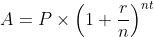
Where,
A = total amount that has to be paid back after a certain time period
P = principal amount
r = rate of interest (in percent)
n = number of times interest is compounded per year
t = time (in years)
The compound interest can be calculated as:
Compound Interest (CI) = Amount (A) - Principal Amount(P)
In the above example, P=4000, r=6, t=5, n=4
After substituting, the amount payable after five years is A= Rs. 5387.42
Frequently Asked Questions (FAQs)
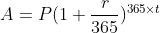
Q: What is the formula for finding daily compound interest?
A:
The formula to find the total amount when the compound interest is calculated daily is:
A = P(1 + \frac{r}{365})^{365 \times t}
Q: Where can the principle of compound interest be used?
A:
It can be used to calculate the total amount to pay back after a loan with compound interest. Also, the compound interest formula can be used to find the population growth or decline of an area or the growth of bacteria in a culture.
Q: What are the different types of simple interest?
A:
When time is considered in days, there are two categories of simple interest. They are ordinary and exact simple interests. Ordinary simple interest takes only 360 days as the number of days of a year but exact simple interest takes 365 days for a normal year and 366 for a leap year.
Q: What are the main elements of simple interest?
A:
There are three major elements of simple interest. They are:
Principal amount
Rate of interest per annum
Time
Q: At what rate PCPA will the simple interest of a certain amount of money be 2/5 of the amount in 5 years?
A:
Let A=100, SI=(⅖) * 100 = 40
P=A-SI=60
R=\frac{(SI \times 100)}{(P\times40)}
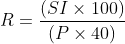
R=6.66 per cent per annum
Upcoming Exams

Study Resources, Applications and Opportunities
Ranked 1 st among Top Law Schools of super Excellence in India - GHRDC | NAAC A+ Accredited | #36 by NIRF
KCC Institute of Legal and Higher Education, Greater Noida
ApplyLaw Admissions 2026 Open | Avail Merit-Based Scholarships
Emversity
ApplyGet Job Ready in Healthcare | Employability-Focused Programs
Lal Bahadur Shastri Institute of Management, Delhi
ApplyHighest CTC: 24 LPA | Average CTC: 12.32 LPA | 85 Placement Partners
Indian Institute of Art and Design, New Delhi
ApplyLeading Design College | Highest CTC: ₹12 LPA | Average CTC: ₹7.5 LPA | Scholarships for Deserving Students
Career Launcher
EnquireAttend 9-Hour Masterclass on 10th October 2026 to help you score 99+ percentile in CAT 2026