KCC Institute of Legal and Higher Education, Greater Noida
Law Admissions 2026 Open | Avail Merit-Based Scholarships


Principles of Inheritance and Variation explain how traits are passed from parents to offspring and why the individuals of the same species have different characteristics. This chapter is based on the extraordinary work of Gregor Johann Mendel, who established the fundamental laws of inheritance through his garden pea plant experiment. These principles form the foundation of genetics.
This Story also Contains
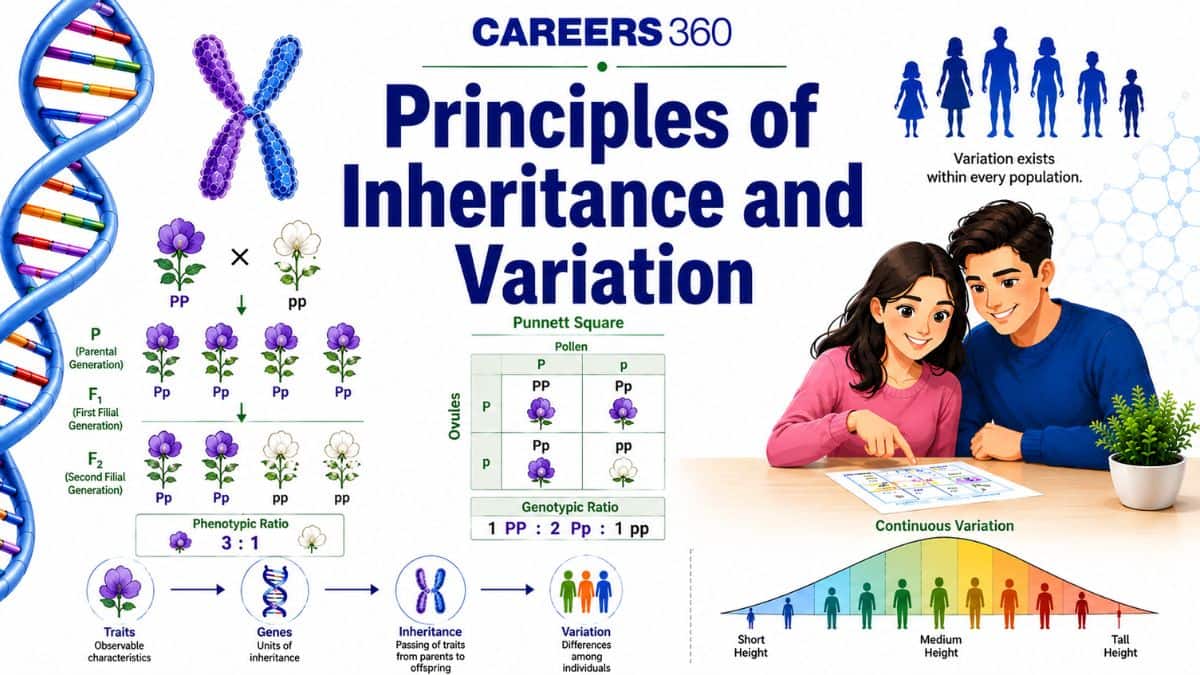
Principles of Inheritance and Variation covers the most important concepts of inheritance, including Mendel's law of inheritance, chromosomal theory of inheritance, sex determination, linkage and recombination, genetic disorders, and the causes of variation. Understanding these concepts helps explain how the genetic information is passed from one generation to the next.
The law of inheritance describes how characteristics are passed from parents to offspring through genes, whereas variation is used to describe differences in characteristics within members of the same species. These are biological principles that underlie the understanding of heredity, evolution, and genetic diversity. Inheritance occurs according to laws developed initially by Mendel, whereas variation is a result of a number of mechanisms, such as recombination of genes, mutations, and the environment. Together, these principles account for the expected and unexpected results in the appearance and function of organisms. Some of the basics are discussed below:
Law Admissions 2026 Open | Avail Merit-Based Scholarships
BBA/MBA/PGDM Early Bird Applications Deadline 06th Nov'26. Apply now using coupon code CAREER250 and get ₹250 off the application fee
Gregor Johann Mendel is a scientist who is the father or inventor of genetics. Mendel considered many garden pea plants primarily based on their distinctive features, such as height or shortness, green or yellow seeds. He applied pollen in two different pure forms. Below is a list of 7 peas of pea plants with different characteristics that Mendel chose for self-breeding.
Character | Contrasting Traits |
Stem height | Tall / Dwarf |
Flower colour | Violet / White |
Flower position | Axial / Terminal |
Pod colour | Green / Yellow |
Pod shape | Inflated / Constricted |
Seed colour | Yellow / Green |
Seed shape | Round / Wrinkled |
The offspring produced from a cross between two parental plants form the F1 generation. Self-pollination of the F1 plants produces the F2 generation. Genes are units of inheritance that control specific traits, and different forms of a gene are called alleles.
Based on this test, he developed three rules. These rules are:
Mendel’s Law | Description |
| |
| |
|
In incomplete dominance, neither allele is completely dominant over the other. As a result, the heterozygous individual shows an intermediate phenotype. For example, crossing red-flowered and white-flowered snapdragons produces pink flowers.
In codominance, both alleles express themselves fully in the heterozygous condition. Neither allele masks the effect of the other. A common example is the AB blood group in humans, where both A and B alleles are expressed simultaneously.
The Chromosomal Theory of Inheritance, advanced independently by Walter Sutton and Theodor Boveri in the early 1900s, related Mendel's laws of heredity to chromosome behaviour during meiosis. According to the theory, genes are on chromosomes, and the segregation and independent assortment of chromosomes are responsible for the patterns of inheritance described by Mendel. Supported by experiments, especially Thomas Hunt Morgan's experiments in Drosophila melanogaster (fruit fly), the theory proved that chromosomes carry genetic information and gene linkage and recombination account for genetic variation. Some important points are discussed below:
Genes are sequentially ordered along chromosomes.
One set of chromosomes is inherited from the mother and the other set from the father.
Chromosomes assort and segregate independently of each other in meiosis.
Explained Mendel's laws at the cellular level.
Established by Morgan's experiments on Drosophila sex linkage.
Provided the physical basis of inheritance.
Sex determination is the mechanism of determining the sex of an offspring. In humans, females have XX sex chromosomes, while males possess XY sex chromosomes. During fertilisation, an X chromosome is contributed by the ovum, whereas the sperm contributes either an X or a Y chromosome. Based on this chromosome coming from the father, the sex of the offspring is determined.
The term recombination is the process by which two DNA strands are separated and recombined during meiosis. The frequency of reunification and the presence of connections allow chromosomes to map the genetic makeup and DNA structure of living organisms. It is therefore one of the most important parts of heritage systems and diversity. Some important factors about Linkage and Recombination are discussed below:
Linkage | Recombination |
|
|
|
|
|
|
|
|
|
|
Pedigree analysis is the study of inheritance patterns of traits through successive generations of a family. This chart helps in identifying whether a trait is dominant, recessive, autosomal, or sex-linked. Not only this, but the pedigree chart is useful in tracing inherited disorders and the probability of any genetic disease in future generations.
Genetic disorders occur due to abnormalities in genes or chromosomes. These can be inherited or caused by mutations.
Here is a list of a few common genetic disorders
Genetic Disorder | Cause / Description |
Haemophilia | A sex-linked recessive disorder that affects the normal clotting of blood. |
Colour Blindness | A sex-linked disorder that affects the ability to differentiate between certain colours. |
Sickle Cell Anaemia | A genetic disorder caused by a mutation in the gene responsible for haemoglobin production. |
Down Syndrome | A chromosomal disorder caused by the presence of an extra copy of chromosome 21 (trisomy 21). |
Turner Syndrome | A chromosomal disorder in females caused by the absence of one X chromosome (45, XO). |
Klinefelter Syndrome | A chromosomal disorder in males caused by the presence of an extra X chromosome (47, XXY). |
Some important topics in the Principles of Inheritance and Variation are mutation, which are sudden changes in the DNA sequence that can produce genetic variation. Somatic and germline mutations vary in that somatic mutations occur in body cells and are not passed to offspring, whereas germline (genetic) mutations are transmitted to offspring. Alleles, genotype, phenotype, homozygous, and heterozygous are also definitions that are important in understanding inheritance. These topics contribute to explaining normal variation as well as genetic disorders through generations.
Mutation- This term refers to the alteration of DNA sequences in any living organism that leads to genetic diversity. It can be divided into two categories.
Somatic- This genetic mutation occurs during a person's lifetime. Environmental factors such as UV rays and others are good examples of this. As the name suggests, it occurs in cells of the whole body and cannot be inherited from one generation to the next.
Germline Mutation- Germline mutations occur in reproductive cells and can be transmitted from parents to offspring. Therefore, the mutation may be present in all cells of the offspring.
Frequently Asked Questions (FAQs)
The basic principle of Inheritance is dominant segregation and independent assortment.
Inheritance is a process of passing down genetic material from parents to offspring while variation refers to the difference among the individuals.
Basically demographic variation is maintained through genetic variation or reunification (recombination) that occurs during meiosis.
Refers to a situation where there is nothing in the two alleles from the parent in charge. Therefore, the heterozygous phenotype is not the same for any parent. In such cases, heterozygotes. Example - When red snapdragons contrast pollen with white snapdragons, they result in pink snapdragons. This is because there are no red or white alleles of the flower.
When both alleles manifest themselves together in an individual it is called codominance.
Henking was the first scientist on the X chromosomes and named them 'X'. Chromosomes that determine the growth of sex cells in a young person are called sex chromosomes. Some chromosomes are called autosomes. Male heterogamety is when the male produces two different types of gametes. It occurs in many animals, such as humans, fruit flies, locusts, etc.
In some animals, this happens to women. That is, women exhibit heterogamety. Examples - birds.
Inheritance is the process by which certain traits are passed on from one parent to another. Understandably, heredity and diversity are an integral part of every kind of life.
Examples of variation include the variety of plant leaves, animal hide, eye color, etc. Significantly, diversity can be seen in all forms of life, especially when it is a living cell with many cells.

Law Admissions 2026 Open | Avail Merit-Based Scholarships
BBA/MBA/PGDM Early Bird Applications Deadline 06th Nov'26. Apply now using coupon code CAREER250 and get ₹250 off the application fee
Ranked #36 amongst institutions in Management by NIRF | 100% Placement
Globally Recognized by AACSB (US) & AMBA (UK) | 18 LPA Avg. CTC for PGPM 2026
NEET PG All India & State College Predictor with Admission Process Guide
Top B-School: Ranked #9 in NIRF Management Rankings 2025.