
Search Colleges, Exams, Schools & more


Login
Adiabatic Process: Definition, Equation, Formula, Examples, Limitations
An adiabatic process is a process in thermodynamics in which there is no transfer of heat to or from the surroundings. The statement essentially means that there is complete insulation in the system; hence, no transfer of heat takes place into or out of the system. Actually, "adiabatic" is from the Greek words "a" meaning "without" and "dia" meaning "through," emphasizing that no transfer of heat has taken place. In such processes, changes in a system's internal energy are due solely to work done on or by the system. In an adiabatic process, either the work done by or on the system will raise or lower the temperature and pressure.
This Story also Contains
- Adiabatic Reversible Expansion of An Ideal Gas
- Some Solved Examples
- Summary
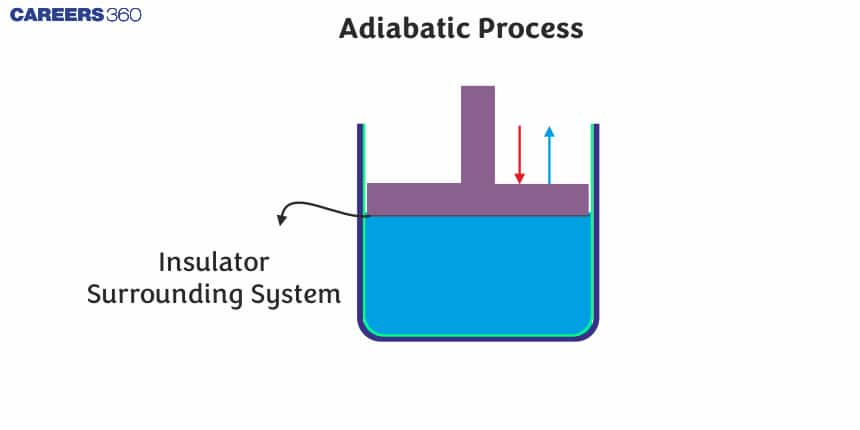
Adiabatic Reversible Expansion of An Ideal Gas
(1) Process Equations for Reversible Adiabatic Process
$\mathrm{PV}^\gamma=$ constant
$\mathrm{TV}^{\gamma-1}=$ constant
$\mathrm{T}^\gamma \mathrm{P}^{1-\gamma}=$ constant
As in an adiabatic change, there is no transfer of heat that is, q = 0 or dq = 0.
$\begin{aligned} & \Delta \mathrm{E}=\mathrm{W} \\ & \mathrm{dE}=\mathrm{dW}\end{aligned}$
W can be written as
$W=\Delta E=n C_V \Delta T=n \frac{R}{\gamma-1} \Delta T=\frac{P_2 V_2-P_1 V_1}{\gamma-1} \longrightarrow$ (1)
Alternatively, the Work can also be derived from the formula
$\mathrm{W}=\int \mathrm{P}_{\text {ext }} \mathrm{dV}$ and $\mathrm{PV}^\gamma=$ constant
(2)Irreversible Adiabatic Process
The process equations mentioned above for the Reversible Adiabatic Process do not hold for the Irreversible Adiabatic Process.
However, the First Law of Thermodynamics and the Ideal Gas equation hold true for the Irreversible Adiabatic Process and the work can be calculated using Equation (1) as given above
(3)Irreversible Adiabatic Free Expansion
In a free expansion, the expansion is carried out against the Vacuum in an isolated container. Thus, the value of external pressure is zero so work done is zero and also Q is zero as the system is Isolated ( Adiabatic).
Thus, it can be said that
$\begin{aligned} & \Delta \mathrm{E}=\mathrm{W}=0 \\ & \Delta \mathrm{T}=0, \Delta \mathrm{H}=0\end{aligned}$
________________________________________________
Comparison between Isothermal and Adiabatic Curves

Recommended topic video on(Adiabatic Process)
Some Solved Examples
Example 1: During reversible adiabatic expansion of an ideal monoatomic gas, the final volume becomes 20 times the initial volume. The ratio (Final Temperature/Initial Temperature) will be equal to:
1)$(20)^{\frac{2}{3}}$
2)$(20)^{\frac{5}{3}}$
3)$\left(\frac{1}{20}\right)^{\frac{5}{3}}$
4) $\left(\frac{1}{20}\right)^{\frac{2}{3}}$
Solution
For a reversible adiabatic change,
$T V^{\gamma-1}$= constant
Value of $\gamma$ for a monoatomic gas is equal to $\frac{5}{3}$
$\frac{T_2}{T_1}=\frac{V_1^{\gamma-1}}{V_2^{\gamma-1}}$
$\frac{T_2}{T_1}=\left(\frac{1}{20}\right)^{\gamma-1}$
$\frac{T_2}{T_1}=\left(\frac{1}{20}\right)^{\frac{2}{3}}$
Hence, the answer is the option(4).
Example 2: During an adiabatic reversible expansion of an ideal diatomic gas, initially the pressure was 2 atm and the volume was 5 L, after the expansion the volume occupied by gas was 15 L. What is the pressure in the container after expansion?
1) $2 \times\left(\frac{1}{3}\right)^{\frac{7}{5}} \mathrm{~atm}$
2)$2 \times\left(\frac{1}{3}\right)^{\frac{5}{3}}$ atm
3)$\left(\frac{2}{3}\right) \mathrm{atm}$
4)$\left(\frac{2}{3}\right)^{\frac{5}{3}} \mathrm{~atm}$
Solution
During an adiabatic reversible process, the PV relationship is given by:
$P V^\gamma=$ constant
For a diatomic gas value of =$7 / 5$
$P_1 V_1^\gamma=P_2 V_2^\gamma$
$2 \times 5^{\left(\frac{7}{5}\right)}=P_2 \times 15^{\left(\frac{7}{5}\right)}$
$P_2=2 \times\left(\frac{1}{3}\right)^{\left(\frac{7}{5}\right)}$ atm
Hence, the answer is the option(1).
Example 3: During an adiabatic compression, 830 J of work is done on 2 moles of a diatomic ideal gas to reduce its volume by 50%. The change in its temperature (in K) is nearly :
(R=8.3 JK-1 mol-1)
1)40
2)33
3) 20
4)14
Solution
$\mathrm{W}=\Delta \mathrm{U}$
(In adiabatic process)
Since, $\Delta \mathrm{U}=\mathrm{nC}_{\mathrm{v}} \Delta \mathrm{T}$
$\Rightarrow \Delta \mathrm{T}=\frac{\mathrm{W}}{\mathrm{nC}_{\mathrm{v}}}=\frac{(830)}{2 \times\left(\frac{5}{2}\right) \times \mathrm{R}}$
$\Rightarrow \Delta \mathrm{T}=\frac{830}{5 \times 8.314}=20 \mathrm{~K}$
Hence, the answer is the option (1).
Example 4: During an adiabatic compression, 830 J of work is done on 2 moles of a diatomic ideal gas to reduce its volume by 50%. The change in its temperature (in K) is near: (R=8.3 JK-1 mol-1)
1) 20
2)40
3)50
4)22
Solution
$\mathrm{W}=\Delta \mathrm{U}$
(In adiabatic process)
Since, $\Delta \mathrm{U}=\mathrm{nC}_{\mathrm{v}} \Delta \mathrm{T}$
$\Rightarrow \Delta \mathrm{T}=\frac{\mathrm{W}}{\mathrm{nC}_{\mathrm{v}}}=\frac{(830)}{2 \times\left(\frac{5}{2}\right) \times \mathrm{R}}$
$\Rightarrow \Delta \mathrm{T}=\frac{830}{5 \times 8.314}=20 \mathrm{~K}$
Hence, the answer is the option(1).
Example 5: When Air undergoes an adiabatic process, its temperature and volume are related by the equation $T V^n=$ constant, and the value of n will be:
1) 0.4
2)0.33
3)2.33
4)1.4
Solution
For adiabatic process.
$T V^{\gamma-1}=$ constant
For Air, since it majorly consists of N2 and O2, it can be considered as diatomic
$\therefore \gamma=1.4$
Hence,
$\begin{aligned} n & =\gamma-1 \\ & =1.4-1=0.4\end{aligned}$
Hence, the answer is the option(1).
Summary
An adiabatic process is one in which there is no exchange of heat with the environment. The insulating condition makes any change in the system's energy due to work interaction only. In such a process, the temperature and pressure of the system change without the gain or loss of heat. Such processes are of central significance for theoretical thermodynamics and several applications of this science related to compressions and expansions of gases in engines and refrigeration cycles. In adiabatic expansion, a gas does work on the surroundings, hence decreasing its temperature. The reverse happens in adiabatic compression: work is done on a gas and its temperature rises. Because no exchange of heat takes place during the process, the change in entropy of the system will be zero. Accordingly, adiabatic processes are isentropic, where entropy remains constant. This forms the basis for the engine's efficiency and design of thermodynamic cycles.
Articles
Upcoming Exams

Study Resources, Applications and Opportunities
Law Admissions 2026 Open | Avail Merit-Based Scholarships
Global Institute of Business Studies, Bengaluru
ApplyBBA/MBA/PGDM Early Bird Applications Deadline 19th Oct '26. Apply now using coupon code CAREER250 and get ₹250 off the application fee
School of Business, UPES, Dehradun
ApplyRanked #36 amongst institutions in Management by NIRF | 100% Placement
Great Lakes Institute of Management, Chennai
ApplyGlobally Recognized by AACSB (US) & AMBA (UK) | 18 LPA Avg. CTC for PGPM 2026
Indian Institute of Art and Design, New Delhi
ApplyLeading Design College | 95% Placement Record | Merit-cum-Means Scholarships for Deserving Students
NEET PG College Predictor
ExploreNEET PG All India & State College Predictor with Admission Process Guide