KCC Institute of Legal and Higher Education, Greater Noida
Law Admissions 2026 Open | Avail Merit-Based Scholarships


Can a statement always be true regardless of the values assigned to its variables? Can another statement always be false no matter what? These intriguing questions lead us to the concepts of tautologies and contradictions, which are fundamental topics in mathematical logic and discrete mathematics. Tautologies and contradictions help in mathematics and computer scientists, and logicians analyze logical statements, construct valid arguments, and design algorithms. They play a crucial role in truth tables, logical reasoning, Boolean algebra, digital circuits, and computer programming. In this article, we will explore the definitions of tautologies and contradictions, their truth tables, properties, examples, and applications in logic and computer science.
This Story also Contains
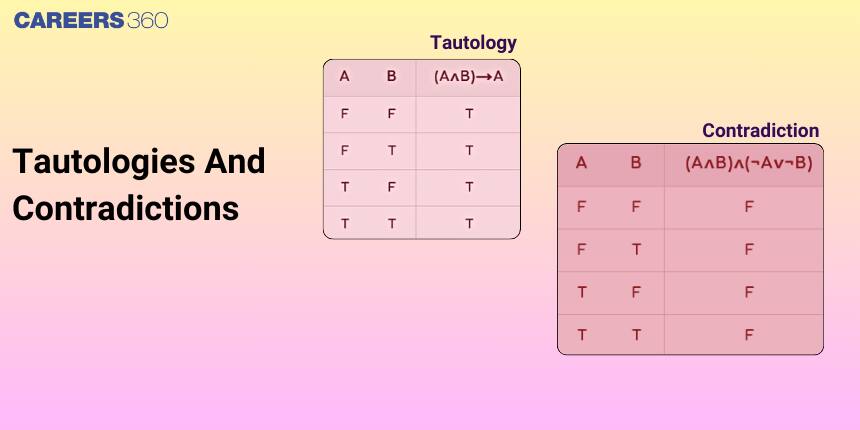
Tautologies and contradictions are fundamental concepts in mathematical logic and propositional logic. They help determine whether a logical statement is always true, always false, or depends on the truth values of its variables. These concepts are widely used in truth tables, logical reasoning, Boolean algebra, computer science, digital electronics, and artificial intelligence.
A tautology is a statement that is true in every possible situation.
In simple words, no matter what truth values are assigned to its variables, the statement always remains true.
For example, the statement $(p \vee \neg p)$ is always true because either $p$ is true or $p$ is false.
A contradiction is a statement that is false in every possible situation.
In simple words, the statement can never become true regardless of the values assigned to its variables.
For example, $(p \wedge \neg p)$ is always false because a statement cannot be true and false at the same time.
A tautology is a compound proposition whose truth value is true for every possible combination of truth values of its component propositions.
A statement is called a tautology if the final column of its truth table contains only T (True).
A contradiction is a compound proposition whose truth value is false for every possible combination of truth values of its component propositions.
A statement is called a contradiction if the final column of its truth table contains only F (False).
Tautologies and contradictions play an important role in logic, mathematics, and computer science.
Some important applications include:
Law Admissions 2026 Open | Avail Merit-Based Scholarships
BBA/MBA/PGDM Early Bird Applications Deadline 06th Nov'26. Apply now using coupon code CAREER250 and get ₹250 off the application fee
Before studying tautologies and contradictions, it is important to understand the basic concepts of mathematical logic.
A proposition is a declarative statement that has a definite truth value.
A proposition must be either true or false, but not both.
Examples:
Logical connectives are symbols used to combine propositions and create compound statements.
| Symbol | Name | Meaning |
|---|---|---|
| $\neg$ | Negation | Not |
| $\wedge$ | Conjunction | And |
| $\vee$ | Disjunction | Or |
| $\rightarrow$ | Implication | If...Then |
| $\leftrightarrow$ | Biconditional | If and Only If |
These connectives form the basis of logical expressions and truth tables.
A compound statement is formed by combining two or more propositions using logical connectives.
Examples include:
The truth value of a compound statement depends on the truth values of its individual propositions.
Every proposition has one of two truth values:
| Symbol | Meaning |
|---|---|
| T | True |
| F | False |
Truth values are used to construct truth tables and analyze logical statements.
A tautology is one of the most important concepts in propositional logic because it represents a statement that can never be false.
A tautology is a logical expression that is true for all possible truth values of its variables.
Example:
$(p \vee \neg p)$
This statement is always true because one of the two possibilities must occur.
A tautology has the following characteristics:
Consider the statement:
$(p \vee \neg p)$
| $p$ | $\neg p$ | $p \vee \neg p$ |
|---|---|---|
| T | F | T |
| F | T | T |
Since the final column contains only T values, the statement is a tautology.
Some common tautologies are:
| Logical Expression | Result |
|---|---|
| $p \vee \neg p$ | Tautology |
| $p \rightarrow p$ | Tautology |
| $(p \wedge q)\rightarrow p$ | Tautology |
| $p\rightarrow(p\vee q)$ | Tautology |
These expressions are always true regardless of the truth values of their variables.
Contradictions represent statements that can never be true.
A contradiction is a logical expression that is false for every possible truth value assignment.
Example:
$(p \wedge \neg p)$
This statement requires $p$ to be both true and false simultaneously, which is impossible.
Contradictions have several important properties:
Consider the statement:
$(p \wedge \neg p)$
| $p$ | $\neg p$ | $p \wedge \neg p$ |
|---|---|---|
| T | F | F |
| F | T | F |
Since every value in the final column is false, the statement is a contradiction.
Common contradictions include:
| Logical Expression | Result |
|---|---|
| $p \wedge \neg p$ | Contradiction |
| $\neg(p \vee \neg p)$ | Contradiction |
| $p \leftrightarrow \neg p$ | Contradiction |
These statements can never be true.
Truth tables are the most reliable method for determining whether a statement is a tautology, contradiction, or contingency.
Follow these steps:
Step 1: Identify all variables in the statement.
Step 2: List all possible truth value combinations.
Step 3: Compute intermediate expressions.
Step 4: Evaluate the final logical expression.
Step 5: Examine the final column to classify the statement.
A statement is a tautology if every entry in the final column is T.
Example:
$(p \vee \neg p)$
Final column:
T, T
Therefore, it is a tautology.
A statement is a contradiction if every entry in the final column is F.
Example:
$(p \wedge \neg p)$
Final column:
F, F
Therefore, it is a contradiction.
| Expression | Classification |
|---|---|
| $p \vee \neg p$ | Tautology |
| $p \wedge \neg p$ | Contradiction |
| $p \rightarrow p$ | Tautology |
| $p \vee q$ | Contingency |
| $p \wedge q$ | Contingency |
Although both concepts are based on truth tables, they represent completely opposite logical situations.
A tautology is always true, whereas a contradiction is always false.
| Feature | Tautology | Contradiction |
|---|---|---|
| Truth Value | Always True | Always False |
| Final Truth Table Column | All T | All F |
| Logical Meaning | Universally Valid | Impossible Statement |
| Usage | Proofs and Logic | Proof by Contradiction |
| Aspect | Tautology | Contradiction |
|---|---|---|
| Outcome | True | False |
| Validity | Always Valid | Never Valid |
| Example | $p \vee \neg p$ | $p \wedge \neg p$ |
In practical terms:
Both concepts help determine the validity of logical arguments.
Not all logical statements are tautologies or contradictions. Some statements are true in certain situations and false in others.
These statements are known as contingencies.
A contingency is a logical statement whose truth value depends on the truth values assigned to its variables.
It is neither always true nor always false.
| Contingency | Tautology |
|---|---|
| Sometimes True | Always True |
| Sometimes False | Never False |
| Contingency | Contradiction |
|---|---|
| Sometimes True | Never True |
| Sometimes False | Always False |
Some common contingencies include:
| Expression | Classification |
|---|---|
| $p \vee q$ | Contingency |
| $p \wedge q$ | Contingency |
| $p \rightarrow q$ | Contingency |
Their truth values depend on the truth values of the individual propositions.
Tautologies and contradictions have numerous applications in mathematics, logic, computer science, and engineering.
Mathematicians use:
Proof by contradiction is one of the most powerful techniques in mathematics.
Logical expressions are widely used in:
Digital systems rely on Boolean logic.
Tautologies and contradictions help:
Artificial intelligence systems use logic for:
Several methods can be used to classify logical expressions.
Truth tables provide the most reliable approach.
Many logical expressions can be identified without constructing a full truth table.
Examples:
Logical equivalences simplify the identification process and are frequently used in discrete mathematics, symbolic logic, computer science, and competitive examination problems.
Quantifiers are words or phrases such as "for every", "for all", "there exists", and "there is at least one" that indicate how many elements in a set satisfy a given property. Quantifiers are widely used in mathematical logic to express statements involving sets, numbers, and mathematical objects.
Let:
$p$: "For every prime number $x$, $\sqrt{x}$ is an irrational number."
$q$: "There exists a triangle whose all sides are equal."
These statements contain quantifiers that specify whether a property applies to all elements of a set or to at least one element of the set.
There are two main types of quantifiers used in mathematical logic.
The universal quantifier uses words such as:
For all
All
For every
Every
It indicates that a particular property is true for every member of a given set.
$p$: "For every prime number $x$, $\sqrt{x}$ is an irrational number."
This statement means that the given property holds for all prime numbers.
The existential quantifier uses words such as:
There exists
Some
There is at least one
It indicates that at least one member of the set possesses the specified property.
$q$: "There exists a triangle whose all sides are equal."
This statement means that the property is true for at least one triangle, namely an equilateral triangle.
To find the negation of a statement containing a quantifier, we do two things:
Add the word "not" at the appropriate place in the statement.
Change the quantifier:
Universal quantifier $\rightarrow$ Existential quantifier
Existential quantifier $\rightarrow$ Universal quantifier
This rule is fundamental in mathematical logic and propositional reasoning.
Consider the statement:
$p$: "For every prime number $x$, $\sqrt{x}$ is an irrational number."
The negation of $p$ is:
$\sim p$: "There exists at least one prime number $x$ such that $\sqrt{x}$ is not irrational."
Equivalently:
$\sim p$: "There exists at least one prime number $x$ such that $\sqrt{x}$ is rational."
Notice that:
"For every" has been changed to "There exists at least one".
The phrase "is irrational" has been replaced by "is not irrational".
Consider the statement:
$q$: "There exists a triangle whose all sides are equal."
The negation of $q$ is:
$\sim q$: "For every triangle, all sides are not equal."
More precisely:
$\sim q$: "No triangle has all sides equal."
Notice that:
"There exists" has been changed to "For every".
The property "all sides are equal" has been negated to "all sides are not equal."
| Original Statement | Negation |
|---|---|
| "For every $x$, $P(x)$" | "There exists at least one $x$ such that not $P(x)$" |
| "There exists an $x$ such that $P(x)$" | "For every $x$, not $P(x)$" |
| Quantifier | Symbol | Negation |
|---|---|---|
| Universal Quantifier | $\forall$ | $\exists$ |
| Existential Quantifier | $\exists$ | $\forall$ |
Thus,
$\neg(\forall x, P(x)) \equiv \exists x, \neg P(x)$
$\neg(\exists x, P(x)) \equiv \forall x, \neg P(x)$
These rules are extensively used in mathematical logic, discrete mathematics, theorem proving, computer science, and competitive examinations.
A strong understanding of mathematical logic and truth tables is essential for solving tautology, contradiction, and logical reasoning questions.
| Book Name | Best For | Why It Helps |
|---|---|---|
| Discrete Mathematics and Its Applications – Kenneth Rosen | University Students | Comprehensive logic coverage |
| Discrete Mathematical Structures – J.P. Tremblay | Logic Fundamentals | Strong conceptual explanations |
| NCERT Mathematics Class 11 | School Students | Introduction to mathematical reasoning |
| Discrete Mathematics – Seymour Lipschutz | Competitive Exams | Practice-oriented approach |
| Discrete Mathematics – Schaum's Outline | Self-Study | Large collection of solved problems |
Understanding a few standard logical identities can help identify tautologies and contradictions without constructing lengthy truth tables.
| Trick | Explanation |
|---|---|
| Law of Excluded Middle | $p\vee\neg p$ is always a tautology |
| Law of Non-Contradiction | $p\wedge\neg p$ is always a contradiction |
| Check Final Truth Table Column | All T → Tautology, All F → Contradiction |
| Use Logical Equivalences | Avoid lengthy truth tables |
| Simplify First | Reduce expressions before testing |
| Watch for Double Negatives | They often simplify expressions |
| Memorize Common Forms | Speeds up exam solutions |
This formula table contains some of the most important logical identities used in tautology and contradiction problems.
| Concept | Formula |
|---|---|
| Law of Excluded Middle | $p\vee\neg p \equiv T$ |
| Law of Non-Contradiction | $p\wedge\neg p \equiv F$ |
| Implication | $p\rightarrow q \equiv \neg p\vee q$ |
| Biconditional | $p\leftrightarrow q \equiv (p\rightarrow q)\wedge(q\rightarrow p)$ |
| De Morgan's First Law | $\neg(p\wedge q)\equiv\neg p\vee\neg q$ |
| De Morgan's Second Law | $\neg(p\vee q)\equiv\neg p\wedge\neg q$ |
| Double Negation | $\neg(\neg p)\equiv p$ |
| Contrapositive | $p\rightarrow q \equiv \neg q\rightarrow\neg p$ |
Example 1: Which of the following Boolean expressions is a tautology?
Solution:
Consider option (3):
$(p \wedge q) \rightarrow (p \rightarrow q)$
Since:
$p \rightarrow q \equiv \neg p \vee q$
we get:
$(p \wedge q) \rightarrow (\neg p \vee q)$
Whenever $(p \wedge q)$ is true, both $p$ and $q$ are true, making $(\neg p \vee q)$ true as well.
Therefore, the implication is always true.
Hence, $(p \wedge q) \rightarrow (p \rightarrow q)$ is a tautology.
Example 2: If $P$ and $Q$ are two statements, then which of the following compound statements is a tautology?
Solution:
The left-hand side is the same in all options:
$((P \rightarrow Q) \wedge \neg Q)$
Since:
$P \rightarrow Q \equiv \neg P \vee Q$
Therefore,
$((P \rightarrow Q) \wedge \neg Q)$
$\equiv (\neg P \vee Q) \wedge \neg Q$
$\equiv (\neg P \wedge \neg Q) \vee (Q \wedge \neg Q)$
$\equiv \neg P \wedge \neg Q$
Now check each option.
Option (A)
$(\neg P \wedge \neg Q) \rightarrow Q$
$\equiv \neg(\neg P \wedge \neg Q) \vee Q$
$\equiv (P \vee Q) \vee Q$
$\equiv P \vee Q$
This is not a tautology.
Option (B)
$(\neg P \wedge \neg Q) \rightarrow P$
$\equiv \neg(\neg P \wedge \neg Q) \vee P$
$\equiv (P \vee Q) \vee P$
$\equiv P \vee Q$
This is not a tautology.
Option (C)
$(\neg P \wedge \neg Q) \rightarrow \neg P$
$\equiv \neg(\neg P \wedge \neg Q) \vee \neg P$
$\equiv (P \vee Q) \vee \neg P$
$\equiv (P \vee \neg P) \vee Q$
$\equiv T \vee Q$
$\equiv T$
Hence, this is a tautology.
Option (D)
$(\neg P \wedge \neg Q) \rightarrow (P \wedge Q)$
$\equiv \neg(\neg P \wedge \neg Q) \vee (P \wedge Q)$
$\equiv (P \vee Q) \vee (P \wedge Q)$
$\equiv P \vee Q$
This is not a tautology.
Therefore, option (3) is the correct answer.
Example 3: If the Boolean expression
$(p \rightarrow q) \leftrightarrow (q * \neg p)$
is a tautology, then the Boolean expression
$p * \neg q$
is equivalent to:
Solution:
Given:
$(p \rightarrow q) \leftrightarrow (q * \neg p)$
Since:
$p \rightarrow q \equiv \neg p \vee q$
we get:
$q * \neg p \equiv q \vee \neg p$
Therefore,
$* \equiv \vee$
Now:
$p * \neg q$
$\equiv p \vee \neg q$
But:
$q \rightarrow p \equiv \neg q \vee p$
$\equiv p \vee \neg q$
Hence,
$p * \neg q \equiv q \rightarrow p$
Therefore, option (2) is the correct answer.
Example 4: If the Boolean expression
$(p \wedge q) \circledast (p \otimes q)$
is a tautology, then $\circledast$ and $\otimes$ are respectively:
Solution:
Consider option (1):
$(p \wedge q) \rightarrow (p \rightarrow q)$
Construct the truth table:
| $p$ | $q$ | $p \wedge q$ | $p \rightarrow q$ | $(p \wedge q)\rightarrow(p \rightarrow q)$ |
|---|---|---|---|---|
| T | T | T | T | T |
| T | F | F | F | T |
| F | T | F | T | T |
| F | F | F | T | T |
The final column contains only T.
Therefore,
$(p \wedge q) \rightarrow (p \rightarrow q)$
is a tautology.
Hence, $\circledast = \rightarrow$ and $\otimes = \rightarrow$.
Therefore, option (1) is the correct answer.
Example 5: Which of the following statements is a fallacy (contradiction)?
Solution:
Consider:
$p \wedge \neg p$
Construct its truth table:
| $p$ | $\neg p$ | $p \wedge \neg p$ |
|---|---|---|
| T | F | F |
| F | T | F |
The final column contains only F.
Therefore, the statement is always false.
A statement that is always false is called a fallacy or contradiction.
Hence, $p \wedge \neg p$ is a fallacy.
Therefore, option (3) is the correct answer.
The topics below cover important concepts in mathematical logic, truth tables, logical reasoning, and discrete mathematics that are closely connected to tautologies, contradictions, and logical equivalences.
Frequently Asked Questions (FAQs)
A compound statement is called tautology if it is always true for all possible truth values of its component statement.
A compound statement is called a contradiction if it is always false for all possible truth values of its component statement.
Quantifiers are phrases like ‘These exist’ and “for every”. We come across many mathematical statements containing these phrases. There are two types of quantifiers, namely, universal quantifiers and existential quantifiers.
In universal quantifiers, words like 'For all', 'All', 'For every', "Every' etc, are used and it denotes that all members of a set has that property.
In existential quantifiers, words like 'There exist a', 'Some', 'There is at least one' etc, are used and it denotes that there is at least one member in the set that has that property.

Law Admissions 2026 Open | Avail Merit-Based Scholarships
BBA/MBA/PGDM Early Bird Applications Deadline 06th Nov'26. Apply now using coupon code CAREER250 and get ₹250 off the application fee
Ranked #36 amongst institutions in Management by NIRF | 100% Placement
Globally Recognized by AACSB (US) & AMBA (UK) | 18 LPA Avg. CTC for PGPM 2026
NEET PG All India & State College Predictor with Admission Process Guide
Top B-School: Ranked #9 in NIRF Management Rankings 2025.