KCC Institute of Legal and Higher Education, Greater Noida
Law Admissions 2026 Open | Avail Merit-Based Scholarships


The Asteraceae, Poaceae, and Brassicaceae families are major flowering plant groups with high biodiversity and agricultural value. They include ornamental flowers, staple crops like rice and wheat, and nutritious vegetables such as cabbage and mustard. These families carry 2–5% weightage in NEET and CBSE exams, making them essential for students.
This Story also Contains
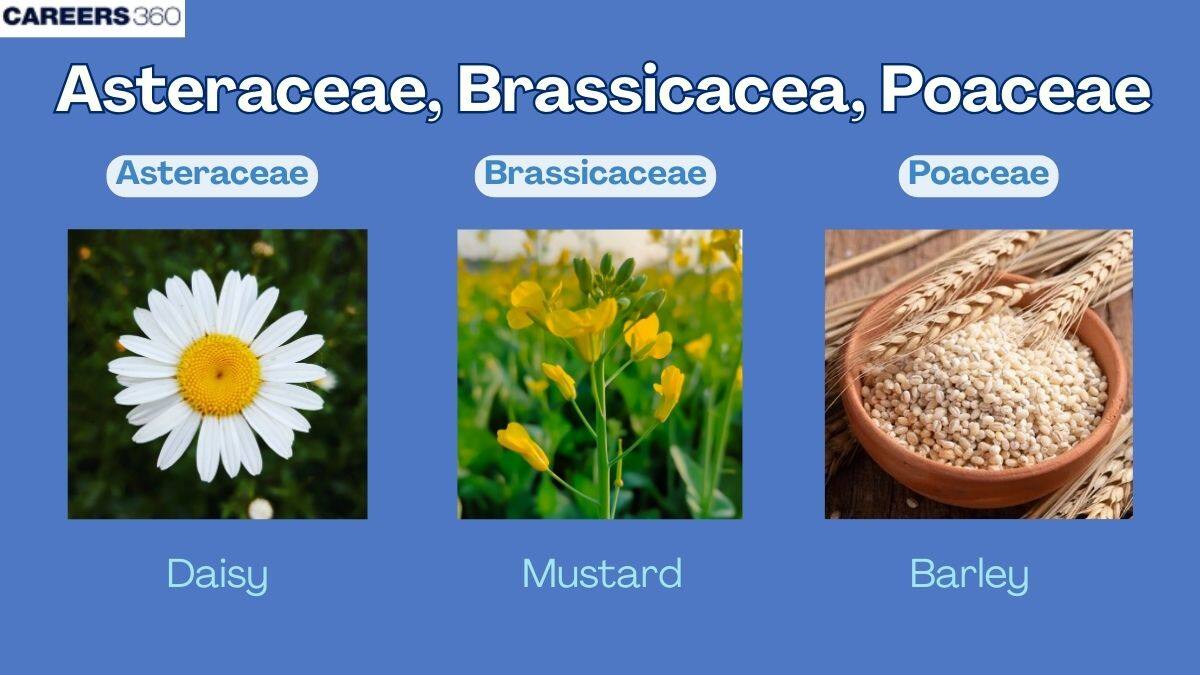
Angiosperms are the most diverse group of plants on Earth. They can be distinguished for their ability to produce flowers and enclosed seeds within fruits. Angiosperms are believed to have had their beginnings during the cretaceous period, approximately ninety to one hundred and thirty million years ago. They have since diversified to the extent of occupying most of the plant niches.
The Asteraceae, Poaceae and Brassicaceae families are important groups of angiosperms and they contribute to biodiversity and human agriculture. Each one of them has a unique character such as Asteraceae to the flowers, Poaceae to the important food production and Brassicaceae to the vegetables.
The Asteraceae, Poaceae and Brassicaceae families are known for their contribution to biodiversity agriculture and the ecosystem. These families are important because we use the products significantly in our daily lives. Some of the basic points about these families are discussed below:
The Asteraceae, Poaceae and Brassicaceae families belong to the important group of flowering plants.
Family has contributed to important sections such as biodiversity agriculture and ecosystem.
Asteraceae is also known as composite flower heads as it includes species with ornamental as well as medicinal value.
Poaceae belong to the grass family and include important grass like rice wheat and corn.
Brassicaceae belongs to the mustard family and is known for its nutritional benefits and has vegetables like cabbage and broccoli.
These families are important for food security and environmental balance in the agriculture field.
Law Admissions 2026 Open | Avail Merit-Based Scholarships
BBA/MBA/PGDM Early Bird Applications Deadline 19th Oct '26. Apply now using coupon code CAREER250 and get ₹250 off the application fee
Family members of Asteraceae, Poaceae and Brassicaceae are commonly found all across the globe. Due to different climatic conditions, there is a variety of habitats present in the family. They have remarkable adaptability to climatic conditions all across the globe. Some basic habitat features of Asteraceae, Poaceae and Brassicaceae are discussed below:
They are commonly found in diverse habitats such as tropical rainforests or temperate regions.
There are approximately 378 species with 138 genera which are identified in India only.
These are commonly found in the Himalayas and mountains of Southern and western India.
Some of the basic characteristics of Asteraceae, Poaceae and Brassicaceae are discussed below in the table:
The economic importance of Asteraceae, Poaceae and Brassicaceae is discussed below:
Family | Economic Importance |
Asteraceae |
|
Poaceae |
|
Brassicaceae |
|
During exam preparation, different types of questions about Asteraceae, Poaceae and Brassicaceae are asked. The table below contains the different patterns of questions asked in different exams.
Exam Type | Types of Questions Asked |
| |
| |
Paramedical |
|
It takes effort to remember everything in a single go. We made the entire problem easy. Some of the tricks regarding Asteraceae, Poaceae, and Brassicaceae families are given below which you can use to memorise the important points.
Asteraceae Family (Daisy/Sunflower Family)
"COF: Composite, Ornamental, Food"
C: Composite flowers (flower heads made of many small florets).
O: Ornamental plants (e.g., daisies, sunflowers for decoration).
F: Food plants (e.g., lettuce, artichokes).
Poaceae Family (Grass Family)
"CFR: Cereal, Fodder, Renewable"
C: Cereal crops (e.g., rice, wheat, corn for staple food).
F: Fodder for livestock (grasses as feed for animals).
R: Renewable resources (grasses used in biofuel production and paper-making).
Brassicaceae Family (Mustard Family)
"VEO: Vegetables, Edible oils, Organic farming"
V: Vegetables (e.g., cabbage, broccoli, mustard).
E: Edible oils (e.g., canola oil).
O: Used in organic farming (pest control, soil health improvement).
Q1. The conducting elements found in angiosperms are
Tracheid
Vessels
Sieve tube
All of the above
Correct answer: 4) All of the above
Explanation:
The conducting elements, specifically in angiosperms, include:
1. Xylem: This structure is crucial for the transportation of water and essential minerals throughout the plant.
2. Tracheids: These are elongated cells with pointed ends that contribute to water conduction and offer mechanical stability.
3. Vessels: Unique to angiosperms, these are tubular structures created by the fusion of vessel elements, facilitating rapid water flow.
4. Phloem: This tissue is vital for the movement of nutrients, primarily sugars, from one plant part to another.
5. Sieve tubes: Composed of sieve tube elements in a serial arrangement, they create continuous pathways for food translocation.
6. Companion cells: These accompany sieve tubes and play a key role in the loading and unloading of substances during the transportation process.
7. Phloem parenchyma: Involved in the storage and sideways movement of nutrients in the phloem.
8. Phloem fibres: Providing mechanical support to the phloem tissue.
These elements collectively form the vascular system essential for plant function and growth.
Hence, the correct answer is option 4) All of the above.
Q2. Double fertilization is found without any exception in
Bryophytes
Gymnosperms
Angiosperms
Pteridophytes
Correct answer: 3) Angiosperms
Explanation:
Double fertilization is a process unique to flowering plants (angiosperms), which results in the formation of triploid nuclei that develop into endosperm, and also a zygote which is formed by the union of a male gamete and a female ovum.
Hence, the correct answer is Option (3) Angiosperms
Q3. Sporophyte of angiosperm is
Diploid and dominant
Diploid and recessive
Haploid and dominant
Haploid and independent
Correct answer: 1) Diploid and dominant
Explanation:
The sporophyte phase in the angiosperm lifecycle is the diploid (2n) stage that generates spores through a process termed meiosis. This is the prominent and mature phase, characterized by the presence of recognizable flowering plants.
Within specialized areas known as sporangia, the sporophyte gives rise to haploid spores. In these advanced plants, these sporangia are situated within the flowers, leading to the creation of pollen grains (the male gametophyte) and ovules (the female gametophyte). Upon fertilization of the ovule by pollen, a zygote is formed, which evolves into the subsequent sporophyte generation.
Hence, the correct answer is option 1) Diploid and dominant.
Also Read:
Asteraceae (Compositae): One of the largest families of dicot plants, commonly called the sunflower family. It includes herbs, shrubs, and some trees.
Poaceae (Gramineae): The grass family, a monocot family that includes cereals, millets, and fodder grasses.
Brassicaceae (Cruciferae): A dicot family known as the mustard family, including many vegetables, oil-yielding, and ornamental plants.
Asteraceae: Inflorescence is a capitulum (head) surrounded by involucral bracts; flowers are ray and disc florets; fruit is cypsela with pappus.
Poaceae: Stem is usually hollow with nodes and internodes; leaves are linear with sheathing base; inflorescence is a spikelet; fruit is caryopsis.
Brassicaceae: Flowers are tetramerous (4 sepals, 4 petals, 6 stamens – tetradynamous); fruit is silique or silicula; leaves are often simple and alternate.
Asteraceae: Provides edible plants (sunflower oil, lettuce), ornamentals (daisy, chrysanthemum), medicinal plants (Artemisia, Eclipta), and weeds.
Poaceae: Most important food crops—wheat, rice, maize, barley, sugarcane, bamboo; also used for fodder, paper, and biofuel.
Brassicaceae: Source of oil seeds (mustard, rapeseed), vegetables (cabbage, cauliflower, radish, turnip, broccoli), and condiments.
Examples of Asteraceae plants include sunflower (Helianthus annuus), marigold chrysanthemum, dandelion, lettuce (Lactuca sativa), safflower, and Eclipta (Bhringraj). These plants are widely grown for ornamental, edible, medicinal, or oil purposes.

Law Admissions 2026 Open | Avail Merit-Based Scholarships
BBA/MBA/PGDM Early Bird Applications Deadline 19th Oct '26. Apply now using coupon code CAREER250 and get ₹250 off the application fee
Ranked #36 amongst institutions in Management by NIRF | 100% Placement
Globally Recognized by AACSB (US) & AMBA (UK) | 18 LPA Avg. CTC for PGPM 2026
Leading Design College | 95% Placement Record | Merit-cum-Means Scholarships for Deserving Students
NEET PG All India & State College Predictor with Admission Process Guide